Hot-Stamp vs Digital Print Lanyards: Which Spec Wins?
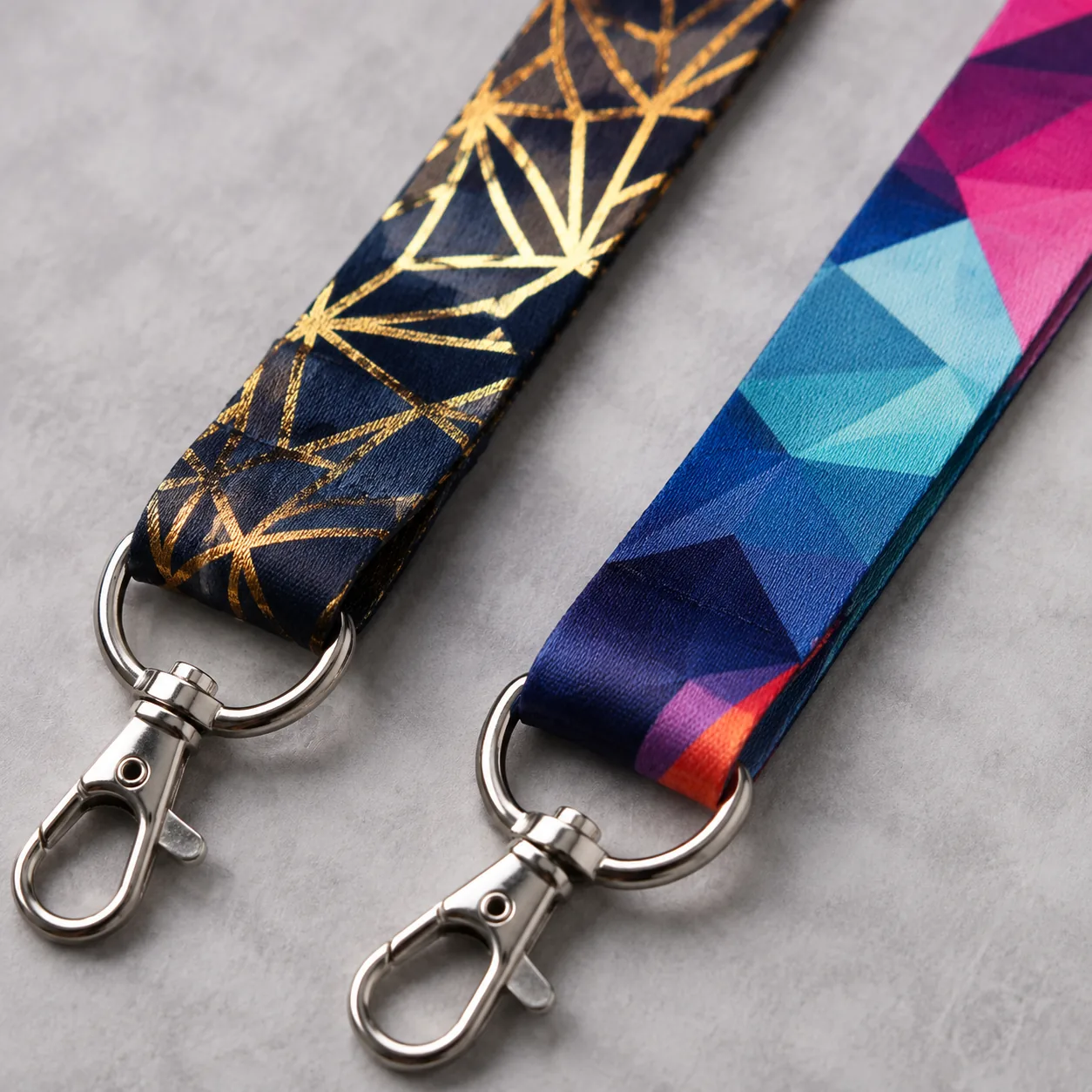
Start with the lanyard duty cycle, not the print method
Most lanyard problems begin before the factory opens the artwork file. The buyer selects hot-stamp or digital print first, then tries to force the event schedule, logo detail, badge weight, budget, and delivery date into that method. A three-day conference badge lanyard does not need the same abrasion resistance as a retail merch lanyard that hangs on a peg, rubs against zippers, and is photographed under high-CRI LED lighting.
The better comparison is the complete specification: artwork complexity, base fabric, width, edge construction, color standard, hardware load, packing method, inspection level, and production tolerance. A 15 mm flat polyester lanyard with a one-color logo repeat every 100 mm has a very different risk profile from a 25 mm satin lanyard with sponsor logos, gradient backgrounds, dual hooks, a detachable buckle, and a safety breakaway.
Use this practical rule. Hot-stamp is strongest for simple, approved artwork where a crisp metallic or pigmented surface matters. Digital print is stronger for gradients, small multi-color graphics, sponsor blocks, event maps, and designs that may change close to production. If you compare only unit price, the cheaper quote can become expensive after a failed strike-off, missed color approval, or late air freight.
Quoting table: technical and commercial differences
The ranges below reflect common FOB China production for 15-20 mm polyester, satin polyester, or smooth tubular lanyards with one standard metal hook. They exclude retail gift boxes, custom header cards, RFID pouches, and unusually heavy hardware. Final pricing changes with strap width, fabric weight, total length, repeat length, color coverage, packing, and quantity.
| Spec item | Hot-stamp lanyard | Digital print lanyard |
|---|---|---|
| Best artwork fit | Simple logos, icons, text, 1-3 spot colors, metallic foil, matte pigment film | Gradients, photos, sponsor logos, QR-style graphics, full-color backgrounds |
| Common base fabric | Flat polyester, satin polyester, smooth nylon-like polyester, PU-coated polyester | White or light polyester, satin polyester, microfiber polyester for sublimation |
| Typical MOQ | 300 pcs standard; 200 pcs possible with stocked foil; 500 pcs for custom foil color or two-color registration | 100-200 pcs possible; 300 pcs preferred; 500 pcs for stable repeat color and lower unit cost |
| FOB price, 15 mm, 500-3,000 pcs | USD 0.38-0.78/pc with standard J-hook or lobster hook | USD 0.34-0.72/pc with standard J-hook or lobster hook |
| FOB price, 20 mm, 500-3,000 pcs | USD 0.46-0.95/pc depending on foil, repeat length, and hardware | USD 0.42-0.88/pc depending on coverage, fabric, curing, and hardware |
| Sample lead time | 5-7 days after vector artwork and foil reference approval | 4-6 days after artwork approval; 6-8 days if color correction is needed |
| Bulk lead time | 10-16 days after sample approval for 500-5,000 pcs | 8-14 days after sample approval for 500-5,000 pcs |
| Line detail | Positive line 0.30-0.35 mm minimum; 0.50 mm safer on ribbed webbing | Positive line 0.15-0.25 mm possible on satin; 0.30 mm safer on textured webbing |
| Reverse detail | 0.45-0.60 mm minimum to avoid foil fill-in | 0.25-0.35 mm minimum depending on ink spread and fabric texture |
| Logo placement tolerance | ±1.0 mm achievable on controlled runs; specify ±2.0 mm commercial max unless premium QC is paid | ±1.0-1.5 mm achievable; full-bleed edge designs should allow ±2.0 mm visual tolerance |
| Strap tolerance | Width ±0.5 mm; total finished length ±10 mm typical | Width ±0.5 mm; total finished length ±10 mm typical |
| Color control | Good for fixed foil references; metallic appearance changes with light angle | Good for CMYK-style artwork; approve by physical strike-off, not screen image |
| Hand feel | Stamped area feels slightly raised, smoother, or firmer | Sublimation remains soft; UV or surface ink may feel coated |
| Wear risk | Foil edge polishing, cracking, or flaking at folds and hook areas | Scuffing, dulling, blocking, or color transfer if curing and packing are weak |
| Best use case | VIP badges, executive events, premium staff programs, controlled brand orders | Trade shows, universities, campaigns, sports events, multi-sponsor orders |
Where hot-stamp wins: crisp finish and controlled branding
Hot-stamp transfers foil or pigment film to the lanyard under heat and pressure. A metal die or heated plate presses the transfer layer onto the fabric, creating a clean edge and a premium surface effect. Gold, silver, matte black, white, holographic, and high-gloss foils are common. On dark polyester, foil often looks stronger than ink because it sits visually above the substrate instead of being absorbed into the yarn texture.
The process works best when the artwork is stable. A corporate wordmark repeated every 80-120 mm on a 20 mm strap is a strong hot-stamp candidate. A two-color logo can work, but each added color adds die setup, registration risk, sample time, and scrap. For repeat corporate programs, hot-stamp can be efficient because the die, foil reference, logo size, and repeat distance are already approved.
A reliable hot-stamp spec should define foil code or pigment color, fabric color, strap width, strap length, logo size, repeat distance, reading direction, and clearance from hardware. For bulk production, keep positive strokes at 0.30 mm or wider, reverse gaps at 0.50 mm or wider, and small text at 5 pt or larger on smooth satin polyester. On ribbed polyester or coarse woven webbing, increase small text to 6-7 pt and avoid condensed fonts.
Registration expectations should be written before sampling. For one-color stamping, ±0.5-1.0 mm on logo position is realistic on a controlled line, but ±2.0 mm is the safer commercial tolerance across long flexible straps. If the logo must align with a sewn joint, detachable buckle, or breakaway connector, mark the datum on the drawing. Without that instruction, the factory will treat the lanyard as a textile item, not a rigid printed part.
Where hot-stamp fails: fine detail, folds, and late changes
Hot-stamp is less forgiving with tiny counters, hairline strokes, distressed textures, and small reverse text. Foil can fill small openings, skip over fabric texture, or crack where the strap bends sharply. Metallic color matching is also limited. The same gold foil can look warm under tungsten light, pale under daylight, and greenish under exhibition hall LEDs.
The main durability risk is foil-edge wear. If the stamped logo sits near the fold into a lobster hook, buckle, crimp, or stitched loop, the transfer layer is repeatedly bent and rubbed. Over time the foil can polish, lose brightness, or flake at the edge. For staff lanyards used daily for several months, keep hot-stamp artwork at least 10-15 mm away from metal crimps, stitching, and hard fold points. For event-only use, that clearance is still good practice because it reduces visible damage during packing and distribution.
Hot-stamp also carries more risk when approvals are not final. Sponsor logo changes, last-minute badge layout changes, and color edits may require a new die, new foil selection, or another strike-off. If the buyer is still collecting assets one week before production, digital print usually protects the schedule better. Choose hot-stamp when the finish is important and the artwork is locked.
Where digital print wins: complex graphics and faster artwork changes
Digital print is the better method when the artwork contains complexity that would be impractical to stamp: gradient backgrounds, full-color icons, sponsor grids, event maps, QR-style graphics, and multi-tone brand systems. For conferences, universities, campaigns, and sports events, digital print reduces redesign work because the file does not need to be simplified into one or two spot colors.
Most promotional digital lanyards are printed on polyester by dye-sublimation or a surface digital process. Sublimation performs best on white or light polyester because the dye bonds into the synthetic fiber and preserves a soft hand. It is suitable for full-coverage designs and double-sided printing. UV or surface digital printing can be used on some darker substrates, but the ink layer may feel more coated and depends heavily on curing quality.
For production files, use vector logos wherever possible. Raster backgrounds should be 300 dpi at final printed size. On smooth satin polyester, 0.15-0.20 mm positive lines may be visible, but 0.25-0.30 mm is safer for bulk production. Reverse-out lines should not be thinner than 0.25-0.35 mm because ink spread and fabric texture can close them. For QR codes, avoid miniature codes on narrow straps; keep the code at least 18-20 mm high on a 25 mm strap and test scanability on the physical sample.
Digital print also handles short-to-mid runs well. For 100-300 pieces, it usually has lower setup friction than hot-stamp. For 500-3,000 pieces, it remains competitive because artwork changes are easier before bulk production. If the buyer is waiting for final sponsor logos or event naming, digital print gives procurement more room to move without restarting the entire decoration process.
Where digital print fails: color drift, curing, and edge layout
Digital print is not automatically more durable. Performance depends on fabric preparation, ink system, heat setting, curing, drying time, and packing. A low quote may hide weak color density, insufficient curing, or rushed packing. The shipment may then arrive with dull color, transfer marks, blocking between straps, or scuffs where hooks rubbed against printed areas.
Color accuracy needs realistic control. Digital print can reproduce many colors, but it does not guarantee Pantone-perfect output on textile. Polyester reflects light differently from coated paper, and sublimation color can shift after heat transfer. For brand-critical work, provide Pantone references and request a physical strike-off. If the buyer requires a measurable target, ask whether the factory can work to Delta E. A practical promotional standard is Delta E 3-5 for key brand colors when measured on the same fabric under controlled light; many lanyard factories still approve visually unless a paid QC plan is specified.
Full-bleed edge designs are another common failure point. Lanyards are cut, folded, sewn, heat-pressed, and packed as flexible textile strips. If critical text sits within 2 mm of the edge, some pieces will look off-center even when the factory is within tolerance. Keep important logos at least 3-4 mm away from the edge on 20 mm straps and at least 2-3 mm away on 15 mm straps. Use bleed for background color only, not for sponsor names, URLs, or small icons.
MOQ, lead time, and FOB cost by order size
The most expensive lanyard is often the one that misses the event date. Unit cost matters, but sampling time, artwork correction, hardware availability, packing labor, and freight mode decide the real landed cost. A factory may quote a low unit price and still fail the order if the safety breakaway is out of stock or the final logo file arrives too late.
For a standard 20 mm polyester lanyard with one lobster hook and one safety breakaway, typical FOB ranges at 500-3,000 pcs are USD 0.45-0.95/pc for hot-stamp and USD 0.42-0.88/pc for digital print. At 100-200 pcs, digital print may run USD 0.65-1.20/pc depending on artwork and packing, while hot-stamp is usually less attractive unless foil is stocked and the logo is simple. At 5,000-10,000 pcs, both methods can drop by 10-25%, but the saving often comes from hardware purchasing and line efficiency rather than print method alone.
Lead time should be separated into sample and bulk stages. A realistic schedule is 4-7 days for a physical pre-production sample, 1-2 days for buyer review if decisions are fast, and 8-16 days for bulk after approval. Add 2-4 days for nonstandard hooks, double clips, detachable buckles, woven labels, individual polybags, barcode stickers, or retail display cards. Add more buffer before Canton Fair periods, Christmas shipment peaks, and Chinese New Year.
MOQ tiers are practical as well as commercial. Below 200 pcs, the factory has little room to absorb setup waste, color adjustment, and line changeover. At 300-500 pcs, both processes are easier to control. At 1,000 pcs and above, approve a finished-position sample with final hardware, stitching, strap length, and packing—not only a flat printed strip.
Quality checkpoints and AQL before approval
A clean approval should inspect the finished lanyard, not only the decorated surface. Decoration, webbing, heat cutting, stitching, hooks, crimp strength, breakaway function, and packing all affect complaints. Common rejects include off-center logos, rough cut ends, weak crimps, stuck safety breakaways, hook plating scratches, inconsistent strap length, and scuffs caused by loose mixed packing.
Use this checklist before releasing bulk production:
- Confirm fabric type, width, thickness, and edge construction. Common widths are 10, 15, 20, and 25 mm; typical promotional thickness is about 0.8-1.3 mm depending on weave.
- Set artwork minimums: 0.30 mm positive stroke and 0.50 mm reverse gap for hot-stamp; 0.25-0.30 mm positive stroke and 0.25-0.35 mm reverse gap for digital print.
- Define logo repeat distance, reading direction, and clearance from hardware. Keep critical hot-stamp art 10-15 mm away from folds, crimps, and stitching.
- Approve color from a physical sample or fabric swatch, not from a PDF, phone photo, or monitor image.
- Require one finished-position sample with final hook, safety breakaway, detachable buckle if used, stitching, strap length, and packing.
- Specify tolerances: logo placement ±2.0 mm commercial standard, strap width ±0.5 mm, total finished length ±10 mm unless tighter control is quoted.
- Confirm packing: pieces per inner bag, anti-scuff separation for coated or metallic surfaces, carton quantity, carton marks, and desiccant if sea freight or humid storage is expected.
- Set inspection level before production. Do not introduce AQL rules only after defects appear.
For incoming QC, a common buyer standard is AQL 2.5 for major visual defects and AQL 1.5 for functional defects such as broken hooks, failed stitching, loose crimps, or nonworking safety breakaways. Critical safety defects should be zero-tolerance. For small event orders under 300 pcs, 100% visual sorting is often more efficient than formal sampling because there is no time to replace defective units after delivery.
Final selection: which specification wins?
Choose hot-stamp when the brand mark is simple, the artwork is approved, and the buyer wants a premium surface effect. It is a strong fit for VIP programs, executive events, hospitality staff, luxury retail activations, and gift sets. Keep the artwork bold, avoid tiny reverse detail, define the foil reference, and protect the stamped area from hard folds and hardware abrasion.
Choose digital print when the artwork is detailed, colorful, sponsor-heavy, or still changing. It is usually the better choice for trade shows, schools, sports tournaments, campaigns, and short-to-mid runs. Control the base fabric, request a physical strike-off, keep important details away from cut edges, and verify curing or heat-setting before bulk packing.
There are cases where neither method is ideal. If the design needs a textile-built premium look, woven or jacquard lanyards may outperform both. If the artwork needs raised texture, a silicone patch or rubber badge attachment may be better. If the deadline is extremely tight, a stock strap with a printed badge insert may be safer than forcing a fully custom lanyard with no correction window.
For the cleanest quote, send one complete spec package: vector artwork, strap width, finished length, fabric preference, decoration method, Pantone references, hardware, breakaway requirement, packing format, order quantity, destination, and required delivery date. If the decision is still open, request hot-stamp and digital print quotes on the same base lanyard and hardware. That makes the comparison real instead of distorted by different assumptions. ZheCraft can sample both methods from the same Yiwu production chain so buyers can compare hand feel, color, and logo legibility before locking the purchase order.
Have a project? Send your artwork and target quantity and we’ll reply with a detailed quotation within 12 working hours.
Ready to get this made?
Send your sketch, target quantity and ship-date. Detailed quotation in 12 hours.



