Hook vs Backing Card: Choosing the Better Pin Package
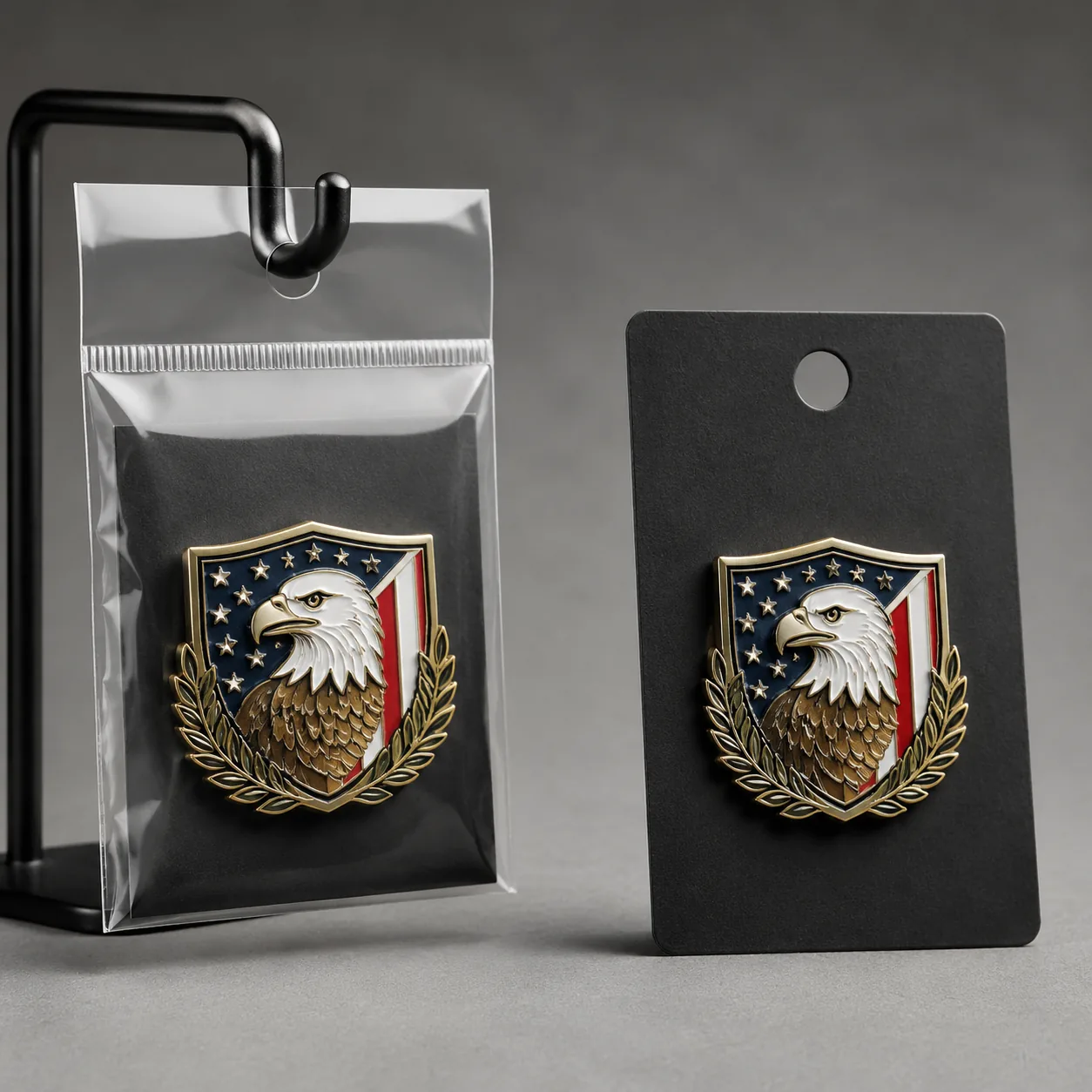
Why the package changes the real unit cost
For custom pins, packaging is part of the product specification, not an afterthought. A hook display, a backing card, or a simple OPP bag changes freight cube, pack-out labor, retail presentation, and the chance of scuffs or bent posts in transit. On a 1,000-piece order, the difference may look small; on a 20,000-piece reorder, a few cents per set and a few millimeters of carton height become material.
The right choice is usually driven by channel. Retail and pegboard merchandising favor hook-style hanging packs. Corporate gifting, collector drops, and SKU-controlled fulfillment usually favor backing cards because they add branding space and make counting easier. If you only compare pin cost and ignore pack-out, you will miss the actual landed cost.
- Use a hook display when the pin must hang on a pegboard, blister wall, or merch rack.
- Use a backing card when branding, barcode labeling, or gift presentation matters.
- Use bulk packing only when you can tolerate manual kitting and less surface protection.
- Request packaging as a separate FOB line so you can compare true landed cost.
Hook display vs backing card: core specs
The ranges below reflect common custom enamel pins in the 20-35 mm range, typically 1.2-2.0 mm thick with one or two posts. Heavier cast pins, moving parts, or pieces over about 15 g need tighter retention and usually more rigid packaging. Ask your supplier to quote the pack style separately from the pin itself so you can see the real delta.
| Spec item | Hook display | Backing card |
|---|---|---|
| Typical use | Retail hanging, peg hooks, header strips | Gift packaging, e-commerce, branded sets |
| Paper stock | Often none; sometimes 250-300 gsm header card | 300-400 gsm coated paper or SBS cardstock |
| Common size | 40 x 60 mm to 60 x 90 mm header area | 50 x 80 mm, 55 x 85 mm, 60 x 90 mm |
| Print method | 1-4C offset or digital on header only | 4C offset; spot UV optional on premium runs |
| Finish | Usually uncoated or matte laminated header | Matte or gloss lamination, sometimes soft-touch |
| FOB add-on cost | About USD 0.03-0.10 per set | About USD 0.06-0.20 per set |
| Lead-time impact | 0-2 extra days | 1-3 extra days |
| Carton density | Higher if flat-packed | Lower due to board thickness |
| Protection | Moderate; better with sleeve or polybag | Good for surface protection and SKU control |
| Best fit | Store walls, trade show merch, retail resale | PR kits, gifts, collector releases |
For MOQ planning, many factories can do hook-pack or simple header packs at 500-1,000 sets, with better pricing at 3,000-5,000 sets. Backing cards are usually priced more efficiently at 1,000-3,000 pieces, and the print economy improves again at 5,000+ pieces. If your supplier quotes a premium at low volume, that is normal: setup, die-cutting, and assembly are the real cost drivers.
Where hook displays win
Hook displays win when the pin needs to sell from a wall or pegboard. They use less paper, pack flatter, and usually keep carton density high. For retail programs, that matters because outbound freight and warehouse storage often cost more than the paper itself. A simple hanging format also keeps the item visible without forcing the buyer to design a full front-and-back card.
This format is especially practical for mass retail or wholesale programs where the buyer wants a clean SKU system and fast replenishment. A factory can often pack 200-300 sets per master carton depending on the pin size and hang format, while cards typically lower that density. That difference affects sea freight cube, local warehouse slots, and the cost to move replenishment stock into stores.
The trade-off is branding space. A hook pack gives you less room for logo, story copy, and compliance text, and the presentation can feel utilitarian if the pin is meant as a premium gift. It is also less forgiving with protruding posts or sharp edges, so you may need a sleeve or small bag to prevent rub marks.
In practice, hook packs work best when the buyer sees the product in a hanging fixture before purchase. A 25 mm hard enamel pin with a single logo mark can move well in this format because the package only needs a clean title, a SKU, and a hang hole. Once you need a full retail story, the format starts to feel cramped.
Where backing cards win
Backing cards are the better choice when the package has to do part of the selling. A printed card can carry the logo, SKU, barcode, short product story, social handle, and care note without crowding the pin itself. For collector pins and corporate gifting, that extra surface often justifies the added cost because it raises perceived value and makes the set look finished.
Cards also improve pack-out control. A carded pin is easier to count, label, audit, and repack by SKU. If you have multiple designs in one order, a card can reduce mix-ups because each design gets its own printed identifier. For channel fulfillment, that matters more than it sounds: a mislabeled pin set costs more to correct than the paper card ever did.
The main technical risk is card quality. Thin stock around 250 gsm can curl, bow, or crease during bagging and shipping, especially with humidity changes. For most production runs, 300-350 gsm coated paper is a safer baseline; 400 gsm is better when you want a stiffer premium feel. Matte lamination is usually the safer default because it hides scuffs, while gloss shows color more strongly but can scratch more visibly.
For premium releases, a 55 x 85 mm or 60 x 90 mm card gives enough room for branding without dwarfing the pin. If the pin uses two posts, the hole spacing should match the actual post centers, typically within +/- 0.5 mm, or the pack-out team will force the clutch and deform the card. That is a small tolerance on paper, but it is the difference between a clean retail finish and a bent mount.
Cost, freight, and labor trade-offs
On a factory quote, the packaging delta is usually modest. A hook-style pack may add only USD 0.03-0.10 per set if the hanger is simple. A backing card usually adds USD 0.06-0.20 per set depending on size, print coverage, lamination, and whether the pin is already bagged. Those numbers can climb if you want spot UV, foil, or a custom die-cut shape.
Lead time is usually short but not zero. Hook packs generally add 0-2 days to production if the factory already has hanger materials in stock. Backing cards usually add 1-3 days because the print must be checked, cut, and paired with the pins. For custom artwork, ask for a pre-production digital proof and a physical sample if the order is over 1,000 pieces.
Freight is where the true cost difference shows up. A backing card can reduce carton packing efficiency by roughly 10-25 percent versus bulk or a thin hook hanger, depending on board size and whether the pin is sleeved. If you are shipping by air, that cube loss can outweigh the retail upside quickly. If you are shipping by sea, the effect is smaller but still relevant for warehousing and fulfillment labor.
To keep comparisons honest, quote the same pin spec both ways. For example: a 30 mm hard enamel pin, zinc alloy, 1.5 mm thickness, nickel plating, two posts, rubber clutches, individually bagged. Then compare FOB at 500, 1,000, and 5,000 sets. At that point, you can see whether packaging is a brand decision or just extra cost.
A realistic sourcing example helps. For a 30 mm enamel pin with a 55 x 85 mm printed card, many factories will quote a 500-piece run at about USD 0.09-0.14 extra per set for the card package, then drop to roughly USD 0.06-0.10 at 3,000 pieces and USD 0.04-0.08 at 5,000+ pieces. Hook packs often come in lower on paper cost, but the savings can disappear if you need extra bagging or manual sorting.
How to write the PO and control quality
The packing instruction should be as specific as the pin drawing. Do not write only 'with backing card' or 'with hanger.' State dimensions, board grade, print coverage, lamination, hole position, retention method, and any bag or sleeve requirement. If the supplier has room to improvise, they usually will.
- Backing card size: specify exact finished size, for example 55 x 85 mm or 60 x 90 mm.
- Paper stock: use 300-350 gsm coated paper for standard programs; 400 gsm for premium feel.
- Print: specify 4C offset, with text no smaller than 6 pt and barcode quiet zones kept clear.
- Finish: choose matte lamination for lower glare or gloss for stronger color pop.
- Retention: define one or two posts, clutch type, and whether the pin is fixed before bagging.
- Hook pack: specify hanger hole diameter, header thickness, and tear resistance for pegboard use.
- Tolerance: hold card size to +/- 1 mm and hole position to +/- 0.5 mm.
- Packaging condition: state whether each set ships in OPP bag, sleeve, or bulk tray.
For quality control, ask the factory to send a pre-production packaging sample with the actual pin inserted. That is the fastest way to catch a hole that is too tight, a card that bows under weight, or a hanger that fails when pulled off a peg. If your supplier performs in-house assembly, request a pack-out photo from the first run so the final presentation matches the proof.
If the package includes a protective sleeve or polybag, specify the film thickness as well. A 40-60 micron OPP bag is common for light protection, but heavier pins or sharp attachments can justify 60-80 micron film to reduce punctures. For printed cards, ask the factory to confirm edge trim quality and maintain a clean cut tolerance so stacked cards do not bind or flare at the corners.
When neither option is the right one
Sometimes the lowest-friction choice is neither hook display nor backing card. If the pins are internal giveaways, trade show handouts, or mixed promotional kits assembled later, bulk packing in OPP bags may be better. A simple 40-60 micron polybag can protect the finish without adding much cube or labor, and it keeps kitting flexible at your warehouse.
Avoid backing cards when the margin is too thin to absorb the paper, print, and assembly cost. Avoid hook displays when the final channel is a gift box, collector case, or mailer, because the hanging format can look out of place and waste space. In those cases, presentation packaging should match the channel, not fight it.
A useful rule: if the customer will see the pin on a wall, use a hanging format. If the customer will open it in hand, use a card. If neither visibility nor presentation matters, use the lightest practical pack that protects the finish and keeps SKU control manageable. For short-run merch under 1,000 sets, that often means a simple OPP bag plus an insert label rather than a full retail card.
A practical buying checklist
- Confirm the sales channel before you approve packaging.
- Ask for FOB pricing at 500, 1,000, and 5,000 sets.
- Compare carton count and ship cube, not just unit price.
- Lock card size, gsm, finish, and print method in writing.
- Specify tolerance, retention, and bagging method on the PO.
- Request a pre-production sample with the actual pin inserted.
- Keep the reorder sheet identical so later batches do not drift.
If you need a simple decision path, start with the channel and work backward. Retail wall display usually points to hook packaging. Gifting and premium resale usually point to backing cards. Once that is decided, lock the specification tightly enough that the next order arrives the same way, without hidden changes in stock, size, or assembly.
Have a project? Send your artwork and target quantity and we’ll reply with a detailed quotation within 12 working hours.
Ready to get this made?
Send your sketch, target quantity and ship-date. Detailed quotation in 12 hours.



