Hook-and-Loop Patch Specifications That Prevent Peel-Off Claims
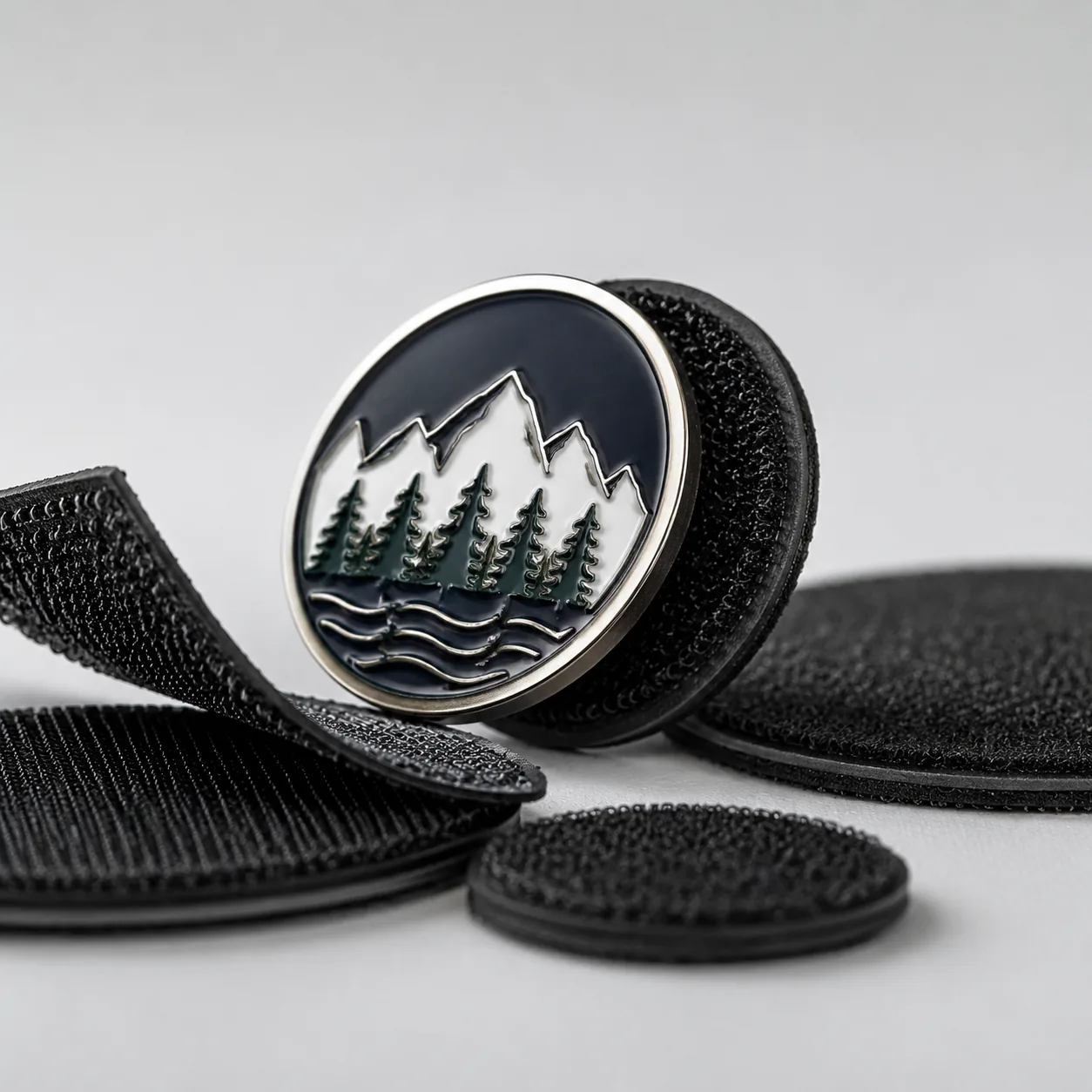
1. Define the Patch Build, Not Just “Velcro Backing”
Most peel-off claims start with an underspecified RFQ. “Velcro backing” can mean a sewn hook tape, pressure-sensitive adhesive hook, laminated hook, a hook-and-loop set, or only the hook side on the patch. Those options look similar in a photo but perform very differently after repeated removal, export shipping, heat exposure, and garment washing.
A complete B2B specification should identify the front construction, edge finish, backing layer, attachment method, loop requirement, and packing method. For embroidered and woven patches, the typical stack is fabric face, non-woven stabilizer if needed, merrowed or heat-cut edge, hook tape inset from the border, and perimeter stitching. For PVC patches, the hook side is normally placed in a recessed back channel or bonded flat before stitching so the finished patch does not rock on the garment.
For uniform, tactical, workwear, school, club, and outdoor patches, stitched hook backing is the safer default. Adhesive-only hook backing can be acceptable for short-term display boards, event badges, or low-cost giveaways, but it is a weak choice for patches wider than 70 mm, patches removed frequently, or any patch expected to stay reliable through humidity and temperature changes.
| Patch Type | Recommended Backing Construction | Typical Finished Thickness | Best Use | Avoid When |
|---|---|---|---|---|
| Embroidered patch | Sewn hook tape, 1.5-2.0 mm inset, 2.5-3.5 mm stitch margin | 2.0-3.2 mm | Uniforms, clubs, staff badges, giveaways | Photographic detail or text below 3 mm high |
| Woven patch | Sewn hook tape with tighter die-cut registration | 1.5-2.5 mm | Small text, clean logos, thin borders | Raised 3D texture is required |
| PVC patch | Recessed hook backing, bonded plus stitched where size allows | 3.0-5.5 mm | Outdoor, tactical, waterproof-feel products | Very light garments, low-postage mailers, very flexible caps |
| Leather-look patch | Sewn hook backing with reinforced corners | 2.2-3.8 mm | Caps, bags, lifestyle accessories | High-temperature laundering or industrial uniforms |
2. Specify Hook Grade, Loop Supply, and Grip Level
Hook-and-loop tape is not a single material grade. Hook density, filament stiffness, pile height, base fabric, dye color, and tape thickness all affect grip, hand feel, abrasion, and cost. A cheap low-density hook may pass sample approval when new, then lose holding force after 30-50 removal cycles. A very aggressive hook may grip well but fuzz polyester sleeves, catch knitwear, and create garment return claims.
For standard promotional and uniform patches, medium hook tape around 280-350 g/m² is a practical baseline. For tactical, motorcycle, and outdoor applications, buyers often move to 350-450 g/m² hook tape, accepting a stiffer patch and stronger abrasion risk. Standard hook tape thickness is usually 1.0-1.4 mm. Heavy-duty hook for PVC or field-use patches is commonly 1.5-2.0 mm. The hook should stop 1.5-2.0 mm inside the visible edge on fabric patches and about 2.0-2.5 mm inside PVC edges.
The RFQ should also state whether the loop side is included. Patch-only pricing is not comparable with patch-plus-loop pricing. A loose loop piece usually adds USD 0.12-0.55 FOB per set depending on size, color, and whether it is die-cut, stitched to a backing card, or bulk packed. If the buyer supplies the garment loop field, request a sample of that loop material before mass production because grip can vary sharply between brushed loop, low-profile loop, and molded loop panels.
- State hook color: black, white, navy, olive drab, coyote brown, grey, or custom dyed for larger runs of roughly 3,000-5,000 pieces and above.
- Specify supply format: hook on patch only, patch plus loose loop piece, or patch shipped to a garment factory for sewing onto buyer-supplied loop panels.
- Define hook inset: 1.5-2.0 mm for embroidered or woven patches; 2.0-2.5 mm for PVC patches to reduce edge scratch and curl.
- Use medium hook for thin polyester uniforms; reserve high-aggression hook for tactical gear, bags, motorcycle jackets, and heavy outerwear.
- Avoid adhesive-only hook for patches above 70 mm wide, repeated-removal products, humid shipping routes, or washable uniform programs.
3. Control Size, Shape, and Edge Tolerances
Hook backing is stiffer than iron-on, sew-on, or plain fabric backing. On round, shield, oval, and mascot shapes, the hook layer should be simpler than the visible outline. If the hook follows every small cutout or sharp corner, it can snag, lift, or expose scratchy hook points along the edge.
For patches below 60 mm, keep the hook shape simple and inset. For 70-120 mm sleeve and chest patches, use continuous perimeter stitching and avoid narrow protrusions below 4 mm on woven or embroidered designs and below 5 mm on PVC. For back patches above 150 mm, full hook coverage can make the patch too rigid. Segmented hook strips or partial hook fields often conform better to jackets, backpacks, and curved panels while lowering material cost.
Tolerance should be written in measurable terms. A patch that is 2 mm oversized may not fit a sleeve loop field; a hook layer that is 2 mm off center can expose a scratchy side on one edge and look visibly crooked on the other. For repeat corporate programs, measure against the approved physical golden sample as well as the digital drawing.
| Spec Item | Recommended Value | Production Tolerance | Why It Matters |
|---|---|---|---|
| Outer patch size | 30-120 mm common; 150-300 mm for back patches | ±1.0 mm below 100 mm; ±1.5 mm at 100 mm and above | Controls fit on garment panels and loop fields |
| Hook inset from edge | 1.5-2.0 mm fabric; 2.0-2.5 mm PVC | ±0.5 mm | Prevents exposed hooks, edge curl, and skin abrasion |
| Minimum narrow protrusion | 4 mm woven or embroidered; 5 mm PVC | ±0.5 mm | Allows cutting and stitching without tearing or distortion |
| Corner radius | Minimum R1.5 mm fabric; R2.0 mm PVC | ±0.3 mm | Reduces lifting, snagging, and premature edge wear |
| Hook-to-front registration | Hook centered within 1.0 mm of visible outline | Visual and ruler check under AQL sampling | Prevents uneven borders and poor placement on loop panels |
4. Set Stitching and Peel-Resistance Requirements
The least visible construction line is often the most important: how the hook tape is secured to the patch. Heat lamination or pressure-sensitive adhesive can keep hook tape flat during sewing, but it should not be the only retention method for professional-use patches. A perimeter stitch adds labor, yet it is the main safeguard against corner lift after removal cycles, heat, humidity, and flexing.
For embroidered and woven patches, specify lockstitch or dense zigzag stitching around the hook layer at 8-10 stitches per inch, or about 3-4 stitches per centimeter. The stitch line should sit 1.5-2.5 mm from the outer edge and must not cut through small embroidered letters. For PVC patches, a molded or pressed recessed sewing channel reduces thread abrasion; without that channel, thread can sit proud and wear faster when the patch is dragged across a sleeve or bag.
Peel resistance should be tested in two ways: hook-to-patch retention and hook-to-loop engagement. A practical factory control is 20 manual attach-detach cycles followed by corner-lift inspection. For more technical programs, request a 180-degree peel check on the backing edge using a 25 mm strip where the geometry allows. For sewn hook, the usual pass/fail criterion is no stitch break, no adhesive bleed, and corner lift not exceeding 2 mm after cycling. For adhesive-only samples, require a higher-risk notation on the approval sheet rather than treating the sample as equivalent to sewn backing.
- Make perimeter stitching mandatory for uniform, tactical, outdoor, school, club, bag, and workwear patches.
- Match thread color to the border unless contrast stitching is part of the approved artwork.
- Set maximum trimmed loose-thread length at 2 mm on both front and back.
- Reject skipped stitches longer than 5 mm on any visible border or hook-retention stitch line.
- Reject any patch where hook corners lift more than 2 mm after 20 attach-detach cycles on the approved loop material.
5. Address Heat, Laundry, Adhesive, and Materials
Adhesive still matters even when the hook is stitched because it holds the backing flat during cutting, sewing, packing, and early use. For short-event or display applications, light adhesive plus stitch is usually enough. For uniforms, outdoor teams, sports clubs, and industrial buyers, specify heat-resistant adhesive or make clear that mechanical stitching is the primary retention method.
A useful heat exposure screen is 60°C for 4 hours with no visible hook curling, bubbling, delamination, or glue bleed onto the patch face. For shipping into hot climates or container routes, buyers may request 70°C for 2 hours as an added risk check, but this should be agreed before sampling because some decorative materials, especially leather-look synthetics and specialty films, may deform at higher temperatures.
Laundry claims must be precise. “Washable” is too vague unless it states whether the patch is removed before washing. If the patch stays on the garment, the loop field, garment fabric, detergent, water temperature, spin speed, and drying method all affect results. A practical uniform requirement is 5 domestic wash cycles at 30-40°C with the patch attached, followed by inspection for curl, hook contamination, color bleed, and loop damage. For industrial laundering, hook-backed removable patches are usually higher risk unless the garment system is tested as a complete assembly.
Combining iron-on and hook backing is possible but usually not ideal for serious uniform use. It increases thickness, reduces flexibility, and can create a bulky edge while still requiring accurate hook attachment. If a retail program needs both attachment methods, two SKUs are cleaner: one iron-on or sew-on version and one hook-backed version with loop supplied separately.
6. MOQ, FOB Pricing, and Lead-Time Benchmarks
Hook backing affects cost in three places: hook tape material, die cutting or laser cutting, and sewing time. The effect is modest on a simple 80 mm rectangle but more visible on irregular shapes, small production lots, and PVC patches with recessed backs. When comparing quotes, confirm whether the loop piece, retail packing, barcode label, and AQL inspection are included. A quote for hook-only bulk-packed patches is not the same product as a patch-and-loop retail set.
For ZheCraft production, practical MOQ is usually 100 pieces for embroidered or woven hook-backed patches and 300 pieces for PVC because PVC mold, color setup, and curing time are heavier. Samples below MOQ are possible, but the unit economics are poor for procurement orders. Normal sampling takes 3-7 days after artwork approval. Mass production is typically 10-16 days for embroidered or woven patches and 15-22 days for PVC, excluding international transit and buyer approval delays.
| Order Type | Typical MOQ | FOB Unit Range USD | Sample Time | Mass Production Time |
|---|---|---|---|---|
| Embroidered patch, sewn hook only | 100 pcs | 0.45-1.60 | 3-5 days | 10-14 days |
| Woven patch, sewn hook only | 100 pcs | 0.55-1.80 | 4-6 days | 12-16 days |
| PVC patch, recessed hook backing | 300 pcs | 0.90-2.80 | 5-7 days | 15-22 days |
| Patch plus loose loop piece | 100-300 pcs | Add 0.12-0.55 | Add 1-2 days | Add 1-3 days |
| Large back patch above 150 mm | 100 pcs | 1.80-6.50 | 5-7 days | 14-22 days |
These ranges assume normal artwork, up to 8 thread or PVC colors, standard hook colors, bulk polybag packing, and no licensed compliance testing. Custom-dyed hook tape, Pantone-critical PVC, individual retail cards, UPC labels, segmented hook layouts, and buyer-supplied loop testing can add cost and 2-7 working days. Rush orders are realistic only when hook tape, thread, fabric, and PVC colors are already in stock.
7. Use AQL Inspection for Functional Failures
Hook-backed patches need cosmetic and functional inspection. Cosmetic checks cover logo shape, thread shade, PVC color, border cleanliness, stains, scorching, and front-face defects. Functional checks cover hook alignment, stitch security, corner lift, grip on the specified loop, finished thickness, and whether hooks extend beyond the intended edge.
For most B2B promotional orders, AQL 2.5 for major defects and AQL 4.0 for minor defects is a reasonable sampling basis, aligned with common ISO 2859-1 inspection practice. Critical defects should be zero tolerance: wrong logo, mixed customer designs, wrong backing type, broken needle fragments, sharp exposed material, mold contamination, or unsafe loose parts for child-facing goods. For uniform supply or recurring corporate programs, keep a signed golden sample and inspect reorders against that physical sample, not just the PDF artwork.
| Defect | Classification | Suggested Limit |
|---|---|---|
| Wrong hook color, missing hook, or adhesive-only backing when sewn hook was specified | Major | AQL 2.5 |
| Hook layer off center by more than 1.5 mm | Major | AQL 2.5 |
| Corner lift above 2 mm after peel cycling | Major | AQL 2.5 |
| Loose thread longer than 2 mm after trimming | Minor | AQL 4.0 |
| Visible stain, glue bleed, scorching, or burnt edge | Major if front visible; minor if slight on back | AQL 2.5 or 4.0 |
| Wrong logo, unsafe fragment, mixed design, or needle contamination | Critical | 0 allowed |
- Measure at least 10 pieces per colorway for outer size, thickness, and hook inset before packing.
- Run attach-detach testing on at least 5 pieces per shipment lot; increase the sample size for uniform and tactical orders.
- Check grip on the actual buyer-approved loop material, not only on generic factory loop tape.
- Photograph front, back, side thickness, hook inset, and peel-cycle results for the shipment QC file.
- Pack hook-backed patches face-to-face or hook-to-loop so exposed hooks do not abrade the front of another patch in transit.
8. Put the Functional Spec Directly in the RFQ
Before requesting prices, define the real use case: short event giveaway, retail morale patch, school uniform, workwear badge, bag decoration, outdoor tactical patch, or reorderable corporate program. Then write the construction in one sentence: “80 mm woven patch, heat-cut edge, black sewn hook backing inset 2 mm, loose loop piece included, 20 attach-detach cycle check, AQL 2.5 major and 4.0 minor.” That sentence prevents one supplier from quoting adhesive-only backing while another prices stitched hook.
Send vector artwork, Pantone or thread references, finished size, backing color, loop requirement, packing method, order quantity, and whether the patch must survive washing or repeated removal. Ask for a pre-production sample showing the front, back, side thickness, and one corner after 20 attach-detach cycles. If the program may reorder, approve a physical golden sample that includes the final hook tape, not only the approved front artwork.
At ZheCraft, hook-backed patch RFQs are best reviewed in two parts: visual artwork and functional backing. Buyers can approve logo accuracy while still controlling hook grade, stitch margin, tolerance, peel behavior, packing, MOQ, and inspection criteria. The extra detail takes a few minutes at RFQ stage and prevents the most common field failures: curling corners, weak grip, scratchy edges, poor garment fit, and inconsistent reorders.
Have a project? Send your artwork and target quantity and we’ll reply with a detailed quotation within 12 working hours.
Ready to get this made?
Send your sketch, target quantity and ship-date. Detailed quotation in 12 hours.



