Hard Enamel vs Soft Enamel Pins: Spec-First Buying Guide
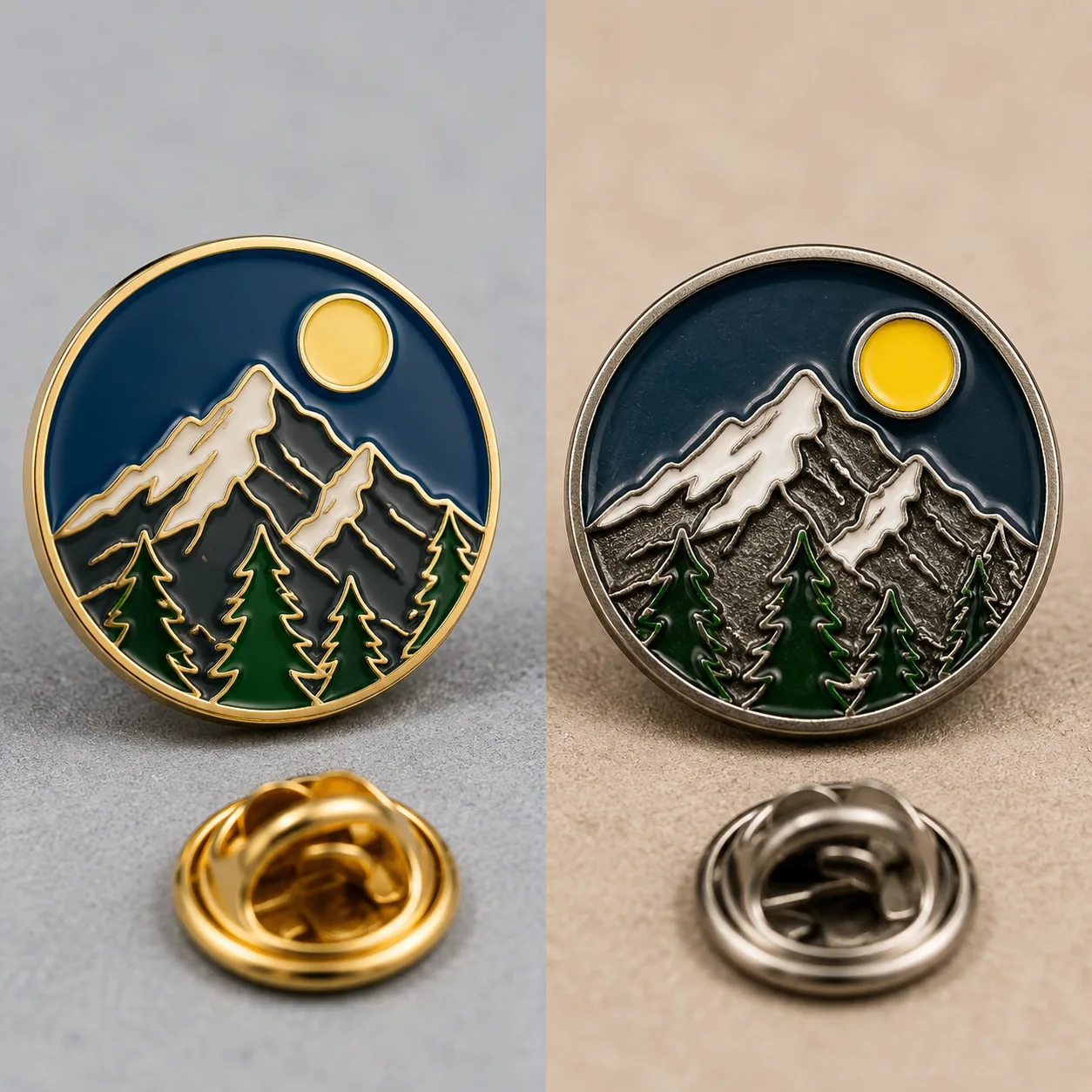
What Actually Changes Between the Two Builds
Buyers often compare hard enamel and soft enamel by finish alone, then discover the real difference only after the sample arrives. The useful comparison is not “glossy versus textured”; it is how each build handles line width, fill depth, polishing, plating wear, and artwork tolerance. Those variables affect not only appearance, but also unit price, reject rate, and whether the pin holds up on jackets, lanyards, or retail packaging without snagging or dulling. For corporate gifting, merch resale, and badge-style use, the process choice usually matters more than the marketing label attached to it.
At the production level, both styles start from the same metal shell, usually brass, iron, or zinc alloy, then diverge in how enamel is filled and finished. Hard enamel is filled, cured or fired, then polished flat so the color ends up nearly level with the metal lines. Soft enamel leaves the fill below the raised metal, which creates more tactile relief and stronger visual separation. The spec stack that matters most is metal thickness, fill depth, plating thickness, minimum line width, size tolerance, and inspection standard—not just whether the pin is described as “premium.”
| Spec item | Hard enamel | Soft enamel |
|---|---|---|
| Surface feel | Flat after polishing; low snag risk | Raised metal with recessed fill; more texture |
| Typical fill depth | Flush to slightly domed before final polish | About 0.20–0.40 mm below metal lines |
| Minimum practical line width | 0.25 mm workable, 0.30 mm safer | 0.20 mm workable, 0.25 mm safer |
| Minimum practical text height | 5 pt preferred; 4 pt only for very simple copy | 4 pt possible; 5 pt safer |
| Common metal thickness | 1.0–1.5 mm; 1.2 mm most common | 1.0–1.5 mm; 1.2 mm most common |
| Typical plating thickness | 0.03–0.05 mm decorative layer | 0.03–0.05 mm decorative layer |
| MOQ | 100–300 pcs typical; 500 pcs better pricing | 100–300 pcs typical; 500 pcs better pricing |
| Lead time after sample approval | 12–18 days | 10–16 days |
| FOB price range | USD 0.28–1.20/pc | USD 0.22–0.95/pc |
| Size tolerance | ±0.3 mm common; ±0.2 mm for tighter tooling | ±0.3 mm common; ±0.2 mm for tighter tooling |
| Inspection standard | AQL 2.5 major / 4.0 minor typical | AQL 2.5 major / 4.0 minor typical |
How to Read the Spec Sheet
A pin quote becomes useful only when the spec is tight enough to compare factories on the same basis. For a 1.25 in / 32 mm pin, 1.2 mm base metal thickness is a common middle ground; 1.0 mm lowers cost and weight, while 1.5 mm gives a heavier premium feel and more edge rigidity. Plating is usually a decorative layer rather than structural armor, so the practical question is finish quality and consistency, not extreme thickness. Nickel, gold, black nickel, and antique finishes are common, and each changes both appearance and price. In most factory quotes, the big cost drivers are mold complexity, color count, plating finish, and any added packaging.
Color count matters less than artwork density. A two-color pin with thin outlines can be harder to produce than a six-color pin with broad fields if the linework is crowded. Good vendors will confirm minimum line width, minimum text size, and whether any interior cutouts or floating islands need to be removed. If they only ask for a JPG and reply with “can do,” the quote is not yet controlled enough for a clean comparison.
- Specify exact size in millimeters and inches, not “about 1 inch.”
- Lock metal thickness at 1.0, 1.2, or 1.5 mm before quoting.
- Ask for plating finish by name: shiny gold, nickel, black nickel, antique brass, or matte black.
- Confirm minimum line width and minimum text height in writing.
- State whether clutch, magnet, rubber clutch, or safety pin backing is required.
- Ask for final inspection against AQL 2.5 major / 4.0 minor, or a higher standard if the pin is retail-facing.
When Hard Enamel Is the Better Choice
Hard enamel is the better fit when the pin needs a polished, higher-end look that reads more like jewelry or a commemorative medal. The flat face sits neatly in presentation boxes and blister packs, photographs cleanly, and usually feels more refined in hand. That makes it a strong choice for executive gifts, premium retail SKUs, awards, and any design that will be inspected up close under bright light. If the buyer is paying for perceived value, hard enamel generally supports that positioning better than soft enamel.
It is also a strong option when the pin will be worn on jackets, handbags, uniforms, or conference lanyards where snag resistance matters. Because the enamel and metal end closer to one plane, there are fewer raised edges to catch on threads. In daily-wear applications, that flatness helps the piece keep a clean look longer. The trade-off is that the artwork must be opened up slightly so polishing does not soften narrow gaps or overwork the lines.
Hard enamel is not automatically “better,” but it is more forgiving on the customer-facing side of the product. A small retail badge with clear shapes, bold edges, and moderate detail can look excellent in hard enamel. A dense illustration with micro-lettering usually cannot. The safe approach is to simplify first, then decide whether the premium surface is worth the tighter manufacturing window.
When Soft Enamel Is the Better Choice
Soft enamel is the better choice when the design benefits from depth, stronger separation, and lower unit cost. Because the fill remains below the raised metal, outlines stay crisp and the artwork has a more dimensional look. That makes it ideal for sports teams, club merch, campaign giveaways, mascot pins, and retro-style graphics that rely on visible linework. It is also easier to explain to nontechnical buyers: the surface has tactile relief, and the process usually costs less at the same size and plating.
The economics are often compelling. For a 1.25 in / 32 mm pin with standard plating, soft enamel can land at roughly USD 0.22–0.95 FOB per piece, while hard enamel may price at USD 0.28–1.20 FOB depending on finish, color count, and packaging. At 100–300 pieces, the difference is often modest because setup costs dominate. At 500–3,000 pieces, the gap can widen by 10–25 percent, especially when the hard enamel version needs extra polishing or tighter artwork control.
The main caution is wear and finish consistency. Raised edges can catch on fabric, and recesses can show dust or uneven gloss if the fill depth or curing is off. If you need the texture to stay visible, avoid over-sealing the face. If you need more abrasion resistance, ask whether a clear top coat is available and whether it changes the intended look. Soft enamel is not inferior by default; it simply shows relief more honestly and makes fabrication errors easier to see.
Failure Modes Buyers Miss in RFQs
The most expensive mistakes happen before sampling. Buyers often send only artwork and ask for “best quality,” which forces the factory to guess line width, enamel type, plating thickness, and finish level. Two suppliers can then quote the same pin very differently because one assumes a polished hard enamel build with extra polishing time, while another prices a simpler soft enamel execution. Without a controlled spec, the quotes are not comparable and the lowest number is often the least realistic.
Common failure modes include color bleed, weak edges, dull plating, over-polishing, and inconsistent fill depth. Hard enamel is especially vulnerable to lost definition if the metal ridge is too low or the artwork is too dense. Soft enamel is more vulnerable to uneven cavity fill, pinholes, and sharp edges that snag fabric. A reliable factory should be able to quote against a dimensioned drawing with plating choice, enamel type, metal thickness, and an acceptance standard tied to AQL. If they cannot, the order is not ready for production.
| Risk | Hard enamel control | Soft enamel control |
|---|---|---|
| Tiny text disappears | Use 5 pt+ text, widen strokes, reduce polishing pressure | Prefer raised text or simplify copy |
| Color overflow | Control fill depth and polishing sequence | Control fill viscosity and cavity depth |
| Snagging on fabric | Low risk due to flat surface | Higher risk if metal edges are sharp |
| Cheap-looking finish | Risk if plating is thin or polish is uneven | Risk if fill is blotchy or too glossy |
| Quote confusion | Polishing assumptions change price | Fill assumptions change price |
How to Compare Quotes Fairly
Two quotes for the same pin can differ by 20–40 percent without either factory being dishonest, because they may be pricing different specs. To compare fairly, lock the same width, height, metal thickness, plating type, enamel type, attachment, and packing method. For a 1.25 in / 32 mm pin, 1.2 mm metal thickness is a common middle ground; 1.0 mm lowers cost, while 1.5 mm gives a heavier premium feel. Also confirm whether the quote includes mold, sample, plating, color fill, back stamp, individual polybag, and FOB port handling so scope does not drift after approval.
The better method is to define one use case and one acceptable quality band. A trade-show giveaway may tolerate a broader finish range than a retail pin sold at full price, even if the artwork is identical. Ask for final inspection at AQL 2.5 major / 4.0 minor, plus a reference sample or approved photo set for color and polish matching. For retail or licensed programs, buyers sometimes tighten cosmetic acceptance to AQL 1.5 major / 4.0 minor on visible defects; that should be agreed in writing before production. If the supplier cannot explain how their process affects line definition, wear, and edge finish, the quote still needs clarification.
For repeat programs, consistency matters more than chasing the lowest unit price. A stable order is usually the one with measured specs, not the one described with words like “nice,” “premium,” or “luxury.” When buyers specify tolerance, plating, finish, and inspection expectations up front, the factory can control tooling, reject fewer samples, and reduce back-and-forth. In practice, a clear RFQ usually saves more than a small process switch ever would.
What to Do Next
Start by sorting your artwork into three buckets: smooth premium face, relief-driven design, or high-volume cost-sensitive program. Then decide whether the pin will be worn daily, displayed, or handed out in volume. If snag resistance and polished presentation matter most, lean hard enamel. If visual depth and lower FOB price matter more, lean soft enamel. In both cases, the artwork should be simplified before quoting, not after the sample comes back wrong.
Before sending RFQs, prepare one dimensioned vector file with exact size, one approved color list, the preferred plating finish, the desired enamel type, and a note on packaging and attachment. For serious procurement, request two quotes from the same factory: one hard enamel version and one soft enamel version built to identical dimensions. That makes the trade-off visible in price, finish, and usability instead of in sales language. If you are buying at scale, this side-by-side sample approach is usually the fastest way to choose the right build without rework.
- Prepare a vector file with final size, metal thickness, and backing type.
- State enamel type, plating finish, MOQ, and target FOB price before asking for samples.
- Ask for line width and minimum text size confirmation in writing.
- Request sample approval against AQL 2.5 major / 4.0 minor, or tighter for retail work.
- Compare hard and soft enamel using the same art, same plating, same packaging, and same inspection standard.
Have a project? Send your artwork and target quantity and we’ll reply with a detailed quotation within 12 working hours.
Ready to get this made?
Send your sketch, target quantity and ship-date. Detailed quotation in 12 hours.



