Golden Sample Control for Custom Metal Giveaways
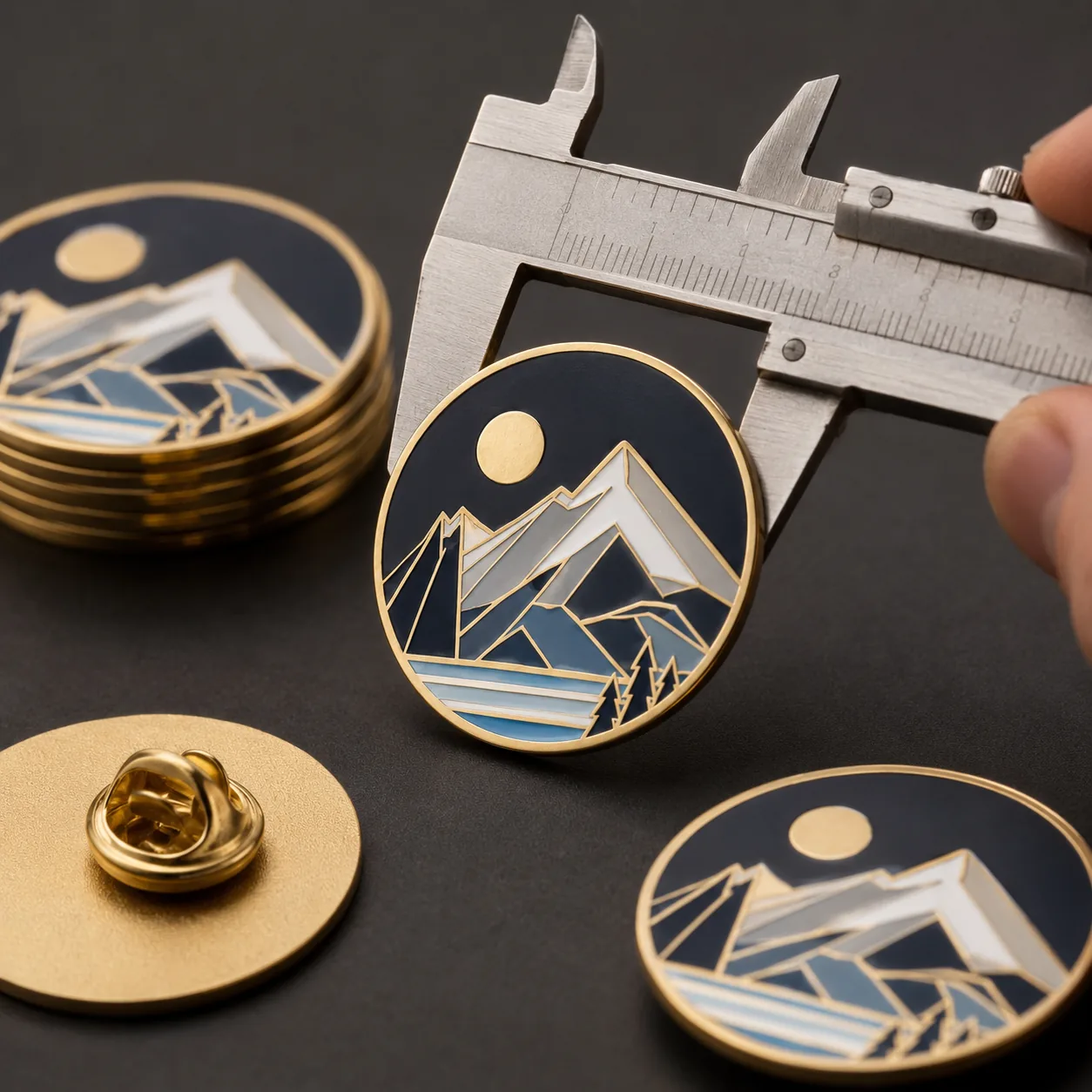
Why an Approved Sample Still Fails in Bulk Production
Many custom metal orders fail after the buyer approves the pre-production sample. The sample looks correct on a desk in London, Dubai or Chicago, but the shipment arrives with darker enamel, thinner plating, loose split rings, weaker magnets, rougher edges or a different backing card. The factory may still argue that production is acceptable because the approved sample was never converted into a controlled standard.
A golden sample is not simply the nicest piece from sampling. It is a sealed physical reference supported by written tolerances, photos, approval date, revision number, packaging status and inspection rules. For enamel pins, brooches, keychains, fridge magnets, challenge coins, woven patches and lanyards, it defines the production window before mass production starts.
This control matters most when the product will be reordered, distributed through retail, issued to staff, sold under license or used across several event shipments. It usually adds 2 to 5 working days at approval stage, but it can prevent expensive sorting, air freight replacement or brand disputes at final inspection. As a practical trigger, use formal golden sample control when order value exceeds about USD 2,000, quantity exceeds 1,000 pieces, or the item has more than three controlled components such as metal part, plating, enamel, attachment, backing card and carton label.
When Golden Sample Control Is Worth It
Not every order needs a formal process. A 100-piece soft enamel pin with one plating finish, no retail packaging and a one-day event deadline can often be managed with artwork approval and one pre-production sample. The risk changes when several small variations can cause visible brand failure or functional returns.
Use golden sample control for retail products, franchise rollouts, staff recognition pins, sponsor coins, licensed artwork, color-critical logo items and distributor programs. It is also important for mixed-component items: a die struck keychain with epoxy, split ring, jump ring, backing card, OPP bag and export carton label has multiple points where a factory may substitute a cheaper or available component unless the standard is locked.
| Order situation | Priority | Practical control level |
|---|---|---|
| 100 to 300 simple pins for one event | Low | Artwork approval plus one production sample; visual check before packing |
| 500 to 2,000 logo pins or keychains | Medium | One sealed golden sample set; normal AQL 2.5 major / 4.0 minor |
| 2,000 to 10,000 retail or distributor items | High | Three controlled sets; first article, inline and final inspection required |
| 10,000+ pieces or repeat program | Very high | Four controlled sets; reorder comparison and carton-level traceability |
| Challenge coins with antique finish | High | Physical reference for antique wash, polish level, edge thickness and weight |
| Magnets, brooches or lanyards with load requirement | High | Functional pull, sag and attachment checks recorded in grams or newtons |
| Multi-item gift sets | Very high | Separate approved standard for metal, textile, insert, pouch and master carton |
Build a Complete Golden Sample Pack
The approved sample must represent the complete shipped product, not only the metal piece. If the final item ships with a backing card, barcode sticker, velvet pouch, warning label, retail insert, silica gel, inner bag or carton label, the golden sample pack should include those parts. Otherwise, the factory may control the badge correctly but change the packaging in a way that causes retail rejection.
For a pin, the pack should include the front finish, back stamp, pin post position, clutch or rubber cap, backing card, bag and any age or choking warning label. For a keychain, include the metal charm, connector, jump ring, split ring, lobster clasp, epoxy status, plating finish and packaging. For a challenge coin, include the coin, capsule or pouch, edge numbering if used, antique wash standard and agreed weight band.
Keep at least three identical approved sets: one with the buyer, one with the factory production team and one sealed for QC inspection. For programs above 10,000 pieces, staggered shipments or multiple factories, keep four sets so sales, production, QC and packing teams do not share one worn reference. A sample handled daily can lose plating gloss, collect fingerprints or bend packaging corners within two to three weeks, making it unreliable as an inspection standard.
- Include the full shipped configuration, not only the metal component.
- Mark each set with SKU, PO number, artwork revision and approval date.
- Seal at least one complete set for QC use only.
- Photograph front, back, side thickness, hardware, packaging and carton mark.
- Record plating finish, enamel type, attachment, packing unit and carton quantity.
- Replace the golden sample if artwork, plating, hardware, material or packaging changes.
Labeling, Sealing and Revision Control
A golden sample without a control label is just a sample. Each approved set should carry a label with project name, SKU, purchase order number, artwork revision, approval date, sample quantity, factory contact and buyer approver. For repeat orders, add the previous PO and reorder version, such as R2 or R3, so the inspector knows whether the old sample still applies.
Use a tamper-evident bag, numbered security seal or signed sample carton when the set will be used for final inspection. The seal number should appear on the inspection booking, QC checklist and production file. If the sample is opened for photography, measurement or customer review, record who opened it and whether it was resealed, replaced or downgraded to visual reference only.
The physical piece should be paired with a digital control sheet. The sheet should show dimension drawings, Pantone references, plating name and thickness target, attachment type, packaging method, carton rules and measurable tolerances. The physical sample controls appearance; the sheet controls dimensions and acceptance limits. This prevents the common dispute where the sample looked right but nobody defined the allowed variance.
Revision control should be strict. If a buyer approves gold plating, then changes to black nickel after costing, that is not a comment; it is a new revision. The same applies to clutch type, backing card artwork, barcode, epoxy dome, magnet grade, pouch material or carton label. Each revision should have one final approver and one file name, not scattered approvals across email, chat and spreadsheet comments.
Write Tolerances Beside the Sample
The golden sample should not require every production piece to be identical under a microscope. Custom metal giveaways are stamped or cast, polished, plated, enamel-filled, printed and assembled partly by hand. A realistic tolerance band protects both sides: the buyer gets measurable control, and the factory avoids impossible zero-variation demands.
For most die struck or enamel pins, size tolerance should be ±0.20 mm on dimensions under 30 mm and ±0.30 mm on 30 to 60 mm pieces. Thickness tolerance is usually ±0.15 mm for stamped brass or iron and ±0.20 mm for zinc alloy casting. Weight tolerance is commonly ±5%, but coins, medals and premium executive gifts may need ±3% because hand feel is part of perceived quality.
Plating thickness should be written when durability or premium appearance matters. Standard promotional flash plating is often 0.03 to 0.05 microns and is acceptable for low-cost event giveaways. For higher handling, humid storage or retail use, specify 0.08 to 0.12 microns for nickel, gold-tone, black nickel or rose gold finishes. For antique silver, antique bronze or black finishes, consider a clear electrophoretic coating of about 5 to 8 microns if abrasion resistance matters.
| Control item | Typical tolerance | Tighten when |
|---|---|---|
| Overall length or width | ±0.20 mm under 30 mm; ±0.30 mm from 30 to 60 mm | Licensed logos, fitted inserts, paired left-right designs |
| Metal thickness | ±0.15 mm stamped; ±0.20 mm cast | Coins, magnets, brooches and retail items |
| Weight | ±5% standard; ±3% for premium coins | Hand feel, retail price point or matching sets matter |
| Enamel color | Visual match under D65 or 6500K light at 30 to 40 cm | Brand colors, sponsor logos or shelf display sets |
| Plating thickness | 0.03 to 0.05 microns standard; 0.08 to 0.12 microns upgraded | High-touch keychains, humid storage or retail handling |
| Pin post position | ±0.50 mm from drawing | Anti-rotation designs, brooch balance or multi-post badges |
| Magnet pull force | ±10% from approved sample or stated grams | Fridge magnets, name badges and display products |
| Packing count | Zero tolerance for mixed SKU in inner bag | Retail cartons, drop shipments and event kits |
Control Color, Plating and Surface Finish Separately
A single golden sample cannot control color unless the viewing condition is also controlled. Enamel, printed epoxy and woven thread can look different under warm office light, warehouse LED light and daylight. For color-sensitive orders, inspect against the sample under D65 daylight lamps or neutral 6500K light, not under yellow desk lighting. The viewing distance should be defined, typically 30 to 40 cm for pins and keychains.
Pantone numbers help, but cured enamel rarely matches a coated paper swatch perfectly because the enamel is glossy and sits inside plated metal borders. A practical standard is visual match to the approved sample, with no obvious mismatch among pieces in the same carton. For large enamel areas over 10 mm wide, small flow marks, trapped dust or slight level differences can appear; decide before production whether these are minor defects or rejection points.
Plating needs separate attention because bath chemistry, current, racking position and post-treatment can shift the result. Gold-tone plating may move from pale champagne to deep yellow. Black nickel can look smoky gray or almost black. Antique silver and antique bronze depend on blackening and polishing pressure, so the sample should include front, back and side photos with wording such as: medium antique wash, raised areas polished bright, recessed areas dark but not filled.
Surface defects should be classified in plain language. A tiny polish line on the back of a giveaway pin may be minor; a scratch across a retail coin face is major. Sharp burrs, exposed pin points, loose magnets on child-related products and detachable small parts are critical defects with zero tolerance, regardless of AQL result.
Use the Sample at First Article, Inline and Final Inspection
The golden sample should be used at three production stages: first article check, inline inspection and final random inspection. First article check happens when the first 20 to 50 pieces come off the line, before the whole order is plated, filled or packed. If the first article fails, stopping there is much cheaper than sorting 5,000 finished pieces.
Inline inspection should compare production to the sample at about 20% to 30% completion. For enamel pins and keychains, check plating tone, enamel fill, polish level, epoxy clarity, hardware security and visible scratches. For patches and lanyards, check thread color, edge cut, print registration, buckle direction, packed length and barcode accuracy.
Final inspection should use an AQL plan matched to product risk. A common setting for promotional metal goods is AQL 2.5 for major defects and AQL 4.0 for minor defects, with zero tolerance for critical safety issues. Premium retail, licensed programs and repeat corporate awards often tighten major defects to AQL 1.5, accepting higher inspection or sorting cost. For very low-cost event giveaways, some buyers keep AQL 2.5 / 4.0 but add strict checks for mixed SKU, wrong logo and unsafe sharp points.
| Inspection stage | Golden sample use | Typical decision |
|---|---|---|
| First article, 20 to 50 pcs | Confirm bulk production matches approved appearance and dimensions | Approve, adjust tooling/process or remake first batch |
| Inline, 20% to 30% complete | Catch color, plating, polishing, epoxy or hardware drift early | Continue, sort affected pieces or pause production |
| Pre-pack check | Confirm accessories, labels, bags, cards and carton marks match sample pack | Release to packing or correct line setup |
| Final AQL inspection | Use sealed set as appearance, assembly and packaging reference | Accept shipment, rework, sort or reject |
| Reorder startup | Compare new first article to old golden sample and current PO revision | Approve repeat or create revised golden sample |
Costs, Lead Times, MOQ Tiers and Common Failure Points
Golden sample control is not free, but it is usually cheaper than rework. For a new metal pin, keychain or coin, sampling normally takes 5 to 10 working days after artwork approval if tooling is required. Complex 3D coins, spinning keychains, epoxy domes, multiple plating finishes or mixed-material gift sets often need 10 to 15 working days. Add 2 to 4 days if backing cards, barcodes, pouches or printed inserts must be approved with the metal item.
Typical sample charges are USD 45 to 120 for simple enamel pins or small metal keychains, USD 80 to 180 for larger coins, medals or brooches, and USD 150 to 350 for multi-item gift sets with custom packaging. Express sample freight is often USD 25 to 60 for small parcels and can exceed USD 100 for heavy coin sets. Some factories refund sample fees after bulk confirmation; others do not because tooling, plating setup and hand finishing have already been consumed.
MOQ usually does not change because of golden sample control, but tolerance and inspection requirements can affect unit price. As rough FOB China ranges, a 25 mm soft enamel pin may be USD 0.55 to 1.10 at 500 pieces, USD 0.35 to 0.75 at 2,000 pieces and USD 0.25 to 0.55 at 10,000 pieces, depending on plating, colors, attachment and packaging. A 40 mm metal keychain may run USD 0.90 to 1.80 at 500 pieces and USD 0.55 to 1.20 at 5,000 pieces. A 45 mm challenge coin often ranges from USD 1.80 to 3.80 at 300 pieces and USD 1.10 to 2.40 at 2,000 pieces. Upgraded plating, individual backing cards, sealed sample control, extra sorting and tighter AQL can add USD 0.03 to 0.15 per piece.
The biggest failure is approving a beautiful sample that mass production cannot repeat at the quoted price. A senior technician may hand-polish, hand-fill or selectively repair the sample, especially on recessed enamel areas under 0.4 mm, mirror plating on complex edges or antique wash in deep relief. If normal production cannot repeat it, the sample becomes a trap. Ask the factory to confirm that the sample represents normal production method, not a showroom-grade special piece.
Other failures come from incomplete approval. Buyers often approve the front logo and miss the back stamp, side wall, pin post, brooch bar, magnet adhesive, jump ring gauge or carton label. Returns often happen because hardware fails, not because the logo is slightly off. Do not mix approval channels: design, procurement and warehouse should work from one revision file and one final approver.
- Do not approve a sample with known defects and expect bulk production to improve automatically.
- Do not change plating, backing card, barcode, hardware or carton marks without a new revision.
- Do not rely on screen photos for antique finish, glitter enamel or translucent color.
- Do not set unrealistic zero-variation standards for hand-polished metal products.
- Do not ignore inner bag quantity, mixed-SKU rules and export carton labels.
- Do not discard the sample after shipment if the product may be reordered.
Before the next custom metal order, decide whether it needs simple sample approval or formal golden sample control. For cheap, short-lived, non-critical giveaways, keep the process lean. For retail-facing, color-critical, safety-sensitive, high-volume or repeat products, write the golden sample rules into the purchase order before sampling begins. The most practical starting point is three complete sample sets, AQL 2.5 major / 4.0 minor, written dimensional tolerances, sealed QC reference and full packaging approval.
Have a project? Send your artwork and target quantity and we’ll reply with a detailed quotation within 12 working hours.
Ready to get this made?
Send your sketch, target quantity and ship-date. Detailed quotation in 12 hours.



