Glitter Enamel vs Epoxy Dome: Which Finishes Fit Your Brief?
Why buyers confuse these finishes
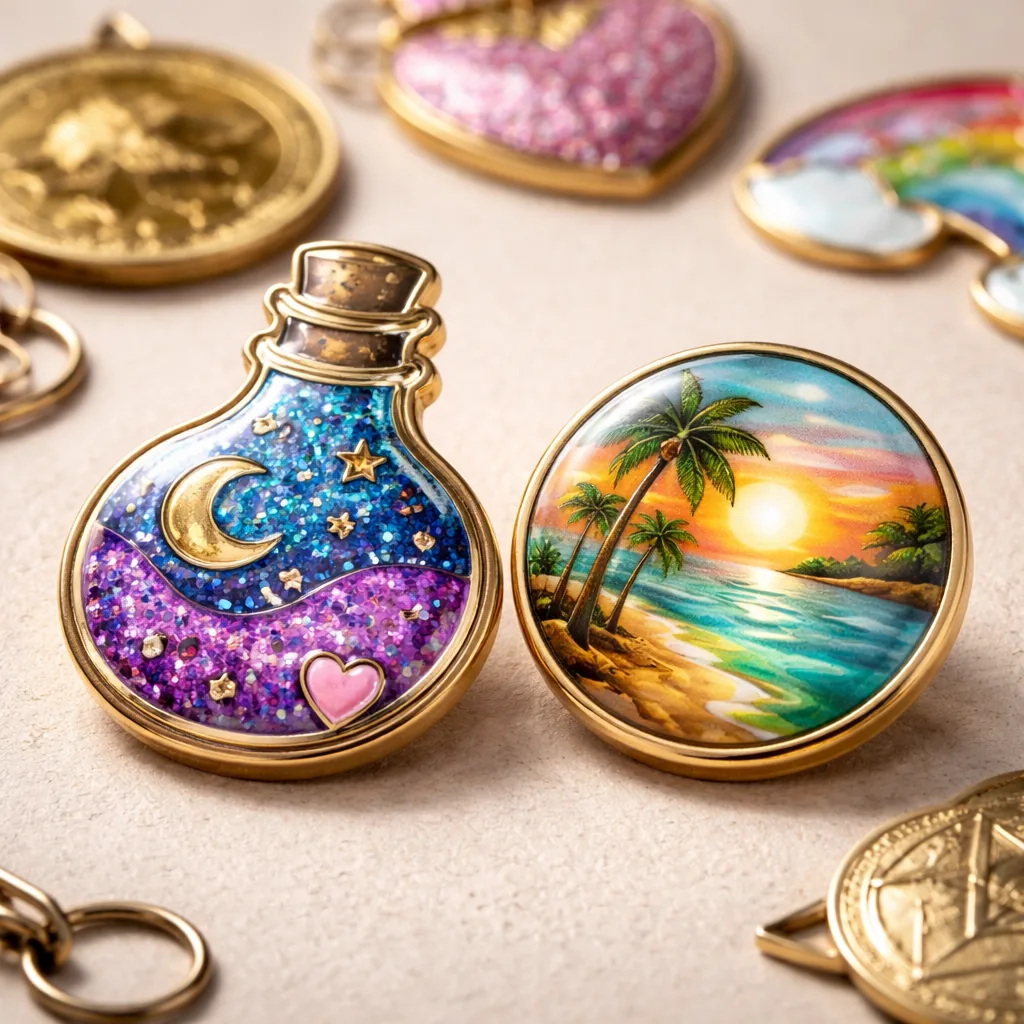
Glitter enamel and epoxy dome both make a promotional item look more premium, but they do it in different ways. Glitter enamel is an in-fill effect: sparkle is mixed into the colored enamel inside recessed cells. Epoxy dome is a top-surface effect: a clear polyurethane or epoxy resin is dispensed over printed or flat artwork to create a glossy lens and extra abrasion protection.
That distinction matters because the wrong finish changes the product’s geometry, inspection risk, and unit cost. A glitter pin can still feel like a conventional soft-enamel piece with a decorative sparkle, while an epoxy-domed badge or keychain behaves more like a sealed print. If the brief only says “premium look,” the factory may choose the cheaper process that misses the intended wear resistance or visual style.
In practice, the right choice depends on artwork structure, handling conditions, and size. Glitter works best when color blocks are broad enough to carry the sparkle cleanly. Epoxy dome works best when the art is printed, the product will be handled often, or the buyer wants a smooth touch and a high-gloss finish.
The fastest spec comparison
The table below reflects typical export production ranges for metal promo goods in standard finishes, not luxury hand-finished work. Costs move with size, color count, base metal, and whether the artwork is stamped, die-cast, or printed. Micron values refer to clear-coat film build or typical raised effect depth, not the total metal thickness of the item.
| Spec | Glitter enamel | Epoxy dome |
|---|---|---|
| Visual result | Sparkle suspended in colored fill | Clear glossy lens over art |
| Best artwork type | Large solid fills, simple logos, bold shapes | Printed art, flat graphics, photo-style logos |
| Minimum readable line width | 0.30 mm recommended; 0.25 mm is the practical floor | 0.20 mm on print; 0.15 mm possible but risky after doming |
| Minimum text height | 1.2 mm recommended | 1.0 mm recommended on printed graphics |
| Surface build | No extra top layer; fill usually sits flush to slightly recessed | Adds about 200–800 microns of dome height |
| Typical hardness after cure | Similar to standard enamel; surface remains exposed | About 2H–3H pencil hardness after full cure, depending on resin |
| AQL target for appearance inspection | AQL 2.5 common for visual defects | AQL 2.5 common, with stricter zero-tolerance on dust and bubbles |
| Lead-time impact | Usually +2 to 4 days | Usually +3 to 5 days, plus cure time before packing |
| FOB price impact | About USD 0.05–0.20/pc | About USD 0.08–0.30/pc |
| Typical MOQ | 300–500 pcs per design | 300–500 pcs per design |
| Best avoided when | Tiny text, dense patterns, fine gradients | Stepped relief, deep recesses, sharp high edges |
When glitter enamel is the better fit
Glitter enamel is strongest when the brief wants visual energy without changing the object’s form. It gives pins, medallions, and collectible badges a lively finish that catches light at different angles, which is useful for fashion drops, event merch, club badges, and holiday programs. Because the sparkle sits in the fill itself, the product still reads like a metal badge rather than a coated print.
The finish is most reliable on designs with wide enamel cells and generous borders. For example, a 30 mm round lapel pin with five bold color zones and a 0.4 mm border is usually a safe candidate. A 22 mm pin with tiny lettering, thin facial features, or complex gradients is not: glitter particles can visually soften edges, create uneven density, and make small text harder to read after curing.
A useful rule is this: if the artwork can still be understood when reduced to flat color blocks, glitter enamel is viable. If the design depends on line clarity, shadows, or crisp negative space, glitter becomes a compromise. It is also a poor match for products that need a clean corporate look, because the sparkle can make brand marks feel less controlled and less exact.
When epoxy dome earns its keep
Epoxy dome is primarily a protection strategy, not a decoration strategy. It is the better fit for printed keychains, soft PVC or PU inserts, badges, magnets, and promotional tags that get rubbed in pockets, shipped in bulk, or wiped repeatedly. The clear resin shields the image from scuffing and gives the surface a smooth, glassy hand feel that many buyers associate with a higher retail finish.
The process does change the artwork. A good dome usually adds 0.2 to 0.8 mm of height, which can deepen dark colors slightly and soften very fine contrast. It also magnifies defects that a flat print might hide. Dust, lint, silicone contamination, poor edge control, and trapped air are all more visible once the resin levels out. For that reason, epoxy is unforgiving on artwork that is not truly flat or on parts with stepped embossing.
A practical example: a 50 mm keychain with a CMYK-printed logo and a white background is an ideal dome candidate, because the print is flat and the topcoat protects the graphic from key friction. A die-struck keychain with raised lettering, layered relief, and sharp edges is not ideal, because the resin will pool unevenly around the steps and can leave an overly rounded profile at the edges.
Technical limits that affect approval
The decision should be based on geometry, not taste. Glitter enamel tolerates moderate surface variation but does not solve weak tooling or low-quality border definition. Epoxy dome, by contrast, demands a flatter substrate and cleaner artwork edges, but it can extend the useful life of printed graphics significantly when the product is handled daily.
For glitter enamel, most factories want enamel cells at least 0.3 mm wide and border lines around 0.25–0.30 mm to maintain separation after fill and polishing. On very small items below 25 mm, the sparkle can clump visually and make the sample look richer than the production batch. That is why buyers should judge the sample under the same lighting and viewing distance used for inspection, not under showroom spotlights.
For epoxy dome, the key controls are resin viscosity, dispense volume, and cure condition. Too little resin leaves a thin patchy dome; too much causes overflow, edge drag, or a meniscus that swallows detail. Typical acceptable appearance limits are tight: no visible dust clusters, no pinholes larger than 0.2 mm, no edge lift, and no yellowing shift beyond the agreed reference under standard light. If the product will ship in warm cartons, the supplier should confirm full cure before packing to avoid pressure marks.
Cost, MOQ, and lead times in real terms
For standard metal promo production, glitter enamel generally adds about USD 0.05 to 0.20 per piece, depending on how many cells use the effect and whether the glitter pigment is mixed into multiple colors. Epoxy dome usually adds USD 0.08 to 0.30 per piece because it requires an extra dispensing step, leveling time, and curing control. On complex art with many separate print zones, the dome cost can rise further if the factory needs masking or rework.
MOQs are usually driven by the base item and tooling method more than by the finish itself. A common entry level is 300 pieces for a straightforward design and 500 pieces for more customized work. Some suppliers will quote 200 pieces, but the unit price often rises enough that the apparent flexibility disappears. If you need multiple SKUs, ask whether the factory can combine them under one metal mold while varying only the finish, because that is often the easiest way to keep cost down.
Lead time is similarly modest but not identical. Glitter enamel usually adds 2 to 4 production days beyond standard pin or badge timing. Epoxy dome usually adds 3 to 5 days, mainly because the resin must flow, settle, and cure before packing. A normal budget forecast for a new design is 10 to 15 days for glitter enamel samples and 12 to 18 days for epoxy-dome samples, depending on artwork approval speed and whether revisions are needed.
Quality risks you should expect
Glitter enamel’s main risk is false confidence. The sparkle can hide weak border cutting, slight overfill, or uneven polishing, so a buyer may approve a sample that looks more polished than the mass run. When the production batch arrives, the underlying tooling flaws become easier to see because the glitter no longer masks them in the same way across every viewing angle. That is why glitter is not a substitute for clean die work.
Epoxy dome’s risks are more mechanical. Air bubbles can appear if the resin is mixed too aggressively or dispensed too quickly. Dust inclusion usually comes from poor workspace control. Yellowing can happen if the resin formula is low grade or if the product is exposed to strong UV over time. On dark artwork, the dome may also produce an optical magnification effect that makes tiny misregistrations or print edge raggedness look more obvious than on a flat surface.
If the product will be handled heavily, both finishes need a clear durability target. A practical ask is a rub test of 50 to 100 double passes with a dry cloth for office-use items, or a short abrasion check with light bag friction for keychains and magnets. The point is not to over-spec the finish; it is to confirm that the intended finish survives the actual use case without the buyer discovering problems after shipment.
What to lock in the PO and sample sign-off
The best way to avoid avoidable disputes is to define the finish as an inspection standard, not a marketing adjective. The supplier should know exactly what counts as acceptable coverage, what defects are rejectable, and when the finished goods may be packed. This matters most when one order includes both glitter and epoxy finishes, because each finish has a different defect profile and different tolerance for visual variation.
- State whether the finish covers all cells, selected cells, or only the face panel.
- Specify the approved viewing distance: 30–50 cm under neutral white light.
- Set separate acceptance limits for bubbles, pinholes, dust, overflow, and edge lift.
- Define color tolerance for the enamel or print and a separate reference for the clear dome.
- Confirm minimum line width, text height, and any no-go areas before tooling approval.
- Require full cure before carton packing, especially for domed parts shipped flat-packed.
- Ask for one mass-production reference sample to be signed and retained by both sides.
For inspection, a normal commercial standard is AQL 2.5 for appearance and function, with tighter zero-defect expectations on obvious cosmetic flaws such as open bubbles, visible contamination, or dome overflow across critical artwork. If the item is a premium retail accessory rather than a giveaway, write that distinction into the PO. It changes the supplier’s handling standard and gives QC a clear basis for rejection.
A simple choice framework
Use glitter enamel when the design needs sparkle, simple color blocking, and a finish that still feels like a metal promotional item. Use epoxy dome when the design is printed, needs wipe-clean durability, or will be touched and rubbed often. If both options are possible, choose based on artwork geometry first, then service environment, then unit cost.
A fast decision check is easy to run before sampling: if the art has wide cells and the brief emphasizes visual energy, start with glitter enamel. If the art is flat, printed, or likely to be handled daily, start with epoxy dome. If the design has both tiny typography and a premium retail look, it may need a layout revision rather than a finish compromise.
At ZheCraft, we usually recommend requesting both finishes on the same base tooling when the artwork is not obvious. That gives the buyer a direct comparison of edge clarity, gloss, touch, and defect visibility before committing to mass production. It is usually cheaper to spend one extra sampling round than to discover that the chosen finish conflicts with the product’s real use case.
Have a project? Send your artwork and target quantity and we’ll reply with a detailed quotation within 12 working hours.
Ready to get this made?
Send your sketch, target quantity and ship-date. Detailed quotation in 12 hours.



