From RFQ to Bulk: Sourcing Custom Pins Without Rework
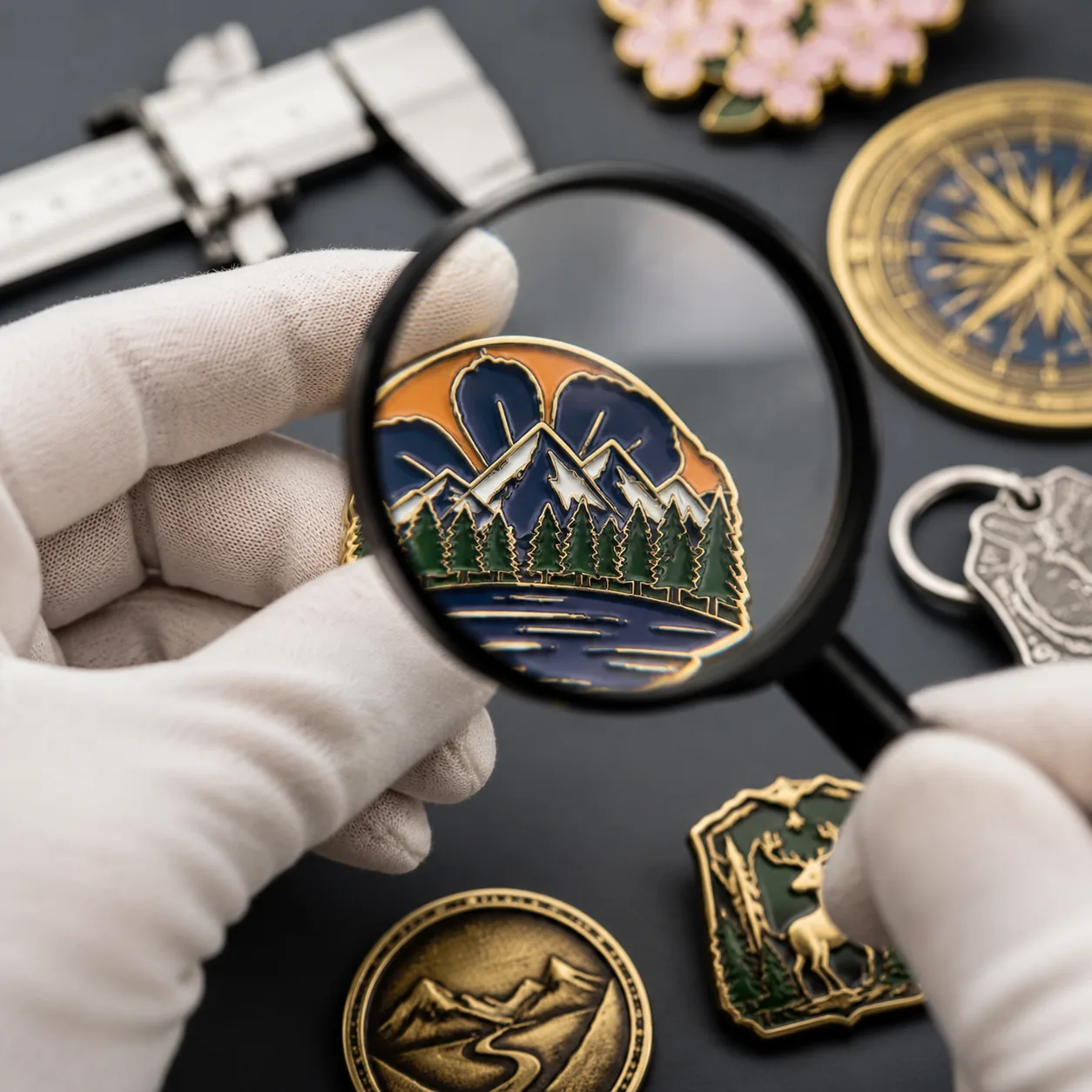
Start With The Production Path, Not The Artwork
If an RFQ starts with a logo file only, the factory has to guess at the build method, base metal, metal thickness, plating, and finishing sequence. That is where inconsistent quotes and sample rework begin. For custom pins, the first decision is the production path: soft enamel, hard enamel, die-struck without color, printed, or a mixed build with epoxy. Each path changes tooling depth, line width, polishing time, scrap risk, and price.
Use the end application to choose the build. Retail pins usually need tighter finish control and better packaging. Promo giveaways can tolerate simpler construction. Collector pieces often justify tighter specs, such as polished edges, clean enamel boundaries, and controlled plating tone. A 25 mm soft enamel pin with black nickel plating and butterfly clutch is not the same job as a 35 mm hard enamel pin with sandblasted recesses and a rubber clutch, even if the artwork is identical.
A practical starting point is to define the project in manufacturing terms before design terms. Common custom pin sizes are 20 to 40 mm, thickness is typically 1.0 to 1.5 mm for zinc alloy and 1.2 to 1.8 mm for iron, and visible line width should usually be at least 0.25 to 0.30 mm for reliable separation. If the art has hairline text or tiny icon details, simplify before quoting, not after sampling.
For low-detail bulk giveaways, a simple die-struck pin can be the best value. For brand merch, soft enamel often balances detail and cost. Hard enamel usually costs more because it needs extra fill, sanding, and polishing; that added labor is the reason it looks more like jewelry than merch.
| Spec choice | Why it matters | If omitted |
|---|---|---|
| Build type | Sets tooling, fill depth, and polish sequence | Quotes are not comparable |
| Size | Drives mold cost and visual legibility | Artwork may look cramped or oversized |
| Plating finish | Affects tone, wear, and corrosion resistance | Unexpected color or tarnish |
| Attachment | Controls comfort and retention | Pins sag, rotate, or fall off |
| Quantity | Determines setup amortization and MOQ | Unit price and lead time stay vague |
Write An RFQ That Forces Comparable Quotes
A usable RFQ is short, but it must be complete. Include product type, exact dimensions in millimeters, thickness target, plating finish, enamel type, attachment, backing card or packaging, quantity tier, target ship date, and whether design cleanup is needed. Ask the supplier to quote the same assumptions across every price so you can compare real differences instead of hidden scope changes.
For enamel pins, specify tolerances when you know them. A normal overall dimensional tolerance is often ±0.3 mm to ±0.5 mm on small pins, with thickness tolerance around ±0.2 mm. For logo details, state the minimum readable line width and the smallest void or cutout you will accept. If you need nickel-free plating, low-lead metal, or RoHS-aligned materials, say so explicitly rather than assuming the factory will infer it from the artwork.
Ask for separate pricing on sample, tooling, and freight. The cleanest RFQs request price tiers at 100, 300, 500, and 1,000 pieces, plus any overrun policy. This makes it easier to see whether the supplier is discounting tooling, inflating low-MOQ pricing, or hiding setup cost in the unit rate. It also helps you compare factories that work in different process families.
A strong RFQ also names the commercial terms. FOB is the most common basis for comparing supplier quotes, while EXW puts more booking responsibility on the buyer. If the supplier quotes DDP, ask what duties, brokerage, and last-mile charges are included before you compare it to an FOB price.
- State exact size in mm, not “medium” or “large”.
- Attach one final artwork file and one reference image.
- Specify build type, plating, attachment, and packaging.
- Ask for separate lines for mold, sample, unit price, and freight.
- Request lead times in days for sample and bulk production.
- Confirm whether quoted prices are FOB, EXW, or DDP.
Read Quotes Like A Factory Buyer
When quotes arrive, compare more than the unit price. A low quote can mean thinner base metal, simpler polishing, lower plating thickness, or a sample fee that is not credited later. On pin projects, a difference of USD 0.03 to USD 0.10 per piece can reflect a real process choice, but it can also signal looser inspection or reduced finishing time. If two suppliers are close in price, the better quote is usually the one with clearer assumptions and fewer exclusions.
Watch the MOQ logic. A factory may quote 100 pieces at USD 1.80 and 500 pieces at USD 0.78; that is normal because setup cost spreads out. For custom enamel pins, common FOB ranges are roughly USD 0.60 to USD 2.50 per piece at 300 to 1,000 units, depending on size, plating, and complexity. Tooling is often USD 40 to USD 150 per design for standard zinc or iron builds, while complex multi-level molds or unusually detailed artwork can run higher. Simple die-struck pins without color can be lower, especially at larger volumes.
Lead time should also be compared line by line. A standard sample is often 7 to 12 days, with bulk production commonly 15 to 25 days after sample approval. If the quote says “fast” but does not separate mold, sample, and mass production timing, treat it as incomplete. A genuine quote shows where the time goes.
Price only means something when the spec is locked. A quote for “gold pins” is not useful unless it says shiny gold, matte gold, antique gold, or black nickel. The same applies to attachment: butterfly clutch, rubber clutch, safety pin, or magnetic backing can change both cost and end-use performance. If the quote does not name the finish, attachment, and packaging method, the price is incomplete.
| Quote item | What good looks like | Red flag |
|---|---|---|
| Sample fee | Separate and refundable or credited | Hidden inside unit price |
| Tooling | Listed apart from production | Unclear ownership or reuse rights |
| Lead time | Sample and bulk shown in days | Only “about two weeks” |
| Plating | Named finish, not “gold color” | No finish specified |
| QC standard | AQL or inspection method stated | “Checked before shipment” only |
Choose The Sample Path That Matches Your Risk
Sampling should prove that the factory can make your exact product, not just something visually close. A pre-production sample should validate proportions, line thickness, plating tone, enamel fill behavior, edge finish, attachment strength, and packaging fit. For a standard pin, the sample is often ready in 7 to 12 days. For more complex multi-process items, expect 12 to 18 days, especially if the design needs multiple mold adjustments.
Do not judge the sample only by the front view. Check the back, pin post placement, clutch fit, edge quality, and whether the pin lies flat. For hard enamel, confirm the surface is polished flush enough for the intended look. For soft enamel, confirm the recessed areas are clean and the color sits evenly without overfill. If the sample is for a larger order, ask the factory to record the exact die, plating batch, enamel code, and attachment used so the bulk run can match it.
Use the sample to test handling, not just appearance. Wear-test the attachment, inspect under consistent lighting, and compare against a physical or calibrated digital reference. A sample that looks acceptable on a desk can still fail once it moves through packaging, shipping, and retail handling.
For branded retail pins, a good sample should also survive one simple abuse test: shake it in a padded pouch for 60 seconds, check for scuffs, and verify the post is still centered. That is not a lab test, but it catches weak clutches and loose finishing early.
- Inspect front and back under the same lighting.
- Check color against a physical or locked digital reference.
- Test closures for tightness and rotational play.
- Measure size and thickness with calipers.
- Confirm packaging dimensions fit the final item.
- Approve only what matches the RFQ, not memory.
Approve With A Scorecard, Not A Gut Feeling
A simple scorecard keeps sample approval objective. Rate dimensions, plating, color, surface finish, edge quality, attachment function, packaging fit, and match to artwork. Use a 1-to-5 scale if helpful, but define pass/fail items first. A pin that looks clean but has a weak clutch should not pass if it is meant for retail resale, daily wear, or event distribution where retention matters.
If you want the sample to become the golden reference, lock the measured dimensions, plating code, attachment type, packing format, and approved photo in one written approval note. The more of this that stays informal, the more likely the bulk order will drift. In practice, even a 0.3 mm shift can be visible on a small logo badge or a text-heavy design.
A strong scorecard also reduces disputes over “acceptable variation.” Suppliers often interpret that phrase differently than buyers do. If a change is not acceptable, name it: line thickness, fill level, plating tone, or post position. If a change is acceptable, state the limit in millimeters, percent, or AQL terms so the factory has a real target.
For many accessory programs, an inspection plan based on AQL 2.5 for major defects and AQL 4.0 for minor defects is a reasonable starting point. For premium retail lines, buyers often tighten cosmetic expectations further by defining a zero-tolerance list for plating flakes, open enamel cells, bent posts, and missing clutches.
| Check item | Target | Typical failure if ignored |
|---|---|---|
| Line width | Readable at actual size | Thin details fill poorly or break |
| Color fill | Even and cleanly bounded | Overfill, pits, or shrink lines |
| Plating | Consistent tone across batch | Mixed shades from batch variation |
| Attachment | Secure and centered | Rotation, sagging, or pull-off risk |
| Packaging | No pressure marks or rubbing | Scratches or bent posts in transit |
Lock Bulk Specs Before Production Starts
Bulk production should never begin on a verbal approval. The factory needs one final spec sheet listing the approved sample date, quantity, finish, attachment, packaging, inspection level, and shipping terms. If you want a formal quality standard, a common expectation for cosmetic or retail accessories is AQL 2.5 for major defects and AQL 4.0 for minor defects, though stricter programs may require tighter limits. Define what counts as rework, replacement, or rejection before the run starts.
This is also the time to specify hidden constraints. If the pins will go on apparel, note whether the back post must avoid fabric damage and whether the clutch should be low-profile. If the order is for event distribution, you may care more about cost and speed than mirror-polished surfaces. Standard bulk lead time for custom enamel pins is often 15 to 25 days after sample approval, with special plating, epoxy coating, or custom carding adding several more days.
Be specific about overrun and substitution. Ask for quantity tolerance in writing, such as ±3% or exactly shipped quantity with no overrun unless preapproved. If color consistency matters across multiple SKUs, state whether plating runs can be shared and whether enamel batches must stay separate by design. That matters when pins, coins, and badges are being produced in parallel.
If the product will be packed on cards, give the card size, finish, and insert direction. A 40 x 60 mm card that looks fine in layout can still crush a tall pin if the post or clutch sits too close to the edge. Packaging is a production spec, not an afterthought.
- Freeze the approved sample as the reference.
- Confirm exact quantity and overrun policy.
- Set AQL and defect categories in writing.
- Confirm plating, enamel colors, and attachment type.
- Approve carton and inner packing before mass production.
- Ask for a production start date, not only a ship date.
Know Where Bulk Orders Usually Slip
Most bulk problems come from small details, not the main process. Mold wear can soften sharp logo edges, and a minor plating variation can make a branded pin look like a different product in the same shipment. Packing compression is another common issue: a perfect pin can arrive scratched if the post, clutch, or accessory rubs inside the carton during transit. Standard packing may be fine for cheap giveaways, but it is often too weak for retail presentation.
Watch for changes between sample and bulk production. Some factories will alter the plating lot, polish level, or attachment supplier to protect schedule unless the buyer blocks substitutions. A good bulk spec says what can change and what cannot. If the order includes several related products, insist on matching finish codes and separate batch control so the color tone does not drift from item to item.
Concrete failure modes are easy to miss early. A soft enamel pin with recessed areas too shallow can wash out after polishing. A hard enamel pin that is overfilled can lose its crisp surface after grinding. A magnetic backing can be useful for fabric protection, but it may not hold well on thick jackets or uneven surfaces. These are sourcing decisions, not cosmetic preferences.
It also helps to define acceptable visual variation by surface type. Antique finishes often hide small tooling marks better than polished finishes, while shiny nickel or gold shows every scratch. If you need a premium retail look, specify polishing direction and allowable scratch density before the factory starts mass production.
A Practical RFQ Checklist
Use this checklist before you send the next inquiry. It keeps the conversation technical, comparable, and much less likely to produce rework later.
- Product type and end use are clearly stated.
- Exact size, thickness, and tolerance are listed.
- Build type, plating, enamel, and attachment are fixed.
- Sample, tooling, unit price, and freight are separated.
- FOB, EXW, or DDP terms are named.
- Sample lead time and bulk lead time are in days.
- AQL, defect limits, and overrun policy are written.
- Approved artwork and reference photo are attached.
If you want a shortcut, reuse the same RFQ structure across every pin, badge, or keychain project and only change the product-specific fields. That makes supplier comparison much faster and exposes weak quoting habits immediately.
What To Do Next
If you are sourcing now, build the next RFQ around one approved sample path, not around the cheapest quote you received. Start with product type, dimensions, plating, attachment, quantity tiers, and the inspection standard the factory should use. Then ask every supplier to quote the same assumptions so you compare risk as well as price.
The fastest sequence is simple: send a complete RFQ, compare the quoted assumptions, approve a measured sample, then lock the bulk spec sheet before production. That process is usually faster than fixing a bad run, and it costs less than recovering from rework or missed delivery. If you want, I can turn this into a buyer-facing RFQ template or a sample approval checklist for enamel pins, badges, or keychains.
Have a project? Send your artwork and target quantity and we’ll reply with a detailed quotation within 12 working hours.
Ready to get this made?
Send your sketch, target quantity and ship-date. Detailed quotation in 12 hours.



