From RFQ to Bulk: A Stepwise Custom Promo Product Sourcing Guide
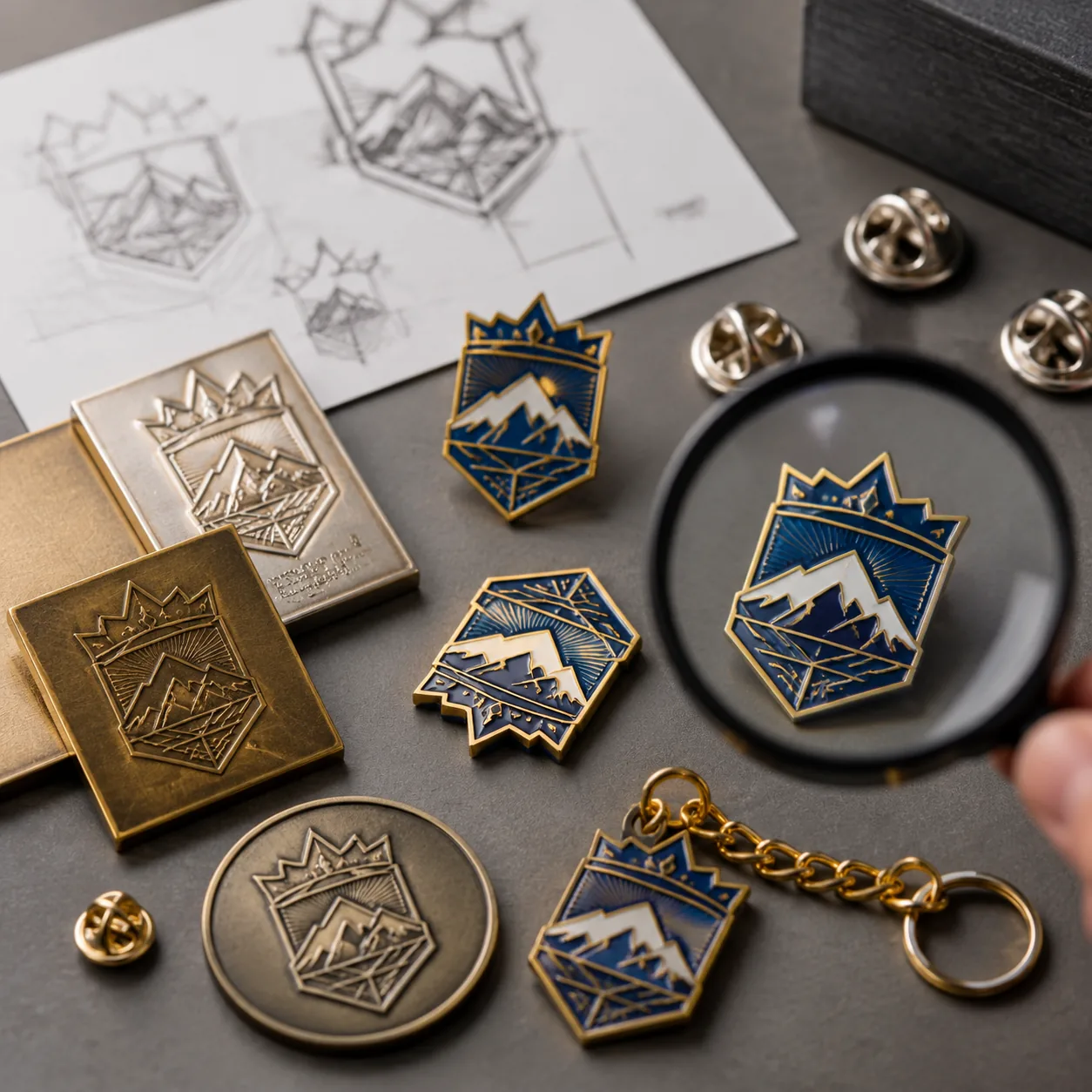
Start With the Buyer’s End State
Most sourcing problems start before the RFQ is sent. Buyers often request a quote before they have fixed the use case, decoration method, target carton count, or acceptance standard for the first sample. That creates avoidable noise: one supplier prices soft enamel with black nickel, another assumes hard enamel with gold plating, and a third prices a printed zinc-alloy version with gift-box packing. At that point you are not comparing quotes; you are comparing assumptions.
For custom pins, coins, keychains, patches, lanyards, badges, and similar promo products, define the end state first: what the item must look like, feel like, pack like, and survive after delivery. A procurement team may care most about unit cost and lead time, while a marketing team may care more about color fidelity and presentation. Both are valid, but they need to be translated into measurable specs before the factory starts quoting.
Write the non-negotiables in plain language, then convert them into numbers. Example: “35 mm lapel pin, soft enamel, black nickel plating, polished back, rubber clutch, 1 pc/polybag, shipped in inner cartons of 100 pcs.” That single line tells the supplier more than a page of vague brand language. It also sets the baseline for tooling, plating, finishing, and packing labor.
- Define product type, use case, and target audience.
- State must-have specs: size, thickness, finish, colors, attachment, packing.
- Set a quantity range, not only one number.
- Separate acceptable variation from rejection criteria.
- Decide whether the order is for launch, campaign use, or replenishment.
Write an RFQ That Suppliers Can Actually Quote
A usable RFQ lets the factory convert your request into tooling, material, labor, plating, and packing assumptions. For metal promo items, include artwork files, dimensions, material preference, plating finish, special effects, attachment style, and packaging. If the brief says “logo pin quote” with no size or finish, the supplier has to guess the mold, metal weight, and process route; the quote will be slow and often inconsistent.
The most quoteable RFQs also define compliance and performance expectations. State whether the item must be nickel-free, whether edges must be skin-safe, whether magnets must hold through clothing thickness, or whether a patch must survive repeated washing. If you are ordering a mixed promo set, specify whether each component must match a master Pantone target or only match within its own item family. Clear instructions reduce revision cycles and sample loops.
A good RFQ should also state commercial boundaries. Tell suppliers whether you want EXW or FOB pricing, whether packaging is retail-ready or bulk only, and whether you expect the quote to include sample fees, mold charges, and carton labels. For small custom orders, a factory may quote FOB with a $40 to $120 sample fee and a $50 to $180 tooling charge; for repeat programs, those costs may be waived or credited against the first bulk order depending on order size and product complexity.
| RFQ field | Good specification | Why it matters |
|---|---|---|
| Size | 35 x 25 mm, ±0.5 mm | Lets the factory plan tooling and price correctly |
| Thickness | 1.8 mm body, 2.0 mm max including plating | Controls weight, feel, and die cost |
| Finish | Black nickel, 0.1–0.3 μm visible target | Aligns plating expectation and visual tone |
| Artwork | Vector file, 1:1 scale, PMS callouts | Prevents redraw errors and color drift |
| Packing | 1 pc per polybag, 100 pcs per inner box | Affects labor, carton count, and freight |
| Quality target | AQL 2.5 major, 4.0 minor | Gives a shared inspection standard |
Separate Must-Haves From Nice-to-Haves
Not every design request deserves equal weight. The fastest way to control pricing and lead time is to split the brief into must-have, preferred, and optional. Must-haves affect quotation and sample approval. Preferred items can be substituted if they create yield risk or delay. Optional items should be priced as alternates, not silently bundled into the base quote.
This matters because decorative effects change process complexity. Glow enamel, glitter fill, translucent enamel, epoxy domes, and laser engraving all add handling steps and can affect yield. A 2-color hard enamel pin and a 6-color soft enamel pin may look similar in a sketch, but the latter usually needs more fill control and a longer inspection cycle. If a feature is only for presentation, do not let it drive the base price unless you truly need it.
A practical way to sort features is to ask one question: will this change acceptance, or only appearance? If the answer is acceptance, it belongs in must-have. If it only improves presentation, move it to preferred or optional. That simple filter keeps RFQs clean and makes supplier comparisons meaningful.
- Must-have: affects final acceptance and cannot be waived.
- Preferred: may be changed if it improves cost, lead time, or yield.
- Optional: quote as an add-on or alternate version.
- If a feature raises scrap risk, mark it clearly.
- If a feature is cosmetic, separate it from core function.
Use the Sample to Validate the Process, Not Just the Look
A sample is not just a visual check. It is a process check that shows whether the factory understood the file, selected the right materials, and can repeat the result in bulk. For metal items, check line sharpness, plating tone, fill level, edge safety, and attachment strength. For printed or woven items, check color registration, stitch density, edge finish, and whether the hand-feel matches expectation. A woven patch might pass visually but fail if the border frays after trimming or if the backing adhesive lifts at the corners.
The sample stage should also expose hidden cost drivers. If the sample shows extra polishing, hand-color correction, or a second plating pass, the bulk unit price may change and the lead time may extend. For a simple zinc-alloy pin, sample lead time is often 7 to 10 days and bulk lead time 12 to 18 days; for a more complex multi-part keychain or layered badge, sample lead time can move to 10 to 14 days and bulk to 18 to 30 days. A factory that hides those process steps in the sample stage is not giving you a stable production plan.
Use the sample as an approval gate with measurable checks. A small promo item typically needs dimensional tolerance of ±0.3 to ±0.5 mm, edge burr control that leaves no sharp points on skin-contact areas, and plating coverage with no visible base metal on the front face. For printed items, require color alignment against the approved Pantone reference under standard light, not under a phone flashlight in the warehouse.
| Sample check | What to look for | Typical tolerance or target |
|---|---|---|
| Dimension | Overall size and critical features | ±0.3 to ±0.5 mm for small metal items |
| Color | Pantone match against approved reference | Visual match under standard light |
| Plating | Uniform coverage, no flash or dull spots | No visible base metal on front face |
| Attachment | Pin clutch, keyring, magnet, or clasp hold | No failure under normal handling |
| Finish | Smooth edges, no burrs or pits | No sharp edge on skin-contact areas |
Approve the Golden Sample and Freeze the Specification
Once the sample is acceptable, turn it into a golden sample or reference standard. This step matters because email threads are poor substitutes for a physical benchmark. The approval should include exact size, Pantone references where applicable, plating finish, attachment type, packaging format, and any acceptable variation. Without that freeze point, the factory may continue improving the product while you assume the approved sample is already locked.
A strong golden sample process also clarifies responsibility. Decide who keeps the reference, how long it remains valid, and whether reorder production must match it exactly or may follow a revised spec sheet. For repeat orders, keep the golden sample, the signed spec sheet, sample photos, and any agreed exceptions in one control set. That avoids the common dispute where a buyer says the reorder looks different, while the factory says it followed the latest email version.
For higher-risk items, write the acceptance criteria into the approval record. A reasonable package might specify AQL 2.5 major and 4.0 minor defects, no cracked enamel, no missing components, no sharp burrs, and no carton count variance beyond ±1 percent. If you buy frequently, version control matters more than memory. One dated, signed record is worth more than ten informal approvals.
- Keep one signed physical sample and one dated photo set.
- Attach the final spec sheet to the approval record.
- Record any agreed exceptions in writing.
- Freeze the version number before bulk production.
- Use the same reference for reorder comparisons.
Translate the Sample Into a Bulk Production Plan
The bulk order should begin as a production plan, not just a repeat of the sample. That means confirming tooling status, material lots, plating batch planning, assembly sequence, inspection points, and pack-out. For larger runs, small details such as carton count, inner box sizing, and label format affect labor time and freight efficiency. A standard bulk carton might hold 500 to 1,000 pcs depending on item size, while inner cartons are commonly packed at 50, 100, or 200 pcs to reduce handling damage.
Bulk planning is also where you decide inspection depth. A common approach for custom promo products is AQL-based inspection, often with major defects at 2.5 and minor defects at 4.0, though the right target depends on use case and customer tolerance. For launch orders, some buyers request tighter checks on color and appearance; for reorder programs, consistency against the golden sample usually matters more than perfect cosmetic uniformity. If a supplier cannot map the process step by step, the order is not yet production-ready.
The core controls are straightforward: confirm the mold or die revision, lock the raw material specification, define the plating or print batch, verify assembly sequence, and sign off on final packing. For metal items, confirm alloy type, plating thickness, and attachment hardware. For patches and lanyards, confirm fabric weight, thread count or weave density, edge finish, and backing type. If any one of those changes after approval, the factory should re-quote or re-sample before bulk starts.
| Production stage | Control point | Buyer action |
|---|---|---|
| Tooling | Mold, die, or cavity confirmation | Approve only after artwork and size are frozen |
| Incoming materials | Alloy, plating base, thread, or fabric spec | Confirm material grade and finish |
| In-process | Color fill, polishing, assembly | Request photo or video checkpoints if needed |
| Final inspection | Visual, dimensional, function check | Use agreed AQL and defect definitions |
| Packing | Bag, card, box, carton configuration | Confirm counts and shipping marks |
Manage MOQ, Lead Time, and FOB Price Together
MOQ, unit price, and lead time are linked, so treat them as one sourcing decision. A lower MOQ often means higher setup cost per unit, while a faster lead time may require standard tooling, standard finishes, or simpler packing. For custom metal promo products, MOQ commonly starts around 100 to 300 pcs for very simple items, 300 to 500 pcs for medium-complexity pieces, and 500 to 1,000 pcs for multi-part or highly finished products. Sampling is often charged separately even when the bulk MOQ is modest.
Typical FOB pricing varies by material, size, decoration, and quantity. As a practical benchmark, simple stamped pins or keychains may land around USD 0.35 to 0.90 FOB at 500 to 1,000 pcs, while thicker enamel pieces, plated coins, or multi-component keychains often sit around USD 0.90 to 2.50 FOB at similar volumes. Complex items with epoxy dome, specialty plating, or gift packaging can move above USD 2.50 FOB depending on finish and packing. These are sourcing ranges, not guarantees; the real quote depends on artwork coverage, metal weight, and process steps.
Lead times should be checked in days and tied to a specific spec. A clean standard order may need 7 to 10 days for sample approval and 15 to 25 days for bulk after approval. More complex or highly customized items may need 12 to 15 days for sampling and 25 to 35 days for bulk. Ask the supplier what extends the timeline: plating capacity, artwork revisions, raw material stock, packaging procurement, or inspection backlog. If the answer is vague, the schedule is not yet reliable.
When comparing suppliers, compare the same spec sheet, not just the final number. Check whether the quotation includes mold/tooling, plating thickness assumptions, packaging, freight to port, sample fees, and carton marks. A lower FOB can disappear once you add upgrades for clasp type, thicker plating, printed insert cards, or split cartons. The best comparison format is a line-by-line matrix that shows what each supplier included and excluded, then calculates true landed cost.
- Compare on identical specs only.
- Separate tooling, sample, unit price, and packing.
- Check whether plating and packaging are included.
- Ask what causes lead time to extend.
- Use landed cost, not only FOB, for final comparison.
Close the Order and Protect the Reorder
The final step is not shipment; it is control of the reorder path. Save the final artwork files, approved sample photos, spec sheet, packing configuration, defect notes, and the final PO in one folder so the next purchase order can reuse them. If the order will repeat, confirm what can stay fixed and what may drift, such as plating bath condition, carton format, or accessory substitution. Many buyers only see the real savings on the second and third run, because the first order pays for the learning curve.
Before closing the file, confirm the operational details that affect repeatability: who owns the golden sample, which revision is active, what defect threshold triggers rejection, and whether the supplier must notify you before changing a source material or accessory. If you are sourcing through ZheCraft or another integrated factory, the goal is the same: turn a loose concept into a controlled spec, then carry that spec through sampling and mass production with fewer surprises. Clean handoff equals fewer delays, fewer reworks, and fewer mismatches on reorder.
A good closeout package should be ready to hand to a colleague six months later. If a new buyer cannot reconstruct the order from the folder, the sourcing record is too weak. The easiest way to protect margin on promo products is to make the next order boring: same file, same tolerance, same packing, same approval path.
Have a project? Send your artwork and target quantity and we’ll reply with a detailed quotation within 12 working hours.
Ready to get this made?
Send your sketch, target quantity and ship-date. Detailed quotation in 12 hours.



