From RFQ to Bulk: A Sourcing Workflow That Prevents Rework
Start with the order reality, not the artwork
Most rework starts before the factory opens your file. Buyers ask for a quote for a pin, coin, keychain, badge, or medal, but the supplier only sees an image and a target price, not the production risk hidden in the spec. If the RFQ does not define material, size, thickness, plating, attachment, finish, and packing, every quote becomes an estimate. In custom metal promo products, the cheapest quote is often the least repeatable.
A better RFQ begins with the use case. Is this a retail item, a membership gift, a trade-show giveaway, or an internal recognition piece? A lapel pin for a subscription program can justify cleaner polishing, tighter color control, and a lower defect rate; a 20,000-piece event giveaway usually needs simpler construction, fewer enamel zones, and a safer MOQ. When you state the function first, the factory can recommend the right build instead of forcing a premium spec into a low-price brief.
For most metal promo items, start with a baseline the factory can actually produce repeatably: zinc alloy or iron body, 20 to 35 mm size for pins and coins, 1.2 to 2.0 mm thickness for flat pieces, and one defined attachment type. That gives you a quote you can compare instead of a price built on assumptions. If the supplier is guessing on thickness or backing, they are also guessing on tooling, plating time, yield, and packing labor.
- State the product type, audience, and intended use.
- Include approximate size in mm, thickness in mm, and quantity.
- Specify finish expectations such as polished, matte, antique, or soft enamel fill.
- Define packing: bulk, polybag, backing card, or gift box.
- Ask for alternates only after one baseline spec is fixed.
Write an RFQ the factory can actually price
A useful RFQ is short, but it is not vague. The minimum set of inputs should be product type, dimensions, thickness, material, finish, plating color, attachment type, artwork file, target MOQ, sample requirement, and delivery window. For custom metal products, a quote without thickness or attachment is incomplete because both affect tooling, assembly, and reject risk. If the supplier has to ask three follow-up questions, your timeline is already slipping.
A practical RFQ also separates must-have specs from preferences. For example, “must be 28 mm round, 1.5 mm thick, nickel plated, butterfly clutch, individual polybag” is clear. “Prefer premium feel” is not. If you need colored enamel, specify Pantone references or at least the visual target: PMS 186 C red, matte black fill, translucent blue, or hard enamel flush with the metal. Those details change the production method and cost.
For metal promo items, a production-grade brief should also define visible-surface expectations. If the line art includes text under 1.0 mm high, declare whether that text must remain legible after plating. If a badge has cut-outs, note the minimum bridge width; 0.8 to 1.0 mm is often the practical floor for small stamped details, while 1.2 mm or more is safer for repeatability. These numbers help the factory judge whether your concept belongs in stamping, die casting, or a hybrid process.
| RFQ item | Good spec example | Why it matters |
|---|---|---|
| Size | 28 mm round | Controls pricing, detail density, and packaging fit |
| Thickness | 1.5 mm | Affects rigidity, feel, and die cost |
| Plating | Nickel, antique brass, or black nickel | Changes appearance, corrosion behavior, and cost |
| Attachment | Butterfly clutch, magnetic, or safety pin | Affects assembly time and failure risk |
| Quantity | 500 pcs trial, 5,000 pcs bulk | Drives MOQ, unit price, and tooling allocation |
| Artwork detail | Minimum line width 0.2 mm, text height 1.0 mm | Prevents unmanufacturable fine features |
Compare quotes by process, not just by unit price
Two quotes can look similar and still represent very different production risk. One factory may be quoting zinc alloy with polished edges, tight color fill, and AQL 2.5 inspection; another may be quoting thinner iron, looser tolerances, and only a visual spot check. If you compare unit price alone, you can miss the hidden cost of rework, delays, or field failures. The right comparison is process plus price plus lead time.
Ask every supplier to quote the same baseline spec and list substitutions explicitly. If one quote reduces plating thickness, swaps enamel type, or changes the attachment, it is not equivalent. For promo buyers, the lowest price is only useful when it is repeatable at your required quality level. A good supplier should be able to show where the cost steps occur: tooling, sample, plating, assembly, packing, and freight.
Typical FOB pricing for standard custom metal promo items varies by spec, but realistic ranges help separate market price from wishful thinking. A 500-piece zinc alloy soft-enamel pin often lands around USD 0.65 to 1.40 FOB each. A 1,000-piece die-struck coin is commonly USD 0.80 to 1.90 FOB each. Hard-enamel or epoxy-finished pieces with more polish or multi-step assembly often run USD 1.10 to 2.80 FOB each. Small runs usually carry a tooling or setup surcharge of about USD 30 to 120 per design, while molded 3D pieces or multi-piece keychains can push setup higher.
For comparison, the right quote should also separate tooling from unit price. A simple stamped pin may use a one-time die charge of USD 40 to 90, while a deeper 3D zinc alloy item can require USD 120 to 280 for tooling depending on cavity depth and mold size. If a supplier rolls everything into one price, ask them to break it out so you can see the reorder economics.
| Comparison point | Lower-risk spec | Lower-cost spec | When to choose |
|---|---|---|---|
| Body material | Zinc alloy | Iron or thinner alloy | Choose zinc for 3D detail or smoother finish |
| Plating | Controlled decorative plating with stable process control | Minimal decorative finish | Choose better plating for retail, gifts, or reorders |
| Inspection | AQL 2.5 visual and critical-size checks | Basic spot check | Choose AQL 2.5 for branded programs |
| Packing | Individual bag + backing card | Bulk packed | Choose individual packing for retail or mail fulfillment |
| Lead time | 18 to 28 days after sample approval | 12 to 20 days for simple bulk | Choose longer lead time for tighter QC or mixed finishes |
Lock the sample stage before you approve anything
The sample is not a formality; it is the only time you can still change the product cheaply. Review size against the drawing, line weight, fill level, plating tone, attachment fit, edge safety, and packaging before approving bulk. If the sample looks right but the dimensions are off by more than your tolerance, that problem will multiply in production. For most metal promo items, a tolerance window of ±0.2 to ±0.3 mm on critical dimensions is a sensible starting point; interlocking parts, magnets, and multi-piece sets often need tighter control.
Do not approve a sample from photos alone. Hold it in hand, check the pin post alignment or coin rim, and test any moving parts, magnets, or clasps under real handling. If the item includes enamel, compare the sample under neutral light against the approved Pantone reference. For patches and lanyards, check stitch density, print clarity, edge finish, and color consistency using the lighting your recipients will actually see. A strong sample process converts opinion into evidence.
A sample should also prove manufacturability, not just appearance. A good factory will tell you if a 0.8 mm raised line is too thin to hold polish consistently, or if a recessed area is too narrow for enamel fill without overflow. That sort of feedback saves more money than a lower quote ever can. If the design needs a recessed color pocket, a common safe depth is 0.25 to 0.35 mm for soft enamel; deeper cavities can trap bubbles or create inconsistent edge fill.
Sample approvals should be versioned. If the factory sends a revised sample with a thicker border, different plating tone, or adjusted clasp position, that revised version must supersede the previous one in writing. Otherwise, the bulk order can drift back to an older revision after the first production run starts.
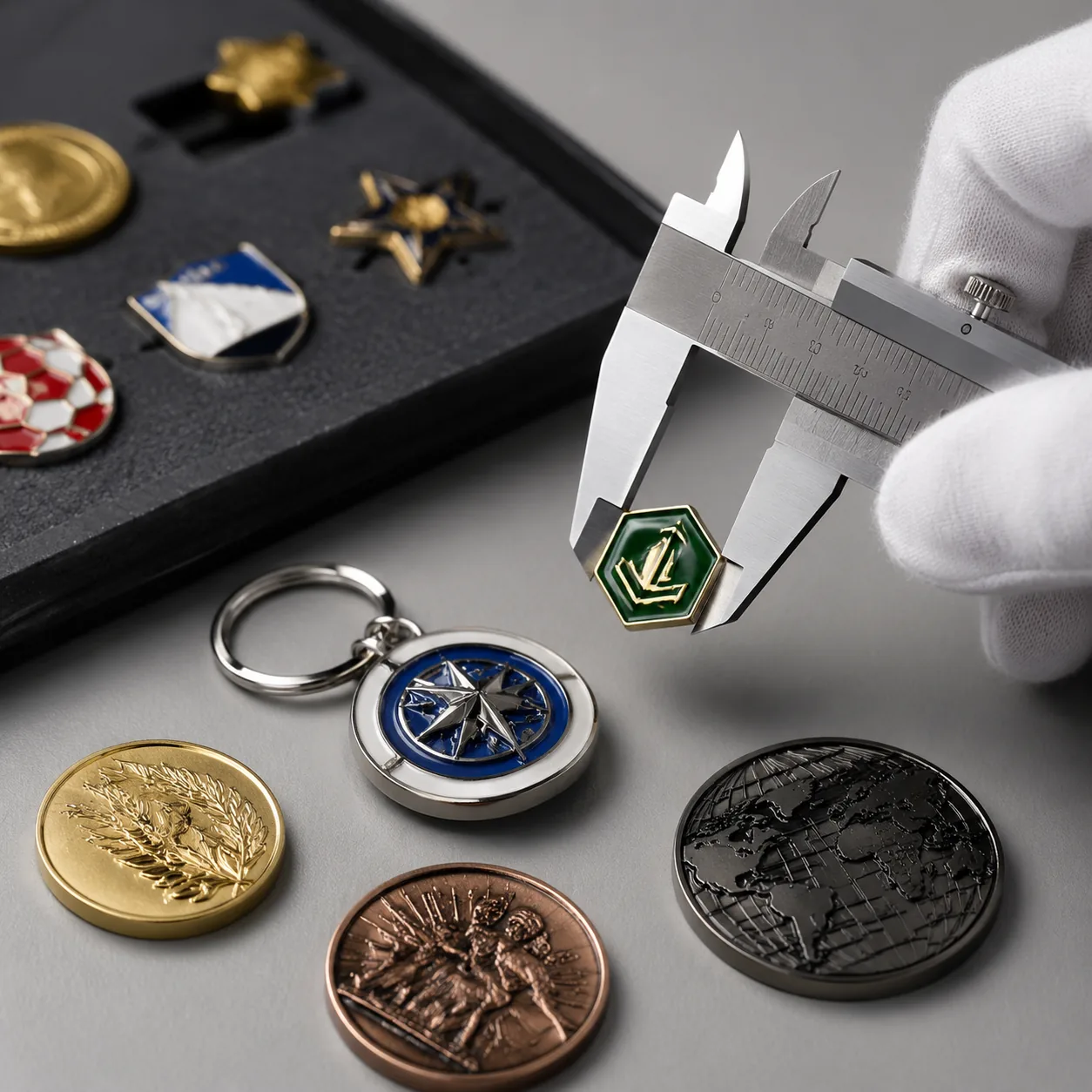
- Measure critical dimensions with calipers, not by eye.
- Check color against the approved Pantone reference under neutral light.
- Test attachment strength and insertion fit on real garments or bags.
- Confirm packaging size, insert-card text, and barcode placement.
- Record sample approval in writing with date, version, and exceptions.
Use a simple quality gate before bulk release
Once the sample is approved, move to a written bulk release checklist. This is where buyers often lose control: the sample is approved, but the bulk order runs on a looser understanding because nothing is documented. The bulk spec should repeat the approved sample details and add defect limits, carton packing rules, and final inspection method. Without that, any dispute turns into a memory contest.
For custom metal gifts, a typical inspection plan combines appearance checks, size checks, attachment pull checks, and packing verification. Many buyers use AQL 2.5 for major defects and AQL 4.0 for minor visual issues, though the right level depends on the market and price point. A practical tolerance set for simple flat items might allow ±0.3 mm on overall diameter, ±0.2 mm on critical linework, and no visible plating voids larger than 0.5 mm in the primary viewing area. For retail-facing products, tighter standards are usually worth the extra inspection time.
Bulk lead times vary by complexity and quantity. Simple repeat orders can often ship in 12 to 18 days after sample approval, while new custom projects commonly need 18 to 35 days for production plus 3 to 7 days for air transit or 20 to 35 days by sea freight. If you need individual packing, printed backing cards, or mixed SKU sets, add another 3 to 7 days for packing and carton verification. Those extra days are usually cheaper than rushed rework.
Define the acceptance method before production begins. If a run has a 2,000-piece quantity, for example, specify whether the factory may replace a defect batch or whether every unit must be sorted. If the buyer expects 100% visual sorting, say so; otherwise the supplier may quote only standard lot inspection and you will inherit the sorting labor later.
| Bulk control point | Suggested spec | Practical note |
|---|---|---|
| Critical dimensions | ±0.2 to ±0.3 mm typical starting point | Tighten for interlocking parts or multi-piece sets |
| Surface defects | Define max visible scratch size and count | Use photographed reference samples |
| Attachment strength | Must hold under repeated normal handling | Test on actual fabric or loop hardware |
| Carton packing | Fixed count per inner box and outer carton | Prevents short-ships and mixed lots |
| Inspection level | AQL 2.5 major / AQL 4.0 minor | Balance defect tolerance against product value |
| Plating voids | No voids over 0.5 mm in the primary view | Useful for gift and retail programs |
Watch the cost drivers that change after approval
Bulk surprises usually come from five places: artwork edits, plating changes, attachment substitutions, packaging upgrades, and quantity shifts. A buyer may approve a sample for a 500-piece run, then ask for 2,000 pieces with a different clasp and a printed backing card. That is not a simple extension of the same order; it is a new production combination. The earlier you freeze these variables, the safer your quote stays.
Price also moves with order size in non-linear steps. In custom metal products, tooling is fixed, but unit pricing often drops only after the factory crosses efficiency thresholds around 300, 500, 1,000, 3,000, or 5,000 pieces, depending on shape complexity and packing method. For example, a 300-piece order may cost 15% to 35% more per unit than a 1,000-piece run of the same design. Very small orders can be sensible if they reduce risk, but tiny quantities rarely deliver the best per-unit cost.
If your project includes plated finishes, keep in mind that color and sheen are process variables, not cosmetic afterthoughts. Black nickel, antique brass, and matte silver each behave differently in polishing and visual consistency. A plating change can alter the perceived line depth, especially on raised logos and fine text. When the branding must match across a set, specify the exact plating family rather than asking for “premium finish.”
The same logic applies to tolerances. If a keychain ring must fit a 4.0 mm hole, a nominal 4.0 mm opening is not enough. A 4.2 to 4.4 mm hole may be safer depending on plating build-up, because decorative plating can add roughly 0.01 to 0.03 mm per side and make tight parts bind. Good sourcing teams ask about tolerance before they ask about the next discount.
- Freeze artwork before sampling; do not change line art after approval.
- Treat plating, attachment, and packing as locked specs.
- Ask for price breaks at realistic MOQ steps, not arbitrary round numbers.
- Confirm whether tooling belongs to you for reorders.
- Build a contingency for rework, plating drift, or color correction.
Translate approval into a clean bulk order
The purchase order should repeat the approved sample in production language, not marketing language. Include size, thickness, material, plating, color count, attachment type, packaging, inspection standard, tolerance targets, shipping term, and ship date. If the supplier can print your PO and use it as a shop-floor control document, you have reduced the chance of mismatch. This matters even more when several items must match in one promo set.
A good PO also names the approval record. Reference the sample date, the approved version, and any written exceptions. If you accepted a minor cosmetic deviation on the sample, document it so the factory knows it is intentional and the inspector knows what to allow. That one line often prevents the classic dispute: the buyer expects one finish, the factory ships another, and nobody can prove what was approved.
Your PO should also state the commercial terms that affect landed cost. If the quote is FOB, specify the departure port and whether the price includes export carton labels, inner box packing, or palletization. If the order is split across multiple cartons, define whether each carton must contain the same SKU count or whether mixed cartons are allowed. Those details change both cost and the risk of shortages.
For buyers sourcing through ZheCraft, the strongest results come when RFQ, sample, and bulk order are treated as one chain rather than three separate events. The factory can then align tooling, finish control, and packing from the start. In practice, that usually shortens lead time, reduces sample loops, and makes reorders easier to lock at the same spec. It is the difference between buying a one-off item and building a repeatable supply standard.
What to do next
Take your current project and reduce it to one locked baseline spec before asking for more quotes. If you already have artwork, add size, thickness, material, plating, attachment, packing, quantity, target FOB, and delivery window, then request a sample quote against that exact set. Once the sample arrives, inspect it with calipers, a written checklist, and a clear pass/fail decision. Only after that should you release bulk production.
If you want the fastest path, start with one SKU, one finish, and one packing method, then expand only after the first run is stable. That gives you clean cost data and a much lower rework risk on future orders. For mixed promo sets, this same workflow helps you match pins, coins, keychains, badges, patches, and lanyards without spec drift.
A practical first order is often 500 to 1,000 pieces with one approved sample and one inspection method. That quantity is large enough to expose process drift, but small enough to correct before the next reorder. Once the baseline is stable, ask the factory to quote a repeat run and a stepped MOQ tier so you can see the true savings at 3,000 or 5,000 units.
Have a project? Send your artwork and target quantity and we’ll reply with a detailed quotation within 12 working hours.
Ready to get this made?
Send your sketch, target quantity and ship-date. Detailed quotation in 12 hours.



