From Brief to Shipment: Buying a Promo Set Without Rework
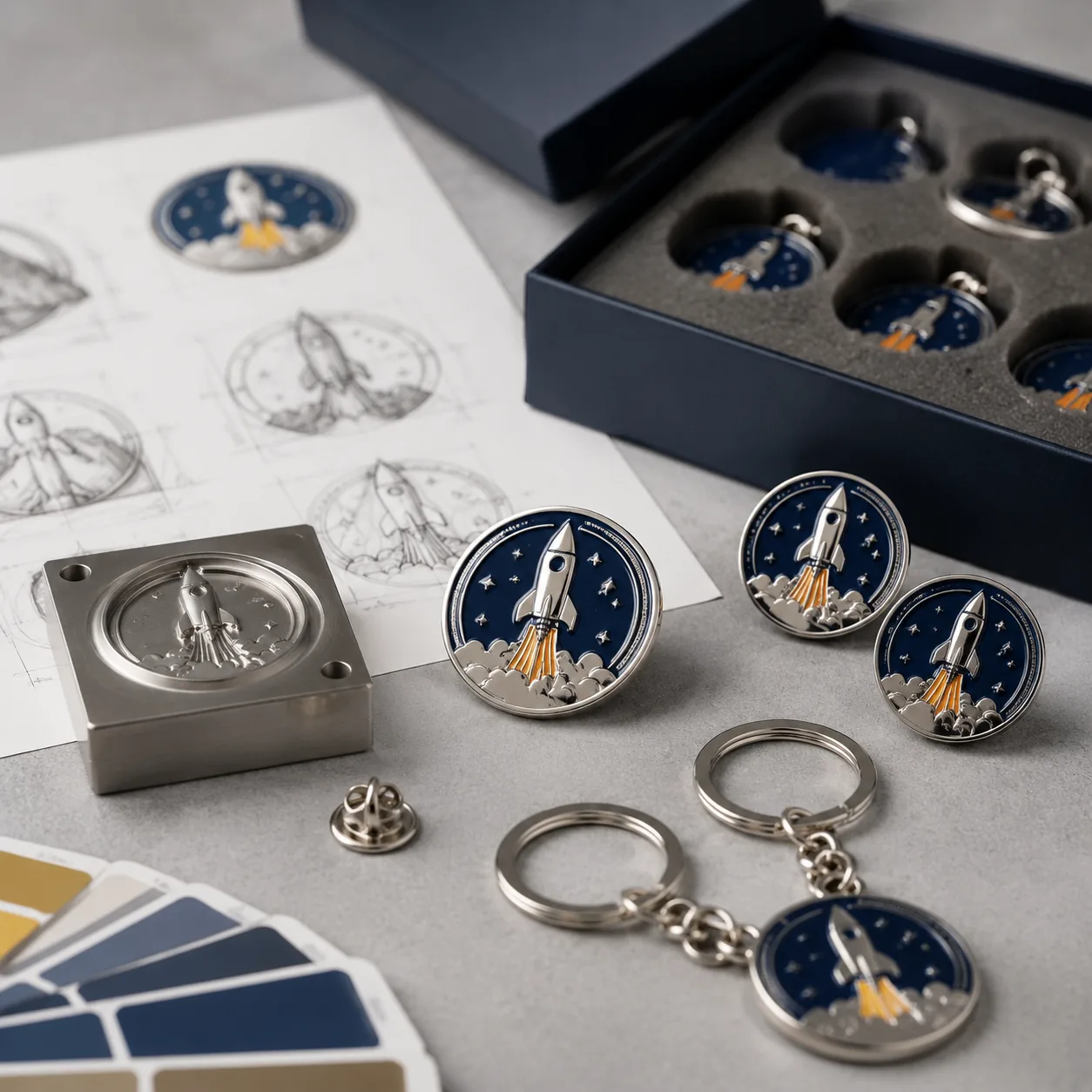
Buy the set as one system, not four separate quotes
A promo kit looks straightforward until it is split across separate suppliers. A pin from one factory, a coin from another, a patch from a third, and a lanyard ordered later almost always creates problems that do not show up on the first sample sheet: different plating tones, a blue that shifts under indoor light, packaging that no longer fits the final mix, and one late item that forces rush freight or rework. The better model is to buy the kit as one coordinated system with one artwork master, one approval path, and one ship date.
That system view matters because the hidden cost is rarely unit price. Every handoff adds time for file cleanup, sampling, and color confirmation, and every separate carton adds inspection and packing labor. For a 500-piece conference kit, a single change in logo scale can ripple through all four products. A logo that reads cleanly on a 42 mm coin may be too fine for a woven patch unless stroke width is increased. A lanyard print that looks close on screen may still miss the brand blue by a visible margin if the file was not matched to a physical Pantone target.
Start with a master brief that defines the set architecture before anyone quotes. Decide which item carries the hero artwork, which items are supporting pieces, and whether every component must match exactly or only share the same brand family. That one decision prevents the common failure mode where each supplier optimizes its own part and the final kit looks assembled rather than designed.
Use a realistic buyer scenario to set the target
A practical example is a marketing team ordering 500 launch kits for a trade show in 35 days. The kit includes a soft enamel lapel pin, a die-struck challenge coin, a woven patch, and a printed lanyard. The team wants the set to feel premium, but the budget is fixed and the internal brand team needs one review cycle before production starts. That is a typical mixed-order brief, and it only works if the supplier receives precise inputs on day one.
A useful target spec might be a 45 mm pin, a 40 mm coin, an 80 x 80 mm patch, and a 20 mm x 900 mm lanyard. If the brand blue is Pantone 286 C, ask for a physical swatch match on textile and print items, and a plated sample or plated chip for metal items. If the set is meant for executive gifting, specify tighter visible-defect controls than you would for a general giveaway: no bent pins, no ink smears, no frayed patch borders, and no mismatched plating between components.
Work backward from the ship date instead of forward from the quote. A standard mixed-kit schedule often needs 2 to 4 days for quoting and file cleanup, 5 to 8 days for pre-production samples, 10 to 18 days for production, and 2 to 4 days for packing and cartonization before handoff. If approvals slip by a week, the factory either compresses production, substitutes simpler finishes, or pushes the order into rush freight. None of those outcomes improve quality.
Spec each component to its process, not to a generic checklist
Pins, coins, patches, and lanyards fail for different reasons, so they need different specs. A soft enamel pin is controlled by metal line width, fill depth, and plating quality. A coin is controlled by relief height, edge detail, and surface treatment. A woven patch lives or dies by the smallest readable text and the stability of the border. A printed lanyard depends on print registration, color control, and attachment hardware. Treating them as the same item is how buyers end up with vague quotes and weak samples.
Use process-specific tolerances from the start. For most promo pins, a finished size tolerance of plus or minus 0.3 mm is reasonable on small parts, with metal line widths not below 0.25 to 0.30 mm and enamel fill depth around 0.6 to 0.8 mm. Decorative plating is usually specified in microns: a nickel underplate around 3 to 5 um and a gold flash around 0.03 to 0.08 um are common reference points, depending on the finish system. For coins, a thickness of 3.0 to 4.0 mm and a relief of about 0.3 to 0.6 mm per side is typical for a premium feel without overcomplicating tooling.
| Item | Buyer spec to lock | Typical MOQ | FOB price range (USD) |
|---|---|---|---|
| Soft enamel pin | 35 to 50 mm, 1.2 to 1.5 mm thick, 0.25 to 0.30 mm minimum line width, +/-0.3 mm size tolerance, enamel matched to approved Pantone | 100 to 300 pcs custom; best pricing at 300 to 1,000 pcs | 0.78 to 2.10 |
| Challenge coin | 38 to 45 mm diameter, 3.0 to 4.0 mm thick, 0.3 to 0.6 mm relief, edge text at least 1.5 mm high if used, +/-0.15 mm thickness tolerance | 100 to 300 pcs custom; best pricing at 300 to 1,000 pcs | 1.35 to 4.20 |
| Woven patch | 70 to 90 mm width, 0.3 mm minimum readable stroke, heat-cut or merrow border, +/-1.0 mm edge tolerance | 100 to 500 pcs custom; best pricing at 500 to 2,000 pcs | 0.20 to 0.70 |
| Printed lanyard | 15 to 20 mm width, 900 to 950 mm loop length, print registration within +/-1 mm, safety breakaway if required | 100 to 300 pcs custom; best pricing at 500 to 2,000 pcs | 0.32 to 1.20 |
These are practical sourcing ranges, not promises. A more complex die on the coin, a thick epoxy dome on the pin, individual carding, or retail boxing will move the price quickly. The cheapest unit quote is not always the lowest landed cost if it requires separate freight, separate QC, and separate repacking later.
Keep color, metal, and packaging aligned across the kit
The most common complaint in a mixed promo order is that each item looks fine alone but not together. The pin gold reads warm, the coin looks pale, the patch border is darker than the logo stroke, and the lanyard blue is one step off from the printed insert card. The fix is to specify one master color reference and one finish family for the entire order, then control all deviations deliberately rather than by accident.
For print and textile items, a Pantone reference is only useful if the supplier is matching against a physical standard, not a PDF. For brand-critical blue, ask for a delta E target of 2.0 or better against the approved swatch on the final substrate. For metal items, identify the finish family in plain language: bright nickel, antique brass, black nickel, or matte silver. If the set is meant to look uniform, do not mix warm and cool metal tones unless contrast is part of the design.
Packaging deserves the same discipline. A 500-piece kit packed as loose parts may save a few cents per unit, but it increases labor and inspection time later. If the kit is retail-facing or handed out as a single presentation piece, specify the pack-out early: individual polybag, backing card, insert card, gift box, or assembled set tray. A common, cost-effective spec is a 300 to 350 gsm printed insert card or a 250 to 600 gsm folding carton, with clear compartment sizing so the pin, coin, patch, and lanyard cannot scuff each other in transit.
- Use one physical Pantone target for all print and textile components
- Confirm enamel color against a real swatch, not a screen file
- Ask for plated chips or a plated reference piece before approval
- Keep all metals in one family unless contrast is intentional
- Approve the set under the same lighting condition each time
- Lock pack-out style before the factory starts mass production
Approve samples in the right order so the set does not unravel late
A mixed kit should not be approved as one giant sample pile. Each process has its own failure points, and the right sequence is artwork, component sample, then assembled set. Approve the pin colors and plating first, confirm the coin relief and edge detail second, verify the patch border and stitch or weave clarity third, and then review a packed full-kit mock-up. That sequence catches process-specific issues before they become expensive across the full order.
For the pin, check whether the color fill sits flush and whether the plating is even at corners and cutouts. For the coin, measure the diameter and thickness, and inspect whether the high points are crisp enough to read under side light. For the patch, look at the smallest text and the outer border stability. For the lanyard, check print repeat, color consistency across the full length, and hardware attachment strength. If the order includes a badge clip or safety breakaway, test that function on the sample before mass approval.
An assembled pre-production sample is worth asking for when the items will be seen together in a gift box or event kit. A good pin can still look wrong if the lanyard print makes the whole pack feel cheap, or if the coin insert shifts in transit and scuffs the finish. One consolidated sample pack is usually the fastest way to catch scale, spacing, and presentation problems before the carton line starts.
Know the MOQ, lead-time, and price levers before you commit
MOQ and lead time are tied to the production route, not just the item. Mixed orders move fastest when the factory can make all components in-house or through a tightly controlled partner network. If the pin and coin need dies, the patch needs digitizing, and the lanyard needs a separate print setup, the factory will price the order around tooling and setup time as much as around material.
As a rule of thumb, custom promo kits are most efficient at 300 to 500 sets, with better unit pricing at 1,000 sets and above. Below 300, setup cost per piece rises quickly, especially for metal items. Typical sampling runs take 5 to 8 days, standard production 10 to 18 days, and final pack-out 2 to 4 days. If you need air shipment, add time for booking and export coordination; if you are shipping FOB, the factory should still quote the goods-ready date clearly so you can control freight separately.
The real cost drivers are tooling, finish complexity, packaging labor, artwork complexity, and shipment efficiency. A deeper coin relief, a thicker plating system, a soft enamel pin with multiple small color breaks, or a lanyard with double-sided printing will all raise cost. In a mixed kit, the most expensive hidden mistake is usually not the unit price itself; it is splitting the order and paying multiple sample rounds, multiple inspections, and multiple freight charges.
Run QC on both the parts and the final kit before cartons close
Quality control for a promo set should verify two things at once: each component must meet its own spec, and the full kit must look coherent as a group. Part-level checks include size, color, plating tone, surface finish, print clarity, border quality, and attachment strength. Set-level checks include the order of items in the box, the fit of the insert card or tray, and whether the kit can survive handling without scuffing or shifting.
Agree the AQL before production starts. For most branded promo items, many buyers use a normal inspection level around AQL 2.5 for major defects and AQL 4.0 for minor defects, with critical defects at 0. Major defects include wrong logo, broken hardware, missing parts, and bad color mismatch. Minor defects include slight surface marks, small print variation, or subtle trim inconsistency. For executive gifts or high-visibility event kits, tighten the visible-defect rules even if the formal AQL stays unchanged.
Use a practical inspection checklist so the factory knows what to measure and what to photograph before cartons close. The goal is not to inspect everything, but to make the acceptance standard unambiguous and repeatable.
- Compare every production batch to one approved master sample
- Measure a random subset with calipers for size and thickness
- Check plated items under the same light source used for approval
- Test the pin clasp, coin edge, patch backing, and lanyard attachment
- Verify pack-out sequence and count before carton sealing
- Photograph one complete kit for final sign-off
The best handoff is a clean one: one master brief, one approved visual target, one packing standard, and one final inspection record. That is the path that keeps a promo set from turning into a rework exercise after it has already been paid for.
Have a project? Send your artwork and target quantity and we’ll reply with a detailed quotation within 12 working hours.
Ready to get this made?
Send your sketch, target quantity and ship-date. Detailed quotation in 12 hours.



