From Brief to Shipment: A Promo Set Buyer Scenario
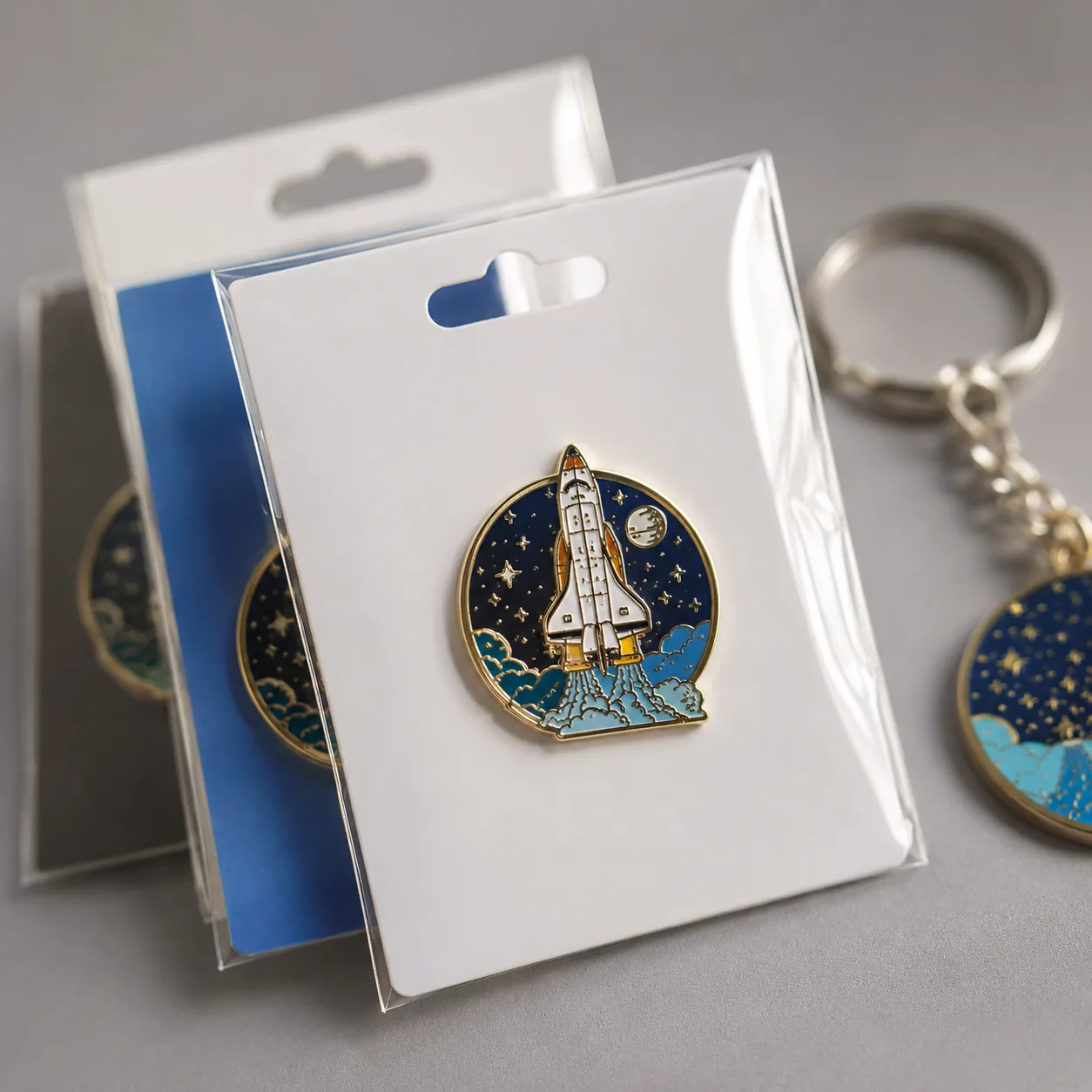
The order lands on your desk
A marketing team needs a mixed promo set for a launch event: 1,000 enamel pins, 500 keychains, 2,000 woven patches, and 800 lanyards, all delivered in one shipping window. The artwork is approved in principle, but each item brings its own risk in material, decoration, packaging, and freight coordination. Your job is not to optimize each SKU in isolation; it is to make the full set arrive together, look consistent, and stay inside budget.
Most mixed-set problems start with an incomplete brief. Buyers approve a pin, a patch, and a lanyard as if they were separate projects, then discover the real issue is cross-item mismatch: a slightly different red, a different gold tone, inconsistent pack counts, or one SKU that needs 7 more days than the others. A clean order starts with one master brief, one shared color reference, and one production calendar.
For a launch-critical set, treat the order like a mini program, not a basket of products. That means one owner, one revision log, one sample approval path, and one shipment promise tied to the slowest component.
Define what must match and what can vary
Before requesting quotes, split the order into must-match and can-vary items. Must-match usually includes brand color, logo proportions, packaging style, and release date. Can-vary may include backing type, edge finish, attachment hardware, or decoration method if the budget is tight and the brand can tolerate the difference.
If you do not define this early, suppliers will optimize each item independently. That can produce a good pin, a good keychain, and a good patch that still look wrong together on the table. In mixed sets, the biggest cost savings usually come from allowing controlled variation in hidden hardware or base construction, not from relaxing the visible artwork standard.
Use one Pantone reference for all visible brand colors, and specify whether the supplier must match coated or uncoated values. For metal items, define the finish family explicitly: bright nickel, matte nickel, black nickel, bright gold, antique gold, or matte gold. “Gold” alone is too vague; a bright plated gold and an antique gold can differ enough to look mismatched under event lighting.
- Lock one master Pantone reference for all visible brand colors.
- State which finish family must be shared, such as nickel, black nickel, or gold.
- Define what can vary, for example pin back type or patch border width.
- Confirm whether every item ships retail-ready or only the hero product.
- Set one delivery deadline for the full set, not separate deadlines by SKU.
Build one master spec sheet before pricing
A master spec sheet keeps you from comparing apples to oranges. For each SKU, include size in millimeters, thickness in millimeters, material, decoration method, accessory type, packaging, quantity, and any special handling notes. For metal items, a practical tolerance target is ±0.3 mm on dimensions up to 40 mm and ±0.5 mm on larger pieces. For textile items, define both cut size and artwork placement, because a patch can be dimensionally correct and still look off-center in a set.
This is where quote noise gets reduced. When three factories quote the same pin at 32 mm, 1.5 mm thick, soft enamel, 0.1 to 0.12 micron nickel plating over copper, and butterfly clutch, the pricing becomes comparable. Without that detail, one supplier may be quoting a thin stamped piece and another may be pricing a heavier cast build with extra labor and packing.
For patches, do not stop at “woven” or “embroidered.” Lock the border type, edge shape, backing, and thread density. For a woven patch, specify whether the face should hold 1.0 to 1.2 mm line detail or whether the artwork needs simplification. For lanyards, define width, print side, attachment style, and safety breakaway requirement if needed. The more exact the spec sheet, the less likely it is that a low quote hides a downgrade.
| Item | Core spec to lock | Typical buyer mistake |
|---|---|---|
| Pin | 30-35 mm, 1.2-1.5 mm thick, soft enamel, 0.1-0.12 micron plating | Comparing quotes with different thickness or plating |
| Keychain | 35-45 mm body, 2.0-3.0 mm if metal, split ring plus jump ring | Ignoring hardware count and finish type |
| Patch | Woven or embroidered, edge shape, border width, backing | Leaving size vague so border pricing shifts |
| Lanyard | 15-20 mm width, print method, safety breakaway if needed | Missing attachment and safety requirements |
Price the set by risk, not by unit cost
The cheapest unit price is often the wrong metric for a mixed order. A pin at USD 0.35 FOB can be more expensive in practice than a pin at USD 0.48 if the cheaper version has higher scrap, slower sample approval, or awkward packaging labor. For mixed sets, compare total landed cost and schedule risk together, not the lowest number on the first quote sheet.
Realistic FOB ranges for volume orders vary by size, build, and decoration method. Enamel pins often land at USD 0.35 to 1.20 each. Metal keychains typically sit around USD 0.55 to 1.80. Woven patches are often USD 0.25 to 0.90. Printed lanyards commonly run USD 0.18 to 0.75. These ranges move quickly if you change thickness, add epoxy, request custom backing cards, or upgrade packaging. If a quote falls well below the range, check whether tooling, plating, setup, or packing has been omitted.
MOQ tiers also matter. Many factories can quote pins and patches at 500 pieces, but better pricing usually appears at 1,000, 3,000, and 5,000 units. A common pattern is a 15 to 25 percent drop between 500 and 1,000 units, then another 8 to 15 percent improvement by 3,000 pieces. If one SKU is far below the rest in quantity, ask whether the factory is cross-subsidizing it with another item or hiding a higher setup fee.
Commercially, the real question is not “What is the cheapest quote?” but “Which quote protects the launch date and the brand appearance?” In a mixed set, a slightly higher pin price is acceptable if the factory can coordinate all SKUs in one production window and keep carton counts aligned for distribution.
| SKU | Typical FOB range (USD) | Common MOQ tiers | Usual lead time after sample approval |
|---|---|---|---|
| Enamel pin | 0.35-1.20 | 500 / 1,000 / 3,000 / 5,000 | 18-25 days |
| Metal keychain | 0.55-1.80 | 500 / 1,000 / 3,000 | 20-28 days |
| Woven patch | 0.25-0.90 | 500 / 1,000 / 2,000 / 5,000 | 14-22 days |
| Printed lanyard | 0.18-0.75 | 500 / 1,000 / 3,000 / 5,000 | 12-20 days |
Use one sample path for the visible items
Not every SKU needs the same level of sampling. The hero item, usually the pin or keychain, should go through a pre-production sample or golden sample approval. Secondary items like patches or lanyards can often be approved by artwork proof plus one reference sample if the build is standard and low risk. The point is to preserve decision speed without compromising the visible items that carry the brand in photos and at the event.
A practical approval path is: digital proof for all SKUs, physical sample for the hero item, and golden sample lock before bulk start. If the lanyard is standard printed polyester with a common clip, a first article sample plus photo confirmation may be enough. If the keychain includes cutouts, epoxy, or color fill, insist on a physical check because small defects show up immediately in hand.
The main schedule risk is iteration. If every item goes through three sample loops, the order slips even when the products are simple. Consolidate corrections into one controlled revision pass wherever possible.
| Approval step | Use for | Expected time |
|---|---|---|
| Artwork proof | All SKUs | 1-2 days |
| Physical sample | Hero item or complex build | 5-10 days |
| Golden sample lock | Mass production reference | Before bulk start |
| Packing mock-up | Retail sets and mailers | 2-4 days |
Check the factory’s production sequence, not just capacity
A factory saying it can make everything is not the same as a factory being able to sequence everything correctly. Ask how the shop schedules die striking, casting, embroidery, printing, sewing, assembly, and packing if all SKUs share one shipment date. The key risk is not raw capacity; it is whether one delayed process blocks the full order.
For example, metal pins and keychains may run through different plating tanks, while patches and lanyards need separate print or embroidery windows. If the factory batches by process, a late color approval on one item can hold cartons for the entire order. A better supplier will give you a calendar showing artwork lock, sample approval, production start, inspection, and pack-out milestones for each SKU.
Ask for lead times in days, not vague promises. A standard mixed promo set after sample approval often takes 18 to 30 days for production, plus 3 to 7 days for carton consolidation and booking, depending on the freight mode. If custom packaging, epoxy coating, laser engraving, or complex attachment assembly is included, plan on 28 to 40 days instead.
Ownership matters too. If lanyards are outsourced and pins are in-house, the supplier needs buffer time for inbound quality checks. A mixed set is safest when one coordinator owns final packing, carton labeling, and the ship-ready count.
Inspect the details that actually catch problems
Mixed promo sets fail in the details buyers do not inspect. For metal items, check plating color consistency, edge burrs, enamel fill level, and clasp security. For patches, check border symmetry, thread density, backing adhesion, and size tolerance. For lanyards, check print alignment, stitch quality at the neck, and hardware attachment strength.
A practical inspection plan usually uses AQL 2.5 for major defects and AQL 4.0 for minor defects on promotional goods. For launch-critical campaigns, some buyers tighten the major-defect target to AQL 1.5 and require 100 percent visual sorting on the hero item. If the order includes retail-ready packaging, add carton drop resistance and barcode legibility checks. If the set will be split across multiple warehouses, verify count accuracy by SKU and master carton label matching before shipment.
For metal pieces, ask the factory to state plating thickness in microns and confirm the measurement method, because “gold finish” is not a specification. A decorative finish at 0.08 micron will not behave the same as a heavier 0.12 micron layer, especially after handling and transit. For textile items, confirm the stitch count or weave density if the artwork has fine lines; otherwise a logo can blur even though the size is correct.
Tolerance control matters as much as appearance. For pins and keychains, agree on a visual acceptance standard plus dimensional tolerances. For woven patches, a common control target is ±1.0 mm on cut size and ±0.5 mm on border placement. For lanyards, ask for print registration within 1.5 mm and stitch alignment at the neck within 2.0 mm. Those are small numbers, but they separate a retail-looking set from a loose promo bundle.
- Inspect the first and last 10 percent of each production run.
- Check one full carton per SKU for count, finish, and packing sequence.
- Measure random pieces against the agreed size tolerance.
- Confirm every accessory bag contains the same parts list.
- Photograph packed cartons before sealing for claims support.
Finalize shipment as one campaign, not four products
The shipping plan should match the marketing plan. If the event needs all items on one date, set the shipment promise based on the slowest SKU, not the fastest. Freight consolidation saves money only if the factory can hold finished goods safely and label them correctly until everything is ready.
For FOB orders, ask for inner pack, outer carton, carton count, gross weight, carton dimensions, and net weight for each SKU so your freight forwarder can build a usable booking. If the items will ship together in one master carton set, confirm the packing sequence and whether any product needs desiccant, polybag, or scratch protection. When buyers skip this step, the shipment can be technically on time but operationally unusable at destination.
If the order includes multiple warehouses or kitting downstream, make carton labeling explicit: SKU code, quantity per carton, carton number, and PO number should all match the packing list. If one carton is short by 20 lanyards, a launch team can lose hours re-counting goods on arrival. That is cheaper to prevent than to fix.
As a rule, give yourself 5 to 7 extra days beyond the quoted factory lead time if the order contains four or more SKUs, because one approval loop or rework event can affect the full set. For standard mixed promo sets, many factories can complete production in 18 to 30 days after sample approval, but custom packaging or complex finishing can push that longer. For a tighter event calendar, build the buffer into the PO rather than hoping air freight can rescue a late start.
What to do next
Turn the campaign into one master brief with a locked color reference, item-by-item specs, tolerance targets, packaging requirements, and one shipping date. Then ask each supplier to quote the full set on the same sheet, with separate pricing, lead times, MOQ tiers, and packing details for every SKU. That is the fastest way to expose weak quoting, hidden omissions, and unrealistic scheduling.
If you are sourcing a mixed set from China, ZheCraft can help coordinate the parts that tend to drift apart: metal items, patches, lanyards, pack-out, and carton control. The practical next step is simple: send one consolidated RFQ, ask for a single production calendar, and approve one golden sample path before bulk starts.
Have a project? Send your artwork and target quantity and we’ll reply with a detailed quotation within 12 working hours.
Ready to get this made?
Send your sketch, target quantity and ship-date. Detailed quotation in 12 hours.



