Fridge Magnet Construction Specs That Prevent Curling and Slips
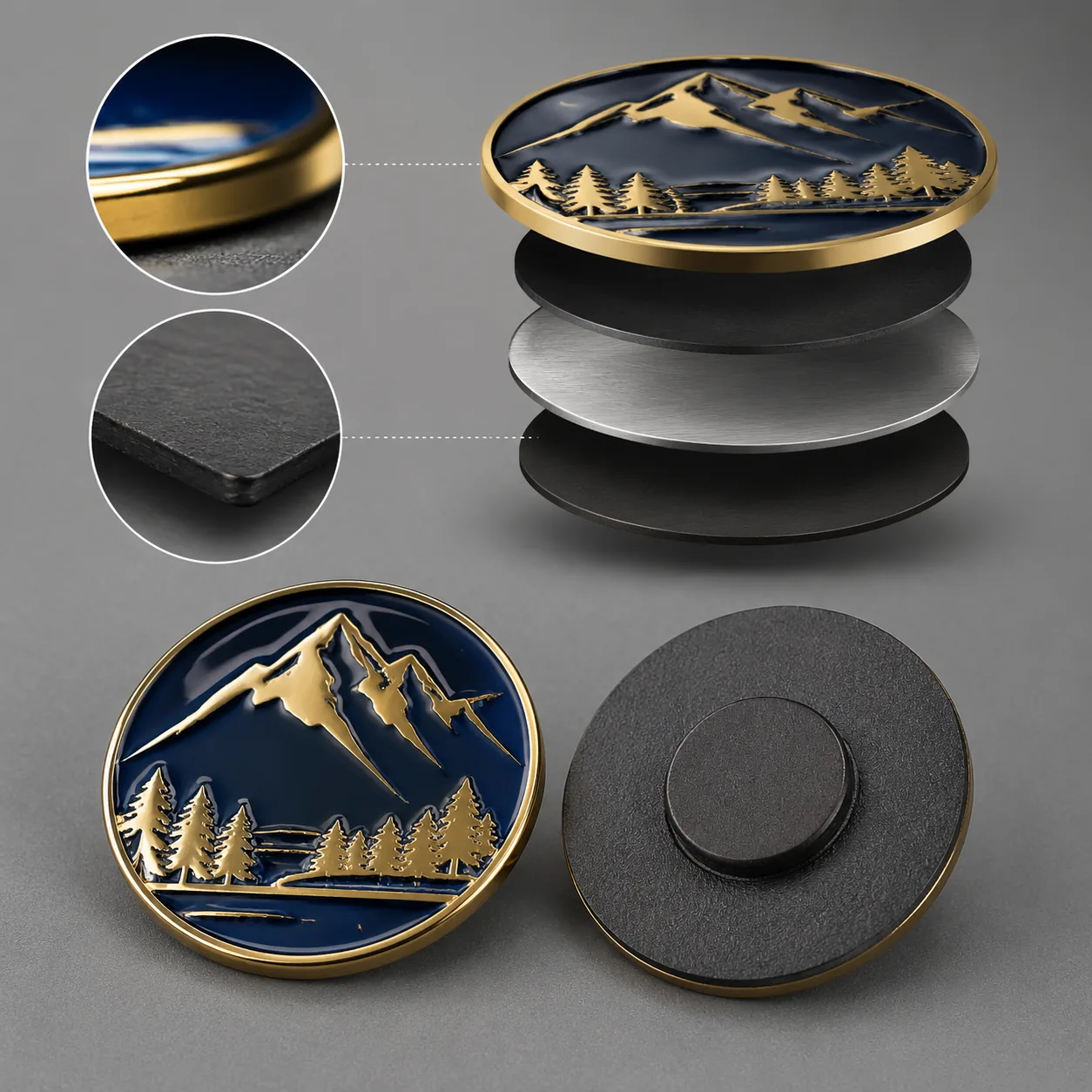
Start with the failure mode, not the artwork
Most fridge magnet complaints are not caused by bad artwork. They come from underspecified construction: corners curl after unpacking, the magnet creeps down a painted refrigerator door, the bonded disc separates from the face, or the printed surface scratches during bulk shipment. A sample can look acceptable on a desk and still fail after 30 days in a hotel kitchen, school office or retail display.
A useful purchase specification defines the complete stack: face material, total thickness, magnet type and size, adhesive system, surface protection, pull-force target, flatness tolerance, packing method and AQL inspection level. If an RFQ only says “custom fridge magnet,” suppliers may quote a 0.3 mm flexible sheet, a 0.6 mm sheet, a bonded ferrite disc or a neodymium disc. Those are different products, not equivalent quotes.
For planning, simple printed flexible magnets in 60 to 80 mm sizes usually fall around USD 0.18 to 0.48 FOB at 1,000 pieces, depending on magnetic sheet thickness, lamination and die-cut complexity. Acrylic, soft PVC, wood and metal-faced magnets typically range from USD 0.38 to 1.95 FOB at 1,000 pieces. Normal production after artwork approval is 7 to 14 days for printed flexible magnets, 10 to 18 days for acrylic or wood, 14 to 24 days for soft PVC, and 18 to 30 days for zinc alloy or enamel styles with tooling.
Match construction to weight and use case
The first engineering decision is the product structure. A full-back flexible ferrite magnet is appropriate for flat promotional mailers, calendars, tourist souvenirs and low-cost campaigns where thickness, freight cost and unit price matter. A decorative face with one or more bonded magnets is better when the buyer wants relief, premium weight, a domed photo effect, enamel color or retail perceived value.
Do not pair a heavy face with an undersized magnet. A 50 mm zinc alloy face weighing 25 to 35 g normally needs one 15 to 20 mm neodymium disc at 2 mm thickness, or two 12 x 2 mm discs if the shape has an off-center mass. A 70 mm soft PVC face weighing 20 to 30 g may work with a 25 x 1.5 mm flexible magnet patch if the back is flat and the product only needs to stay in place. If it must hold paper, the same patch may be insufficient.
Specify the surface as well as the product. Painted refrigerator doors, powder-coated cabinets, stainless-look magnetic boards and vehicle panels have different friction and steel thickness. Many stainless refrigerators have only partial magnetic response or non-magnetic outer skins, so a “works on stainless steel” claim should be tested on the buyer’s actual appliance panel. If the magnet must hold a document, write the load clearly, such as “holds one A4 sheet of 80 gsm paper on a vertical painted steel plate for 10 minutes without sliding more than 5 mm.”
| Construction | Typical technical spec | Best use | Avoid when | USD FOB at 1,000 pcs |
|---|---|---|---|---|
| Printed flexible magnet | 0.45 to 0.85 mm total; 0.4 to 0.6 mm ferrite sheet; gloss or matte PP film 18 to 25 microns | Mailers, calendars, flat souvenirs, low-cost logo campaigns | Premium weight or reliable paper holding is required | 0.18 to 0.48 |
| Acrylic face magnet | 2.0 to 3.0 mm acrylic; UV print or printed insert; 10 to 20 mm disc magnet | Photo gifts, clean logo pieces, small retail souvenirs | Loose bulk packing can chip edges; acrylic softens near heat sources | 0.45 to 1.20 |
| Soft PVC magnet | 2.5 to 5.0 mm PVC relief; raised lines 0.6 mm minimum; ferrite patch or disc magnet | Cartoon shapes, children’s campaigns, irregular outlines | Fine text under 0.8 mm or strong odor limits are critical | 0.50 to 1.45 |
| Zinc alloy or iron magnet | 1.5 to 3.0 mm metal body; 5 to 12 micron plating; enamel, epoxy or print | Premium souvenirs, collectible sets, corporate gifts | Budget is tight or magnet size cannot match face weight | 0.70 to 1.95 |
| Wood or MDF magnet | 2.5 to 5.0 mm board; print, engraving or varnish; bonded disc or strip magnet | Museums, rustic retail designs, eco-style programs | Humid storage, thin boards, or exact wood-tone matching are required | 0.38 to 1.25 |
Specify magnet type, size and pull force
Flexible ferrite sheet is normally specified by thickness, magnetization pattern and surface flux. For fridge magnets, 0.4 to 0.6 mm sheet is common; 0.3 mm can be acceptable for small mail inserts but is more likely to curl and slide on larger pieces. A practical surface flux range for promotional flexible sheet is about 60 to 110 mT at the surface, but the finished holding behavior still depends on contact area, flatness and the door coating.
Disc magnets require a different specification. Ferrite discs are economical but bulky for their strength. Neodymium discs, commonly N35 or N38 for promotional goods, give much higher pull in a small diameter. Grade alone is not enough: an N35 disc at 10 x 1 mm does not perform like an N35 disc at 15 x 2 mm. For humid markets or long storage, specify nickel-copper-nickel plating at 10 to 20 microns total, or epoxy coating where corrosion risk is higher.
Set a pull-force target using the finished item, not the bare magnet. For lightweight flexible magnets under 15 g, 40 to 80 g pull on a clean vertical painted steel plate may be acceptable. For souvenir magnets weighing 15 to 35 g, target 150 to 350 g. For metal or multi-piece magnets above 35 g, use 300 to 600 g depending on center of gravity and required paper-holding function. Measure at 20 to 25°C after the adhesive has cured for at least 24 hours.
- Define magnet type: flexible ferrite sheet, ferrite disc, neodymium disc or flexible strip.
- State dimensions: diameter x thickness for discs; length x width x thickness for sheets or strips.
- State the test surface: 0.8 to 1.0 mm painted steel plate, cleaned and dried before testing.
- Require no more than 5 mm sliding in 10 minutes on the agreed vertical surface.
- Specify the paper load if used as a holder, including paper size, gsm and sheet count.
- Avoid detachable small magnets if the item may reach children under 3; review small-parts rules before production.
Control curling, flatness and adhesive lift
Curling is usually a layer-balance problem. Thin magnetic sheet laminated to a paper face, aggressive adhesive shrinkage, moisture absorption or tight curved packing can all pull the part out of plane. On flexible magnets above 70 mm in either direction, use at least 0.5 mm magnetic sheet when flat retail appearance matters. For 90 to 120 mm calendar magnets, 0.6 mm sheet with film lamination is a safer starting point than 0.3 or 0.4 mm economy sheet.
Define flatness with a measurable tolerance. For finished pieces under 80 mm, a practical limit is maximum 1.5 mm corner lift when placed face-up on glass after 24 hours unpacked at 20 to 25°C and 45 to 65% relative humidity. For 80 to 120 mm pieces, maximum 2.5 mm corner lift is more realistic. For acrylic, PVC, wood and metal-faced products, the main issue is adhesive lift: specify no visible adhesive gap above 0.3 mm around the bonded magnet and no displacement above 0.5 mm after a 24-hour vertical hang test.
Adhesive choice should match the substrate. Metal backs should be degreased before bonding; polished nickel or chrome backs often need abrasion, primer or a higher-performance pressure-sensitive adhesive. PVC may need adhesive selected for plasticizer resistance. Acrylic usually bonds well with quality tape, but low-temperature storage can reduce initial tack. A sensible production check is 24 hours at 40°C with no peel separation, followed by cooling to room temperature before judgment.
Packing is part of the flatness spec. Flexible magnets should be stacked flat, not rubber-banded tightly or forced into cartons with curved side pressure. For export cartons, use inner bags of 50 to 100 pieces, chipboard separators every 100 to 200 pieces for large formats, and carton gross weight below 14 to 16 kg. Retail pieces with acrylic, enamel or epoxy faces should use individual OPP bags or paper interleaves to prevent abrasion.
Set artwork, coating and dimensional tolerances by process
Different processes have different artwork limits. Printed flexible magnets can reproduce gradients, photos and small logos, but text below 5 pt may fill in after lamination and die cutting. Use 2 mm bleed and keep live text at least 2 mm inside the cut line. For high-volume retail work, approve a physical print sample under D50 or D65 lighting rather than judging from a monitor.
Soft PVC magnets need wider details because the material is molded and filled by color. Raised lines should normally be at least 0.6 to 0.8 mm wide, recessed color pools at least 1.0 mm, and text height at least 3.0 to 3.5 mm for legibility. For zinc alloy enamel magnets, raised metal lines can be finer, usually 0.25 to 0.30 mm minimum, but polishing and plating will soften sharp corners. Avoid thin raised borders on the outer edge unless minor rounding is acceptable.
Use realistic dimensional tolerances. Die-cut flexible magnets can normally hold ±0.8 mm on simple outlines and ±1.0 mm on complex shapes. Acrylic laser-cut shapes can hold about ±0.3 mm on the material, while print-to-edge registration is closer to ±0.5 mm. Soft PVC molded parts are commonly ±0.5 mm for small sizes and ±0.8 mm for larger relief pieces. Zinc alloy molded bodies can hold ±0.2 to ±0.3 mm before finishing, but plating thickness and polishing change the final feel.
Protect the surface according to expected handling. Printed paper or synthetic faces should use gloss or matte film lamination, typically 18 to 25 microns, or UV varnish where cost is critical. Epoxy doming adds depth and scratch resistance, but it increases thickness and can yellow if low-grade resin is used. For decorative metal plating, 5 to 8 microns is common for standard souvenir handling; 8 to 12 microns is safer for retail displays with frequent touching.
Use inspection tests customers will actually notice
Visual inspection alone is not enough. Use ANSI/ASQ Z1.4 or ISO 2859-1 sampling at general inspection level II unless the buyer specifies otherwise. Common acceptance limits are critical defects 0, major defects AQL 2.5 and minor defects AQL 4.0. Critical defects include sharp exposed metal, loose magnets on child-accessible goods, wrong logo, wrong color family, broken pieces, or finished magnets that cannot attach to the agreed steel surface.
Functional checks should appear on the QC sheet. At minimum, test attachment, sliding resistance, adhesive bond, flatness, surface scratches, packing accuracy and carton condition. For color-sensitive programs, use a retained approved sample; if the buyer provides instrument data, set a Delta E target, commonly ΔE 2.0 to 3.0 for controlled brand colors and ΔE 4.0 to 5.0 for standard promotional printing. For PVC and painted metal, compare under consistent light because gloss level changes perceived color.
Do not over-test a one-week internal giveaway, but do not under-test retail or child-accessible programs. For a 1,000-piece conference magnet, a pre-production sample and final AQL inspection may be enough. For repeat retail orders above 10,000 pieces, written test methods, retained golden samples, pull-force records and packing photos reduce reorder disputes.
- Inspect 100% for sharp edges on metal, acrylic and laser-cut components.
- Check magnet attachment on at least 32 pieces per lot, or follow the agreed AQL sample size.
- Measure pull force and sliding resistance on the approved steel plate, not a random workshop cabinet.
- Leave 10 pieces unpacked for 24 hours before judging curl or corner lift.
- Run one 60 cm carton drop test when retail packaging or brittle acrylic faces are used.
- Retain one approved sample and one mass-production sample for each reorder reference.
Plan MOQ, lead time and cost trade-offs
MOQ depends on the process, not only the factory. Printed flexible magnets can often start at 300 to 500 pieces per design, but the unit price usually improves at 1,000, 3,000 and 5,000 pieces because setup, printing and die cutting are spread across more units. Acrylic and wood magnets commonly start at 300 to 500 pieces. Soft PVC and zinc alloy custom-shaped magnets usually make more sense from 500 to 1,000 pieces because molds, color setup and finishing labor are involved.
Tooling should be shown as a separate line item. Simple soft PVC molds are often USD 40 to 90. Zinc alloy molds usually run USD 60 to 180 depending on size, relief depth and cavity count. Existing-shape acrylic or printed flexible magnets may have little or no hard tooling, but special dies, fixtures or retail cards can still add setup cost. Reorders are faster when the supplier retains artwork, approved magnet dimensions, packing photos and golden samples.
| Order type | Practical MOQ | Sample lead time | Mass production after approval | Main cost drivers |
|---|---|---|---|---|
| Printed flexible magnet | 300 to 500 pcs; best pricing from 1,000 pcs | 3 to 5 days | 7 to 14 days | Size, sheet thickness, lamination, die-cut complexity, packing |
| Acrylic magnet | 300 to 500 pcs | 5 to 7 days | 10 to 16 days | Acrylic thickness, print method, edge polish, magnet size |
| Soft PVC magnet | 500 to 1,000 pcs | 7 to 10 days | 14 to 24 days | Mold size, PVC thickness, color count, magnet area |
| Zinc alloy enamel magnet | 500 to 1,000 pcs | 8 to 12 days | 18 to 30 days | Tooling, plating microns, enamel colors, polishing, magnet count |
| Wood or MDF magnet | 300 to 500 pcs | 5 to 8 days | 12 to 20 days | Board thickness, print coverage, varnish, moisture control |
Rush orders should simplify the build. If the delivery date is less than 14 days after artwork approval, choose printed flexible magnets or existing-shape acrylic pieces where possible. Avoid custom metal molds, multi-color enamel, special retail boxes and extra laboratory testing unless the schedule includes time for sample approval and correction.
Build the RFQ so quotes are comparable
Before requesting prices, decide whether the magnet is a low-cost mailer, a retail souvenir, a corporate gift or a functional paper holder. That decision determines face material, magnet size, adhesive strength, packing and inspection. A cheap flexible magnet is correct for many campaigns, but it is the wrong product when the buyer expects premium weight, enamel finish or reliable paper-holding strength.
A complete RFQ should include finished size, construction, face material thickness, magnet type and dimensions, target pull force, artwork file, color standard, coating, tolerance, packing method, carton limit, AQL level, sample requirement and required ship date. Ask suppliers to quote the magnet dimensions and total thickness, not only the unit price. A USD 0.22 magnet using 0.3 mm sheet is not comparable to a USD 0.31 version using 0.6 mm sheet and 25 micron lamination.
For a practical starting point, request two options: an economy build and a safer build. For example, for a 70 mm printed promotional magnet, compare 0.4 mm flexible sheet with varnish against 0.6 mm sheet with 18 to 25 micron gloss lamination and flat packed export cartons. For a 50 mm metal souvenir, compare one 15 x 2 mm N35 disc against two 12 x 2 mm discs if the shape is tall or bottom-heavy. This makes the trade-off visible before the purchase order is issued.
Have a project? Send your artwork and target quantity and we’ll reply with a detailed quotation within 12 working hours.
Ready to get this made?
Send your sketch, target quantity and ship-date. Detailed quotation in 12 hours.



