Fridge Magnet Backing Specs That Prevent Peeling and Curling
Why Magnet Backs Fail Before the Printed Face
Most fridge magnet claims are not caused by bad artwork. They come from the back construction: the magnet creeps down a powder-coated appliance door, the adhesive lifts after two weeks, or the finished piece curls because the front layer and magnetic layer shrink at different rates. Once a distributor hears about it, the campaign is already in market and replacement freight can exceed the original unit saving.
A quote that says only “rubber magnet back” is under-specified. A reliable RFQ defines magnet type, thickness, coverage, pull-force target, adhesive chemistry, placement tolerance, flatness limit, edge clearance, packing method and inspection standard. These are measurable inputs, not factory preferences.
The figures below reflect normal B2B production ranges for promotional fridge magnets, acrylic magnets, PVC magnets, zinc alloy badge magnets and bottle-opener magnets. They are not laboratory maximums. They give procurement teams a practical benchmark for comparing suppliers and rejecting backs that look acceptable in a sample photo but fail after lamination, carton compression or warm transit.
Select Magnet Type by Weight and Contact Area
Flexible magnetic sheet is the default for flat paper, PVC and acrylic fridge magnets because it gives broad contact at low cost. Common production thicknesses are 0.4 mm, 0.5 mm, 0.7 mm and 1.0 mm. For a 70 x 50 mm printed magnet under 20 g, 0.4-0.5 mm sheet is usually enough on clean painted steel. For pieces above 90 mm wide, raised acrylic fronts or products from 25-45 g, specify 0.7-1.0 mm sheet to reduce sliding and corner lift.
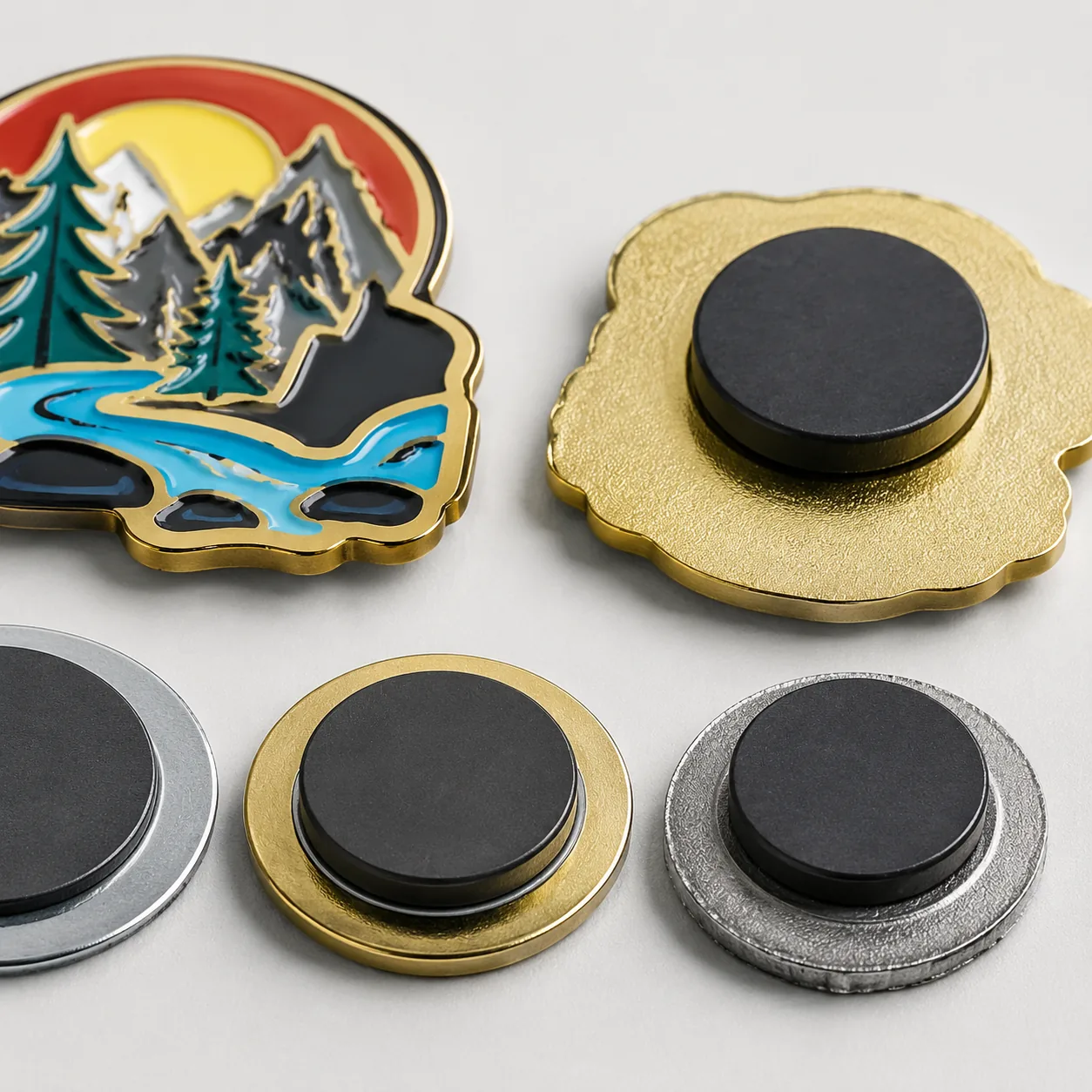
Ferrite disc magnets are useful when the product body is thick enough to hold a recess. Typical sizes are 10, 12, 15 and 20 mm diameter at 2-4 mm thickness. They suit molded PVC, resin and wood magnets, but they are brittle. Avoid exposed ferrite on items likely to be dropped, mailed loose or packed with hard metal parts that can chip disc edges.
Neodymium magnets are best when high pull is needed in a small space, such as zinc alloy badges, bottle openers and premium metal souvenirs. Promotional orders normally use N35 or N38; higher grades rarely justify the cost unless the finished part exceeds 80-100 g. Standard disc sizes include 8 x 2 mm, 10 x 2 mm, 12 x 2 mm and 15 x 3 mm. Specify Ni-Cu-Ni plating at 8-12 µm total thickness and require the magnet to be recessed or sealed if the item may face humidity.
| Backing type | Typical production spec | Best use | Avoid when |
|---|---|---|---|
| Flexible magnetic sheet | 0.4-1.0 mm thick; full or 60-90% coverage | Flat paper, PVC and acrylic magnets under 45 g | Heavy metal parts, rough paint, small contact area |
| Ferrite disc | 10-20 mm diameter; 2-4 mm thick | Molded PVC, resin or wood with recessed pockets | Thin mailers, brittle-drop risk, ultra-flat backs |
| Neodymium disc | N35-N38; 8-15 mm diameter; 2-3 mm thick | Metal badges, bottle openers, compact premium magnets | Child-risk products or wet use without sealed design |
| Magnetic strip | 8-20 mm wide; 0.7-1.5 mm thick | Rulers, calendars and long name strips | Round or irregular shapes needing balanced pull |
Define Coverage, Placement and Edge Clearance
Full magnetic sheet gives the most stable contact and helps keep thin products flat. It is usually the safest option for shapes from 40 x 40 mm to about 120 x 80 mm. For die-cut outlines, specify a cutting tolerance of ±0.5 mm and an inward offset of 0.5-1.0 mm from the printed front edge so the dark magnet layer does not show from the face.
Partial coverage can reduce cost and carton weight, but it must be balanced. Use at least 60% back coverage for flat lightweight magnets and 80% for pieces wider than 90 mm or heavier than 25 g. For decorative fronts with uneven mass, place the magnet around the center of gravity, not the geometric center. If the top section is heavier, move the backing slightly upward to prevent rotation.
Disc magnets need dimensioned placement on the technical drawing. Write the center point from fixed edges, such as “12 mm from top edge, centered horizontally, tolerance ±0.5 mm.” For products above 50 g, two smaller discs often resist rotation better than one large center disc. Keep discs at least 3 mm from the outer edge to reduce chipping, visible bumps and adhesive squeeze-out.
Edge clearance also affects appearance. For acrylic and paper-faced magnets, a 0.8 mm offset with ±0.3 mm tolerance is a practical RFQ target. For soft PVC, allow 1.0-1.5 mm if the molded edge is rounded. If the backing is too close to the edge, carton pressure can expose adhesive or create a dark outline visible from the front.
Match Adhesive to the Back Surface
Many “weak magnet” complaints are actually adhesive failures. Flexible sheet can be supplied with pressure-sensitive adhesive, hot-melt adhesive or solvent acrylic adhesive. For paperboard and standard PVC backs, pressure-sensitive adhesive at 80-120 µm is common. For acrylic, ABS, painted metal or plated zinc alloy, solvent acrylic adhesive at 100-150 µm performs better under heat and humidity than low-cost hot-melt tape.
Surface preparation is as important as adhesive grade. Polishing compound, silicone release agent, UV-print residue and fingerprints can reduce bond strength. Metal and acrylic backs should be wiped before application, and bonded samples should rest for at least 24 hours before pull or peel testing. Immediate hand tests are misleading because pressure-sensitive systems build strength during dwell time.
Thick PVC, resin and zinc alloy bodies should use a recessed magnet pocket when possible. The magnet should sit flush or 0.2-0.5 mm below the back surface, then be bonded in place. A recess protects the magnet edge, improves placement and reduces rocking on the fridge door. The trade-off is tooling: custom pockets may add 3-5 days and 80-250 USD in mold or fixture cost depending on complexity.
| Bonding surface | Recommended adhesive | Minimum contact target | RFQ note |
|---|---|---|---|
| Paperboard or printed art paper | PSA, 80-100 µm | Full sheet or 80% coverage | Laminate after ink is fully cured |
| Soft PVC | PSA or hot-melt, 100-120 µm | Full sheet preferred | Cool PVC fully before bonding |
| Acrylic or ABS | Solvent acrylic, 100-150 µm | 70% or more | Clean surface before adhesive application |
| Plated zinc alloy or iron | Solvent acrylic, 100-150 µm | Two discs or large sheet area | Do not bond over oily polishing residue |
| Painted wood or MDF | Acrylic foam tape, 0.3-0.5 mm | Disc or strip placement | Paint adhesion may be the weak layer |
Set Pull Force and Slide Tests That Reflect Use
Straight pull force and real fridge performance are not the same. Pull force is measured perpendicular to a steel plate, while most customer failures are sliding on a vertical painted or powder-coated door. A good specification includes both. Without a defined method, “strong magnet” can mean different steel thickness, different surface finish and different pass criteria at each factory.
For flat promotional magnets under 20 g, use a pull-force target of 80-150 g on a clean 1.0 mm low-carbon steel plate. For 20-50 g pieces, specify 200-400 g. For zinc alloy badges, hooks or bottle openers weighing 50-100 g, target 600-1200 g using neodymium discs or a large ferrite insert. If the product carries a load, test the intended load plus a 20% safety margin.
Slide testing should be simple enough for factory QC. Place the finished sample on a vertical painted steel panel for 24 hours at 23 ±2 °C, then repeat for 2 hours at 40 °C. Lightweight flat magnets should move no more than 2 mm. Heavier decorative magnets may allow up to 5 mm if they remain aligned and do not detach. Do not test on stainless steel; many stainless grades are weakly magnetic or non-magnetic.
- State the finished product weight in grams, including attached bottle opener or hook hardware.
- Define the test surface as clean painted low-carbon steel, 0.8-1.0 mm thick.
- Specify pull force in grams or newtons, not “strong,” “premium” or “high power.”
- Add a 24-hour vertical slide test for items over 30 g or wider than 90 mm.
- Require testing after 24 hours adhesive dwell, not immediately after magnet application.
- Record magnet placement tolerance and failed-sample photos during pre-shipment inspection.
Control Curling, Warping and Edge Lift
Curling happens when the face material and backing material move differently. Paper absorbs moisture, PVC retains heat, acrylic can hold UV-ink solvent, and magnetic sheet has its own memory from roll storage. For flat magnets up to 100 mm wide, specify maximum 1.5 mm lift when the item is placed on a glass plate. For larger pieces, 2.0-3.0 mm is more realistic unless the design uses thick rigid acrylic.
Production timing matters. Paper-laminated magnets should dry after printing and lamination before die cutting. Soft PVC should cool fully before the magnet is applied. Acrylic parts should not be packed tightly while UV ink is still releasing solvent. Saving one day at this stage can create curled cartons after a warm truck ride or sea-freight humidity cycle.
Inspect edge lift separately from overall flatness. For flexible sheet backs, specify no visible adhesive gap wider than 0.3 mm along any edge and no delamination after 10 manual bends to about 30 degrees for soft products. For rigid acrylic or metal magnets, do not bend the finished item; instead perform peel checks on adhesive coupons or rejected parts from the same bonding lot.
Use AQL definitions that separate function from appearance. Missing magnets, loose magnets, severe curling, exposed sharp magnet edges, wrong magnet grade and placement outside tolerance are major defects. Minor surface scuffs, small die-cut offset within ±0.5 mm and light packing marks can be minor defects if they do not affect holding performance.
Pack Magnet Backs for Freight, Not Just Appearance
Packing can destroy a good backing. Loose bulk packing allows magnets to attract each other, slide, scratch printed faces and stress adhesive edges. For flat sheet magnets, OPP bags in bundles of 50-100 pieces with alternating orientation are common. For acrylic, resin and metal-front magnets, individual OPP bags, paper sleeves or tray packing reduce face scratches and magnet-to-magnet impact.
Carton pressure is a common cause of curl. Keep inner cartons for flexible magnetic sheet products under 8-10 kg, and do not stack zinc alloy badges or coin products directly on flat magnets. Use chipboard dividers or corrugated layers when the back includes raised ferrite or neodymium discs. For high-gloss print faces, add release paper or individual bagging so a magnet back does not imprint onto the face below it.
For sea freight, specify humidity control for paper-faced magnets and metal magnets. A carton liner bag plus 2-5 g desiccant per inner carton is enough for many normal shipments; increase desiccant when cartons travel through humid ports or remain warehoused for more than 30 days. For neodymium, avoid long exposure to moisture because corrosion often starts at damaged plating edges.
Retail packaging needs a separate check. A blister card or thick backing card can add distance between magnet and display surface, reducing holding force. If the product must remain on a retail display or customer fridge while carded, test the final packed unit, not only the loose magnet.
Budget, MOQ, Lead Time and Approval Checklist
Backing choice changes cost more than many buyers expect. On a 70 x 50 mm flat magnet, upgrading from 0.4 mm to 0.7 mm magnetic sheet typically adds 0.015-0.04 USD per piece depending on volume and shape. Neodymium discs add about 0.03-0.12 USD each before labor, recess tooling or extra QC. Adhesive upgrades are small per unit, usually 0.005-0.03 USD, but they often prevent the most expensive claims.
Typical FOB ranges for standard export orders are 0.18-0.55 USD for paper-laminated flat magnets, 0.35-0.95 USD for soft PVC magnets, 0.60-1.60 USD for acrylic magnets and 1.20-3.80 USD for zinc alloy or bottle-opener magnets with neodymium backs. These ranges assume 500-5,000 pieces, standard packing and no retail blister card. Oversize shapes, multiple magnets, licensed artwork approvals and retail packaging push costs upward.
Practical MOQ usually starts around 1,000 pieces for paper-laminated flat magnets, 500 pieces for PVC magnets and 300-500 pieces for acrylic, zinc alloy or bottle-opener magnets. A normal schedule is 5-8 days for digital proof and material confirmation, 7-12 days for samples, and 12-25 days for mass production after sample approval. Add 3-5 days for recessed magnet pockets, custom molds, retail packaging or nonstandard adhesive sourcing.
| Order type | Typical MOQ | Sample lead time | Mass lead time | FOB range |
|---|---|---|---|---|
| Paper-laminated flat magnet | 1,000 pcs | 5-7 days | 10-15 days | 0.18-0.55 USD |
| Soft PVC magnet | 500 pcs | 7-10 days | 12-18 days | 0.35-0.95 USD |
| Acrylic magnet | 300-500 pcs | 7-10 days | 12-20 days | 0.60-1.60 USD |
| Zinc alloy metal magnet | 300 pcs | 10-12 days | 18-25 days | 1.20-3.80 USD |
| Bottle-opener magnet | 300-500 pcs | 10-14 days | 18-28 days | 1.50-4.50 USD |
Before approval, require the production proof to show magnet type, thickness, coverage, adhesive type, placement dimensions, pull-force target, slide-test method, flatness tolerance and packing method. For normal promotional orders, use AQL 2.5 for major defects and AQL 4.0 for minor defects. For retail or high-liability programs, tighten major defects to AQL 1.5 and request pre-shipment photos of the back, side profile and carton stacking method.
A concise RFQ line is enough if it is measurable: “70 x 50 mm acrylic fridge magnet, finished weight under 35 g, 0.7 mm flexible magnetic sheet covering at least 80% of back, solvent acrylic adhesive, 0.8 mm edge offset ±0.3 mm, flatness lift max 1.5 mm, pull force 200 g minimum on 1.0 mm painted steel, no slide over 2 mm after 24 hours, individual OPP bag, AQL 2.5 major/4.0 minor.” With that detail, ZheCraft or any qualified factory can quote accurately, build the right sample and inspect mass production against objective limits.
Have a project? Send your artwork and target quantity and we’ll reply with a detailed quotation within 12 working hours.
Ready to get this made?
Send your sketch, target quantity and ship-date. Detailed quotation in 12 hours.



