Freight Specs for Custom Pins, Coins and Keychains
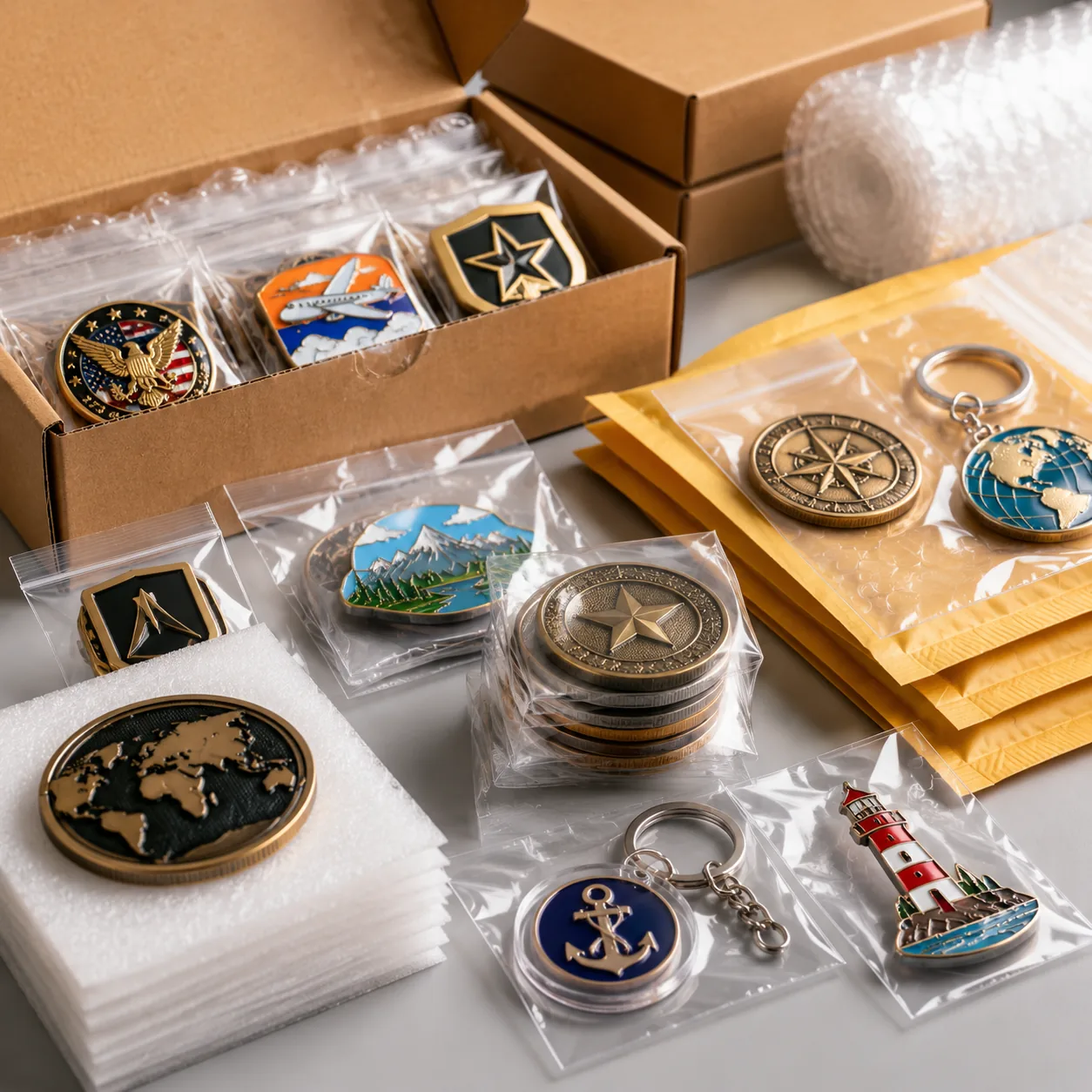
Why Freight Breaks Approved FOB Budgets
For custom pins, coins and keychains, the cheapest approved unit price is often not the lowest landed cost. These products are small but dense, and packing choices can change chargeable weight, carton count and damage risk more than a minor tooling or plating difference. A 30 mm soft enamel pin may quote at USD 0.38 to 0.85 FOB China at 1,000 to 5,000 pcs, but the same order may ship as 18 kg by courier in compact OPP bags or cube out closer to 0.08 CBM when backing cards, envelopes and loose carton packing are added.
Challenge coins require even tighter freight planning. A 45 mm iron or zinc alloy coin at 3 mm thickness usually weighs 35 to 55 g before packaging. At 5,000 pcs, gross shipment weight can exceed 250 kg after pouches, cartons and moisture protection. If that order is needed for an event in 12 days, sea freight is no longer an option and courier or air freight can erase the savings from a low FOB price.
At ZheCraft in Yiwu, we quote enamel pins, brooches, keychains, coins, magnets, patches and lanyards for B2B buyers who compare EXW, FOB and courier terms. The best RFQs define freight constraints before sampling: Incoterm, destination postal code, latest arrival date, packing method, maximum carton weight, carton size limit, labeling rules and whether split shipment is acceptable.
Set Incoterm, MOQ and Lead Time Together
An Incoterm is not a formality; it defines what the supplier price includes. EXW Yiwu means the buyer or forwarder collects cargo from the factory and handles inland trucking, export declaration, international freight, insurance, import clearance, duty and final delivery. FOB Ningbo or Shanghai normally includes local export handling and delivery to the export handover point, but excludes ocean or air freight and destination charges. Courier DAP or door-to-door service bundles pickup, export, international movement and last-mile delivery, although duties, taxes and remote-area charges may still depend on the destination country and courier account.
MOQ and lead time also affect freight decisions. For common enamel pins, a practical MOQ is 100 to 300 pcs per design, but the best FOB range usually starts at 1,000 pcs. Soft enamel pins often run 10 to 18 production days after artwork and pre-production sample approval; hard enamel or imitation cloisonné often needs 15 to 25 days because polishing and color finishing take longer. Challenge coins usually need 18 to 30 days depending on mold complexity, edge style, plating and packaging. Keychains are typically 12 to 22 days for metal or PVC designs.
| Term or lane | Best use | Typical transit after QC release | Cost risk to check |
|---|---|---|---|
| EXW Yiwu | Buyers with an appointed China forwarder | Same day pickup if booked before cutoff | Factory quote excludes export declaration, inland truck and freight |
| FOB Ningbo or Shanghai | Air freight, LCL or container cargo arranged by buyer | 2 to 5 days to port or airport handover | Destination terminal, customs and delivery charges remain open |
| Courier DAP | Samples and orders under about 100 kg gross | 3 to 8 days to most metro addresses | Remote-area, duty, tax and dimensional remeasure fees may apply |
| Air freight to airport | Urgent cargo around 100 to 500 kg | 5 to 10 days airport to airport plus clearance | Buyer needs broker, import entry and final-mile truck |
| Sea LCL | Dense cargo over about 0.5 CBM or 300 kg | 25 to 45 days on common lanes | Minimum destination fees can be high on small shipments |
| Sea FCL | Large campaigns or multi-SKU replenishment | 22 to 40 days port to port on many lanes | Only efficient when carton data and pallet plan are stable |
Calculate Chargeable Weight Before Packaging Approval
Couriers and airlines charge by the greater of actual gross weight or volumetric weight. A common courier formula is length x width x height in cm divided by 5,000. Some air freight lanes use 6,000. A carton measuring 40 x 30 x 25 cm is 30,000 cubic cm, equal to 6.0 kg volumetric weight by the 5,000 formula. If it weighs 4.5 kg actual, the courier bills 6.0 kg; if it weighs 16 kg actual, the courier bills 16 kg.
Metal products are often actual-weight driven, but retail packaging can change that. A 25 to 30 mm pin in an OPP bag packs tightly. The same pin on a 75 x 100 mm backing card inside an envelope may cut carton quantity by half and raise total CBM by 60 to 120 percent. A 50 mm challenge coin in a velvet box can use three to five times the volume of a coin in a pouch, even if the box adds only 35 to 70 g.
A freight-ready quote should state net weight, estimated gross weight, carton count, carton size and total CBM. For repeat orders, lock these figures into the reorder spec with tolerances: carton dimensions within plus or minus 10 mm, gross weight within plus or minus 1.0 kg per full carton, and total carton count unchanged unless the approved packing method changes. This prevents a reorder from shifting into oversized cartons without commercial review.
Use Cartons That Fit the Product and Carrier
For pins, keychains and coins, 5-ply corrugated export cartons are normally safer than thin domestic cartons. For heavy metal goods, specify 44 to 48 ECT equivalent strength or a factory-verified burst strength suitable for the gross weight. Keep pin and keychain cartons around 12 to 18 kg gross for manual handling. For challenge coins, 15 to 22 kg is a practical upper range; pushing to 25 kg may reduce carton count but increases crushed corners, worker injury risk and courier surcharge exposure.
Carton dimensions should match the freight mode. Courier-friendly cartons are usually kept below 50 x 40 x 35 cm to reduce remeasurement and oversize risk. Dense coin cartons may be smaller, for example 35 x 28 x 22 cm, to keep handling weight controlled. For sea freight, stable palletization matters more than individual carton convenience: use a repeatable footprint, avoid bulging, and confirm whether the buyer requires pallets under 1.5 m high or cartons loose-loaded.
Moisture and abrasion controls should be specified, not assumed. For polished gold, nickel, black nickel or antique finishes, individual OPP bags, paper interleaving or fitted trays prevent metal-on-metal rubbing. Standard decorative plating is often a flash layer around 0.05 to 0.20 microns depending on finish and supplier process; heavier plating may improve wear resistance but will not compensate for loose bulk packing.
Use Realistic Packing Densities and Price Ranges
Budgeting improves when the quote uses realistic density by product and packing style. A 25 mm iron soft enamel pin with butterfly clutch may weigh 4 to 7 g before packing. With clutch installed and OPP bag, use 6 to 10 g per pc for early freight planning. With a backing card and envelope, use 10 to 16 g per pc and expect fewer pieces per carton.
Metal keychains vary widely because thickness, ring size and attachment change weight. A 45 to 55 mm zinc alloy keychain with split ring often weighs 25 to 50 g packed. Soft PVC keychains may weigh 12 to 28 g, but thick 3D PVC designs pack less tightly and can become volume-driven. Fridge magnets are also inconsistent: a 60 x 60 mm soft PVC magnet may be 25 to 45 g, while a metal magnet badge with a strong magnet can exceed 50 g.
| Item and packing | Common MOQ and FOB range | Packed weight for budgeting | Typical carton quantity | Freight note |
|---|---|---|---|---|
| 25 to 30 mm soft enamel pin, OPP bag | 300 pcs MOQ; USD 0.38 to 0.85 at 1,000 to 5,000 pcs | 6 to 10 g per pc | 1,000 to 2,000 pcs | Usually actual-weight driven |
| Hard enamel pin on backing card | 300 pcs MOQ; USD 0.65 to 1.35 at 1,000 to 5,000 pcs | 10 to 16 g per pc | 500 to 1,000 pcs | Cards increase CBM faster than weight |
| 45 to 55 mm metal keychain | 300 pcs MOQ; USD 0.70 to 1.80 at 1,000 to 3,000 pcs | 25 to 50 g per pc | 300 to 800 pcs | Separate rings to prevent plating scratches if needed |
| 45 mm challenge coin in pouch | 100 pcs MOQ; USD 1.20 to 3.20 at 500 to 2,000 pcs | 45 to 70 g per set | 200 to 400 sets | Keep full carton under 22 kg |
| 50 mm coin in velvet box | 100 pcs MOQ; USD 2.20 to 5.50 at 500 to 2,000 pcs | 100 to 170 g per set | 80 to 160 sets | Often volume-driven by box size |
| 20 mm polyester lanyard with hook | 500 pcs MOQ; USD 0.35 to 0.95 at 1,000 to 5,000 pcs | 25 to 45 g per pc | 500 to 1,000 pcs | Compressible, but cartons may rebound after packing |
Decide Early Whether to Split Shipments
Split shipment is useful when an event date is fixed but the full order is not needed immediately. A common plan is to send 500 pcs by courier for launch use and move the remaining 4,500 pcs by sea LCL or air consolidation. On heavy challenge coins, this can save hundreds or thousands of dollars versus sending the full batch by express.
Do not split shipments if color consistency, serial-number order, QR-code sequence or retail carton allocation cannot be controlled by the receiving team. Split shipments create extra packing lists, customs entries, tracking numbers and possible duty minimums. If numbered products are involved, define the exact range for each lot, such as serial numbers 0001 to 0500 by courier and 0501 to 5000 by LCL.
Inspection should normally cover the full production batch before the first lot leaves. For promotional metal goods, many buyers use ANSI/ASQ Z1.4 single sampling with AQL 2.5 for major defects and AQL 4.0 for minor defects, unless their internal standard is stricter. Critical defects, such as unsafe sharp edges, broken pin posts or incorrect trademarks, should be treated as zero-tolerance. If the express lot ships before all retail packing is finished, state whether it may be drawn from inspected bulk production or only from finished packed cartons.
Inspect the Details That Drive Freight Claims
Freight claims are weak when packing specs are vague. Before pickup, inspect carton strength, open-carton layout, internal dividers, moisture protection, carton marks, sealed carton condition, gross weight and final dimensions. The most common transit-related defects on custom metal goods are plating scratches from movement, bent pin posts, crushed gift boxes, loose magnets, torn backing cards and split rings rubbing against polished surfaces.
For pins and badges, define post length tolerance and clutch fit because bent posts and loose clutches often appear after poor bulk packing. A practical dimensional tolerance for small die-struck or die-cast metal items is plus or minus 0.2 mm on thickness and plus or minus 0.5 mm on overall length or diameter, unless the design requires tighter assembly fit. Enamel fill should be checked for visible underfill, overflow, dust and color mismatch against approved artwork or Pantone reference under consistent lighting.
For heavy coins and magnets, request a basic packed-carton drop check before mass shipment. A factory screening method is 1 corner, 3 edges and 6 faces from 60 to 80 cm for cartons under 15 kg, and 45 to 60 cm for heavier cartons. This is not a substitute for ISTA lab testing, but it catches overloaded cartons, weak seams and loose inner packing before the forwarder collects.
- Confirm carton grade, flute type, maximum gross weight and carton dimensions before mass packing starts.
- Require photos of one open carton, one sealed carton, carton marks and a weight-scale reading.
- Show PO number, SKU, quantity, gross weight, net weight, carton number and country of origin where required.
- Use AQL 2.5 major and AQL 4.0 minor for general promotional goods unless your standard is stricter.
- Reject rattling bulk metal parts, crushed retail boxes, wet cartons or missing desiccants when moisture bags are specified.
- Request the final packing list, total CBM and carton photos before balance payment or pickup booking.
Put Freight Clauses Directly in the RFQ
The RFQ should make freight measurable. Instead of asking the supplier to quote shipping in general terms, provide destination city, postal code, delivery deadline, Incoterm, commercial or residential address type, unloading restrictions and pallet requirements. For the product, state the target packing: bulk pack, individual OPP bag, backing card, pouch, gift box, retail carton or Amazon-style FNSKU labeling.
Also state warehouse receiving rules. Many distributors require cartons under 18 kg, no mixed SKUs per carton, labels on two adjacent sides, scannable barcodes, pallets under 1.5 m, or advance carton data before delivery appointment booking. If these rules are missing, the factory may pack for production convenience rather than lowest total landed cost.
A freight-ready quote for custom pins, coins, keychains or magnets should show Incoterm, production lead time in calendar days, sample lead time, MOQ tier, FOB unit price range, estimated carton count, carton size, gross weight, net weight, total CBM and packing method. For complex campaigns, ask for a packing matrix listing SKU, packed quantity per carton, carton size, gross weight, net weight, CBM and carton mark wording. That single document gives procurement, logistics and receiving the same baseline before the order is placed.
Before approving the next order, send a one-page freight spec and require final packing data before pickup. The costliest surprise is rarely the enamel color or the die fee; it is a product that was cheap FOB but became expensive, late or damaged because freight assumptions were never engineered into the order.
Have a project? Send your artwork and target quantity and we’ll reply with a detailed quotation within 12 working hours.
Ready to get this made?
Send your sketch, target quantity and ship-date. Detailed quotation in 12 hours.



