Freight-Smart Specs for Custom Metal Promos in 2026
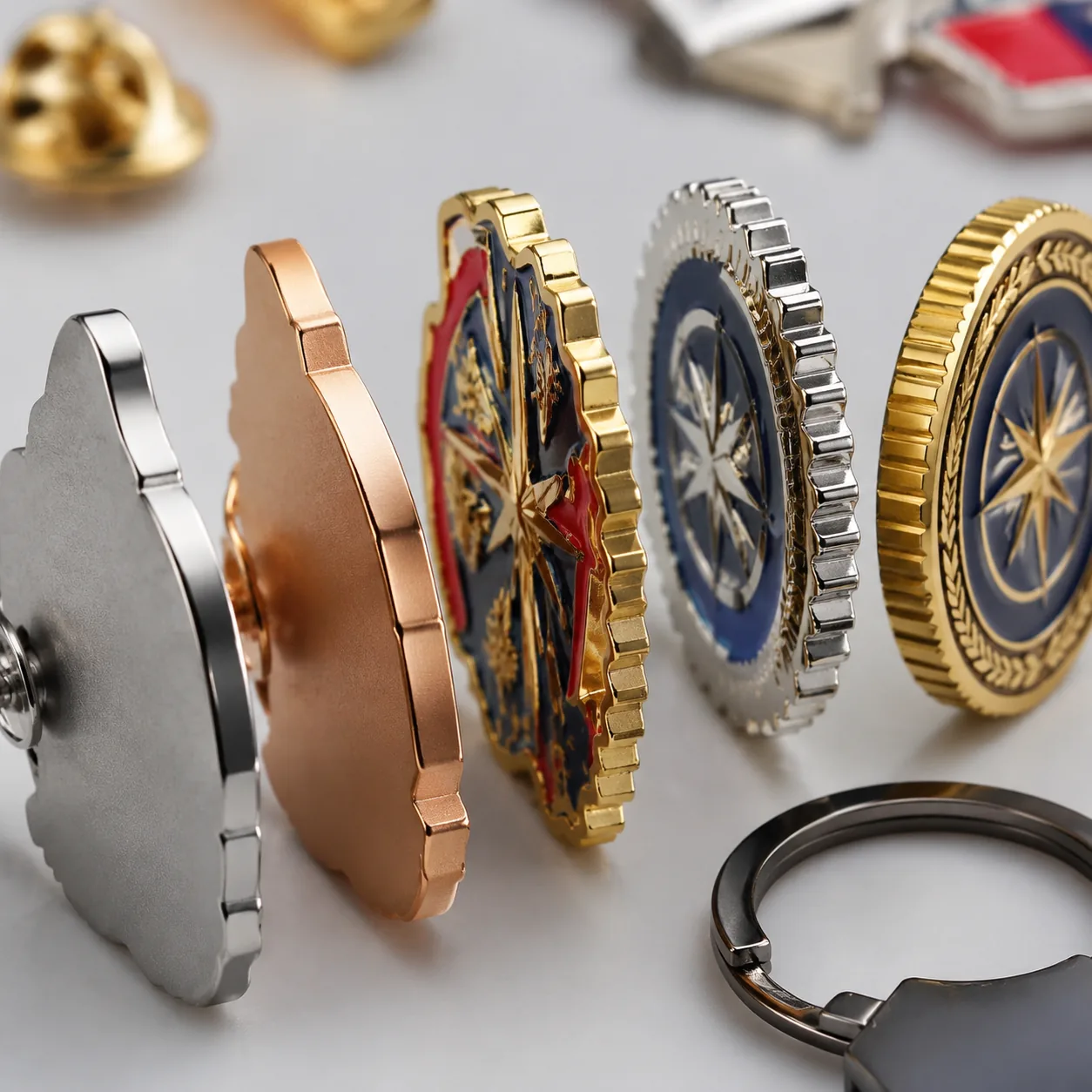
Freight economics are set by product geometry, not by the carton alone
The most common sourcing mistake in custom metal promos is treating freight as a packing-stage issue. By the time the factory is counting cartons, most of the cost has already been designed in through diameter, thickness, alloy density, relief depth, attachment hardware and retail pack format. A proof that looks only slightly heavier can change the shipment from courier-feasible to standard air only, or create export cartons that are too dense for safe handling.
Weight differences between similar-looking products are large enough to change landed cost materially. A 50 mm die-cast zinc alloy challenge coin at 3.0 mm thickness usually weighs about 30-38 g bare. Add deep 3D relief, rope edge, recessed sandblast areas and epoxy fill, and the same diameter can reach 40-46 g. A 50 mm stamped iron coin-style piece with flatter artwork is more often 22-30 g bare. Across 2,000 pcs, that difference is 16-48 kg before OPP bags, capsules, backing cards, inner boxes and export cartons are added. On express or deferred air, that gap can add several hundred to more than $1,000 depending on lane and season.
For 2026 RFQs, freight should be written as a measurable product requirement. Ask every supplier to quote bare unit weight, packed unit weight, packed unit dimensions, units per inner, units per export carton, carton dimensions in cm, gross carton weight and total shipment CBM. Put tolerances around those numbers: unit weight +/-5% after mass production, metal thickness +/-0.10 mm for stamped pins and badges, +/-0.15 mm for die-cast coins and keychains, packed unit dimensions +/-3 mm, carton dimensions +/-1 cm and carton gross weight +/-0.5 kg versus the approved pack plan. Without those figures, FOB comparisons are not aligned.
Set weight caps by freight mode before tooling approval
If a program may ship by courier or standard air, the single most useful control is maximum packed weight per piece. End users usually do not perceive enough difference between a freight-efficient build and a heavier one to justify the logistics penalty. The practical method is to set a packed-weight cap before tooling release, then let the supplier optimize alloy, thickness and hardware within that limit.
Working targets for 2026 are straightforward. For 25-35 mm soft enamel pins, keep the packed weight at 7-14 g with one butterfly clutch, 300-350 gsm backing card and 0.04-0.05 mm OPP bag. For 45-60 mm zinc alloy keychains, 20-32 g packed is a sensible range with a 25 mm split ring and short chain. For challenge coins, 40-45 mm diameter at 3.0 mm thickness commonly lands at 24-36 g bare, while 50 mm at 3.5 mm often rises to 38-52 g. That extra heft may be justified for military, collector or premium commemorative use, but it is usually unnecessary for trade shows, admissions campaigns, campus programs and gift-with-purchase runs.
When weight needs to come down, small edits usually outperform a full redesign. Reducing diameter by 3-5 mm, trimming thickness by 0.3-0.5 mm, switching from die-cast zinc alloy to stamped iron where the artwork allows, reducing relief depth below 0.8 mm, or replacing a long decorative chain with a short chain plus split ring can cut shipment weight by 10-25% with limited visual impact. On keychains, hardware changes alone often save 2-5 g per piece and reduce tangling claims at the same time.
| Product type | Freight-smart target spec | MOQ / lead time | Typical FOB at 1,000 pcs |
|---|---|---|---|
| Soft enamel pin, 30 mm | Stamped iron, 1.2-1.5 mm thick, 7-14 g packed, 1 butterfly clutch, 300-350 gsm card + 0.04-0.05 mm OPP | MOQ 100 pcs; sample 5-7 days; production 10-15 days | $0.28-$0.62 |
| Hard enamel style pin, 30 mm | Brass or iron, 1.2-1.5 mm, polished finish, 8-15 g packed, flat card pack | MOQ 100 pcs; sample 6-8 days; production 12-18 days | $0.42-$0.95 |
| Zinc alloy keychain, 50 mm | 2.0-2.5 mm thick, 20-32 g packed, split ring + short chain, assembled length under 90 mm | MOQ 100 pcs; sample 7-10 days; production 12-18 days | $0.68-$1.55 |
| Challenge coin, 45 mm | Stamped iron or die-cast zinc alloy, 3.0 mm, 24-36 g bare, 28-42 g packed | MOQ 100 pcs; sample 7-10 days; production 12-20 days | $1.10-$2.60 |
| Metal fridge magnet, 60 mm | 18-28 g packed including magnet backer, separator sheet and bag | MOQ 100 pcs; sample 6-8 days; production 10-16 days | $0.52-$1.35 |
Control carton density, board grade and inspection limits
Dense metal promos are usually not penalized on volumetric weight, but they create a different risk: compact cartons that are too heavy for manual handling or too abrasive for polished surfaces in transit. Coins, keychains and magnet sets can produce deceptively small export cartons that burst at the tape seam, crush at the corners or damage contents through internal shifting. The fix is to cap carton gross weight before the supplier decides the pack count.
For courier-focused shipments, keep export cartons at 10-12 kg gross. For standard air and sea LCL, 12-15 kg gross is a practical ceiling. Above 15 kg, dense cartons are more likely to be dropped, dragged, re-taped or repacked by forwarders. Specify double-wall 5-ply export cartons at 44 ECT minimum, or about 275 lb burst strength where ECT is not quoted. For highly polished goods, mirror plating or carton net loads above 8 kg, require inner cartons plus tissue, foam sheet or chipboard layer separation so products do not rub under vibration.
Inspection should cover both cosmetic quality and freight fitness. A workable baseline is ANSI/ASQ Z1.4, single sampling, normal inspection, AQL 2.5 major and 4.0 minor. Add packing checks: carton dimensions within +/-1 cm, carton gross weight within +/-0.5 kg, packed unit dimensions within +/-3 mm, and a transit simulation. For courier-oriented packs, use a 60 cm drop test on one corner, three edges and six faces. For sea/LCL-oriented packs, use 80 cm. Acceptance should require no carton rupture, no broken posts or rings, no loose hardware, no major card crush and no finish abrasion beyond the approved minor-defect standard.
Avoid mixed-SKU export cartons unless the destination is a kitting site. Single-SKU cartonization lowers receiving errors, speeds cycle counts and reduces bent pin posts, scratched plating and tangled keychain assemblies. The factory may save labor by mixing SKUs, but the importer often pays for that decision later in sorting, recounts and claims.
Packaging format often changes freight cost more than the metal itself
For lighter items such as pins and badges, the packaging style can affect freight cost more than the metal spec. A 30 mm pin on a flat card ships efficiently; the same pin in a velvet pouch, acrylic case or rigid gift box can double or triple carton cube. In airfreight, dimensional weight can overtake actual weight quickly once gift boxes are added.
Require at least two quotations from suppliers: standard export packing and retail-ready packing. Each quote should show packed unit dimensions, units per carton, carton dimensions, carton gross weight and total CBM. A flat card pack for a 30 mm pin may fit 1,200-1,800 pcs per export carton depending on card size and inner arrangement, while an individual rigid box may reduce that to 300-600 pcs and move the shipment into volumetric pricing. In practice, the FOB upcharge on the box is often smaller than the freight increase, so buyers need both figures before approval.
Use materials that preserve presentation without wasting cube. For most promo pins, 300-350 gsm backing card is sufficient. OPP bags at 0.04-0.06 mm are standard; thicker film rarely adds enough protection to justify extra material or added pack thickness. EVA or foam inserts should be reserved for long pin posts, fragile moving parts or premium collector sets. If a box is required, fold-flat paperboard usually ships better than pre-formed rigid boxes because it reduces both source storage space and outbound CBM. For deadline-driven event programs, standard flat export packing with local final assembly is often the lower-risk option because production runs faster and airfreight is not moving empty space.
Match finish protection to transit time, humidity and plating sensitivity
Transit mode changes cosmetic risk because time, humidity and carton vibration interact with finish sensitivity. Bright gold-tone, polished black nickel, mirror nickel and smooth epoxy domes show scratches immediately. Matte nickel, antique brass, antique silver and textured recessed backgrounds hide light transit wear much better. Ocean routes of roughly 18-35 days port to port from South China, plus drayage and destination handling, expose goods to longer vibration cycles and wider humidity swings than direct air or courier service.
Decorative plating claims are often overstated in this category. On pins, coins and keychains, decorative nickel- or gold-tone top layers are typically thin, often around 0.03-0.10 microns depending on process and finish target. That is enough for appearance, but it does not replace proper separation, bagging and humidity control. Buyers should focus less on inflated micron claims and more on the process controls that actually affect freight performance: consistent polishing, clear protective topcoat where suitable, anti-tarnish poly bagging for bright finishes, tissue or foam interleaving between layers, and 5-10 g desiccant sachets in sealed inners for long sea moves.
Protection should match the program value. A conference giveaway pin usually needs only individual bagging. A collector coin set shipping by sea, then sitting in distribution before parcel fulfillment, needs tighter outgoing visual limits, anti-tarnish protection and cleaner layer separation. If polished pieces are packed face-to-face without separators, scuffing is not random transit damage; it is a predictable packing failure built into the pack plan.
Attachments and accessories quietly add grams, labor and failure points
Freight creep often comes from accessory upgrades that look minor during artwork review. Locking clutches, double-post setups, magnetic backers, split rings with long chains, swivel clasps, decorative tags, acrylic capsules and velvet pouches all add weight, parts count and assembly time. On small metal promos, those additions can increase packed weight by 10-40% and create more opportunities for tangling, scratching and breakage.
A 35 mm die-struck iron badge with one butterfly clutch may land at 8-12 g packed. Add two magnetic backing plates and the same piece can move into the 16-22 g range depending on magnet grade, card size and separator method. Magnets also attract each other inside inner boxes, which can chip plating on edges or leave pressure marks on polished faces if separator sheets are omitted. Likewise, a basic keychain with a 25 mm split ring and short chain usually packs more cleanly than a long assembled keychain with swivel lobster clasp and extra tag.
- State attachment type, quantity and material in the RFQ, not only in the artwork file.
- Request both bare metal weight and fully packed unit weight including accessories.
- For magnets, specify separator sheets, cell packing or tissue layering when finish quality matters.
- For keychains, confirm split-ring wire diameter, clasp style and total assembled length before sampling.
- Remove decorative add-ons that do not improve end use but increase weight, scratch risk or assembly time.
Approve a packed-shipment simulation before mass production
Most pre-production samples are approved only for color, relief and general appearance. That is not enough for heavy or premium-packed metal promos. For orders above 1,000 pcs, require a packed-shipment simulation using actual retail pack materials and a real export carton build. The supplier should provide measured packed unit dimensions, packed unit weight, units per inner, units per export carton, carton size, gross carton weight and total estimated CBM.
For coins, cast keychains, magnets and accessory-heavy packs, ask for one fully assembled export carton to be shake-tested and then opened for inspection of scuffing, inner deformation and hardware entanglement. Useful planning tolerances are +/-5% on packed unit weight, +/-3 mm on unit pack dimensions, +/-1 cm on carton dimensions and +/-0.5 kg on export carton gross weight. If a supplier cannot hold those numbers between pre-production and final packing, the quotation was not engineered tightly enough for meaningful freight planning.
Lead times should be quoted by stage, not as one vague total. In 2026, a realistic schedule for many custom metal promo orders is 5-8 days for pre-production sample after artwork approval, 10-18 days for mass production at 1,000-5,000 pcs depending on plating and assembly complexity, and 2-5 additional days for premium retail packing, hand assembly or magnet cell packing. Transit ranges are commonly 4-8 days door-to-door by express, 7-12 days by standard air service, and about 18-28 days port to port from South China to the US West Coast by ocean, excluding destination handling. Packaging upgrades usually extend both production time and freight time, not only unit cost.
Use a fixed logistics spec block so quotes stay comparable
Comparable quotes require a standard logistics block in the RFQ. Otherwise one factory may quote loose bulk packing in 16 kg cartons while another prices individual bagging on cards in 10 kg cartons, and the FOB numbers stop meaning the same thing. The clean format is one line each for freight mode assumption, target packed unit, retail pack type, export carton cap, finish protection and inspection standard.
A workable 2026 spec block for a 30 mm event pin could read: stamped iron soft enamel, 1.2 mm thickness +/-0.10 mm, polished nickel, one butterfly clutch, individual 0.05 mm OPP bag plus 300 gsm backing card, packed unit weight under 12 g, packed unit size within 90 x 55 x 5 mm, export carton max 12 kg gross, 1,500 pcs per carton target, suitable for standard air, ANSI/ASQ Z1.4 AQL 2.5/4.0. For a 45 mm commemorative coin: die-cast zinc alloy, 3.0 mm thickness +/-0.15 mm, antique nickel, 28-36 g bare target, anti-tarnish bag plus capsule, desiccant in sealed inner packs, export carton cap 10 kg gross, suitable for sea freight.
Before paying tooling deposit, lock five numbers for each SKU: bare unit weight, packed unit weight, packed unit dimensions, units per export carton and maximum carton gross weight. Then lock the route assumption: courier, standard air, sea LCL or sea FCL. Once those figures are written into the purchase file, decisions on alloy, thickness, attachments and packaging become objective engineering choices instead of late-stage surprises. That is what keeps custom metal promos freight-smart rather than freight-expensive.
Have a project? Send your artwork and target quantity and we’ll reply with a detailed quotation within 12 working hours.
Ready to get this made?
Send your sketch, target quantity and ship-date. Detailed quotation in 12 hours.



