Freight Damage Failure Modes in Custom Metal Promo Orders
Freight damage is usually a packing-spec failure, not a manufacturing defect
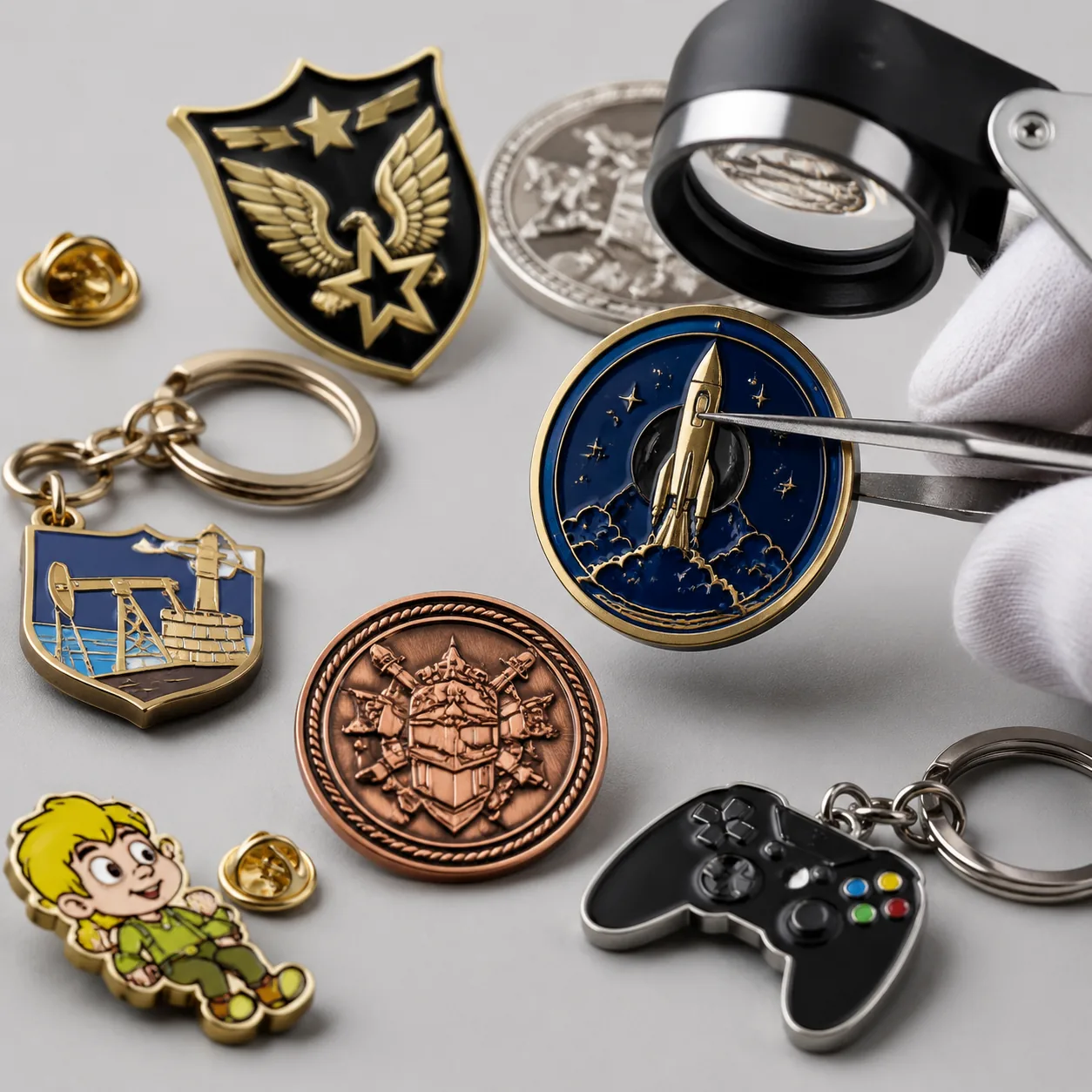
Most arrival claims on custom pins, challenge coins, keychains, badges, magnets and mixed gift sets are not true production defects. Plating, color fill, print registration and final assembly may all pass inspection, yet the goods still arrive scratched, bent or crushed because the pack-out was designed for the wrong freight profile. Typical symptoms are hairline scuffs on polished coin faces, bent pin posts, detached jump rings, warped backing cards, magnet shift, chipped epoxy domes and lanyard ink transfer caused by loose metal hardware inside the retail pack.
The failure usually occurs in the gap between final QC and warehouse receipt. A unit pack that survives a 3 to 5 day express route can fail after 28 to 35 days in LCL sea transit because it sees more vibration cycles, more re-handling, longer dwell time, higher top-load compression and wider humidity swings. In practical terms, a 3,000-piece order that is low risk by courier can become moderate risk by air cargo and high risk by sea if the factory keeps the same bag gauge, inner-box count and master-carton loading.
That is why freight mode should be frozen before final packing approval, not after production finishes. If a buyer switches from express to sea after the goods are already packed, the original spec is often no longer fit for purpose. For metal promotional products, freight is a quality variable that needs its own measurable requirements: pieces per bag, bag thickness in microns, tray or divider type, carton board strength, gross-weight cap, desiccant quantity, pallet rule and hardware-isolation method.
Failure mode 1: abrasion from metal-to-metal contact inside the pack
Abrasion is the most common transit failure on decorative metal goods because the finish is harder than the packaging but still vulnerable to repeated contact. Mirror nickel, imitation gold, bright silver, polished brass, hard enamel flats, UV-printed charm faces and epoxy domes can all mark during transport even when the shipment left the factory clean. The root problem is not only loose bulk packing. Overfilled OPP bags, under-padded inner cartons, exposed clutch tips and unrestrained rings or chains create enough micro-movement to scratch adjacent surfaces during line-haul vibration.
Risk rises with both piece mass and edge hardness. A 42 mm challenge coin at 3.0 to 3.5 mm thickness typically weighs 24 to 32 g in brass and 28 to 36 g in zinc alloy. A 55 mm zinc alloy keychain with ring and short chain often weighs 32 to 45 g. Those parts abrade neighboring items far faster than a 30 mm brass pin at 8 to 12 g. For polished coins, printed charms, black nickel badges and epoxy-face keychains, individual bagging or cavity trays should be the default once transit exceeds about 12 to 15 days. Bulk packing 50 to 100 pieces together is only acceptable for lower-sensitivity finishes such as matte soft enamel or antique plating, and only when exposed hardware is restrained.
The cost logic is straightforward. Upgrading from loose bulk to one-piece-per-bag, or from flat bagging to foam-divider trays, usually adds USD 0.02 to 0.12 FOB per piece depending on labor, tray material and packing density. That is almost always cheaper than a 2% to 5% cosmetic claim rate on a polished or printed SKU. On sea programs, the packing uplift is often the difference between a clean inbound and a dispute over whether the damage happened in production or in transit.
| Product type | High-risk surface or contact point | Recommended inner packing | Typical FOB packing uplift | When to upgrade |
|---|---|---|---|---|
| Soft enamel pin, 25-35 mm | Raised plated lines, exposed clutch rub | Carded, clutch mounted, 25-50 pcs per 50-micron OPP bag | USD 0.01-0.03/pc | Keep for express; upgrade for sea if packed with heavier SKUs |
| Hard enamel pin, 25-35 mm | Polished flat face, edge-to-edge contact | Carded plus individual bag, or 20-30 pcs per tray layer with top pad | USD 0.02-0.05/pc | Upgrade once transit exceeds 15 days |
| Challenge coin, 38-45 mm, 3-4 mm | Mirror rim, raised relief, face-to-face scuffing | 1 pc per bag or EVA/foam recess tray | USD 0.04-0.12/pc | Use for most LCL sea shipments |
| Metal keychain, 45-60 mm | Epoxy or printed face, ring impact, chain impact | 1 pc per bag, ring isolated, 25-50 pcs per partitioned inner box | USD 0.03-0.08/pc | Use when shipment exceeds 20 kg or transit exceeds 10 days |
| Rigid magnet or badge magnet | Decorated face abrasion, magnet-edge chipping | Layer pads plus dividers, no direct face contact | USD 0.03-0.06/pc | Recommended for any sea route above 20 days |
| Patch or lanyard gift set with metal parts | Mixed-material rubbing, snagging, ink transfer | Bag components separately before final set pack | USD 0.03-0.07/set | Recommended for all modes if hardware is exposed |
Failure mode 2: compression, crush and carton collapse under dense loads
Compression damage usually shows up as bent pin posts, warped backing cards, collapsed gift boxes, cracked acrylic lids, dented presentation cases and carton-corner failures. In most cases the cause is measurable: the carton board is too weak, the carton is too heavy, the dimensions are oversized for dense metal contents or heavy SKUs are stacked above fragile retail units. A PO note such as export carton packing is too vague because it leaves the actual board grade and loading pattern open to cost cutting.
For export orders of metal promo goods, ask for defined carton data. A practical baseline is 5-ply corrugated master cartons at roughly 32 ECT or 200 lb burst equivalent. For dense hand-loaded items such as coins, badges and zinc-alloy keychains, cap gross weight at 12 to 15 kg per master carton. If the order includes retail sleeves, rigid gift boxes or carded sets intended for resale, reduce the cap to 8 to 10 kg. That lower limit protects the sales unit from top-load crush during stacking, cross-dock handling and palletized storage.
Inner structure matters just as much as outer board. A folding box made from 300 to 350 gsm SBS or CCNB board may look acceptable in a sample photo but can deform quickly if loaded with 60 to 100 metal pieces. For heavy coins or keychains, specify E-flute partitions, corrugated dividers, chipboard stiffeners or rigid inner boxes. Carton geometry should also stay controlled. Many factories get more stable results around 40 x 30 x 25 cm or smaller because compact masters reduce manual mishandling, lower void space and make pallet patterns more stable.
If the goods are palletized, confirm that cartons do not overhang the pallet deck by more than 10 mm on any side. Corner overhang is a common cause of edge crush during forklift moves and cross-stacking. For FCL programs, stretch wrap plus corner boards typically adds about USD 8 to 18 per pallet FOB. That is a modest cost when the goods include retail presentation packs, paper inserts or acrylic windows that cannot recover once crushed.
Failure mode 3: humidity, tarnish and adhesive creep on long sea routes
Sea-freight damage is not limited to visible impact. On routes running 20 to 35 days, especially in LCL, cartons can see 70% to 95% RH microclimates, container condensation and repeated day-night temperature swings. Bright silver, imitation gold, polished brass-tone and black nickel finishes are more vulnerable if parts are bagged before they are fully dry after plating, washing or polishing. The result may be tarnish bloom, haze inside bags, water spotting in recessed areas or paper cards that bow after absorbing trapped moisture.
For ocean shipments, moisture control needs to be written into the PO. A workable baseline is 40 to 50 micron OPP or self-seal bags, full drying before bagging, liner bags at carton level for sea routes and desiccant inside each sealed inner box or about 10 to 20 g silica gel per 1,000 to 1,500 cc enclosed volume where appropriate. Also prohibit direct contact between polished metal faces and sulfur-bearing paper, low-grade recycled tissue or uncoated inserts that can accelerate tarnish. These controls usually add less than USD 0.01 to 0.03 per piece and are cheaper than replacing a tarnished shipment.
Adhesive-applied accessories need separate controls. Ferrite magnets, rubber magnets, foam pads and some badge fittings can shift if cure time is too short before sealing and container loading. A practical rule is minimum 24 hours cure before bagging and 48 hours before container loading on hot routes above 30°C ambient. If the design allows it, define a simple bond screen such as no accessory lift after a 1 kg pull for 10 seconds on sample units. That is not a formal ASTM or ISTA lab test, but it is a useful production screen for promotional goods.
Paper components also need protection. Backing cards, header cards and instruction inserts should not be packed directly against warm plated goods. If the card must remain flat for retail display, specify an outer bag plus top and bottom pads or increase board grade to 400 gsm or more. Otherwise, buyers often classify warped cards as print-finishing failure when the actual cause is trapped moisture in the sealed unit pack.
Failure mode 4: puncture, snagging and deformation from exposed hardware
Hardware often creates secondary damage inside an otherwise intact carton. Butterfly clutches, rubber clutches, deluxe clutches, brooch bars, split rings, chains, jump rings and badge clips can puncture bags, dent decorated faces, snag patch merrow borders or rub ink off lanyards. This is especially common in mixed gift sets where one metal component damages every softer component inside the same retail pack.
Pin posts deserve explicit dimensional control. For standard lapel pins, a post diameter of 1.2 to 1.4 mm is materially more stable than thin posts below 1.0 mm, especially in air cargo and sea shipments. Require clutches to be mounted before bagging so the post tip is not exposed. For badges wider than about 45 mm, or for tall asymmetrical shapes, specify dual posts or a brooch fitting to reduce leverage. It is also reasonable to define post alignment tolerance, for example no visibly off-angle post beyond 5 degrees from perpendicular on inspection samples, because posts that start skewed will bend more in transit.
For keychains, isolate the split ring or chain from the decorated face. A small sub-bag around the emblem, a foam square or a folded tissue separator that keeps the ring off the logo area prevents repeated impact marks. For lanyard sets with reels, buckles or clips, keep metal hardware separated from the printed polyester strap to prevent ghosting, oil transfer and edge snagging. These steps can add 1 to 3 packing days on runs above 5,000 pieces, but they are predictable labor costs rather than unpredictable claim costs.
2026 freight-mode trade-offs: savings hold only when pack-out changes too
In 2026, freight choice is not simply express versus sea on rate. It is a combined decision on geometry, finish sensitivity, route severity, carton density and pack-out cost. Express remains the safest option for urgent launches, approval samples and small runs under roughly 2 master cartons or 60 to 80 kg chargeable weight. Air cargo suits mid-volume orders that need 7 to 12 day transit without courier pricing. Sea freight is attractive for heavier repeat programs, but only when the protective packing is upgraded for vibration, humidity and stacking.
Typical transit windows remain about 3 to 6 days door-to-door for express, 7 to 12 days airport-to-door for air cargo, 25 to 40 days for LCL sea and 22 to 35 days for FCL sea, excluding customs and port congestion. Buyers can often save USD 200 to 800 by moving a medium order from air to sea, but that saving disappears quickly if a 3% cosmetic claim, missed launch date or partial repack hits the program. Sensitive finishes, mixed-material sets and exposed hardware are the categories most likely to turn nominal freight savings into false economy when the original air pack-out is reused for sea.
Budget the protection correctly. On sea shipments of polished coins, epoxy keychains or mixed gift sets, additional FOB packing cost usually falls in the USD 0.03 to 0.15 per piece range with 1 to 3 extra packing days. That small increase typically buys divider trays, desiccant, liner bags, lower carton weights, more labor for hardware isolation and sometimes better palletization. Those are process controls, not optional extras.
| Freight mode | Transit profile | Typical lead time | Best use case | Most common under-pack failure |
|---|---|---|---|---|
| Express | Low dwell time, moderate shock | 3-6 days | Urgent launches, samples, low carton count | Localized impact or corner crush |
| Air cargo | Moderate handling, moderate stacking | 7-12 days | Mid-volume orders needing speed below express cost | Abrasion in loose bulk, bent hardware |
| LCL sea | High vibration, shared stacking, high humidity exposure | 25-40 days | Cost-driven repeat orders with upgraded export packing | Scuffing, tarnish, carton crush, SKU migration |
| FCL sea | Lower random handling than LCL but still humid and stack-sensitive | 22-35 days | Large stable programs with palletized loads | Moisture issues, compression from weak pallet patterns |
QC checkpoints that catch transit risk before dispatch
Standard pre-shipment inspection is necessary, but it misses many freight-created failures if the packed state is not checked. Appearance, plating color, logo placement and quantity matter, but packed-product behavior matters just as much. Inspectors should verify that the approved unit pack, inner pack and master carton actually match the confirmed freight mode and that measured carton weight and dimensions stay within the approved limits.
For practical control, require three approvals before dispatch: a unit-pack photo, an inner-carton photo showing count and dividers, and a master-carton photo showing dimensions and gross-weight marking. On higher-risk orders, add simple transport simulation. A packed inner-box shake test should not create visible face-to-face contact after 15 to 20 seconds. A drop test from 60 cm on edges and corners is a useful screen for air shipments; 80 cm is reasonable for stronger sea-freight pack-outs. The goal is not laboratory certification. It is early detection of weak packing logic before the goods leave the factory.
Acceptance criteria should distinguish manufacturing defects from packing defects. A scratched face found before bagging is a product defect. Clean goods that scratch during a controlled shake test indicate a packing defect. Bent posts caused by poor solder position are production failures; bent posts caused by exposed tips in overfilled bags are pack-out failures. That distinction matters because it tells the supplier which process must be corrected.
Use realistic sampling language. AQL 2.5 for major defects and 4.0 for minor defects is common for promotional products, but packed-state checks should be more targeted than random appearance sampling alone. On mixed-SKU orders, inspect the heaviest SKU and the most surface-sensitive SKU first because those two usually drive the arrival complaint rate. For any order above 5,000 pieces or above 30 master cartons, it is also prudent to open cartons from the top, middle and bottom pallet layers rather than sampling from one accessible stack only.
- Freeze freight mode before final packing approval and booking
- Cap master carton gross weight at 12-15 kg, or 8-10 kg for retail-boxed sets
- Specify bag thickness, divider style, carton board grade and inner-box structure in writing
- Use individual bagging or trays for mirror, printed, UV or epoxy-finished surfaces
- Add desiccant and liner-bag requirements for sea transit above 20 days
- Isolate rings, chains, posts and clips from decorated faces and textile components
- Approve packed-unit, inner-carton and master-carton photos before dispatch
- Allow 1-3 extra packing days when upgraded protection is required
What the PO should say so the factory can execute without guesswork
Instructions such as pack carefully or export safe do not control anything on the line. A usable PO converts freight risk into measurable requirements: unit pack, pieces per inner box, bag thickness, divider type, carton grade, gross-weight cap, humidity control, hardware isolation, adhesive cure time, freight mode and acceptable tolerance. If those details are missing, purchasing optimizes for cost, packing staff optimize for speed and QC inspects against an incomplete standard.
A strong PO line for a 3,000-piece sea-shipped keychain order might read: zinc alloy keychain, 55 mm overall, 4.0 mm emblem thickness, black nickel plating, epoxy logo face, MOQ tier 3,000 pcs, each piece in individual 50-micron OPP bag, split ring isolated from logo face, 25 pcs per partitioned inner box, 5-ply 32 ECT master carton, max 12 kg gross, carton liner bag plus desiccant for sea shipment, adhesive accessory cure minimum 24 hours before pack-out and 48 hours before loading. If the quoted FOB unit price is USD 1.10 to 1.85 depending on plating and epoxy area, the upgraded pack-out usually accounts for only a small share of the delivered cost.
For pins, a practical PO line could read: hard enamel pin, 30 mm, brass base, dual posts, post diameter 1.2 mm plus or minus 0.1 mm, deluxe clutch mounted before bagging, carded, each card in individual bag, 50 cards per inner box with top and bottom pads, 5-ply master carton, max 10 kg gross, AQL 2.5 major and 4.0 minor. Typical MOQ tiers might be 100, 300, 500 and 1,000 pcs, with FOB pricing around USD 0.55 to 1.10 per piece depending on size, plating and backing card. For challenge coins, a comparable line could specify 42 mm diameter plus or minus 0.15 mm, 3.5 mm thickness plus or minus 0.10 mm, bright gold finish, one piece per bag, 25 pcs per EVA tray layer, 100 pcs per inner box, desiccant and liner bag required for LCL sea. At 500 to 3,000 pcs, a common FOB range is roughly USD 1.20 to 2.80 per coin depending on relief depth and plating.
The lowest-claim programs usually share one discipline: the buyer approves pack-out at the same time as artwork, finish and hardware, not at the end. That gives the factory time to source the correct bags, trays, dividers, inner boxes and pallet materials before mass production starts. Once the goods are finished, late packing changes often lead to rushed repacking, substitute cartons, unstable carton counts or missed sailings. That is where avoidable freight damage usually begins.
Have a project? Send your artwork and target quantity and we’ll reply with a detailed quotation within 12 working hours.
Ready to get this made?
Send your sketch, target quantity and ship-date. Detailed quotation in 12 hours.



