FOB, EXW or DDP for Custom Pins: A Buyer Scenario
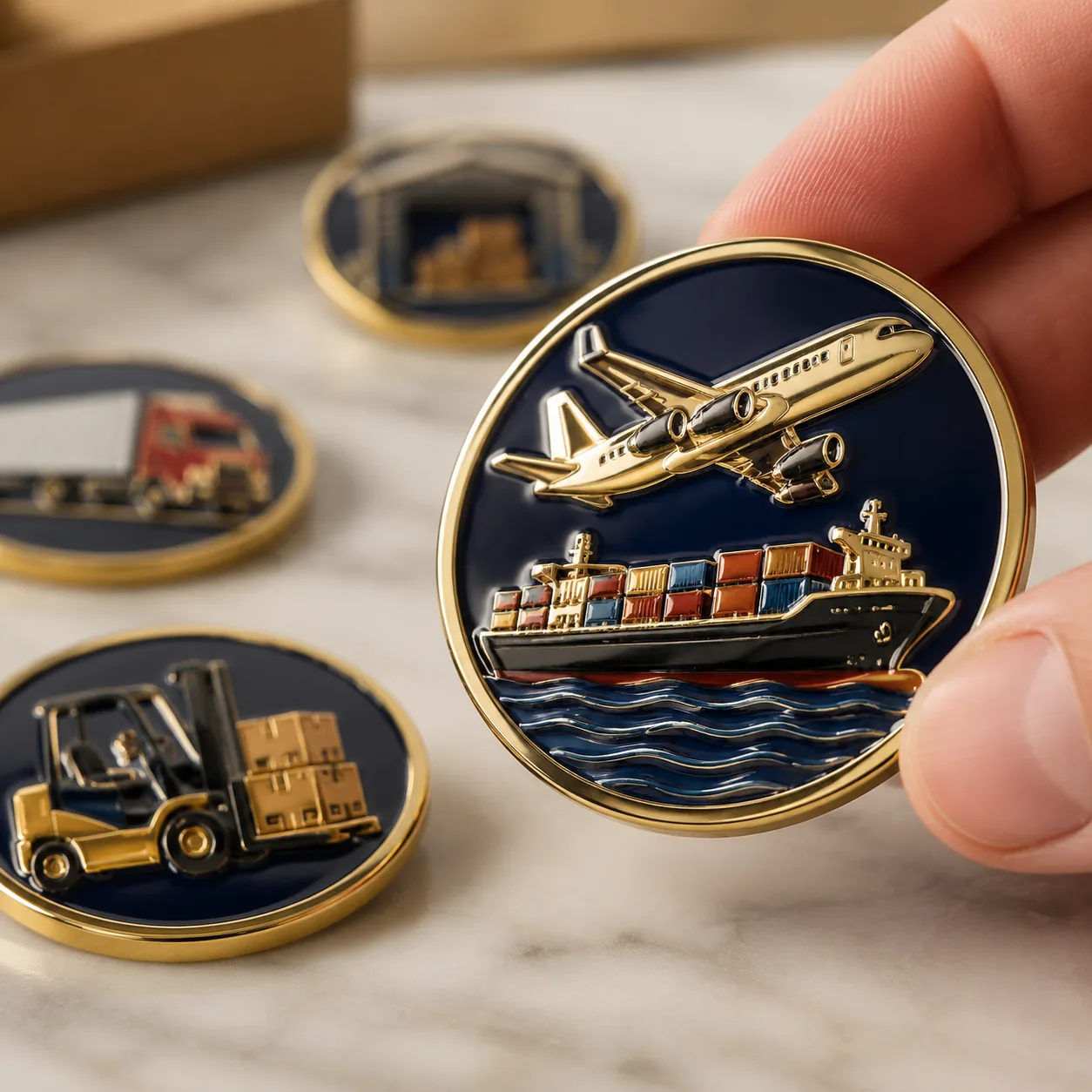
Scenario: the unit price is clear, but the landed cost is not
A promotional-products distributor in Germany needs 8,000 soft enamel pins and 1,200 challenge coins for a technology conference in Hamburg. The event is 74 days after artwork approval, and the buyer wants stock delivered 10 days before the show for kitting. The first factory quote looks straightforward: USD 0.72 per 30 mm pin and USD 2.85 per 45 mm coin, both FOB Ningbo. The real purchasing question is not whether the unit price is attractive. It is whether EXW, FOB or DDP gives the most reliable landed cost and the lowest delivery risk.
Small metal products such as pins, coins, keychains and magnets are dense and carton-efficient, so the product price can look low while logistics add 8 to 35 percent to the delivered cost. The risk is not only freight. Export declaration, pickup timing, carton markings, import duty, VAT handling, destination terminal charges, inspection timing and failed delivery appointments can all change the final cost.
For this scenario, the pins are 30 mm iron soft enamel, 1.2 mm thick, nickel plated at 5 to 8 microns, butterfly clutch, backing card and individual polybag. The coins are 45 mm zinc alloy die-cast challenge coins, 3.0 mm thick, antique gold plated at 6 to 10 microns, two-sided 2D relief, no enamel and individual OPP bag. Production is in Yiwu, with export via Ningbo or Shanghai depending on sailing and air capacity.
Lock specifications, MOQ tiers and packed volume before choosing terms
Incoterms should be compared only after the product specification is stable. A change from no card to backing card, from standard clutch to rubber clutch, or from 1.2 mm to 1.5 mm iron changes carton count, gross weight and inspection time. For metal pins and coins, the RFQ should fix size, thickness, base metal, plating, enamel process, attachment, packaging, carton limit and inspection level.
Typical MOQ tiers also affect the quote. For soft enamel pins, a workable factory MOQ is often 100 to 300 pcs per design, but export pricing becomes more stable at 1,000 pcs and better again at 5,000 pcs. A 30 mm iron soft enamel pin may price at roughly USD 1.20 to 1.80 FOB at 300 pcs, USD 0.82 to 1.10 at 1,000 pcs, and USD 0.58 to 0.82 at 5,000 to 10,000 pcs, depending on color count, cutouts and packaging. Challenge coins are heavier and tooling is more expensive: a 45 mm zinc alloy coin may run USD 4.20 to 6.50 FOB at 300 pcs, USD 3.10 to 4.20 at 1,000 pcs, and USD 2.45 to 3.30 at 3,000 pcs.
For the current order, the 8,000 pins pack at 100 pcs per inner box and 1,000 pcs per export carton. A 30 mm pin with clutch, card and polybag normally weighs 8 to 12 g per set, so each carton is about 11 to 14 kg gross. The 1,200 coins pack at 100 pcs per inner box and 400 pcs per export carton. A 45 mm zinc alloy coin at 3.0 mm thickness usually weighs 35 to 45 g, so each coin carton is about 17 to 21 kg gross.
| Line item | Planning specification | Packing estimate | Weight and volume estimate |
|---|---|---|---|
| Soft enamel pins | 30 mm iron, 1.2 mm, 5-8 micron nickel, 4 enamel colors, clutch, card + polybag | 1,000 pcs/carton; 8 cartons; carton approx. 34 x 26 x 24 cm | 88-112 kg gross; approx. 0.17 CBM |
| Challenge coins | 45 mm zinc alloy, 3.0 mm, 6-10 micron antique gold, two-sided 2D relief, OPP bag | 400 pcs/carton; 3 cartons; carton approx. 32 x 24 x 22 cm | 51-63 kg gross; approx. 0.05 CBM |
| Total shipment | 11 cartons from Yiwu to Hamburg | 5-ply K=A or K=K export cartons; no mixed SKU cartons | 145-175 kg gross; chargeable LCL volume often billed at 0.30-1.00 CBM minimum |
EXW Yiwu: lowest factory price, highest coordination burden
EXW Yiwu means the supplier makes finished goods available at the factory or warehouse. The buyer’s forwarder handles pickup, China domestic trucking, export declaration, customs documents, terminal handling, main freight, import clearance and final delivery. EXW can work for importers with a contracted China forwarder and regular consolidations. It is weak for one-off event orders because every missed handoff costs calendar days.
An EXW quote for this order might be USD 0.69 per pin and USD 2.78 per coin, about USD 5,520 for pins and USD 3,336 for coins, or USD 8,856 total. That looks USD 324 cheaper than the FOB example. However, for a small 0.30 CBM to 1.00 CBM minimum LCL shipment, China-side pickup, document and export handling may add USD 180 to 380. If the forwarder needs supplier assistance for export declaration, additional service charges or delays can erase the EXW saving.
EXW also reduces factory accountability for export timing. If the buyer’s forwarder collects late, books Shanghai while the supplier planned Ningbo, or asks for documents after cargo is packed, the shipment can miss a vessel closing date. For event cargo, one missed LCL cut-off can cost 7 days. ZheCraft can support EXW when the buyer names a forwarder before deposit payment, but we normally advise first-time or deadline-sensitive buyers to compare FOB and DDP first.
- Use EXW when your forwarder already consolidates Yiwu or Zhejiang cargo weekly.
- Avoid EXW for first orders under 1 CBM if you do not have confirmed China pickup and export declaration charges.
- Give the supplier the forwarder contact, warehouse address, booking cut-off and document template before production finishes.
- Require final carton dimensions, gross weight and SKU count before the forwarder books space.
- Confirm whether the supplier will provide a China export license or whether the forwarder exports under its own entity.
FOB Ningbo or Shanghai: the clean baseline for B2B buyers
FOB Ningbo or FOB Shanghai is usually the cleanest basis for distributors and procurement teams. Under FOB Incoterms 2020, the supplier covers China local trucking, export declaration and delivery to the nominated port or forwarder-controlled export point. The buyer controls international freight, cargo insurance, import customs, duty, VAT and final delivery.
For this order, a realistic FOB range is USD 0.72 to 0.78 per pin and USD 2.85 to 3.10 per coin. The variation comes from enamel color count, mold complexity, plating finish, attachment, card printing and inspection requirements. Compared with EXW, FOB may add USD 0.02 to 0.06 per pin and USD 0.05 to 0.15 per coin, or roughly USD 250 to 600 total. That uplift is usually easier to manage than separate pickup, declaration and local handling invoices.
FOB also supports proper quality control. Final inspection can be done at the Yiwu facility after packing but before the goods leave for port. For 9,200 total pieces, a typical inspection plan is ANSI/ASQ Z1.4 general inspection level II, normal severity, single sampling. For an 8,000-piece pin lot, the sample size is commonly 200 pcs under code letter L; for a 1,200-piece coin lot, 125 pcs under code letter K. A common acceptance level is AQL 2.5 for major defects and AQL 4.0 for minor defects. Critical defects should be zero tolerance.
Practical defect definitions should be written before production. Major defects include wrong logo, wrong plating color, missing attachment, sharp burrs, broken clutch, incorrect size outside tolerance, or enamel color not matching approved Pantone reference. Minor defects include small polishing marks, light plating shade variation, tiny enamel specks or packaging wrinkles that do not affect use. Working tolerances for these items are normally size ±0.3 mm, thickness ±0.15 mm and plating thickness within the approved micron range.
DDP: convenient for events, but check what is really included
DDP means the seller is responsible for delivery to the named destination and, in principle, import clearance and duties. It is attractive when the buyer has no freight team or when the goods must reach an event address with minimal internal handling. It is not always the cheapest or most transparent option, especially in the EU where importer-of-record and VAT treatment must be correct.
For 11 cartons and 145 to 175 kg gross weight, DDP air from eastern China to a commercial address in Germany may quote at about USD 4.80 to 7.50 per kg in normal season, or USD 7.50 to 10.50 per kg during peak weeks. Express courier can be faster but may price higher for dense cartons and remote delivery. DDP sea or rail can be cheaper, often USD 1.20 to 2.80 per kg equivalent on small dense cargo, but door-to-door transit may be 35 to 55 days and is not ideal when the event buffer is short.
The buyer must ask what the DDP quote includes. Some offers include duty but not VAT. Some cover delivery only to a warehouse or office, not an exhibition hall with time-slot unloading. Some exclude customs inspection storage, failed delivery, tail-lift service or address correction. For EU shipments, ask who acts as importer of record, what HS code is used, and whether the goods are declared as promotional metal badges, zinc alloy medals or another category. A cheap DDP channel that cannot provide compliant import records may create accounting and resale problems.
| Term | Best fit | Main buyer risk | Cost visibility |
|---|---|---|---|
| EXW Yiwu | Experienced importers with China forwarders and weekly consolidations | Pickup delay, export declaration confusion, fragmented local charges | Low at quote stage; depends on forwarder billing |
| FOB Ningbo/Shanghai | Distributors controlling freight, insurance and import clearance | Buyer still manages main freight, duty, VAT and destination delivery | Good; product and China-side export costs are separated |
| DDP Hamburg address | Event teams needing one delivered price and limited logistics work | Higher cost, less duty/VAT detail, delivery exceptions at venues | Simple total price; lower line-item transparency |
Build the schedule from the event date backward
The order has 74 days from artwork approval and must arrive 10 days before the conference, leaving 64 usable days. Tooling and pre-production samples for enamel pins and challenge coins usually take 7 to 12 days after vector artwork approval. Mass production for 8,000 pins and 1,200 coins normally takes 18 to 25 days after sample approval for standard plating. Add 2 to 4 days if the order includes epoxy doming, sequential numbering, individual barcode labels or complex two-tone plating.
That leaves about 27 to 39 days for inspection, rework if needed, export, freight, customs and delivery. FOB ocean LCL from Ningbo or Shanghai to Hamburg is commonly 35 to 45 days port to port, plus 5 to 10 days for consolidation, customs and truck delivery. It is too tight unless production finishes early. Air freight from Shanghai, Hangzhou or Ningbo to Germany usually needs 5 to 9 days airport to airport and 2 to 5 days for customs and final delivery. DDP air should still be planned with a 10 to 14 day buffer, not treated as overnight freight.
A practical solution is a split shipment. Send 1,500 pins and 300 coins by DDP air for booth kits, VIP packs and staff use. Ship the balance by FOB sea LCL or air economy depending on the post-event distribution plan. Split shipping may add USD 80 to 180 for separate packing, labels and handling, but it is usually cheaper than moving the full 145 to 175 kg by urgent express after a schedule slip.
- Day 0: final vector artwork, Pantone references and packaging method approved.
- Day 1-3: digital proof and proforma invoice confirmed; deposit paid.
- Day 7-12: tooling and pre-production samples completed.
- Day 13-38: mass production, plating, enamel fill, polishing and packing.
- Day 39-41: final inspection under agreed AQL; carton photos and packing list issued.
- Day 42-55: safe window for DDP air to Germany, including customs and delivery.
- Day 42-64: only use sea LCL if production finishes early and the buyer accepts schedule risk.
Compare landed cost per usable piece, not quote price only
The FOB product value at the quoted baseline is USD 5,760 for pins and USD 3,420 for coins, or USD 9,180 total. If buyer-controlled air freight costs USD 850 to 1,350 for 145 to 175 kg, the pre-duty landed value becomes about USD 10,030 to 10,530 before import duty, VAT and local delivery. Sea LCL may show an ocean freight line of only USD 180 to 350, but destination terminal handling, documentation, customs entry and delivery can add USD 250 to 600. The cheapest freight line is not always the cheapest landed result.
For many EU entries, import duty on metal promotional goods may be low to mid single digits depending on HS classification and material, while VAT is a cash-flow issue rather than a product cost for VAT-registered companies that can reclaim it. The buyer should still model VAT at the local rate on customs value plus duty and freight if cash timing matters. Insurance is inexpensive and should not be ignored on event cargo; marine cargo insurance often costs around 0.3 to 0.6 percent of insured value with a minimum premium.
Also calculate usable quantity. AQL inspection does not mean zero cosmetic defects. For event-critical packs, request a 1 to 2 percent spare quantity or order paid overage. On 8,000 pins, 100 to 160 extra pieces is a sensible buffer for scratches, bent posts, clutch loss during kitting or last-minute guest additions. The spare cost is usually lower than an emergency remake, especially when tooling and plating lines must be reopened.
Write the responsibility points into the purchase order
Most incoterm disputes start with vague wording such as “FOB China” or “DDP Europe.” The purchase order should state the named place and rules: “FOB Ningbo Port, Incoterms 2020,” “EXW Yiwu factory address, Incoterms 2020,” or “DDP buyer warehouse, Hamburg full address, Incoterms 2020.” Add the required delivery date, cargo-ready date, inspection point, insurance responsibility and who pays storage, re-delivery or failed appointment fees.
Carton rules should be equally specific. Mark each carton with item number, PO number, SKU, country of origin if required, carton count such as 1/11 to 11/11, gross weight, net weight and dimensions. Do not mix pins and coins in the same carton unless the kitting team requests mixed packs. For this weight profile, keep pin cartons at or below 15 kg gross and coin cartons at or below 20 kg gross unless the buyer approves heavier cartons.
For the next RFQ, send artwork, target quantity, delivery city, required arrival date, packaging method and preferred incoterm in the first email. Ask for MOQ tiers, production days, sample days, carton count, gross weight, CBM and EXW/FOB/DDP options. For most distributors, FOB is the best baseline. For buyers with strong China logistics, EXW can save money. For fixed event dates, quote a DDP air split for the critical quantity before the production clock starts.
Have a project? Send your artwork and target quantity and we’ll reply with a detailed quotation within 12 working hours.
Ready to get this made?
Send your sketch, target quantity and ship-date. Detailed quotation in 12 hours.



