First Import Workflow for Custom Metal Giveaways
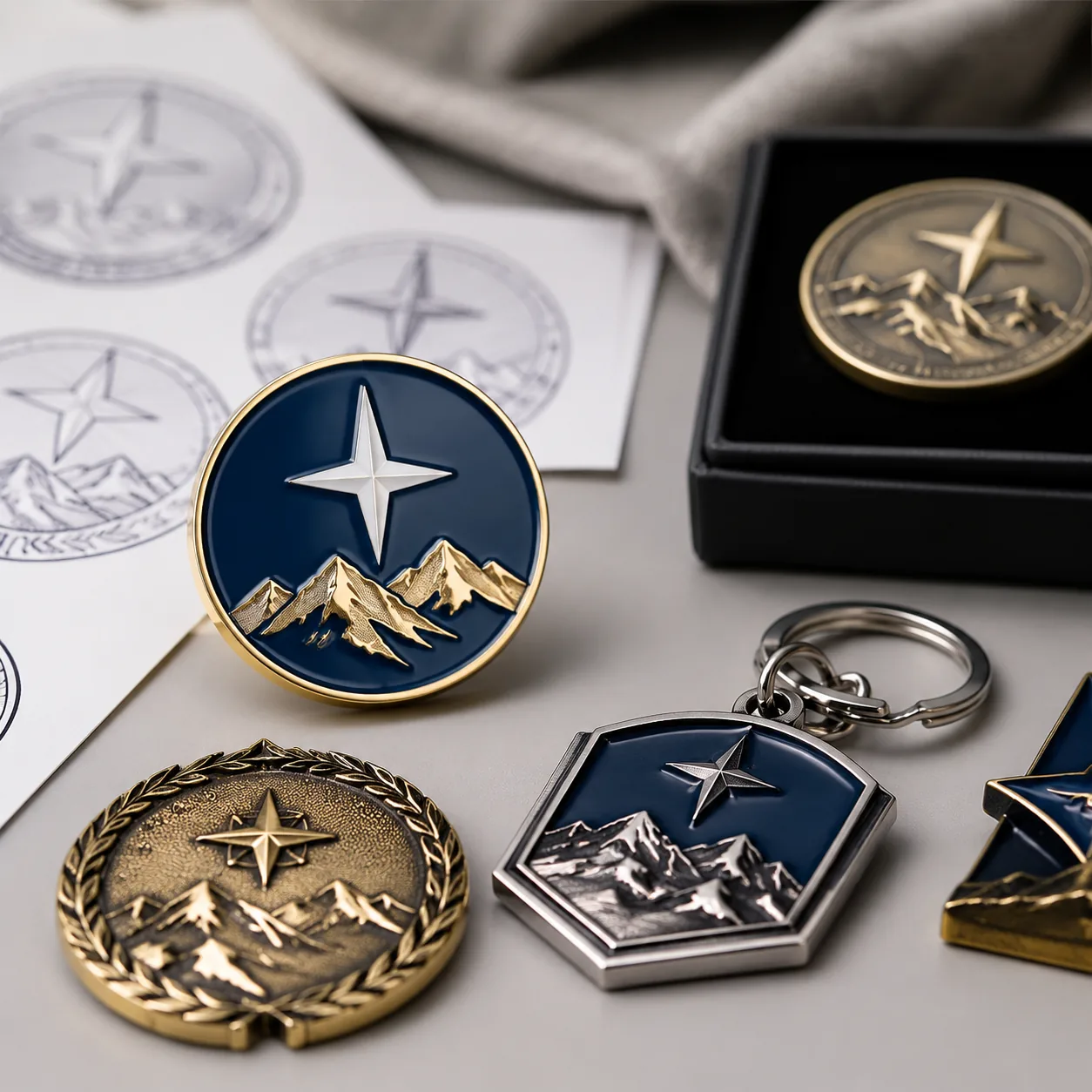
Lock One Importable SKU Before RFQ
For a first import order, the largest avoidable risk is not simply choosing the wrong factory. It is asking several suppliers to price different versions of the item and then treating the answers as comparable. Freeze one importable SKU before requesting prices. A usable first SKU is specific: 30 mm soft-enamel iron lapel pin, 1.2 mm nominal thickness, nickel plating 3-5 microns, two Pantone colors, recessed enamel, butterfly clutch, individual 0.04 mm OPP bag, 500 units, FOB Shenzhen, ship-ready by 2026-05-15.
Define the item type, artwork revision, dimensions, base metal, finish, color count, attachment, packaging, MOQ expectation, destination country, compliance use case, and required ship-ready date. If a feature is undecided, price it as an option rather than leaving it open. For example, ask for 500, 1,000, 2,500, and 5,000 units with butterfly clutch as the base, plus adders for rubber clutch, magnetic backing, epoxy dome, retail backing card, and individually printed QR code label.
Tie the SKU to the distribution method. A pin handed out loose at a trade show can tolerate simpler packaging than a retail-ready gift set. A metal keychain in mailed kits needs stronger attachment testing and abrasion protection. A children's promotional item may trigger CPSIA or destination-market testing that an adult corporate giveaway does not. Suppliers can advise on manufacturability, but they should not have to infer the use case.
Send a Controlled RFQ Pack
A useful RFQ is a controlled quote pack, not a chat message asking for a custom metal item price. Include vector artwork in AI, EPS, or editable PDF; a marked drawing with width, height, and thickness; Pantone Solid Coated references or approved brand colors; backing and packaging requirements; quantity tiers; destination country; compliance assumptions; and the date goods must be available for shipment. Ask each supplier to quote tooling, pre-production sample cost, unit price, export carton estimate, sample lead time in calendar days, bulk production lead time in calendar days, payment terms, and the Incoterm with named port or place.
Use one file revision across all suppliers. Name files clearly, such as ACME_pin_R3_2026-03-14.pdf, and state that all pricing must reference that exact revision. Keep the RFQ, supplier questions, and final clarifications in one thread or shared folder. Small undocumented changes change cost: moving from 25 mm to 35 mm increases metal area and die size; adding a third enamel color adds filling and inspection labor; changing iron to zinc alloy changes mold cost, edge detail, weight, and minimum practical thickness.
For custom metal giveaways, specify tolerances early. A practical first-order tolerance set is overall size +/-0.3 mm, thickness +/-0.2 mm, pin post position +/-1.0 mm, visible enamel contained inside metal lines, no exposed base metal on front face, no sharp burrs on handled edges, and plating thickness 3-5 microns unless the finish is a flash decorative finish agreed separately.
Compare Quotes by Total Import Risk
The lowest unit price is often incomplete rather than efficient. For a 30 mm soft-enamel iron pin, FOB China pricing commonly falls around USD 0.42-0.85 at 500 units, USD 0.34-0.68 at 1,000 units, USD 0.28-0.55 at 2,500 units, and USD 0.23-0.48 at 5,000 units, depending on metal, plating, color count, attachment, and packing. Tooling may add USD 45-140 per design. A physical sample may cost USD 35-90 plus courier freight. Magnetic backing can add USD 0.12-0.40 per unit; epoxy dome often adds USD 0.05-0.15; a printed retail card with bag can add USD 0.04-0.12.
Build a decision sheet before negotiating. Put unit price beside tooling, sample policy, lead time, payment terms, packing method, carton dimensions, shipment term, response quality, and defect prevention. Typical supplier MOQ is 100-300 units for simple pins or medals, but price breaks are usually meaningful at 500, 1,000, 2,500, and 5,000 units. A supplier quoting 7-12 days for sampling and 15-25 days for bulk after sample approval is usually more credible than one promising a custom die, plating, enamel, packing, and export in one week.
| Decision area | Lower-risk first-order default | Numeric target | When to adjust |
|---|---|---|---|
| Quote basis | Same artwork revision, same quantity tiers, same Incoterm and named place | Quote 500, 1,000, 2,500, and 5,000 units FOB; tooling and sample charges separate | Revise only after every bidder receives the same updated RFQ pack |
| Product tolerance | Written tolerance for size, thickness, finish, color, attachment, and packaging | Size +/-0.3 mm; thickness +/-0.2 mm; pin post position +/-1.0 mm; plating 3-5 microns | Tighten for assembly fit, retail display alignment, or premium gift programs |
| Sample approval | Physical pre-production sample before bulk release | Sample 7-12 days after artwork approval; courier 3-5 days to many US or EU addresses | Use photo approval only for stable reorders or low-value internal giveaways |
| Payment terms | Deposit with balance after passed inspection and before shipment release | Common first order: 30% deposit, 70% after final inspection pass | Negotiate credit terms only after repeated on-time, conforming shipments |
| Inspection standard | Final random inspection when goods are complete and export cartons are packed | ANSI/ASQ Z1.4 or ISO 2859-1, General Level II, AQL 0 critical, 2.5 major, 4.0 minor | Add in-process inspection for retail packs, tight color standards, plating risk, or orders above 10,000 units |
Turn the Quote Into a Proforma Control
After supplier selection, the proforma invoice becomes the first commercial control document. It should state SKU description, artwork revision, dimensions, material, finish, enamel or decoration method, attachment, packaging, quantity, tooling charge, sample charge, unit price, Incoterm, named port or place, production lead time, payment schedule, inspection requirement, and export document responsibility. If acceptance depends on a detail, place it in the proforma or in a referenced specification sheet, not only in chat.
Check the payment beneficiary before sending money. The company name, invoice issuer, bank account, and supplier identity should match the business you approved. If the beneficiary changes late, pause and verify through a separate channel. Also confirm the remedy for supplier-caused nonconformity. A practical clause is that nonconforming goods must be corrected before balance payment, with replacement units, repair, resampling, or remake at supplier cost when the approved specification was missed.
- Confirm the proforma references the exact artwork revision, specification sheet, and approved quote date.
- Separate tooling, sample, unit price, courier, freight, testing, and bank charges instead of blending them into one total.
- State sample lead time and bulk lead time separately, in calendar days after deposit, artwork approval, and sample approval.
- Define tolerances: size +/-0.3 mm, thickness +/-0.2 mm, plating 3-5 microns, no sharp burrs, and attachment pull strength suitable for normal handling.
- Confirm AQL level, defect classes, carton marks, inner packing, carton quantity, and export documents before production begins.
- Verify that the payment beneficiary matches the approved supplier before wiring the deposit.
Approve the Sample as the Standard
A sample is not a concept reference. It is the physical production standard that bulk goods must match, with approved changes documented beside it. For custom metal giveaways, a physical sample is usually worth the added time because photos can hide weight, attachment grip, plating tone, edge burrs, enamel sink, glitter density, epoxy thickness, bag fit, and retail card alignment. Photo approval is better reserved for stable reorders where tooling, finish, and packaging have already passed inspection.
Inspect the sample under neutral light and compare it against the RFQ pack. Measure overall size, thickness, post location, and magnet or clasp placement with calipers. For a 30 mm pin, size within +/-0.3 mm and thickness within +/-0.2 mm are reasonable for most promotional use. Check that enamel stays inside raised metal lines, backstamps are legible, plating coverage is even at edges, and the clutch or magnet holds through normal handling. For retail cards, verify hang hole size, barcode quiet zone, bag seal width, suffocation warning where required, and card stock weight, often 250-350 gsm for basic retail presentation.
Use a numbered approval sheet. Approval language should be precise: approved as is, approved with listed changes, or revise and resample. If you accept a small flaw, define the limit. Minor enamel sink below 0.15 mm may be acceptable on a low-cost event pin, but exposed base metal, loose attachments, wrong Pantone family, sharp burrs, plating flaking, illegible logo text, or incorrect safety labeling should block bulk release.
Release Bulk With Checkpoints
Bulk production should start only after the supplier confirms the approved sample standard and the open issue list. Ask for a schedule showing tooling, stamping or casting, trimming, polishing, plating, enamel filling or printing, curing, attachment, packing, and planned final inspection date. Typical bulk lead times after sample approval are 12-20 days for simple pins, 18-30 days for medals, coins, bottle openers, or keychains, and 25-40 days for complex multi-process pieces or orders above 10,000 units.
Lock the features the supplier may not change without written approval: base metal, attachment, plating color, enamel type, Pantone colors, epoxy, packaging, carton quantity, logo position, barcode, warning label, compliance test requirement, and carton mark. Some variation is normal in hand-filled enamel and polishing, but product identity and function should not drift. If the supplier proposes a substitute clutch, magnet, plating bath, bag thickness, card stock, or carton count, ask for the reason, cost impact, timing impact, and photos before accepting it.
For higher-risk orders, request an early production photo set when 10-20% of units are complete. Require front, back, side edge, attachment, packing, carton label, and a ruler or caliper in frame. This checkpoint does not prove batch quality, but it catches wrong backstamp, reversed colors, weak enamel fill, plating tone error, retail card orientation, or missing barcode while correction is still possible.
Inspect Before Payment and Shipment
Plan final inspection when production is complete and export cartons are packed, but before balance payment and shipment release. Check goods against the approved sample, proforma invoice, artwork revision, packaging specification, and carton marks. For first orders, use ANSI/ASQ Z1.4 or ISO 2859-1 sampling instead of opening a casual handful. A common promotional-products setting is General Inspection Level II with AQL 0 critical, 2.5 major, and 4.0 minor. For 1,000 units under General Level II, the typical sample size is 80 pieces; under AQL 2.5 major, acceptance is usually 5 major defects or fewer and rejection at 6, depending on the exact table used.
Classify defects before inspection starts. Critical defects include unsafe sharp points, broken metal, failed applicable lead or nickel testing, and serious choking-hazard or suffocation-warning errors. Major defects include wrong artwork, wrong attachment, loose pin posts, plating peel, missing units, wrong packaging, unreadable barcode, and color visibly outside the approved range. Minor defects include small polishing marks, tiny enamel specks, light bag wrinkles, or minor carton scuffs that do not affect use or brand presentation.
Shipping is part of sourcing control. Confirm carton count, gross weight, carton dimensions, commercial invoice, packing list, declared product description, HS code guidance, and handoff point under the agreed Incoterm. Courier can work for samples and urgent small orders. Air freight often suits event deadlines. Sea freight becomes relevant when volume and weight justify the longer transit, often 25-45 days port to port depending on lane. Ask a forwarder to review documents before goods move if you are new to the destination market.
Close With a Reorder Pack
When goods arrive, close the loop while the details are still fresh. Count cartons, inspect random units, photograph any transit damage, and compare delivered goods with the approved sample. Record actual sample lead time, bulk lead time, inspection results, carton dimensions, gross weight, landed cost assumptions, supplier responsiveness, and changes needed next time. The purpose is to make the second order faster because the evidence from the first order is organized.
- Save the RFQ pack, supplier quote, comparison sheet, final proforma invoice, artwork files, sample approval sheet, inspection report, shipment documents, delivery photos, and defect log.
- Record the final approved specification: dimensions, material, plating microns, enamel type, attachment, packaging, carton quantity, carton size, gross weight, and compliance test status.
- Keep one approved physical sample in a labeled bag with supplier name, PO number, production date, artwork revision, and inspection report number.
- Update reorder tiers using real demand: 500 for pilot demand, 1,000-2,500 for event programs, and 5,000+ when freight, tooling, and supplier performance are proven.
- Note every approved deviation so the next buyer does not reject a feature that was intentionally accepted.
- Review whether the supplier met sample lead time, bulk lead time, inspection cooperation, document accuracy, and defect-rate expectations before reordering.
A controlled first import order moves decisions from chat into specifications, from specifications into a physical sample, and from the sample into inspected bulk goods. Once that chain exists, supplier conversations become more precise, disputes are easier to resolve, and reorders no longer depend on memory.
Have a project? Send your artwork and target quantity and we’ll reply with a detailed quotation within 12 working hours.
Ready to get this made?
Send your sketch, target quantity and ship-date. Detailed quotation in 12 hours.



