First Import Spec Sheet for Custom Pins: 12 Lines That Matter
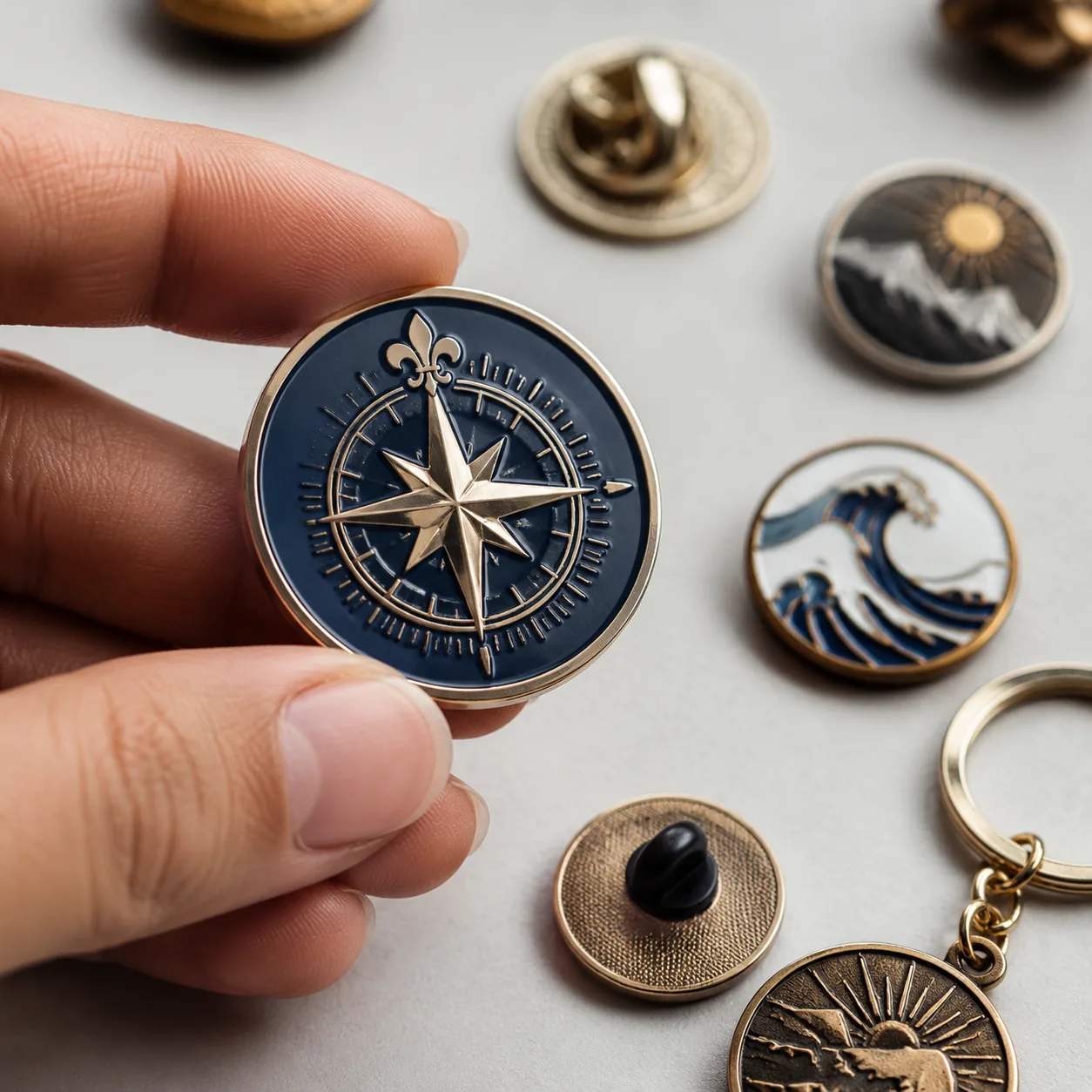
Why first-time pin imports fail before tooling starts
Most first-time custom pin orders go off track before tooling starts, not during production. A buyer sends artwork and a short note such as “35 mm hard enamel pin, gold plated, butterfly clutch,” but the supplier still has to guess the missing engineering rules: base metal, finished thickness, plating stack, edge finish, post count, post spacing, backing card size, bag gauge, carton pack-out and inspection standard.
Those assumptions change the quote materially. On a small run under 1,000 pieces, changing from one post to two posts, from iron to brass, from soft enamel to imitation hard enamel, or from bulk bagging to carded retail packing can move the FOB price by 15 to 40 percent on the same artwork. Lead time can shift by another 3 to 7 working days if epoxy, custom cards, barcode labels or locking clutches are added late.
The bigger risk is commercial failure, not visual failure. A pin can match the artwork and still perform badly because the post weld loosens after repeated wear, the plating dulls after 45 to 90 days in humid storage, the pin rotates on thin fabric because spacing was wrong, or the retail card does not fit the bag once the clutch is attached. A first order should be treated as a controlled build, not a design request.
1-3: Build method, size and thickness set the cost floor
The first three lines of the spec sheet usually determine most of the economics: build method, finished size and body thickness. For first orders, the common routes are die-struck soft enamel, imitation hard enamel, die-cast zinc alloy and photo-etched brass or iron. Die-struck soft enamel is the best default for 100 to 3,000 pieces when the design has clear metal borders and moderate detail. Imitation hard enamel costs more because the surface is polished flat after fill, but it gives a smoother, jewelry-like finish and better face durability. Die-cast zinc alloy is the right choice for internal cutouts, irregular outlines, thicker bodies and raised 3D relief that cannot be stamped cleanly.
State size in millimeters using the longest side and include a tolerance. For a stamped 35.0 mm pin, ±0.30 mm is realistic. For die-cast zinc alloy, ±0.50 mm is more typical because shrinkage control is less precise. Asking for ±0.10 mm on a low-cost promotional pin usually adds scrap, rework and proof revisions without adding practical value. Thickness should also be explicit. Common finished body thicknesses are 1.2 mm, 1.5 mm and 2.0 mm. At 1.2 mm the pin is cheaper but easier to flex; at 1.5 mm it feels solid and remains cost-effective; at 2.0 mm perceived quality improves, but metal weight, plating area and freight all rise.
| Spec line | Recommended first-order default | Typical effect on cost or risk |
|---|---|---|
| Build method | Die-struck soft enamel | Best balance of tooling cost, speed and manufacturability for 100-3,000 pcs |
| Finished size | 30-40 mm longest side | Above 45 mm, second post and heavier metal are usually required |
| Body thickness | 1.5 mm stamped iron or brass | Good rigidity without the premium of 2.0 mm |
| Size tolerance | ±0.30 mm stamped; ±0.50 mm cast | Tighter tolerances increase scrap and sampling time |
| MOQ tiers | 100 / 300 / 500 / 1,000 pcs | FOB unit pricing usually improves clearly at 300+ and again at 1,000 |
A realistic 2026 FOB China reference for a 35 mm die-struck soft enamel iron pin with 4 to 6 Pantone fills, one or two butterfly clutches and bulk polybag packing is about USD 0.60 to 0.98 at 100 pieces, USD 0.44 to 0.74 at 300 pieces, USD 0.34 to 0.59 at 500 pieces and USD 0.25 to 0.47 at 1,000 pieces. Switching to imitation hard enamel usually adds USD 0.10 to 0.22 per piece. Simple stamped tooling is commonly USD 50 to 90; inner cutouts, multi-level dies or complex outlines often push tooling to USD 120 to 180.
4-6: Metal, plating and color fill need measurable specs
Base metal affects detail resolution, plating consistency and yield. Iron is the standard low-cost material for stamped promotional pins and works well for most designs above 0.30 mm line width. Brass costs more but stamps cleaner fine lines, accepts plating evenly and is safer when raised metal lines approach 0.25 to 0.30 mm or when small text must remain sharp. Zinc alloy is a casting metal, not a stamping metal, and is best reserved for openwork, thick profiles and sculpted relief.
Do not write plating as only “gold,” “silver” or “black nickel.” Specify it as a process target. A usable line is: bright imitation gold plating, decorative layer 0.03 to 0.05 microns over copper strike and nickel underplating, with clear anti-tarnish topcoat. Decorative lapel-pin plating is thin compared with functional plating, so the topcoat matters if goods move by sea freight, sit in non-climate-controlled storage or enter markets above 60 to 65 percent relative humidity. If the topcoat is not written into the PO, many suppliers will quote the cheaper version without it.
Color fill also needs a rule. Use Pantone Solid Coated references unless the brand team specifies another system. For soft enamel, define fill as 85 to 95 percent of cavity depth, with no visible overflow, no exposed base metal inside color cells and no pits visible at 30 cm under 500 to 1,000 lux neutral indoor light. If you want a smoother face without moving to imitation hard enamel, specify epoxy dome coating. Epoxy typically adds USD 0.05 to 0.12 per piece at 500 pieces, improves chip resistance and softens hand feel, but it can slightly mute metallic contrast and may amber over long heat exposure.
For manufacturability, set artwork limits on the sheet: minimum raised metal line width 0.30 mm, minimum recessed enamel cell 0.50 mm, minimum knock-out hole 1.00 mm and minimum text height 1.2 mm. Some factories can run finer on brass, but once raised lines drop below 0.25 mm or text below 1.0 mm, yield loss and revision cycles increase quickly.
7-8: Posts, clutches and anti-rotation details determine usability
Attachment hardware is one of the most common complaint points after delivery. Many buyers specify only “butterfly clutch” and stop there, leaving post count, post diameter, post length and spacing undefined. Those dimensions determine whether the pin sits upright, resists twisting and survives repeated wear.
For pins under 25 mm, one post with 0.9 to 1.0 mm diameter and 8 to 10 mm length is usually enough. For pins above 30 mm, or for horizontal shapes where width materially exceeds height, two posts should be the default. On a 35 to 50 mm pin, two posts spaced 18 to 28 mm center-to-center usually control rotation well while leaving room for a backstamp. On a 55 mm wide pin, spacing often moves to 30 to 36 mm depending on the reverse layout.
Butterfly clutches are the lowest-cost standard and work for promotions, events and low-risk retail. Rubber clutches usually add USD 0.02 to 0.05 per piece at 500 pieces and reduce scratching on the reverse, which helps for school, youth and casual apparel programs. Locking clutches hold better and reduce accidental loss, but they typically add USD 0.18 to 0.45 each FOB and increase hand-packing time. They are worth specifying for premium retail, collector releases or thicker garments.
- Specify post count, post diameter, post length and center-to-center spacing in millimeters
- Use two posts by default for pins above 30 mm or wide horizontal layouts
- Set post weld performance as no loosening, rotation or detachment under normal hand pull
- Approve clutch type and reverse-side layout on the pre-production sample
- If rotation is unacceptable, list anti-rotation performance as a formal approval point
These adders are small individually but can distort quote comparisons. A second post often adds USD 0.03 to 0.08 per piece. If one supplier prices one post and another prices two, the cheaper quote is not equivalent even if the front view looks the same.
9-10: Artwork limits, backstamp and packaging must be specified together
Artwork approval alone is not enough. The RFQ should state the minimum producible limits so the designer and factory work to the same manufacturing standard from the start. Without that, the buyer often hears “text will fill in” or “line too fine for stamping” only after the quote is approved or the first proof is returned.
Backstamp is optional but useful for reorder control and brand protection. For first orders, keep it simple: logo, URL, year mark or SKU code within a defined reverse-side zone. On pins below 25 mm, dense backstamps can muddy the reverse and interfere with post welds. If serial numbering or lot coding is needed, specify the method. Laser marking adds flexibility for short runs and variable data; molded numbering is more durable but must be designed into the tool; pad printing is cheaper but less abrasion resistant.
Packaging fit should be locked before sample approval, not after. A common retail setup for a 35 mm pin is a 55 x 85 mm or 70 x 90 mm backing card in 300 to 350 gsm coated paper. For premium retail, 400 gsm is sometimes used, but it adds board cost and can crack at the post holes if score lines are poor. Add a Euro slot only if the item will hang in retail; otherwise it adds die-cut cost without functional gain.
Individual OPP bags are usually 0.03 to 0.05 mm thick. For carded pins, 60 x 100 mm, 70 x 100 mm or 80 x 100 mm bags are common, but final size depends on clutch thickness, card corner radius and whether the barcode sits inside or outside the bag. Export cartons for small pins are commonly packed at 500 to 1,000 pieces per master carton, with a finished carton weight kept around 8 to 12 kg to reduce crush risk and keep handling efficient.
| Packaging line | Typical first-order spec | Failure if omitted |
|---|---|---|
| Backing card size | 55 x 85 mm or 70 x 90 mm | Pin head or clutch extends beyond card edge |
| Card stock | 300-350 gsm coated paper | Card bends at post holes or warps in packing |
| OPP bag thickness | 0.03-0.05 mm | Bag tears, wrinkles excessively or feels under-retail |
| Bag size | 60 x 100 mm, 70 x 100 mm or 80 x 100 mm | Carded pin does not slide in cleanly after assembly |
| Export carton pack | 500-1,000 pcs per carton with inner bags | Counts mix, cards crush or freight cube becomes inefficient |
11: Inspection standards should define defects before mass production
If inspection is not written into the order, the factory will inspect to its own commercial standard, which may be looser than yours. For promotional and retail-grade pins, a practical baseline is ANSI/ASQ Z1.4, General Inspection Level II, with AQL 2.5 for major defects, AQL 4.0 for minor defects and zero tolerance for critical defects. That is specific enough for third-party pre-shipment inspection and internal rework decisions.
Critical defects normally include wrong design, missing or detached hardware, sharp burrs capable of cutting skin, contamination that transfers to fabric, plating flake-off or serious carton count errors. Major defects usually include bent posts, wrong clutch type, obvious enamel voids visible at 30 cm, plating tone clearly different from the approved sample, missing backing cards or incorrect printed packaging. Minor defects usually include light reverse-side scratches, slight color drift within the approved visual range or tiny plating specks in non-display areas.
The viewing rule is often more important than the AQL number. State exactly how the product is judged: front face inspected at 30 cm under neutral indoor lighting of approximately 500 to 1,000 lux, without magnification. Reverse side judged at the same distance unless a branded backstamp is a retail-facing feature. This avoids disputes where one party rejects macro-photo blemishes that are not visible in normal use.
12: Timeline, sample gate and reorder controls prevent drift
Lead time should be broken into stages instead of quoted as one lump sum. For a standard first order, digital proof is commonly 1 to 3 working days, pre-production sample 5 to 8 working days after proof approval, and mass production 10 to 18 working days after sample sign-off for orders up to about 3,000 pieces. Add 2 to 5 working days for custom backing cards, epoxy, barcode labels, assortments or locking clutches. In peak seasons before trade shows, holiday gifting and licensing launches, plating lines and hand-packing are often the bottlenecks rather than stamping itself.
Use one sample gate and one golden-sample rule. The pre-production sample should confirm plating tone, Pantone match, line sharpness, post position, clutch type, backstamp, card fit, bag fit and barcode placement. Once approved, that sample or a signed photo record becomes the reorder baseline. Without that reference, second orders often drift on gold shade, clutch style, card stock, bag gauge and even pin thickness because the supplier relies on incomplete order notes.
Tooling terms belong on the same sheet. Ask whether the die is stored for reorders, how long it remains active, whether maintenance fees apply after inactivity and which changes trigger a new die charge. Minor reverse-side edits such as a backstamp update or small post relocation may be handled as die modifications, often for USD 15 to 40. New outlines, added cutouts or substantial relief changes usually require a new tool.
A quote-ready first-order spec sheet
A strong first RFQ does not need to be long, but it must remove guesswork. A quote-ready example is: 35 mm die-struck soft enamel pin; stamped iron; 1.5 mm finished thickness; bright imitation gold plating, 0.03 to 0.05 micron decorative layer over copper strike and nickel underplating, with anti-tarnish topcoat; 5 Pantone colors; minimum raised metal line 0.30 mm; minimum enamel cell 0.50 mm; two rear posts, 1.0 mm diameter, 9 mm length, 22 mm spacing; butterfly clutches; backing card 70 x 90 mm in 350 gsm coated paper; individual OPP bag 80 x 100 mm, 0.04 mm thick; export pack 500 pieces per carton; ANSI/ASQ Z1.4, Level II, AQL 2.5 major / 4.0 minor; one pre-production sample required before mass production.
That level of detail gives suppliers enough information to quote accurately and flag manufacturability issues early. It also makes price comparisons fair. If one quote lands far below the others, the buyer can immediately check whether the assumptions changed: thinner metal, one post instead of two, no anti-tarnish topcoat, looser inspection, bulk packing instead of carding, smaller bags or lighter card stock.
Before requesting quotes, attach vector artwork in AI, EPS or editable PDF format, include a reverse-side layout and ask suppliers to separate FOB unit price, tooling charge, sample fee, packaging adder and stage-by-stage lead time. For first-time importers, clarity usually saves more time and money than any rush promise. A clean spec sheet reduces quote variance, shortens proof revisions and lowers the chance that the finished pin is technically acceptable but commercially wrong.
Have a project? Send your artwork and target quantity and we’ll reply with a detailed quotation within 12 working hours.
Ready to get this made?
Send your sketch, target quantity and ship-date. Detailed quotation in 12 hours.



