First Import Order: Getting Custom Pins Through Customs
Import scenario: 2,500 pins due in 58 days
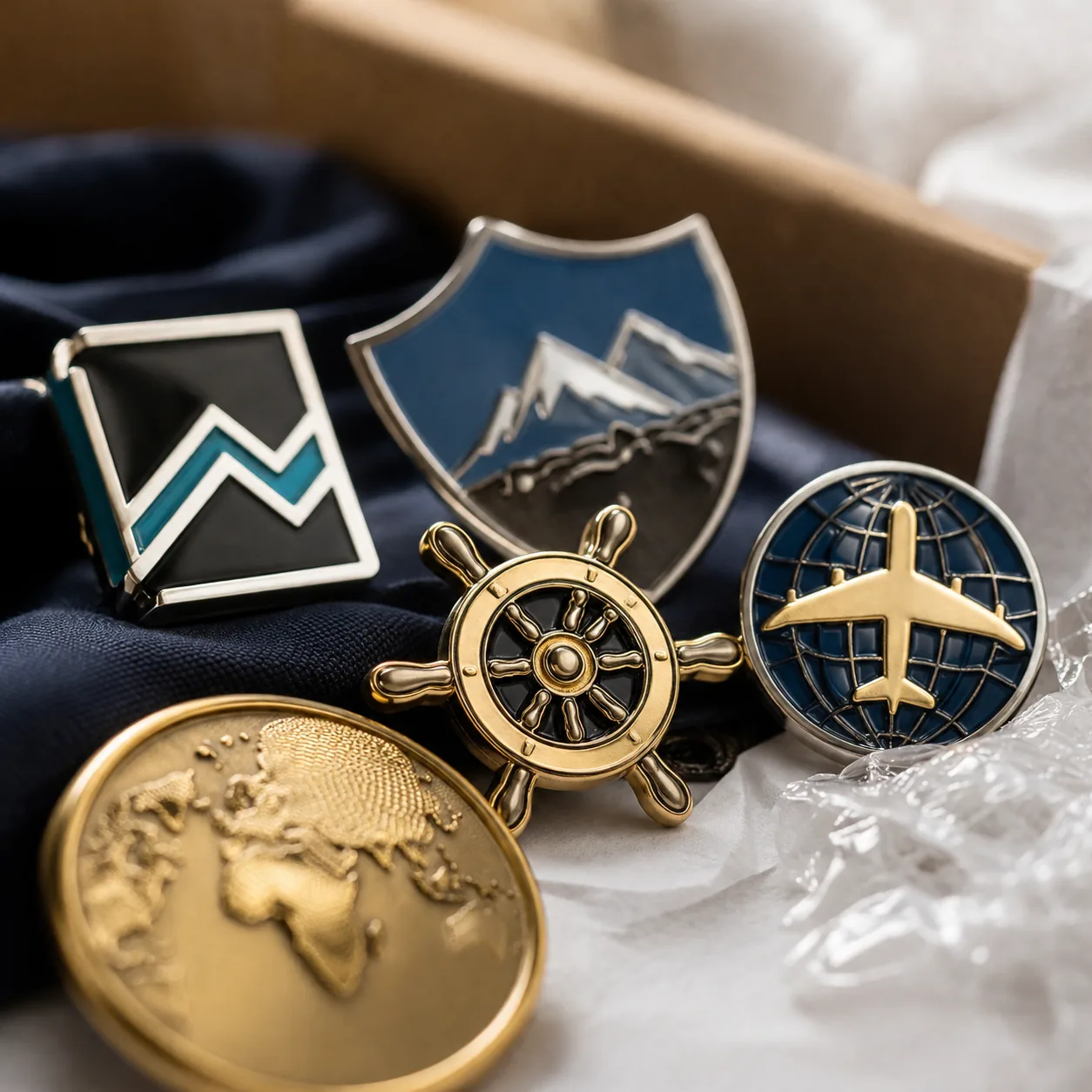
A common first import looks simple: 2,500 custom hard enamel lapel pins for a launch, approved artwork, and an event date 58 calendar days away. The target item is a 30 mm nickel-plated pin with two enamel colors, black line art, two posts with butterfly clutches, individual OPP bags, and delivery to a warehouse in Chicago, Rotterdam, or Sydney. The quote may show a low unit price, but the main risk is usually not the pin itself. It is the missing detail around Incoterms, customs documents, inspection criteria, payment timing, and freight responsibility.
For a first 2026 order, lock four points before paying the deposit: the technical specification, the Incoterm, the commercial invoice wording, and the inspection standard. If these are vague, a USD 0.70 FOB pin can become a USD 1.30-1.60 landed item after rush courier, repacking, storage, customs corrections, rejected cartons, or rework. The 58-day schedule is workable, but only if artwork, sampling, production, inspection, and dispatch are sequenced from day one.
At ZheCraft in Yiwu, we see first-time importers succeed when they treat promotional pins as a small import project, not as a casual online purchase. The same workflow applies to challenge coins, keychains, patches, lanyards, brooches, PVC labels, bottle openers, fridge magnets, and medals after adjusting HS classification, testing needs, carton weight, and production process.
Days 1-3: convert artwork into a factory specification
Do not request a final quote from a PNG alone. A factory needs enough information to calculate mold cost, metal weight, polishing time, plating load, enamel filling, packaging, carton count, and freight. Send vector artwork in AI, PDF, EPS, or SVG; final size in millimeters; Pantone Solid Coated references; plating finish; base metal; back attachment; packaging; destination address or port; requested Incoterm; and whether a physical sample must be approved before mass production.
For this order, a usable specification is: 30 mm hard enamel lapel pin; stamped iron base; 1.5-1.8 mm metal thickness before polishing; raised metal with recessed enamel polished flush; nickel plating 5-8 microns; two 8 mm posts with butterfly clutches; optional black rubber clutches only if separately quoted; backstamp 8-12 mm wide; individual 0.03-0.04 mm OPP bag; 100 pieces per inner bag or box; export cartons below 15 kg gross weight. Practical tolerance is ±0.3 mm on width and ±0.2 mm on finished thickness. Color should match the approved sample under neutral 5000-6500K light, not a laptop screen.
Choose the base metal by design, not by habit. Stamped iron is cost-effective for flat 2D pins and gives crisp raised lines. Brass usually adds USD 0.08-0.20 per piece at 30 mm but can polish cleaner for premium gold or antique finishes. Zinc alloy is useful for 3D relief, deep cutouts, and irregular shapes above about 40 mm; it is not automatically better for a simple badge. Epoxy protects printed pins and soft enamel, but on hard enamel it reduces the flush metal feel and can yellow faster under heat or UV exposure.
| Spec item | Recommended first-order value | Why it matters |
|---|---|---|
| MOQ | 100-300 pcs possible for simple designs; efficient tiers at 1,000, 2,500, and 5,000 pcs | Tooling and setup dominate small runs |
| Size | 25-35 mm for most lapel pins | Controls weight, wearability, and carton density |
| Thickness | 1.5-1.8 mm stamped pins; 2.0-3.0 mm coins or cast 3D items | Too thin feels cheap; too thick raises metal and freight cost |
| Plating | 5-8 microns nickel, gold, rose gold, black nickel, or antique finish | Thin plating wears first on raised edges |
| Color | Pantone Solid Coated reference plus artwork callout | Screens are not production references |
| Attachment | Two posts for pins over 25 mm or asymmetric shapes | Reduces rotation, returns, and complaints |
| Tolerance | ±0.3 mm size; ±0.2 mm thickness; color within approved sample range | Creates a measurable QC baseline |
| Inspection | ANSI/ASQ Z1.4 General Level II; AQL 2.5 major, 4.0 minor | Defines pass/fail before shipment |
Days 3-7: compare MOQ tiers and Incoterms correctly
First-time buyers often compare prices that are not comparable: EXW Yiwu, FOB Ningbo, CIF destination port, DAP door, and DDP door. EXW means the goods are packed at the factory only; the buyer or forwarder handles pickup, export declaration, China local charges, freight, clearance, duty, and delivery. It is rarely ideal unless you already have a China forwarder and know how export documents will be prepared.
FOB Ningbo or Shanghai means the supplier covers export packing, China inland transport, export declaration, and handover at the named port or airport routing point. For B2B importers using their own forwarder, FOB or FCA is usually cleaner than DDP because the importer of record can verify declared value, product description, origin, and duty treatment. DDP door is convenient for small urgent promotional orders, but it gives the buyer less visibility into HS classification, tax handling, and carrier routing.
For 2,500 standard 30 mm hard enamel pins in 2026, a realistic FOB China price is usually USD 0.58-1.15 per piece. A simple two-color stamped iron design may be USD 0.58-0.78 at 2,500 pcs. Brass, cutouts, glitter enamel, translucent enamel, screen printing, dual plating, custom backing cards, sequential numbering, or specialty clutches can push the price to USD 0.90-1.35. Tooling for a simple 2D pin is commonly USD 50-120; complex 3D molds or multi-part tooling can reach USD 150-300.
| Quantity tier | Typical FOB unit range | What changes at this tier |
|---|---|---|
| 500 pcs | USD 0.95-1.80 | Mold and setup cost are spread over few units |
| 1,000 pcs | USD 0.72-1.35 | Better polishing, plating, and packing efficiency |
| 2,500 pcs | USD 0.58-1.15 | Common first import level with stable unit economics |
| 5,000 pcs | USD 0.48-0.95 | Lower unit cost, but higher QC and cash exposure |
| 10,000 pcs | USD 0.40-0.85 | Production may need 25-35 days and tighter carton control |
| Quote term | Usually included | Best use | Risk for first importers |
|---|---|---|---|
| EXW factory | Goods packed at factory only | Buyer has China pickup and export process | Pickup, export declaration, and local charges are missing |
| FOB Ningbo/Shanghai | Export packing, China inland transport, export declaration, port handover | B2B importers using a forwarder | Buyer must arrange freight, clearance, duty, and delivery |
| CIF destination port | Main freight and insurance to destination port | Ocean freight with an experienced broker | Destination charges, duty, and final delivery are excluded |
| DAP door | Freight to buyer address, duty and tax unpaid | Buyer has broker but wants seller-arranged transport | Customs delays and taxes remain buyer responsibility |
| DDP door | Freight, clearance, and duty arranged by seller | Small low-risk orders | Limited control over import records and valuation |
Days 7-14: approve a physical golden sample
For a first order, do not skip the pre-production sample unless the delivery date makes it impossible and management accepts the risk in writing. A physical enamel pin sample normally takes 7-12 production days after final artwork confirmation, plus 3-6 days by courier. Challenge coins and complex 3D badges often need 10-15 production days. Woven patches, printed lanyards, and simple PVC items may be closer to 5-10 days.
Inspect the sample as a manufacturing baseline. Measure width, thickness, post spacing, and backstamp position with calipers. Compare enamel colors under D65 daylight or neutral 5000-6500K lighting. Rub raised plated edges with a white cotton cloth to check residue. Attach and remove each clutch 20 times. Check for burrs along the outline and posts. Weigh the sample if postage, garment pull, or wearable comfort matters. If the approved sample is 30.2 mm wide, 1.7 mm thick, and has 6 micron nickel plating, production should be judged against that approved value and the agreed tolerance.
ZheCraft keeps a sealed golden sample and production file for repeat orders, including mold number, plating finish, Pantone callouts, backing, packaging, carton plan, and inspection notes. For a first importer, the sample is not only a visual reference. It is the contractual baseline for QC, dispute handling, and future reorders.
- Approve the sample only after checking size, thickness, plating color, enamel level, edge smoothness, attachment strength, and packaging.
- List any accepted sample flaw in the approval email if you do not want it corrected or disputed later.
- Ask for high-resolution photos of the sealed golden sample with ruler, PO number, and order number visible.
- Confirm whether sample tooling and courier cost are charged separately, credited after bulk order, or included in the unit price.
- Do not approve metallic finishes, antique plating, or brand-critical colors from photos alone unless the risk is accepted.
Days 14-35: manage production and define defects
After sample approval and deposit, mass production for 2,500 enamel pins usually takes 12-22 days. The process is mold cutting, stamping or casting, trimming, polishing, plating, enamel filling, baking, final polishing, post soldering or assembly, inspection, bagging, and export packing. Orders above 10,000 pcs, dual plating, sliders, spinners, chains, glitter enamel, translucent enamel, custom backing cards, or gift boxes can extend production to 25-40 days.
The most common first-order failure is approving attractive artwork without defining defects. Major defects should include wrong plating, missing enamel color, broken or weak posts, detached clutches, sharp burrs, visible rust, wrong size beyond tolerance, incorrect logo or backstamp, contaminated enamel on the main face, and carton shortage. Minor defects may include tiny polishing marks, slight enamel dimples away from the logo focal point, color overflow under 0.2 mm, light bag scuffing, or small plating shade variation within the approved sample range.
For a 2,500-piece order, ANSI/ASQ Z1.4 General Inspection Level II typically gives a sample size of 125 pieces under normal inspection. With AQL 2.5 for major defects, the lot generally passes at 7 major defects or fewer and fails at 8 or more. With AQL 4.0 for minor defects, it generally passes at 10 minor defects or fewer and fails at 11 or more. Confirm the exact inspection level, AQL table, and defect list in the purchase order. If pins are intended for children, sensitive-skin claims, or a retailer compliance program, allow extra time for nickel release, lead, cadmium, CPSIA, REACH, or Prop 65 review where applicable.
Days 30-42: prepare customs documents before dispatch
Customs clearance is where many first importers learn that a commercial invoice is not just a payment document. It should show seller and buyer names, invoice number, invoice date, product description, quantity, unit price, total price, currency, Incoterm, country of origin, carton count, gross weight, and net weight. The packing list must match the invoice and show carton dimensions, pieces per carton, carton numbers, gross weight, and net weight.
Use descriptions that are specific without being misleading. Instead of “gift items,” write: “custom metal hard enamel lapel pins, iron base, nickel plated, with butterfly clutch, for promotional use.” For keychains, state the main material and hardware. For patches, state embroidered, woven, chenille, PVC, or printed. For magnets, state whether the body is metal, PVC, acrylic, resin, or paperboard with magnet backing. Your broker or forwarder should confirm the destination HS code because classification varies by material, use, and national tariff schedule.
Ask for draft invoice and packing list before dispatch. A mismatch between 2,500 pieces on the invoice and 2,400 pieces on the packing list can trigger clearance questions. A declared value that excludes tooling, packaging, assists, or royalties when your country requires them can create compliance exposure for the importer of record. If you use DDP, still request copies of the shipping invoice, product description, and tracking record so internal purchasing files match what was shipped.
- Commercial invoice with real transaction value, currency, Incoterm, and country of origin.
- Packing list with carton count, carton dimensions, gross weight, net weight, and pieces per carton.
- Air waybill, sea waybill, courier tracking number, or forwarder booking after dispatch.
- Product photos matching the shipment, useful for brokers unfamiliar with promotional products.
- Material statement if requested, especially for nickel-free claims, PVC items, magnets, or children’s products.
- Current test reports only when required by law or buyer policy; unrelated generic reports are not enough.
Days 35-50: choose freight and calculate landed cost
For 2,500 pins, air courier is often the best first-order freight method because the shipment is small and time-sensitive. A 30 mm pin with clutch and OPP bag typically weighs 8-14 g, so 2,500 pieces are about 20-35 kg net before inner packing and cartons. Packed for export, the shipment is often 2-4 cartons, commonly around 38 x 28 x 22 cm or 40 x 30 x 25 cm, with gross weight kept below 15 kg per carton. Dense cartons of pins and coins should not be overpacked; weak cartons split and polished finishes abrade during courier handling.
Ocean freight is rarely efficient for one small pin order unless consolidated with other goods. For heavier challenge coins, bottle opener keychains, or promotional kits, ocean or rail may become sensible above roughly 150-250 kg chargeable weight, depending on destination and deadline. Air freight to airport can be cheaper than courier for larger shipments, but it requires broker handling, terminal charges, local delivery, and more administration.
Calculate landed cost before approving production. Include unit cost, tooling amortized per piece, sample cost if not credited, China inland or export charges if not included, international freight, insurance if used, customs duty, brokerage, local delivery, and tax cash flow. VAT or GST may be recoverable for registered businesses in some markets, but it still affects working capital.
| Cost line for 2,500 pins | Typical 2026 range | Buyer note |
|---|---|---|
| FOB unit price | USD 0.58-1.15 per pc | Depends on metal, size, plating, colors, attachment, and packing |
| Tooling | USD 50-120 total | Adds about USD 0.02-0.05 per pin at 2,500 pcs |
| Sample and courier | USD 35-90 | Some factories credit this after bulk order; confirm in writing |
| Air courier freight | USD 180-420 | Varies by destination, chargeable weight, fuel surcharge, and remote fees |
| Third-party inspection | USD 120-250 | Useful for first orders or strict corporate buyers |
| Import duty | Destination-specific | Confirm HS code and duty rate with broker before ordering |
| Clearance or brokerage | USD 0-120 for many small courier shipments | Basic courier clearance may be included; exceptions cost extra |
Final week: inspect, pay balance, and ship cleanly
The cheapest time to catch defects is before cartons leave the factory. At minimum, request final inspection photos and video showing random pieces from each carton, close-ups of the front, back, side edge, clutch, individual packaging, inner packing, and carton labels. For higher-value or deadline-critical orders, use a third-party inspection or require the factory to follow the written AQL checklist agreed before production.
Carton labels should show item name, PO number, quantity, carton number, gross weight, net weight, carton dimensions, and country of origin if required by your market. Inner packing should prevent metal-on-metal abrasion, especially for polished gold, black nickel, antique finishes, mirror finishes, and epoxy surfaces. If backing cards are used, confirm card size, paper weight, print side, hole position, barcode, and whether each pin is mounted before bagging.
Do not release the balance until inspection evidence and draft shipping documents have been reviewed. A common first-order payment structure is 30% deposit and 70% before shipment. Small sample orders are often prepaid. If you need payment terms, discuss them before sampling; factories rarely change credit terms after production is complete.
Before sending RFQs, build a one-page import brief with product spec, quantity, required delivery date, destination address or port, preferred Incoterm, packaging, inspection requirement, compliance needs, and whether you will use your own forwarder. Ask each shortlisted supplier for unit price, tooling, sample cost, MOQ tiers at 500, 1,000, 2,500, and 5,000 pcs, production lead time in days, carton estimate, payment terms, AQL standard, and draft document process. With those points clear, the first import order becomes a controlled procurement project instead of a gamble on a low quote.
Have a project? Send your artwork and target quantity and we’ll reply with a detailed quotation within 12 working hours.
Ready to get this made?
Send your sketch, target quantity and ship-date. Detailed quotation in 12 hours.



