First Import Order Checklist for Custom Metal Giveaways
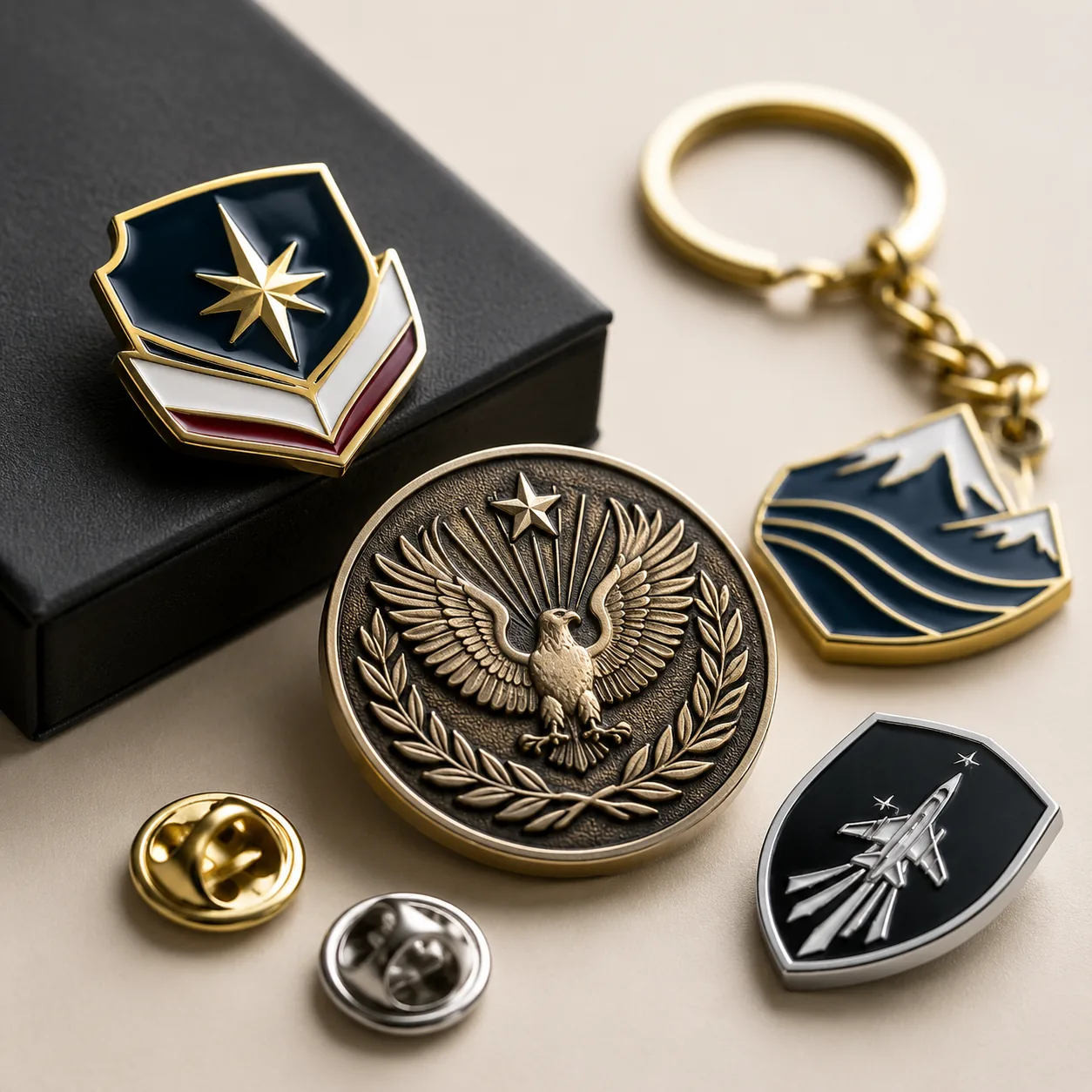
Q1: What must be locked before the RFQ?
Most first import problems start before a supplier is chosen. A loose RFQ lets each factory quote a different product, so the lowest price may simply reflect thinner metal, cheaper plating, simpler packaging or omitted tooling. Before requesting pricing for custom pins, coins or keychains, lock the product type, finished size, thickness, base metal, plating, enamel or color-fill type, color count, attachment, packaging, order quantity by design, destination country, Incoterm and required in-hand date. An RFQ that says only "custom metal pin, 1,000 pcs" may receive one quote for a 25 mm iron soft enamel pin in a polybag and another for a 35 mm zinc alloy imitation hard enamel pin on a printed card. Those are different products.
For a first enamel pin order, a controlled specification is 25 to 35 mm wide, 1.2 to 1.5 mm thick, iron or zinc alloy base, soft enamel or imitation hard enamel, 4 to 8 Pantone Solid Coated colors, nickel or gold plating, butterfly clutch or rubber clutch, and individual polybag or printed backing card. A practical low-risk baseline is a 30 mm iron soft enamel pin, 1.2 mm thick, nickel plated, with one black rubber clutch. For challenge coins, start with 40 to 50 mm diameter, 3.0 to 4.0 mm thickness, zinc alloy die casting or brass stamping, antique gold, antique silver or antique bronze plating, optional enamel on one or both sides, and PVC pouch or acrylic capsule. For keychains, state whether the body is die-cast zinc alloy, stamped iron, stainless steel, acrylic, soft PVC or leather, because tooling, scratch resistance, weight and freight volume change materially.
Separate required construction from decorative upgrades. Black nickel, glitter enamel, translucent enamel, glow pigment, epoxy doming, laser numbering, spinner parts, cutouts and custom backing cards can all be useful, but each adds approval time or defect risk. For a fixed event date, keep the first order mechanically simple, prove the supplier on one clean design, then add complex finishes on a reorder.
Q2: What MOQ and FOB price tiers are realistic?
MOQ is not only a sales policy. Mold cutting, artwork conversion, plating rack setup, enamel filling, polishing, inspection and export packing are required whether the order is 100 pieces or 5,000 pieces. Many factories will accept 100 pieces, but the unit price is high because fixed setup work is spread across too few units. For first-time importers testing a supplier, 300 to 500 pieces is usually the lowest sensible tier for pins and keychains. Challenge coins can start at 100 to 300 pieces because the unit value is higher, but detailed 3D coins, cutouts and two-sided enamel price better at 300 pieces and above.
Typical 2026 FOB Yiwu, Ningbo, Shenzhen or Guangzhou ranges for promotional-grade metal items are USD 0.38 to 0.95 for a 25 to 30 mm soft enamel pin at 500 pieces, USD 0.78 to 1.85 for a 25 to 30 mm imitation hard enamel pin at 500 pieces, USD 1.35 to 3.80 for a 45 mm antique challenge coin at 300 pieces, and USD 0.58 to 1.75 for a metal keychain at 500 pieces. These ranges exclude international freight, import duty, VAT or GST, customs broker fees, domestic delivery and fulfillment. Tooling is commonly separate: USD 35 to 90 per pin design, USD 80 to 180 per coin mold, and USD 50 to 150 per keychain mold, depending on size, depth, cutouts and relief detail.
| Item | Sensible first MOQ | Typical FOB unit range | Tooling range | Production lead time after sample approval |
|---|---|---|---|---|
| 25-30 mm soft enamel pin | 300-500 pcs | USD 0.38-0.95 at 500 pcs | USD 35-90 | 12-18 days |
| 25-30 mm imitation hard enamel pin | 300-500 pcs | USD 0.78-1.85 at 500 pcs | USD 45-110 | 15-22 days |
| 45 mm antique challenge coin | 100-300 pcs | USD 1.35-3.80 at 300 pcs | USD 80-180 | 18-28 days |
| Die-cast metal keychain with split ring | 300-500 pcs | USD 0.58-1.75 at 500 pcs | USD 50-150 | 14-24 days |
| Printed backing card, 300-400 gsm | 500-1,000 pcs | USD 0.04-0.18 per card | Usually none | 3-7 days, often parallel |
For distributors, one design at 500 or 1,000 pieces is usually cleaner than five designs at 100 pieces each. Multiple designs multiply proofing, mold checks, color control, counting and carton segregation. If several designs are required, request tooling per design and unit cost per design instead of one blended number that hides the economics.
Q3: Which specifications belong on the purchase order?
The purchase order should lock measurable requirements, not repeat a catalog name. Include finished size, size tolerance, thickness, base metal, plating finish, minimum plating thickness, enamel type, Pantone references, attachment, packaging, carton marks, inspection standard and approved sample reference. For stamped iron or brass pins, a workable size tolerance is +/-0.20 mm and thickness tolerance is +/-0.10 mm. For die-cast zinc alloy items, use +/-0.30 mm on size and +/-0.20 mm on thickness. For 45 mm coins, weight should normally be controlled within +/-5 percent unless the design has cutouts, bottle-opener geometry or a nonstandard edge.
Specify plating by finish and minimum thickness when wear matters. Standard decorative nickel, gold, brass, copper or black nickel plating is commonly 3 to 5 microns for indoor promotional use. For keychains, coins or items handled daily, 5 to 8 microns is a better target. Do not demand heavy plating without factory review; excessive plating can soften relief, fill shallow recesses and make 0.4 to 0.6 mm raised text less legible. If EU distribution is expected, discuss REACH, cadmium, lead and nickel-release requirements before tooling. Nickel-sensitive applications may require nickel-free plating or a tested coating system.
For enamel and PVC color, use Pantone Solid Coated references and state the acceptance basis. A practical production target is Delta E under 3.0 where instrument checking is available, or visual match to the signed golden sample under D65-equivalent light. Enamel on plated metal will not look identical to ink on paper, sublimated polyester or woven patches because gloss and reflection differ. The PO should say whether coordinated brand matching is acceptable or whether mass production must match the physical approved sample.
Q4: What sample process prevents approval errors?
Do not skip the pre-production sample on a first import order unless the item is extremely simple and the deadline leaves no alternative. A digital proof confirms outline, spelling, logo position, Pantone callouts, plating callouts, attachment position and backstamp, but it cannot prove plating tone, enamel level, edge finish, item weight, clutch grip or packaging fit. Typical physical sample timing after digital proof approval is 7 to 10 days for standard soft enamel pins and simple keychains, 10 to 14 days for imitation hard enamel pins, and 12 to 16 days for detailed coins or multi-process items.
Review the sample first at normal viewing distance, then under bright neutral light. Check for burrs, pits, underfilled enamel, enamel overflow, plating stains, loose jump rings, crooked posts, sharp edges and unreadable backstamp text. For pins, a 25 to 30 mm item usually works with one post. At 35 mm and above, or for tall narrow shapes, two posts reduce rotation on 180 to 220 gsm cotton or polyester fabric. For keychains, open and close the split ring 20 to 30 times and confirm the jump ring gap cannot release the charm.
If the sample is approved with limitations, write them down. Transparent enamel over antique brass may show base-metal variation. Black nickel can reduce contrast against dark blue, purple or black enamel. Epoxy domes add gloss but can trap dust or bubbles if rushed. The factory should keep a golden sample for production control, and the buyer should keep one approved sample so both sides compare mass production against the same reference.
Q5: How should FOB, EXW, air and sea be compared?
First-time importers often compare an EXW unit price from one supplier with an FOB price from another and assume the lower number wins. EXW means the buyer or forwarder handles China pickup, export customs and local origin charges. FOB Ningbo, Shanghai, Shenzhen or Guangzhou normally includes China-side export handling to the named port or airport handover. For buyers with an established forwarder, FOB is usually clearer because the factory's export responsibility is defined. For courier shipments under a few cartons, DAP or DDP quotes may be useful, but confirm who pays duty, tax and remote-area surcharges.
Air express is practical for light, urgent promotional orders. As a guide, 500 standard pins may weigh 6 to 12 kg gross with polybags or backing cards; 1,000 metal keychains may reach 25 to 40 kg; and 500 zinc alloy coins may exceed 35 to 55 kg depending on thickness and packaging. Air express often takes 3 to 7 days in transit plus customs clearance. Air cargo is commonly 5 to 10 days airport-to-airport. LCL sea freight commonly adds 25 to 45 days port-to-door, depending on destination, consolidation schedule and congestion.
Carton planning affects freight and damage claims. Keep gross carton weight under 15 kg where practical for pins and mixed promotional packs. Coins can use 18 to 20 kg cartons if inner packing is strong, but heavy cartons increase corner crush and warehouse handling complaints. Ask for carton dimensions, gross weight and estimated carton count before shipment so the forwarder can quote by chargeable weight, not only actual weight. For air, dimensional weight is commonly calculated from carton length x width x height in centimeters divided by 5,000 or 6,000, depending on carrier.
Q6: What AQL and functional tests should be used?
Use a written AQL standard instead of saying the goods must be perfect. A practical default for first import orders is ANSI/ASQ Z1.4 or ISO 2859-1, general inspection level II, AQL 0 for critical defects, 2.5 for major defects and 4.0 for minor defects. Critical defects include sharp burrs that can cut skin, exposed pin points, loose magnets that create a safety risk, wrong customer logo, wrong legal marking, mixed customer artwork or obvious contamination. Major defects include peeling plating, missing attachment, broken key ring, size outside tolerance, clearly wrong enamel color, unreadable required text or retail packaging that cannot be used.
Minor defects include tiny dust specks in enamel, very small scratches visible only at close range, slight plating shade variation within the approved range, or minor enamel level variation that does not affect the logo. Agree whether the inspection unit is one piece, one set or one retail pack. For mixed-design orders, require the inspector to sample each design rather than pulling all samples from the easiest carton.
- Before production: approve vector artwork, Pantone callouts, size, thickness, plating, attachment, backstamp and packaging layout.
- PO tolerances: size +/-0.20 mm for stamped pins, +/-0.30 mm for cast items; thickness +/-0.10 mm for pins, +/-0.20 mm for coins.
- Inspection default: general level II, critical 0, major 2.5, minor 4.0 unless retail, child-use or safety risk requires tighter limits.
- Functional checks: clutch pull, pin post alignment, jump ring closure, split ring rebound, magnet holding force, sharp edge check and plating adhesion rub.
- Packing checks: quantity by design, inner bag count, carton count, gross weight, carton dimensions, shipping marks and carton sequence.
- Document checks: commercial invoice, packing list, HS code suggestion, product description, country-of-origin marking and destination-specific compliance request.
Functional tests catch problems that visual inspection misses. Pull butterfly and rubber clutches by hand after repeated attachment. Rotate jump rings 20 to 30 cycles and confirm they do not open. Wipe plated surfaces with a clean white cloth to check residue. For magnets, test on a clean 0.8 to 1.0 mm painted steel surface, not only on thick bare steel, because refrigerator doors often have lower holding performance.
Q7: What must be confirmed before deposit and shipment?
Before paying the deposit, reduce the order to one approved artwork file, one specification sheet, one quotation, one purchase order and one written production schedule. A realistic first-order timeline is 1 to 2 days for quote clarification, 1 to 3 days for digital proof, 7 to 16 days for physical sample, 12 to 28 days for mass production after sample approval, 1 to 3 days for final packing and inspection, and 3 to 10 days for air shipment depending on destination and customs. Sea or consolidated freight can add 25 to 45 days.
Confirm what is included and excluded before funds are sent. Tooling, mold ownership, sample fee, revision fee, extra plating charge, two-post attachments, backing cards, barcode labels, carton printing, third-party inspection, bank charges and freight are common dispute points. First-order payment terms are often 30 percent deposit and 70 percent before shipment. Larger or repeat programs may move to negotiated terms after both sides have a working history.
Prepare documents and carton marks early. The supplier should provide a commercial invoice, packing list and export documents requested by the forwarder, such as a certificate of origin when applicable. The importer of record remains responsible for the final HS code, duty rate, VAT or GST treatment and local compliance rules. Use factual customs descriptions such as metal enamel lapel pins with butterfly clutch, zinc alloy challenge coins with enamel, or metal keychains with split ring. Avoid vague descriptions such as promotional gifts or accessories when shipping commercial inventory.
Carton labels should match the packing list exactly. For mixed designs, mark item code, design name or number, quantity per inner bag, quantity per carton, gross weight, net weight, carton dimensions and carton number such as 1 of 8. For event distribution, request inner bags of 50 or 100 pieces and master cartons under 15 kg where practical. For retail programs, confirm barcode stickers, suffocation warnings on polybags where required, country-of-origin marking and customer routing labels before mass packing begins.
Send ZheCraft or any shortlisted factory a complete first-order pack: vector artwork, target quantity, delivery deadline, destination country, packaging requirement, inspection requirement, Incoterm and compliance requirement. Ask for a line-by-line quote showing tooling, unit price by quantity tier, sample cost, sample lead time, mass production lead time, carton estimate and shipment option. If the quote cannot be traced back to measurable specifications, do not use the low number for a landed-cost decision.
Have a project? Send your artwork and target quantity and we’ll reply with a detailed quotation within 12 working hours.
Ready to get this made?
Send your sketch, target quantity and ship-date. Detailed quotation in 12 hours.



