First Import of Custom Pins: A 30-Day Buyer Scenario
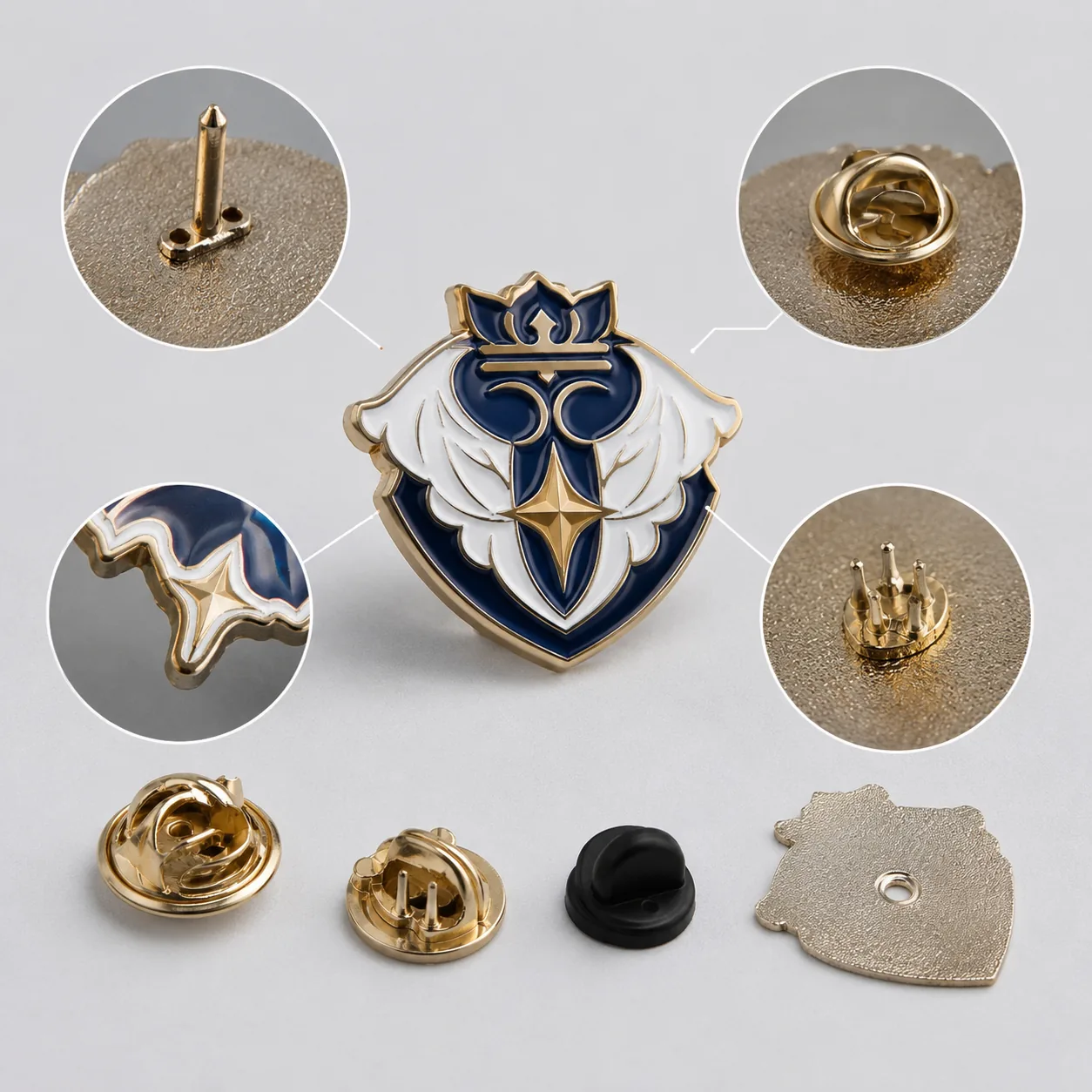
Day 1: Define a 3,000-piece pin program that can actually ship in 30 days
The challenge is not drawing a logo pin. It is getting 3,000 commercially acceptable pieces tooled, sampled, approved, produced, packed, exported, customs-cleared, and delivered before a fixed event date when your team has never imported custom metal products before. In this scenario, you are buying one 35 mm lapel pin design, one backing-card format, one delivery location, and you have no flexibility on the in-hand date.
A realistic starting specification is: 35 mm width x proportional height; 1.5 mm stamped iron base for lowest cost, with 1.8-2.0 mm zinc alloy quoted as an alternate; soft enamel color fill; bright nickel or black nickel plating; two posts with butterfly clutches at 35 mm to reduce rotation; and either individual polybag packing or pin-on-card with 350 gsm coated card plus OPP bag. At 3,000 pcs, you are above normal MOQ, so tooling, attachment count, packaging format, and freight method will affect total landed cost more than a USD 0.02-0.03 unit-price concession.
Typical 2026 market ranges for this size are straightforward. A stamped-iron die charge is often USD 45-90, while zinc alloy mold cost is commonly USD 80-140 depending on cutouts and relief. Unit FOB pricing for a standard 35 mm soft-enamel iron pin at 3,000 pcs usually lands around USD 0.42-0.72 each, rising to roughly USD 0.55-0.95 for zinc alloy. Add USD 0.04-0.10 for backing card plus bagging, and USD 0.01-0.03 for a second post if not already included. The expensive mistake is not the die fee; it is forcing an urgent air move because approvals slipped by three or four days.
A workable 30-day calendar is tight but possible if decisions are locked in the right order: 1-2 working days for artwork review, 2-4 days for die or mold making, 3-5 days for sample production, 7-10 days for mass production, 1-2 days for packing, and 4-8 days for air transit plus customs and final delivery. That leaves very little slack. One unclear proof note, one unresolved packaging change, or one missing PMS reference can consume more schedule than you will ever recover through price negotiation.
Day 2: Build an RFQ around production variables, not marketing language
A usable RFQ for custom pins must answer the questions that determine tooling, process limits, reject risk, and shipping plan. The minimum package is vector artwork in AI, EPS, or editable PDF; final size in millimeters; target thickness; base metal; plating finish; enamel type; number and location of posts; clutch type; packaging method; destination country; requested trade term; and hard in-hand date. If those points are missing, the factory will fill in the blanks, and assumed specifications become disputes later.
For this 30-day order, a practical RFQ is: 35 mm width x proportional height; 1.5 mm stamped iron base, with 1.8 mm zinc alloy quoted as an option; soft enamel; bright nickel plating; two posts with standard butterfly clutches; PMS references for each color; optional sandblasted or black-dyed recessed back; individual polybag or carded packing quoted separately; quantity 3,000 pcs; AQL 2.5 major / 4.0 minor under General Inspection Level II; pre-production photo approval required; and both FOB Shenzhen and DDP destination quotes requested. If the design includes text, specify that strokes below about 0.25-0.30 mm must be thickened and enclosed counters below roughly 0.35 mm may close during tooling or enamel fill.
- Send vector artwork and state whether alternate colorways are separate SKUs; if the outer shape changes, each SKU usually needs its own die.
- Set minimum process limits early: raised metal lines should usually stay at or above 0.25-0.30 mm, and isolated enamel cells smaller than about 0.50 mm are high risk.
- Specify decorative plating expectations; promotional nickel plating is often about 0.03-0.05 microns and improves appearance, not corrosion resistance.
- Define packaging in the first RFQ; plain polybag packing may add less than 1 day, while printed cards, barcode labels, euro slots, or matched sets can add 2-5 days.
- State the approval path before quoting: photos only, couriered sample, or third-party pre-shipment inspection.
Packaging belongs in the first RFQ, not at the end. Pin production and print production often run on separate schedules. A factory can finish metal parts in 10-12 days and still miss your event because the backing card artwork is not approved, the barcode is wrong, or the card punch position does not align with the post spacing. That is one of the most common preventable delays in event merchandise programs.
Day 4: Choose the construction with the lowest revision risk
For a first import on a compressed schedule, the safest build is usually not the most premium-looking one. If the artwork has 4-7 colors, moderate detail, and no jewelry-grade requirement, soft enamel with standard bright nickel or black nickel plating is typically the lowest-risk option. It samples faster than imitation hard enamel, tolerates minor visual variation better, and avoids the extra polishing and flatness expectations that often trigger rework.
The design still has to respect process limits. On a 35 mm pin, simple outlines can usually hold overall dimensional tolerance within plus or minus 0.20 mm; irregular shapes with several curves or cutouts may drift to plus or minus 0.30-0.40 mm. Base thickness tolerance is commonly plus or minus 0.10 mm. Raised borders under 0.25 mm often plate inconsistently, and narrow enamel pockets can flood or chip during polishing. If a detailed logo is compressed into 25-30 mm without simplification, expect blurred outlines, plugged text counters, enamel bleed, and repeated proof changes.
| Build choice | Typical MOQ | Sample lead time | Mass production lead time | FOB unit range at 3,000 pcs | When not to choose it |
|---|---|---|---|---|---|
| Soft enamel iron pin, 35 mm, 1.5 mm | 100-200 pcs | 3-5 days | 7-10 days | USD 0.42-0.72 | Avoid if you need a flat jewelry-like face, mirror polishing, or premium gift presentation |
| Soft enamel zinc alloy pin, 35 mm, 1.8 mm | 100-200 pcs | 4-6 days | 8-12 days | USD 0.55-0.95 | Avoid if the shape is simple and lowest landed cost matters more than cutouts, curves, or cast relief |
| Imitation hard enamel iron pin, 35 mm, 1.5 mm | 100-200 pcs | 5-7 days | 10-14 days | USD 0.70-1.15 | Avoid for compressed schedules, dense multicolor artwork, or low tolerance for proof and sample revisions |
| Die-struck metal pin without color, 35 mm, 1.5-2.0 mm | 100-200 pcs | 3-5 days | 7-10 days | USD 0.38-0.68 | Avoid if the logo depends on exact brand colors or needs strong visibility at event distance |
For most first-time buyers in this situation, stamped-iron soft enamel is the default because it is cost-efficient, stable for standard outlines, and easier to keep on schedule. Zinc alloy earns the higher price when you need interior cutouts, sculpted relief, deep recesses, or curved outer shapes that stamp poorly. The right choice is the one least likely to trigger a second sample round.
Day 7: Treat sample approval like a production-control gate
By day 7, you should have an approved digital proof and ideally pre-production sample photos or a rushed physical sample. Review it like a quality manager, not a casual end user. Check overall dimensions, border consistency, enamel fill level, plating tone, rear finish, post location, clutch fit, pin sharpness, and whether the part sits correctly on the backing card. A front beauty shot does not show if the pin rotates on fabric, if the needle is bent, or if the back has burrs that can catch garments.
For a 35 mm pin, practical post-position tolerance is often around plus or minus 1.0 mm, acceptable for general wear but not for a tightly registered display card. Needle straightness matters more than many buyers expect: if even 2-3% of pieces have visibly bent needles, event staff will notice immediately during handout. Color approval should reference the supplied PMS values under neutral light around 5000K-6500K, but expectations must remain commercial. Soft enamel decorative items are visual-match products, not laboratory color-controlled plastic parts, so a slight batch-to-batch shift within the approved sample range is normal.
If you approve by photos only, require a complete set: front view, back view, side profile, clasp installed, caliper or ruler reference, and at least 3-5 pieces from the same sample batch. One attractive sample proves very little. You want to see spread across several pieces before authorizing 3,000 units. If the event budget can tolerate it, a couriered physical sample is still the safest option when the design includes small type, fine outlines, or critical brand colors.
Day 12: Lock production controls before the full run starts
Once the sample is approved, convert the email chain into one exact production sheet. It should restate the approved specification without interpretation: artwork revision code, final dimensions, base metal, thickness, plating, enamel colors, post quantity and location, clutch type, backing-card file version, card stock, bag type, carton marks, spare quantity, and inspection standard. If those details remain scattered across messages, the factory floor will fill gaps with assumptions.
For a first custom-pin order, AQL 2.5 for major defects and 4.0 for minor defects under General Inspection Level II is a practical commercial standard. Typical major defects include wrong plating finish, missing post or clutch, dimension outside tolerance, loose or broken needle, severe enamel voids visible at normal viewing distance, deep front-face scratches through the finish, wrong backing card, or incorrect packing quantity. Minor defects usually include slight backside marks, acceptable color drift within the approved range, light burrs that do not affect handling, or minor rear-surface texture variation.
- Require a 100% attachment check before packing; loose butterfly clutches generate immediate complaints at distribution tables.
- Ask for in-line photos after plating and after enamel filling, not just final-carton pictures.
- Set carton configuration early, for example 500 pcs per master carton packed as 10 inner bags of 50, if receiving counts matter.
- Request 1-2% spare quantity; on 3,000 pcs, 30-60 extra pieces are inexpensive insurance against count loss or transit damage.
- Confirm whether plating, assembly, and packing are in-house or subcontracted; each handoff adds delay and defect risk.
This is also where packaging friction points should be closed out. If pins are mounted too tightly on cards, packed in bulk without separators, or stacked face-to-face in thin bags, scratching can appear after inspection but before arrival. On bright nickel soft-enamel items, the finish is decorative and relatively thin, so abrasion during transit is a real commercial risk, not a theoretical one.
Day 18: Freight math now matters more than shaving a few cents off the pin
Once production is moving, freight becomes more important than a small unit-price gain. A buyer may negotiate USD 0.04 off each unit and save USD 120 on 3,000 pcs, then lose USD 400-800 because shipment planning started too late and only express service remained. For this order size, FOB product cost is often around USD 1,260-2,850 depending on metal, plating, and packaging, while urgent transport can add a meaningful percentage to landed cost.
As a planning range, 3,000 standard 35 mm pins in individual polybags usually ship in 2-4 export cartons with total gross weight around 18-28 kg. If each pin is mounted on a 350 gsm backing card and inserted into a sealed OPP bag, gross weight may rise to roughly 24-34 kg and chargeable volume may increase enough to move you into a higher air-freight bracket. Standard air freight plus local delivery commonly takes about 5-9 days door-to-door after cargo is ready, while express courier can be 3-5 days but often costs materially more per kilo. Sea freight is rarely compatible with a true 30-day event order unless production finishes unusually early and destination customs is very predictable.
Trade terms must be compared on matching scope. FOB is useful if your company already controls a forwarder, destination brokerage, duty payment, and final-mile delivery. DDP is often simpler for a first-time importer, but only if the quote explicitly states what is included: export clearance, air freight, destination customs brokerage, duties and taxes where applicable, and final delivery to the exact address. Comparing one supplier's FOB unit rate with another supplier's DDP all-in total is not a valid sourcing decision.
Day 24: Final inspection should test usability, count accuracy, and transit resistance
The correct final-inspection question is simple: can these pins be handed out, worn, and photographed at the event without damaging the brand or slowing distribution? Decorative metal products always show some process variation, so the target is commercial acceptability, not zero cosmetic variation. On a low-cost promotional pin, stopping shipment over tiny hidden backside marks is often more expensive than the defect itself.
For this order, random inspection should focus on use-critical defects: clutch retention, needle straightness, front-face plating consistency, enamel coverage, text legibility, correct card insertion, barcode accuracy if applicable, and count accuracy by inner pack and carton. If posts are loose, needles are bent, cards are misprinted, or pieces abrade each other badly enough to scratch in transit, those are shipment-stopping defects. Slight rear texture variation or tiny hidden polishing marks usually are not.
If you hire a third-party inspector, send the approved sample photos, dimensional tolerances, packaging specification, and your major/minor defect definitions before the visit. A generic metal-gift checklist often misses the defects that matter most for event hardware. A one-page buyer defect guide with photo examples usually prevents more disputes than a long contract no production supervisor reads.
Day 30: Turn a rush order into a repeatable sourcing program
If the shipment arrives on time and is commercially acceptable, do not restart from zero on the next order. Build a reorder file that contains the final vector artwork, proof revision, finished dimensions, metal type, thickness, plating, post position, clutch style, packaging layout, carton configuration, approved sample photos, tooling reference, quoted terms, and actual lead time by stage. That file is what converts a one-off emergency purchase into a controlled sourcing program.
Then review the economics honestly. Did late artwork approval force express or premium air service? Did the custom backing card add enough marketing value to justify 2-5 extra days, another supplier process, and higher chargeable weight? Did two posts reduce rotation enough to improve wearability, or would one post have been sufficient on a simpler shape? Did a physical sample prevent quality risk, or did it consume days that photo approval could have saved on a low-complexity design? Those answers are what make order two cheaper, faster, and less stressful than order one.
- Create a one-page reorder sheet with final approved size, thickness, finish, attachment, packaging, AQL standard, and carton specification.
- Record actual lead time by stage: artwork review, tooling, sample, mass production, packing, and shipping transit.
- Keep one sealed production sample and one loose-use sample for future comparison of color, plating tone, and attachment performance.
- Log every defect found in sampling or final inspection so it appears earlier in the next RFQ and approval checklist.
- For the next event order, start 45-60 days in advance if physical sample approval, custom printed packaging, or multi-SKU assortments are required.
For a first-time importer in 2026, the safest custom-pin order is rarely the one with the lowest quoted unit price. It is the one where artwork, tooling, sample approval, packaging, QC, and freight are managed as one chain with realistic tolerances, explicit packaging rules, matched trade-term comparisons, and enough schedule margin to avoid panic upgrades. Do that from day 1, and you reduce rework, avoid rush premiums, and turn a risky first import into a repeatable sourcing process.
Have a project? Send your artwork and target quantity and we’ll reply with a detailed quotation within 12 working hours.
Ready to get this made?
Send your sketch, target quantity and ship-date. Detailed quotation in 12 hours.



