First Import Checklist for Custom Pins and Keychains in 2026
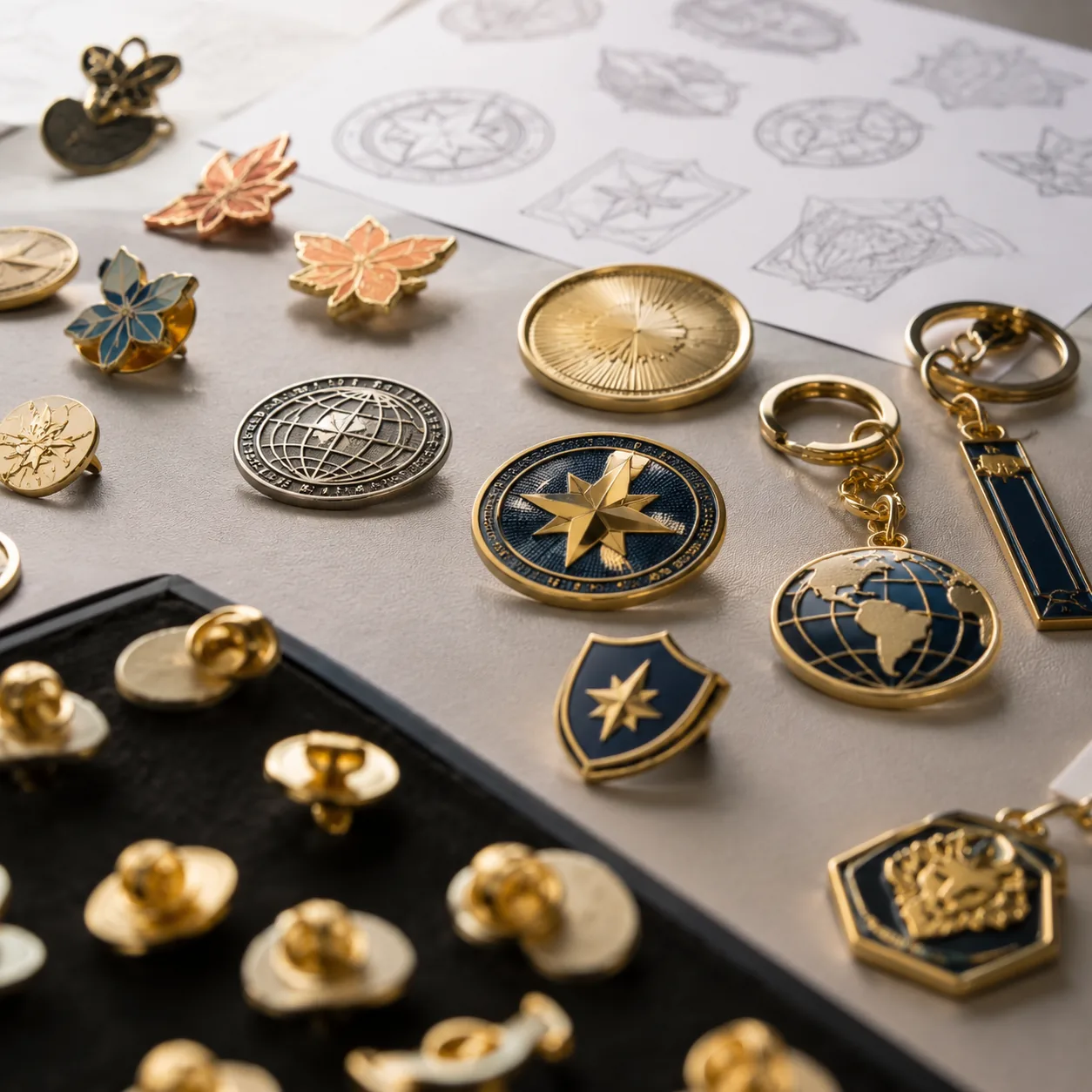
Where first custom pin and keychain orders usually fail
Most first orders fail before production starts. The root problem is usually an incomplete RFQ or PO, not necessarily a bad factory. If the buyer leaves open points, the supplier fills them with its own assumptions: iron instead of brass, 1.2 mm instead of 1.5 mm, bright nickel instead of matte nickel, one post instead of two, 25 mm ring instead of 30 mm, or loose bulk packing instead of carded retail packing. Those assumptions change quoted price, sample appearance, and bulk quality standard.
Three problems repeat on first imports. First, artwork is not production-ready: metal lines are too fine to stamp cleanly, text becomes unreadable after polishing and plating, enamel cells are too narrow to fill consistently, or small interior cutouts cannot release from tooling. Second, the buyer approves only a digital proof, which confirms layout but not plating tone, edge polish, thickness, hardware fit, or assembly quality. Third, the PO includes only size and logo, while a repeatable custom metal item usually needs 15 to 25 locked specifications.
For small and mid-volume B2B orders, treat the first run as a pilot, not a scale order. A practical starting point is 100 to 300 pcs per design, one paid pre-production sample, written dimensional tolerances, and AQL 2.5 for major defects / AQL 4.0 for minor defects under ANSI/ASQ Z1.4 General Inspection Level II. For retail programs, event launches, and orders above 1,000 pcs per SKU, add a signed golden sample, approved packing method, and final carton data before bulk release.
What to lock before you request quotes
If you request pricing using only artwork and finished size, supplier quotes will not be comparable. One factory may price a 30 mm pin as stamped iron, 1.2 mm thick, with one butterfly clutch. Another may quote brass, 1.5 mm thick, with polished edges and a deluxe clutch. A third may switch the build entirely to die-cast zinc alloy. The price gap often reflects a different construction, not just a different margin.
Lock the cost-driving and process-driving details before RFQ. For stamped soft enamel pins, a common commercial range is 25 to 40 mm finished size and 1.2 to 1.8 mm thickness. Iron is common for promotional programs because it is economical, while brass is preferred when the design needs finer detail, cleaner polished edges, or more premium perceived value. For die-cast zinc alloy keychains, a typical body size is 40 to 60 mm with 3.0 to 4.0 mm body thickness, plus a 25 mm or 30 mm split ring connected by one jump ring or a 20 to 30 mm chain.
- Construction: stamped soft enamel pin, imitation hard enamel pin, die-struck pin, die-cast zinc alloy keychain, acrylic keychain, or PVC keychain
- Finished dimensions: width x height in mm, target thickness, and any raised/recessed depth targets
- Artwork limits: minimum metal line width 0.25-0.30 mm, minimum enamel cell width 0.35-0.40 mm, minimum metal text height 1.2 mm and preferably 1.5 mm for reverse text
- Base material: iron, brass, zinc alloy, stainless steel, acrylic 2.0-3.0 mm, or PVC with target Shore hardness if relevant
- Color system: Pantone Solid Coated for enamel, CMYK for print, spot screen-print colors, epoxy dome yes/no
- Finish: bright gold, bright nickel, matte nickel, black nickel, antique brass, antique copper, dyed black, or dual plating only if necessary
- Hardware: butterfly clutch, rubber clutch, deluxe clutch, magnet, safety pin, 25/30 mm split ring, lobster clasp, chain length in mm
- Packaging: individual polybag, self-seal bag, bubble bag, backing card size in mm, barcode label location, inner pack quantity, master carton quantity
- Inspection standard: AQL 2.5 major / 4.0 minor, with critical defects separately defined
- Trade term and destination: EXW, FOB Ningbo, FOB Shanghai, CIF, or DDP, plus estimated carton size and NW/GW
- Lead time target: sample 5-9 calendar days after artwork/tooling approval; bulk 12-20 calendar days after sample approval for standard builds
Without those points, you are not comparing suppliers on the same item. You are comparing three different interpretations of the same logo.
Lowest-risk product builds for a first order
For first-time buyers, simpler constructions are safer than ambitious builds. A flat stamped soft enamel pin with 2 to 4 spot colors, no cutouts, one plating finish, and one standard clutch is easier to control than a small 3D die-cast pin with translucent colors, offset print, epoxy dome, and dual posts. The same principle applies to keychains: a flat 2D die-cast body is lower risk than a spinner, bottle opener, hinge, multi-part assembly, or mixed-material item.
A dependable first-order pin spec for brand merch, schools, events, or distributor resale is stamped iron or brass, 1.5 mm thick, 25 to 35 mm wide, with minimum 0.30 mm line width and minimum text height of 1.2 to 1.5 mm. Use one centered post for shapes under 25 mm and two posts for wider shapes, asymmetrical layouts, or any design likely to rotate on fabric. For keychains, 2D die-cast zinc alloy at 3.0 to 3.5 mm generally holds edge definition and outline stability better than a thin stamped build, especially above 45 mm or on irregular shapes.
| Use case | Recommended first-order build | Typical MOQ | Typical FOB price range |
|---|---|---|---|
| Staff lapel pin | Stamped soft enamel iron, 25-30 mm, 1.5 mm thick, 1 post, butterfly clutch, individual polybag | 100-300 pcs/design | USD 0.38-0.90 each |
| Retail logo pin | Stamped brass soft enamel, 30-35 mm, 1.5 mm, polished edge, deluxe clutch, printed backing card | 100-300 pcs/design | USD 0.75-1.55 each |
| Event giveaway keychain | 2D zinc alloy die-cast, 45-55 mm, 3.0 mm, 30 mm split ring, individual polybag | 100-300 pcs/design | USD 0.85-1.85 each |
| Commemorative keychain | Multi-level zinc alloy die-cast, 50-60 mm, 3.5-4.0 mm, antique finish, short chain plus split ring | 100-300 pcs/design | USD 1.50-3.10 each |
| Budget printed promo keychain | Clear acrylic, 3.0 mm, double-side print, epoxy optional, ball chain or split ring | 100-500 pcs/design | USD 0.45-1.05 each |
Keep the first PO disciplined. Dual plating, glitter enamel, glow pigment, epoxy domes, custom gift boxes, tiny reverse text, and unusual attachments each add another approval point, another defect mode, and often 2 to 5 extra production days.
How to review artwork and approve a real sample
Do not approve a sample because the logo looks acceptable in a phone photo. Sample approval should confirm measurable requirements: width, height, thickness, hardware location, hardware function, plating tone, enamel fill, edge finish, and packaging method. If those points stay open, the factory may treat the sample as approved for mass production even if you intended to approve only graphics.
Review manufacturability before tooling starts. On stamped metal, features below roughly 0.25 mm can soften during stamping and polishing. Enamel cells narrower than about 0.35 mm often show underfill or unstable fill lines. Reverse text below 1.2 mm high frequently loses legibility after plating. Interior cutouts below 1.0 mm may require EDM or laser assistance, which typically adds USD 10 to 30 to tooling and 2 to 4 calendar days to sample lead time.
Ask for a sample report with dimensions and photo checkpoints. For a 30 mm pin, a practical tolerance set is width/height +/-0.20 mm, thickness +/-0.15 mm, post location +/-1.0 mm, and backing-card placement +/-2.0 mm. For a 50 mm die-cast keychain, common working tolerances are body size +/-0.30 mm, thickness +/-0.20 mm, split-ring diameter +/-0.50 mm, and jump-ring closure with no visible open gap after assembly. If the keychain must hang straight on a card, define a visual centering tolerance and require the supplier to show front and hanging photos.
For orders above 500 pcs per design, and for any retail-facing SKU, a physical pre-production sample is usually worth the extra step. Typical sample lead time is 5 to 9 calendar days after final artwork and tooling confirmation, plus 3 to 6 days by courier. Typical sample fees are about USD 15 to 50 for a standard pin and USD 20 to 60 for a standard keychain, often credited back against the bulk order if agreed in writing.
What is normal variation and what should fail inspection
No low-cost custom metal product is completely defect-free. The practical task is to separate normal process variation from rejectable defects. On soft enamel pins, slight enamel height variation, small backside scuffs, and minor plating tone shift between lots can be acceptable if they match the approved sample and do not affect front presentation. Deep front scratches, sharp burrs, missing enamel, weak solder joints, crooked posts, exposed base metal in visible areas, or contamination trapped under epoxy are not acceptable.
Define defect severity before production. Critical defects include sharp points that can injure the user, detached hardware, wrong logo revision, wrong SKU mix, magnets packed into a non-magnet SKU, or any finish issue that creates a safety or regulatory problem. Major defects include front-side scratches visible at 30 cm, severe enamel underfill, obvious exposed base metal, incorrect plating, badly mislocated attachments, or split rings that deform out of round under light hand force. Minor defects include slight backside marks, small color specks outside the main viewing zone, or modest plating tone variation in bulk-packed goods.
- Edge standard: no sharp burr on perimeter, post area, jump ring, or split-ring connection during normal fingertip handling
- Hardware strength: no detachment under firm manual pull; if needed, agree a simple pull reference against the approved sample
- Cosmetic viewing standard: inspect at 30 cm under neutral indoor lighting around 4000K-6500K without magnification
- Color standard: visual match to approved sample; exact Pantone chip parity is not realistic on plated metal or translucent enamel
- Alignment standard: pin posts should not create visible tilt when worn; keychain hardware should allow the item to hang within agreed visual tolerance
- Quantity tolerance: state overrun/underrun in the PO; +/-3% is common for custom runs and repeat jobs may tighten to +/-2%
- Inspection level: AQL 2.5 major / 4.0 minor is common for promotional goods; tighter AQL should be costed before order placement
How to avoid hidden costs after quote approval
First-time buyers often focus on unit price and tooling, then get surprised by add-ons. Common extras include additional Pantone colors, extra pin posts, deluxe clutches, custom backing cards, barcode labels, retail warning bags, carton relabeling, sample courier, third-party inspection, and upgrades such as antique plating, dual plating, glitter, or epoxy. Rush production can add 10% to 25%, and custom packing can add several days even after the metal parts are complete.
Ask suppliers to separate one-time charges from recurring charges. One-time charges usually include mold or tooling, sample setup, screen charges, and packaging die-line or printing plate charges. Recurring charges include unit price, upgraded hardware, custom packaging, inland transport to port under FOB, kitting labor, and inspection fee. This split matters because a quote can look attractive on the first PO but become expensive on reorder if setup charges are hidden in the unit rate.
As a working benchmark, a standard stamped or die-struck pin mold is often USD 40 to 90 per design. A zinc alloy die-cast keychain mold is often USD 70 to 150, with higher costs for deep 3D relief, moving parts, multiple cavities, or complex cutouts. Basic polybags are often included or cost about USD 0.01 to 0.03 each. Printed backing cards typically add roughly USD 0.05 to 0.18 each depending on size, paper weight, finish, and order volume. Upgrading from a butterfly clutch to a deluxe clutch often adds about USD 0.05 to 0.12 per piece.
If landed cost matters, request pieces per carton, carton dimensions in cm, and net/gross weight before issuing the PO. A unit price that is USD 0.08 lower can still deliver a higher landed cost if premium packaging cuts carton density and increases chargeable freight volume.
Commercial terms, lead times, and reorder controls
Commercial terms matter because first orders often become repeat programs. Confirm whether the mold is reserved for your future orders, how long it is stored with no activity, whether a remake fee applies after inactivity, and whether artwork revisions require a new tool or only a tool amendment charge. Also confirm that the final quote, signed artwork, approved sample, tolerance sheet, and packaging approval together form the manufacturing standard for the current PO and future repeat runs.
Incoterms are a common blind spot. For buyers using their own forwarder, FOB Ningbo or FOB Shanghai is usually easier to compare than EXW because export clearance, local handling, and transfer charges are clearer. If you buy CIF or DDP, still request carton count, dimensions, NW/GW, suggested HS code, and any packaging compliance details required by your retailer or destination market.
Count lead time from the right milestone. Standard production is often 12 to 20 calendar days after sample approval for roughly 100 to 3,000 pcs of standard pins or keychains. Tooling may take 2 to 5 days, sample production 5 to 9 days, and courier transit 3 to 6 days. Complex plating combinations, mixed-SKU retail sets, or kitting can push bulk production to 20 to 30 days. During peak convention, holiday, or year-end promotional periods, a 7-day buffer is safer than planning against the shortest quoted schedule.
Pre-PO checklist for first-time importers
Do not optimize every variable on the first order. Choose one design, one finish, one packaging method, and one realistic ship window. The objective of the first PO is not the absolute lowest unit cost. It is a controlled result that can be repeated with minimal friction and minimal argument on the reorder.
- Finalize vector artwork with all dimensions in mm, Pantone references where relevant, and any minimum line-width notes
- Choose the lowest-risk build for the use case: standard stamped pin or flat 2D die-cast keychain unless extra complexity is commercially necessary
- Request quotes that separate tooling, sample fee, unit price, packaging cost, inland FOB charges, and optional upgrades
- Issue a written spec sheet covering size, thickness, base metal, plating, hardware, packaging, AQL, tolerances, and allowed overrun
- Approve a physical pre-production sample for first orders above 300-500 pcs, premium programs, or any retail-facing SKU
- Confirm bulk lead time in calendar days counted from sample approval, not from RFQ date or deposit date unless explicitly stated
- Lock payment terms, mold retention period, shipping term, carton marks, barcode format, and required documents before PO release
- Request final packing data before balance payment: total cartons, pieces per carton, carton dimensions, NW/GW, and pallet plan if needed
- Archive the approved records together: quote, artwork, sample photos, tolerance sheet, packaging approval, inspection standard, and PO
If a supplier cannot answer these points clearly, the quote is not fully comparable yet. A capable factory does more than send a number. It identifies missing specifications that could create defects, delay, or hidden cost later. For first-time buyers of custom pins and keychains, that discipline is usually the clearest sign the order will be controlled rather than improvised.
Have a project? Send your artwork and target quantity and we’ll reply with a detailed quotation within 12 working hours.
Ready to get this made?
Send your sketch, target quantity and ship-date. Detailed quotation in 12 hours.



