First-Article Inspection for Custom Pins: 2026 Buyer Checklist
Why artwork approval does not prevent factory defects
An approved vector proof confirms design intent, not production capability. It does not show whether a 0.20 mm raised border will wash out after die striking, whether a 0.70 mm internal cutout will plate partially closed, whether a 1.50 mm narrow tab will bend during polishing, or whether bright gold plating will haze after curing, bagging, and 25 to 35 days of ocean transit. Those failures appear only when artwork is converted into a steel die or zinc mold and run through stamping or casting, trimming, polishing, plating, enamel filling, curing, and hardware assembly.
A valid first article therefore has to be production-representative. It should use the actual die or mold number, the approved base metal, the real plating finish, the final enamel process, the specified post and clutch, and the intended packaging. A hand-painted showroom sample, a digital render, or a photo of an old order cannot verify manufacturability. Even a seemingly small change such as switching from brass to iron, or from bright nickel to black nickel, can alter edge sharpness, fill behavior, plating tone, and reject risk.
For most custom pin orders from 300 to 5,000 pieces, buyers should review 2 to 5 first-article units made from the same setup. One piece is rarely enough to reveal line spread, cavity depth inconsistency, color drift between fills, or post alignment variation. For higher-risk builds such as spinners, danglers, hinged pins, glow enamel, transparent enamel over texture, exact-fit gift sets, or magnets, 3 to 8 units is safer. Typical first-article cost is modest relative to rework exposure: roughly USD 35 to 160 FOB, versus remake costs that can easily exceed USD 500 to 2,500 once scrap, resampling, and expedited freight are included.
When first-article approval is mandatory and when it can be waived
Treat first-article approval as mandatory whenever any variable can affect fit, finish, or function. In practice that includes new tooling, a new factory, a metal change from iron to brass or zinc alloy, a finish change from bright nickel to black nickel or antique silver, a change in post quantity or location, a shift between soft enamel and imitation hard enamel, or packaging that must fit a card hole pattern, EVA cavity, foam insert, or velvet box precisely. It is also prudent to require a first article for pins above 45 mm, asymmetrical shapes, appendages under 3.0 mm wide, and any program tied to a launch, ceremony, or trade show date.
A waiver can be reasonable only on a stable repeat order where all control points remain unchanged: die or mold number, dimensions, thickness, metal, plating, color references, hardware, and packaging. A retained golden sample from the last approved lot should be on file, and the supplier should confirm that the same process route will be used. Even then, the risk does not disappear. The safer substitute is a reduced first-off control package: factory photos from the first 30 to 50 units, measured dimensions, and final random inspection to ISO 2859-1 or ANSI/ASQ Z1.4 using Normal Inspection, General Level II, with common limits of critical 0, major AQL 2.5, minor AQL 4.0.
| Order scenario | First-article decision | Typical added lead time | Typical FOB sample cost |
|---|---|---|---|
| New 30 mm soft enamel pin, 500 pcs, iron base, butterfly clutch | Strongly recommended | 3-5 days | USD 35-85 |
| Repeat 32 mm pin, same die/specs, 1,000 pcs, golden sample on file | Optional if all controls unchanged | 0-2 days | USD 0-20 |
| Imitation hard enamel pin, 800 pcs, Pantone-critical colors, bright gold plating | Mandatory | 4-6 days | USD 60-130 |
| Spinner or dangler pin, 300 pcs, multi-part assembly | Mandatory | 5-8 days | USD 80-160 |
| Magnetic badge or gift-set pin with exact EVA/foam fit | Mandatory | 4-7 days | USD 50-140 |
Dimensional checks that matter on real pin production
Start with geometry, because cosmetic review is meaningless if the part is built to the wrong size. For stamped pins up to 40 mm, a practical commercial tolerance for overall width and height is ±0.15 mm. From 41 to 60 mm, ±0.20 mm is more realistic. Above 60 mm, or on irregular die-cast zinc alloy parts, ±0.25 mm is the normal expectation unless tighter tooling control was agreed before order placement. Thickness should typically hold within ±0.10 mm for stamped brass or iron and ±0.15 mm for die-cast zinc. Thickness drift affects edge feel, unit weight, perceived quality, and fit inside a pre-cut insert or backing card.
Raised metal line width is a frequent failure point because approved art often contains details that are technically drawable but not robust in production. After finishing, raised lines should usually be at least 0.25 mm for soft enamel, 0.30 mm for imitation hard enamel, and 0.35 mm for long isolated borders or lines close to an outer edge. Text below roughly 5 pt equivalent, or effective strokes under about 0.20 mm, often loses legibility after plating buildup and enamel flow. Internal cutouts should generally finish no smaller than 0.60 to 0.80 mm; below that, plating closure, burrs, and incomplete clearing become common.
Recess depth controls both visual consistency and enamel retention. Soft enamel wells commonly finish around 0.18 to 0.25 mm deep. Imitation hard enamel usually requires more uniform cavity depth, often around 0.20 to 0.30 mm, because the fill is leveled and polished near flush with the metal surface. If one area is too shallow, polishing can expose base metal. If another is too deep, the result may be sink, uneven gloss, or the need for a second fill cycle. Buyers do not need to prescribe factory machine settings, but they should verify that the finished part holds the intended geometry.
Post position must be measured, not estimated by eye. A single centered post is usually acceptable on compact 20 to 28 mm pins. Once a pin exceeds about 30 to 35 mm in width, or the shape is long, heavy, or off-balance, two posts are generally safer. A practical commercial tolerance for post location is ±0.50 mm from approved coordinates. For two-post designs, also verify center-to-center spacing against the backing card die line or presentation insert. A spacing error of 1.0 mm can make retail cards tear during insertion or cause the pin to sit crooked on apparel.
Plating and enamel inspection: what variation is normal and what should fail
Decorative plating on custom pins should be judged for coverage, adhesion, tone consistency, and cosmetic cleanliness. It is usually not jewelry-grade unless a specific plating thickness was purchased. For bright gold, bright nickel, black nickel, gunmetal, and copper finishes, a common decorative flash layer is about 0.03 to 0.08 microns over the supplier’s standard undercoat. That is adequate for normal retail or promotional handling, but not for high-abrasion use, prolonged humidity exposure, or aggressive storage conditions. If the pins will move by sea freight, sit in polybags, or warehouse in humid climates, specify anti-tarnish topcoat or corrosion expectations in writing before production begins.
Inspect plating under neutral diffuse light and angled light from roughly 30 to 50 cm away, then confirm questionable areas at closer distance. Rejectable defects include bare spots, pits, blistering, burn marks, edge peel, cloudy haze on bright finishes, exposed base metal around post joints, and visible tone mismatch between front face, sides, and hardware. Antique finishes naturally show more tonal variation, but that does not mean anything goes. Approval should be tied to a retained reference sample, with specific allowances such as darker tone permitted only inside recessed texture, not on raised borders, logos, or legible text.
For enamel, split review into three categories: color, fill level, and cleanliness. Compare under 5000K to 6500K neutral white light against approved Pantone references or a golden sample. Small enamel areas rarely match a large swatch exactly, especially for transparent, glitter, pearl, or glow fills, but the hue family and contrast must remain recognizably correct. On soft enamel, a light meniscus is normal. On imitation hard enamel, the surface should appear smooth and near flush. First-article rejection is warranted for underfill, pinholes, contamination, color bleed, overflow onto raised metal, cure cracks, visible dust inclusions, or polished metal showing through an area that should be opaque.
Hardware, assembly, and package-fit checks that prevent returns
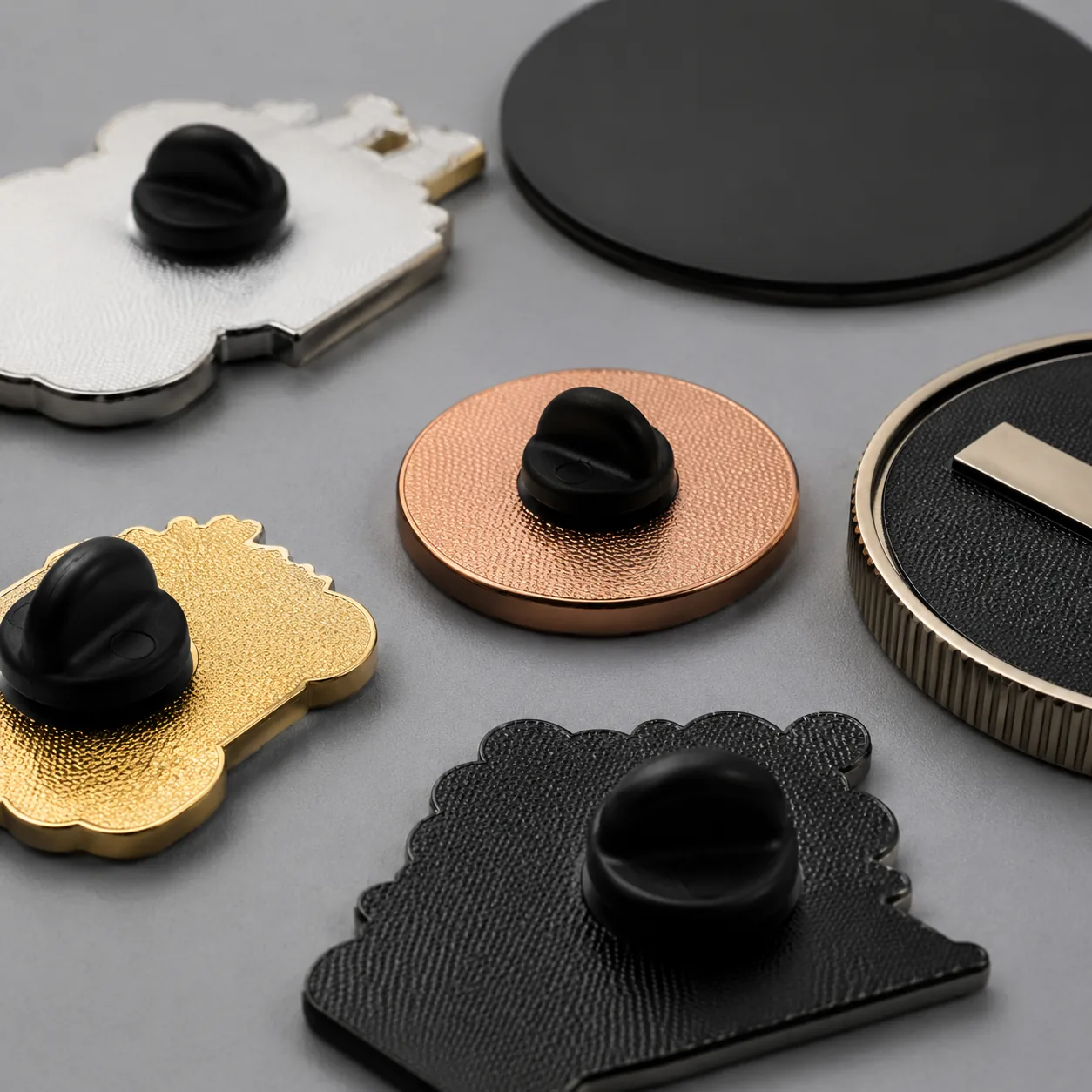
A large share of customer complaints starts on the back side of the pin. Standard pin posts are commonly about 0.90 to 1.20 mm in diameter and 8 to 10 mm in length, depending on clutch style and intended substrate thickness. Check that the clutch seats fully, grips without excessive wobble, and releases without flaking the finish on the post. On premium retail or membership programs, upgrading from a butterfly clutch to rubber, deluxe, or locking backs often adds roughly USD 0.03 to 0.12 FOB per unit but can reduce end-user complaints and accidental loss.
Inspect the post joint closely. On stamped pins with soldered posts, there should be complete wetting around the base, no obvious voids, and no severe heat marks indicating poor attachment or plating damage. On die-cast parts with integrated or welded hardware, confirm the post is perpendicular and centered. If the design uses hinges, spinner rivets, jump rings, chains, or magnets, check that moving parts rotate freely without metal rubbing through the finish and without binding after 10 manual cycles.
Package fit deserves the same rigor as front-face cosmetics. A pin can pass visually and still fail at retail if the posts tear card holes, the EVA cavity is too shallow, or the box insert allows the product to rotate during shipping. Test the first article in the actual card stock, foam, EVA, or gift tray. For magnets, test through the real substrate thickness, not against a bare steel desk. A magnet that feels strong on metal may perform poorly through 1.5 to 2.5 mm of fabric, board, or leatherette. For exact-fit gift sets, even a 0.20 to 0.30 mm dimensional drift can produce a visibly loose or over-tight cavity.
2026 first-article buyer checklist
- Confirm the reference pack is complete: artwork revision, dimensions in mm, thickness, metal, plating, Pantone or approved color standard, hardware, packaging, and target ship date.
- Review 2 to 5 first-article units for standard pins, or 3 to 8 units for spinners, danglers, magnets, and exact-fit gift sets.
- Measure width, height, thickness, post location, and post spacing on every unit; record actual values, not only pass/fail.
- Check minimum line widths, text legibility, cutouts, tabs, and recess depth for closure, burrs, under-forming, or distortion.
- Inspect plating under neutral and angled light for pits, haze, bare edges, blistering, burn marks, and visible tone inconsistency.
- Compare enamel under 5000K-6500K light for hue accuracy, fill level, pinholes, contamination, overflow, and cure cracks.
- Cycle hardware at least 10 times on one sample; verify clutch grip, post strength, hinge or spinner function, and mounted balance.
- Test the real package: backing card, polybag, EVA, foam insert, velvet box, or gift tray; confirm hole spacing and cavity fit.
- Verify required backstamp, logo, serial field, or copyright text for location, spelling, depth, and readability.
- Classify each finding as critical, major, or minor, and issue a photo-marked correction list with measured data.
- State explicitly whether the approved sample becomes the golden sample for in-line QC and final random inspection.
Pass/fail logic: first article is absolute, bulk inspection is statistical
First-article approval should use absolute conformance, not statistical acceptance. The sample must show zero critical defects and zero unapproved deviations from the specification. This is the stage for proving that the chosen process route can make the correct product. If plating finish is wrong, post position is outside tolerance, enamel hue is visibly outside the approved family, the edge is sharper than agreed, or the package fit fails, the first article should be rejected or conditionally held for correction before mass production starts.
Bulk production uses a different logic. After the setup is approved, buyers usually move to lot-based random inspection under AQL. For many promotional pin programs, common limits are critical 0, major AQL 2.5, minor AQL 4.0. As one example, for a lot size of 1,201 to 3,200 pieces under General Inspection Level II, the sample size is commonly 125 units. The exact acceptance and rejection numbers depend on the active table and code letter in the chosen standard, so the QC provider should confirm the final Ac/Re values before inspection day rather than relying on memory or a generic checklist.
In practical classification terms, critical defects include sharp burrs that can cut the user, detached or missing hardware, wrong SKU identity, and severe construction failure that makes the pin unsafe or unusable. Major defects include wrong plating color, clearly wrong enamel family, unreadable branding, severe front-face scratches, obvious underfill, nonfunctional spinner or hinge action, or packaging that cannot hold the pin securely. Minor defects include slight tone drift in an antique recess, a small cosmetic speck on the back, or light print misregistration on a backing card where the finished unit remains saleable.
The quality bar should match the selling channel. Giveaway pins tolerate more minor visual variation than museum retail, membership awards, or executive gift sets. If the buyer expects near-jewelry presentation, that requirement has to be reflected in the approved sample, cosmetic criteria, and inspection plan. First-article approval is the point where those expectations become enforceable rather than assumed.
How to write an approval email the factory cannot misread
Avoid vague approval language such as looks good, proceed. Use only three decisions: approved, approved with mandatory corrections before mass production, or rejected pending remake. Then restate the approved control points in one note: final size in mm, thickness, base metal, plating finish, enamel references, post quantity and coordinates, clutch type, backstamp requirement, packaging method, and any explicitly accepted cosmetic allowances. This reduces the chance that sales, production, plating, and packing teams each work from a different interpretation.
Write allowances precisely. A useful example is: acceptable only, light antique shading variation inside recessed background texture; not acceptable, shading variation on raised border, logo area, or text. If changes are required, specify the evidence needed before bulk production continues: revised photos, one corrected remake, or an in-line check from the first 30 to 50 production pieces. That distinction matters because many factory disputes begin when the buyer treats comments as mandatory and the supplier treats them as advisory.
Also state whether the approved first article becomes the golden sample for production, in-line QC, and final random inspection. The cleanest approval record links the final artwork revision, measured first-article data, marked-up defect photos, packaging die line, and approval email in one document set. Whether that record sits in a PO attachment, ERP workflow, or supplier quality form matters less than maintaining a single version of truth that survives shift changes, workshop handoff, and packing. When that control loop is clear, defect rates usually drop because the process is managed, not assumed.
Have a project? Send your artwork and target quantity and we’ll reply with a detailed quotation within 12 working hours.
Ready to get this made?
Send your sketch, target quantity and ship-date. Detailed quotation in 12 hours.



