Final Inspection Specs for Custom Metal Promo Orders
Why final inspection must be specified before the PO
Most quality disputes on custom metal promo orders start after the cartons are opened, not while the goods are being made. A shipment can look acceptable in factory photos yet arrive with 4 percent loose rubber clutches, plating stains across one SKU, mixed retail cards, or cartons too heavy for a 3PL to handle safely. The factory may still say the goods passed visual checking because the purchase order never defined sample size, defect limits, test method, packing rules, or who pays for sorting.
For enamel pins, challenge coins, keychains, brooches, medals and fridge magnets, final inspection should cover appearance, dimensions, function, artwork, packaging, labeling and carton condition. It should also separate critical, major and minor defects. A tiny polishing line on the back of a pin is not the same risk as a sharp burr, detached pin stem, incorrect warning label, or retail barcode that cannot be scanned.
The best timing is after 100 percent of production is complete and at least 80 percent of goods are packed. At that point an inspector can pull from finished cartons, check real unit packing, verify carton marks against the packing list and issue a release decision before balance payment or freight handover. For rush orders, add an in-process check at 20-30 percent completion, but do not replace the final release inspection with workshop photos.
| Product type | Typical MOQ | Sample or tooling lead time | Mass production lead time | Typical FOB China price range |
|---|---|---|---|---|
| Soft enamel pins, 25-35 mm | 100-300 pcs per design | 5-7 days after artwork approval | 12-18 days | USD 0.45-1.20 per pc |
| Hard enamel pins, 25-35 mm | 100-300 pcs per design | 7-10 days | 15-22 days | USD 0.70-1.80 per pc |
| Zinc alloy keychains, 40-60 mm | 300-500 pcs per design | 7-10 days | 18-25 days | USD 0.90-2.80 per pc |
| Brass or iron challenge coins, 40-50 mm | 100-300 pcs per design | 7-12 days | 18-28 days | USD 1.20-4.50 per pc |
| Fridge magnets with metal face | 300-500 pcs per design | 6-10 days | 15-24 days | USD 0.55-2.20 per pc |
These ranges assume normal artwork, standard plating, standard attachments and export carton packing. Tight color control, retail cards, sequential numbering, thick plating, epoxy coating, individual QR codes or third-party lab testing can add 2-10 days and 5-25 percent to the unit cost.
Use AQL sampling that matches the order risk
Put the inspection standard into the RFQ, production sheet and purchase order before tooling starts. For most B2B promotional orders, use ANSI/ASQ Z1.4 or ISO 2859-1, single sampling, normal severity, general inspection level II. Level I can be acceptable for low-risk repeat orders below 3,000 pieces when the supplier has a strong record, but it reduces coverage. Use level II for first orders, multi-SKU campaigns, retail resale, event-critical deliveries or any item with moving hardware.
AQL is an acceptance rule, not a guarantee that the whole shipment contains that defect percentage. Under AQL 2.5 for major defects, the shipment can still pass with a limited number of major defects in the inspected sample. It does not mean exactly 2.5 percent of the total order is defective. For critical defects, use AQL 0: one sharp edge, unsafe small part, wrong warning label or detached pin stem should stop release until the risk is contained.
| Lot size | General level II sample size | Critical AQL | Major AQL | Minor AQL | Typical accept/reject for major AQL 2.5 |
|---|---|---|---|---|---|
| 501-1,200 pcs | 80 pcs | 0 | 2.5 | 4.0 | Accept 5, reject 6 |
| 1,201-3,200 pcs | 125 pcs | 0 | 2.5 | 4.0 | Accept 7, reject 8 |
| 3,201-10,000 pcs | 200 pcs | 0 | 2.5 | 4.0 | Accept 10, reject 11 |
| 10,001-35,000 pcs | 315 pcs | 0 | 1.5 or 2.5 | 4.0 | Accept 14, reject 15 |
| 35,001-150,000 pcs | 500 pcs | 0 | 1.5 | 2.5 or 4.0 | Accept 21, reject 22 |
For safety and function checks, add special inspection level S-2 or S-3 with defined test quantities. Examples include pin post pull, magnet retention, clasp cycling, barcode scan, small-parts review and sharp-edge review. If a 10,000-piece order is split into 20 designs, do not let the inspector sample only from the easiest cartons. Require coverage by SKU, with a minimum sample per design for artwork, color, attachment and packing.
Classify defects with measurable release rules
A final inspection plan needs a defect classification table. Without it, the buyer, factory and inspector may judge the same stain or scratch differently. The classification should define the defect type, examples, inspection distance, size threshold and release rule.
Critical defects create safety, legal or serious brand risk. Examples include exposed burrs or sharp points above 0.5 mm, detached small parts on child-oriented products, loose magnets, incorrect country-of-origin or choking warning labels, and pin stems that detach under light hand force. One critical defect in the sample should trigger shipment hold, root-cause review and 100 percent sorting or rework of the affected lot.
Major defects make the item unsuitable for normal distribution. These include missing enamel, wrong logo color beyond the agreed tolerance, plating peel, obvious blistering, failed clasp, wrong attachment, reversed backstamp, wrong SKU in retail packaging or barcode failure. Minor defects are visible imperfections that do not affect normal use, such as a tiny back-side hairline, slight enamel waviness within tolerance, or a non-facing carton scuff.
| Class | Concrete examples | Measurement or observation limit | Release rule |
|---|---|---|---|
| Critical | Sharp burr, loose magnet, detached pin stem, unsafe small part, wrong safety label | Any occurrence; sharp projection above 0.5 mm or failed retention test | Reject at 1 piece in sample |
| Major | Missing color fill, plating peel, wrong attachment, failed barcode, wrong SKU packing | Visible at 30-40 cm under 600-1,000 lux; functional failure on first test | Use AQL 1.5 or 2.5 |
| Minor | Tiny back scratch, small color dot, light polishing mark, minor card scuff | Cosmetic mark normally under 0.3-0.5 mm and not on key logo area | Use AQL 4.0 or tighter if retail |
| Observation | Below-limit cosmetic issue, slight carton compression, minor glue string inside bag | No functional or brand impact, no repeating pattern | Record; hold only if clustered |
Measure dimensions, color and artwork against approved standards
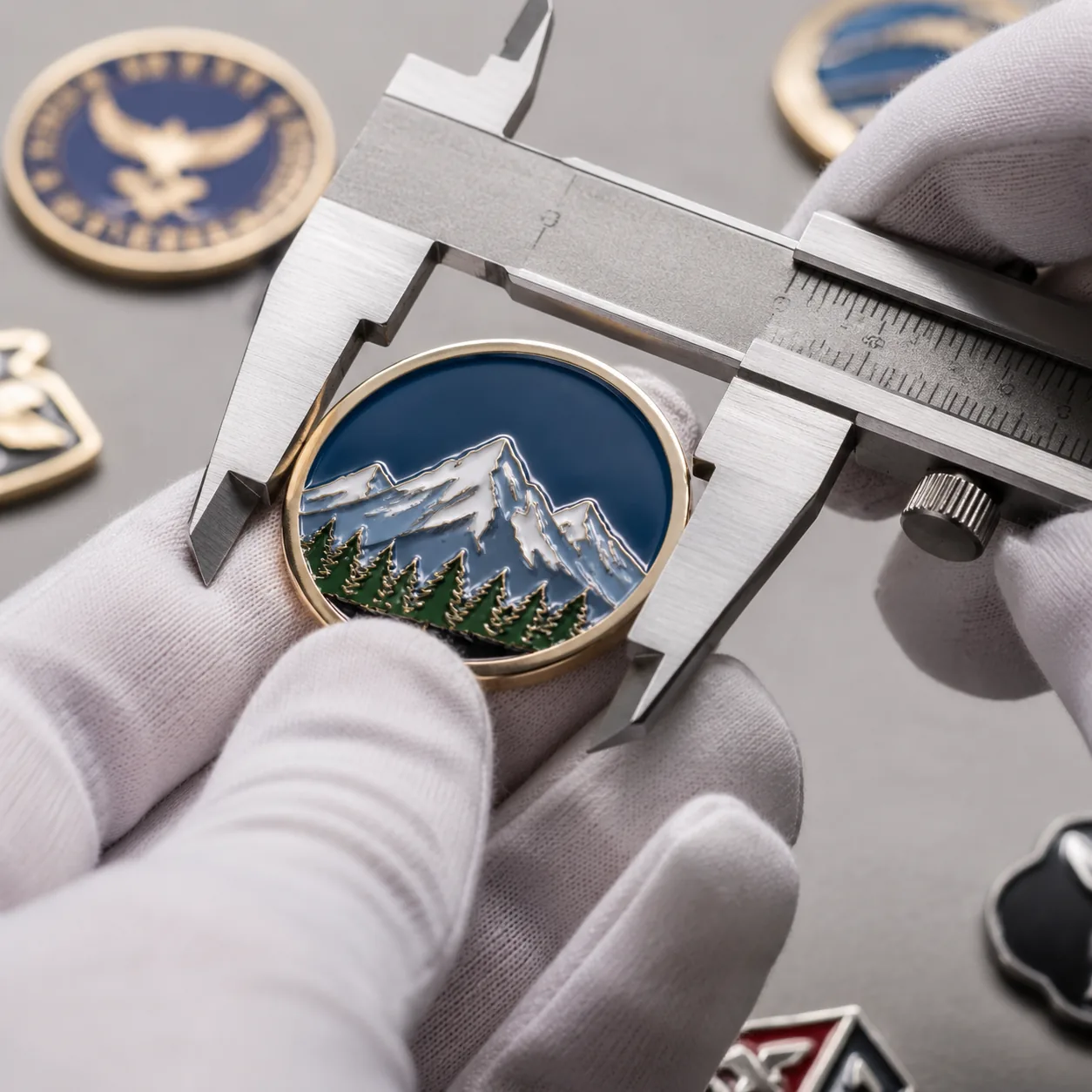
Final inspection should not rely on front-face photos. Use calipers for width, height, thickness, hole position and attachment location. Common dimensional tolerance is ±0.20 mm for pins and small keychains, ±0.30 mm for larger coins, medals and bottle openers, and ±0.50 mm for flexible accessories such as lanyards or PVC add-ons. For thickness, use ±0.15 mm on 1.2-2.0 mm stamped brass or iron pins and ±0.25 mm on 3.0-5.0 mm cast zinc alloy pieces.
Weight checks are useful for premium feel, shipping estimates and reorder consistency. A 45 mm brass challenge coin at 3.0 mm thickness may use a finished-piece tolerance of ±5 percent, measured without packaging. A 25 mm soft enamel pin is usually better controlled by outline size, metal thickness and plating finish rather than weight. If weight affects the brief, state whether the attachment, chain, card or polybag is included in the measurement.
Color must reference the approved physical sample, Pantone number or signed production proof. Visual inspection should be under D65 daylight or a light booth, not yellow workshop lighting. For printed cards, lanyards and inserts, a Delta E limit of 2.0-3.0 can be practical. For enamel, instrument readings are less reliable because metal walls, enamel depth and polishing change perceived shade; a signed pre-production sample is usually the controlling standard.
- Measure at least 13 pieces per SKU for key dimensions on small lots and 20-32 pieces per SKU on larger or high-risk lots.
- Check artwork orientation, backstamp direction, cutout shape, serial number sequence and attachment position against the approved proof.
- Confirm logo text height is legible; very small recessed or raised letters below 0.6 mm often fill, blur or lose plating definition.
- Use 3M 600 or equivalent tape test on printed, epoxy-coated or painted surfaces when adhesion risk is high.
- Perform a 10-cycle open-close test on key rings, lobster clasps, brooch hinges and safety pins.
- Record all measurement tools used, including caliper resolution, light level and any gauge or pull tester model.
Set realistic plating, enamel and surface finish limits
Plating disputes are common because buyers may expect jewelry-level finish at promotional-product pricing. Define inspection distance, lighting and defect size before production. A practical visual standard is 30-40 cm viewing distance under 600-1,000 lux white light, without magnification except for safety or functional checks. State whether the back face is judged to the same standard as the front face; many promo orders allow minor back-side hairlines that would not be accepted on the logo face.
Standard nickel, gold, antique gold, black nickel or dyed black plating on promotional metal items is often 3-8 microns total deposit, depending on base metal and finish. Higher corrosion resistance may require 8-12 microns total deposit, better pre-polishing or electrophoretic clear coating. These upgrades add cost and can extend the plating queue by 2-5 working days, especially before peak seasons. Do not specify outdoor salt-spray performance unless the price includes the base material, plating stack and formal test standard.
Soft enamel normally sits 0.10-0.30 mm below the raised metal line. Hard enamel is polished nearly flush, often within ±0.05-0.10 mm of the metal surface. Reject missing enamel, color overflow into the wrong cell, bubbles over 0.5 mm on the visible face, contamination visible at normal distance, and polishing that exposes base metal on high points. For epoxy coating, check for edge pullback, trapped dust, yellowing, tackiness and bubbles above 0.5 mm.
| Feature | Standard promo limit | Tighter retail limit | Cost or yield impact |
|---|---|---|---|
| Plating thickness | 3-8 microns total deposit | 8-12 microns or tested coating system | Higher unit cost and 2-5 extra days |
| Soft enamel fill | 0.10-0.30 mm below metal line | More even fill with fewer low spots | Higher reject rate on thin metal walls |
| Hard enamel flatness | Flush within ±0.05-0.10 mm | Strict flush feel across logo face | More polishing time and smear risk |
| Visible face defect | No obvious defect over 0.5 mm | No visible defect over 0.3 mm on logo face | Lower yield and slower inspection |
| Tape adhesion | No coating lift after tape pull | No edge lift after crosshatch plus tape where specified | Requires process control and curing time |
Test hardware, magnets and attachments as failure points
Many returns start with hardware, not artwork. A pin can look perfect but fail if the post bends, solder cracks or clutch slips off. For standard butterfly and rubber clutches, a practical retention range is 0.5-1.0 kgf for small promotional pins. Heavy brooches, medals or pins above 35 mm may need dual posts, a bar pin, thicker post wire or a different attachment instead of relying on a stronger single clutch.
For keychains, check split ring outside diameter, wire thickness, plating coverage inside the ring and connector closure. Common split rings are 25-32 mm outside diameter with 1.8-2.2 mm wire. Thin 1.2-1.4 mm rings reduce cost but are poor choices for zinc alloy charms above 30 g, bottle openers or daily-use retail items. Reject rings that keep a visible gap above 0.3 mm after a normal hand twist test.
For magnets, verify magnet type, location, adhesive coverage and pull strength. Small fridge magnets often use 8-12 mm ferrite magnets. Badge magnets and premium clips may use neodymium assemblies, which are stronger but require better corrosion protection and safer handling. If the product will be worn through fabric, test through a fabric thickness similar to the intended use instead of only testing on a bare steel plate.
- Reject pin posts that wobble, tilt more than 10 degrees, or show incomplete solder around the base.
- Reject rubber or butterfly clutches that slide off below the agreed pull force or split during hand fitting.
- Reject brooch hinges that bind, scrape plating, or open during a 10-cycle handling test.
- Reject key rings, jump rings and chains with open gaps above 0.3 mm after handling.
- Reject glued magnets with visible squeeze-out on the face or dry adhesive coverage over more than 20 percent of the magnet back.
- Record hardware lot changes when one order uses mixed attachments, finishes or supplier batches.
Inspect packing, labels and carton release before payment
Product inspection and packing inspection must be one plan. A distributor may need 100 pieces per inner carton, each SKU separated for kitting, with retail cards facing the same direction. If the factory mixes designs randomly or changes inner quantities, local repacking can cost more than the original China packing work and can miss an event deadline.
Specify unit pack, inner quantity, master carton quantity, carton size, carton weight and label content. Small pins in polybags often ship 100 pieces per inner carton and 1,000-2,000 pieces per master carton. Heavy challenge coins may need only 100-300 pieces per master carton to keep gross weight under 15-18 kg. For courier shipments, keeping cartons under 20 kg reduces breakage, surcharge risk and manual handling damage.
Use five-ply export cartons for dense coins and keychains, not thin domestic cartons. Check carton compression, sealing tape, moisture, rust smell, barcode readability, hang-hole position, polybag sealing, warning text and country-of-origin marks. For retail or 3PL delivery, carton labels should show PO number, SKU, design name, quantity, carton number, gross weight, net weight and destination if required.
| Packing item | Inspection check | Recommended rule |
|---|---|---|
| Unit pack | Correct item, card, bag, warning text and barcode | Zero wrong SKU in sample for retail packs |
| Inner quantity | Count per bundle, tray or inner carton | Exact count for kitted orders; no ±1 allowance |
| Master carton | Carton mark, dimensions, gross weight and sealing | Match packing list; gross weight normally under 18 kg |
| Moisture control | Dry cartons, no rust smell, no wet bags | Reject cartons with water staining or condensation |
| Pallet or 3PL loading | SKU separation and visible labels | Required for retail DC or fulfillment center delivery |
The inspection report should end with a decision: pass, conditional pass, hold, fail or reinspect. Pass means the sample is within AQL, carton marks match and no critical defect is found. Conditional pass requires written buyer approval, usually with a discount, spare parts, sorting records or replacement plan. Hold is appropriate when the data is incomplete, packing is not finished, or one SKU shows a pattern. Fail means any critical defect appears or the accepted number for major or minor defects is exceeded.
If the shipment fails, ask for containment rather than a vague promise to improve quality. Identify affected SKUs, production dates, plating batch, operator group or packing line. Then define the action: 100 percent sorting for plating stains, replacement of loose clutches, repacking of mixed cartons, remake of one failed SKU, or reinspection after defective pieces are physically separated. Cost responsibility should be written into the PO: if the goods are outside the approved specification, the factory normally pays for rework and reinspection; if the buyer tightens the standard after finished production, the extra sorting cost is a commercial negotiation.
Build the one-page inspection sheet for the next RFQ
Before requesting price, attach a one-page final inspection sheet to the RFQ. Include the product drawing, approved sample reference, AQL levels, defect classification, dimensional tolerances, plating and enamel limits, hardware tests, packing rules and release terms. This prevents one supplier from quoting a low price based on loose checking while another includes real inspection labor, better cartons and stricter sorting.
For multi-SKU programs, state whether sampling is by total order quantity or by SKU. A 10,000-piece order split across 20 designs can hide one bad design if the inspector samples only from the full mixed lot. For high-risk assortments, require each SKU to receive a minimum artwork, color, dimension, hardware and packing check even when the total order uses general level II.
ZheCraft can build the checklist into the production sheet for pins, coins, keychains, brooches, magnets, patches and lanyards when the RFQ includes the intended market, use case, target quantity, attachment type, packaging plan and deadline. A good inspection plan lets the factory quote the real work needed to ship safely: not only die casting, stamping or plating, but also sorting, packing control, carton labeling and release inspection before the balance payment is made.
Have a project? Send your artwork and target quantity and we’ll reply with a detailed quotation within 12 working hours.
Ready to get this made?
Send your sketch, target quantity and ship-date. Detailed quotation in 12 hours.



