Final Inspection Specs for Custom Metal Promo Orders
Why Approved Samples Still Fail in Bulk
A clean pre-production sample proves that a factory can make one correct piece under controlled attention. It does not prove that 5,000, 20,000 or 50,000 pieces stayed within tolerance through die striking or casting, trimming, polishing, plating, enamel filling, baking, epoxy, assembly and packing. Most shipment disputes on custom metal promotional items come from process drift after sample approval: bent pin posts, thin plating on raised edges, enamel voids, weak magnets, open jump rings, mixed backing cards or cartons with the wrong SKU count.
Final inspection must be specified before mass production starts. If the purchase order says only “good quality,” “same as sample” or “factory standard,” the supplier decides what is acceptable after the goods are already made. A practical inspection appendix should define AQL levels, defect classes, measurement methods, viewing conditions, functional tests, packing checks and the response when a lot fails.
For custom enamel pins, challenge coins, keychains, fridge magnets and brooches, the inspection sheet should reference the approved artwork revision, CAD or mold drawing, golden sample, pantone callouts, plating finish, attachment type and packing specification. The goal is not to make inspection complicated; it is to make the pass/fail decision repeatable enough that a factory QC inspector, a buyer’s agent and a third-party inspector reach the same conclusion.
Choose AQL by Product Risk and Order Size
AQL is a sampling rule, not a guarantee that the order contains no defects. For metal promotional products, a useful baseline is critical defects AQL 0, major defects AQL 1.5 and minor defects AQL 4.0 under ISO 2859-1, general inspection level II, normal severity. At AQL 1.5, a 3,200-piece lot typically uses a 200-piece sample with an accept/reject point of 7/8 major defects. At AQL 4.0, the same sample accepts up to 14 minor defects and rejects at 15. These numbers make expectations much clearer than “inspect randomly.”
Risk should drive the setting. A 25 mm soft enamel giveaway pin with one clutch and a short event lifespan can often use AQL 2.5 major and 4.0 minor. Retail pins, licensed coins, gift-boxed keychains and brooches worn on clothing should usually stay at AQL 1.5 major and 2.5 minor. Child-facing items, sharp wearable items, magnetic products and safety-sensitive brooches need critical AQL 0 and may require 100 percent screening for sharp burrs, loose small parts or missing warning labels.
Do not combine unlike items into one inspection lot simply because they are on the same PO. A 20 mm lapel pin, a 65 mm spinner coin and a zinc alloy bottle-opener keychain have different failure modes. Split inspection lots by SKU, mold, finish, attachment and packaging format. If an order includes 10,000 pins in three plating colors and two backing cards, inspect each finish/card combination separately or at least draw samples from every combination.
| Order type | Typical MOQ and price context | Suggested inspection rule | Main acceptance focus |
|---|---|---|---|
| Event giveaway pins | MOQ 300-500 pcs; USD 0.45-1.20 FOB for 20-30 mm soft enamel | Level II, AQL 2.5 major / 4.0 minor | Color match, post strength, visible plating, unit count |
| Retail pins or brooches | MOQ 500-1,000 pcs; USD 0.80-2.50 FOB depending on size and carding | Level II, AQL 1.5 major / 2.5 minor | Front-face cosmetics, barcode match, attachment reliability |
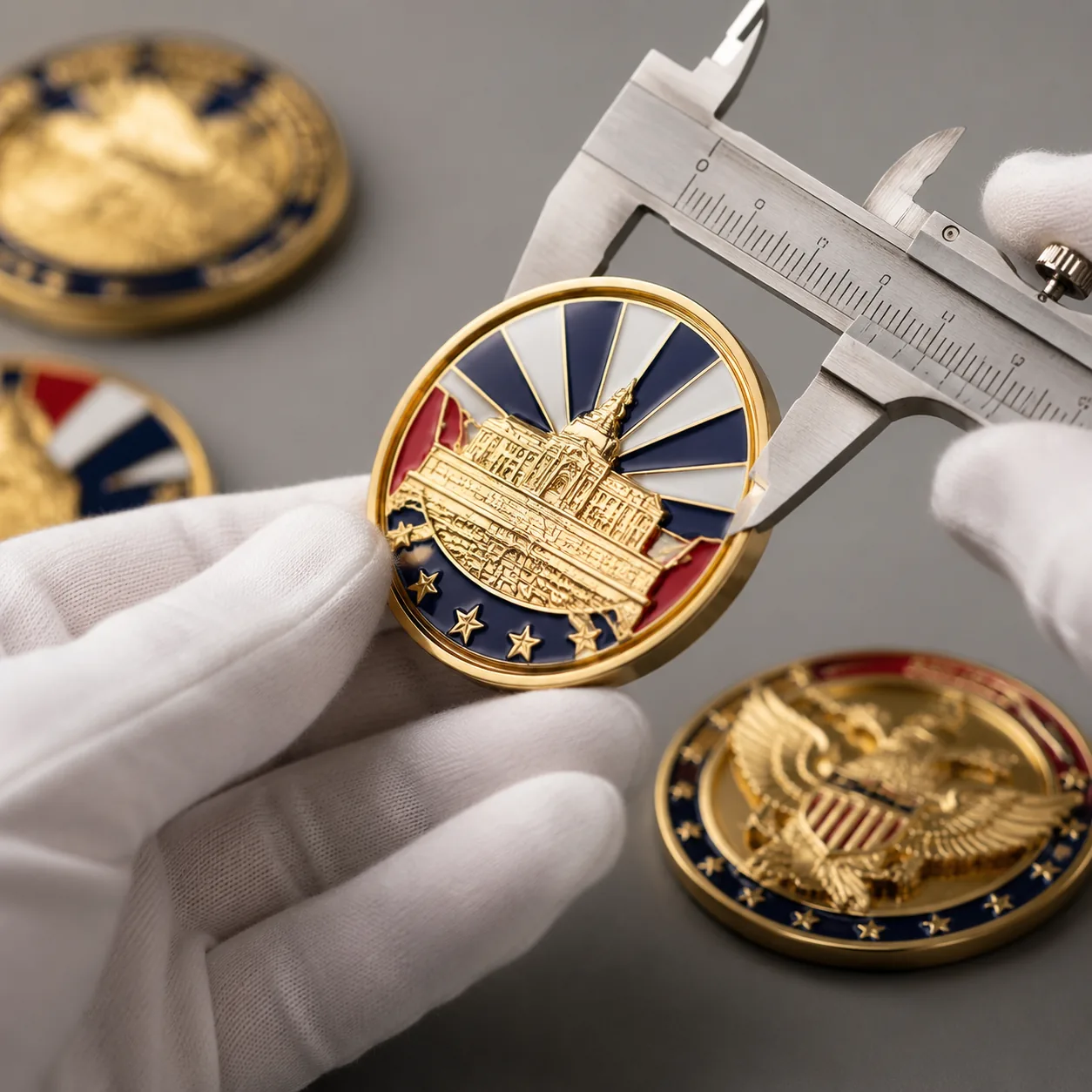
| Challenge coins | MOQ 100-300 pcs; USD 1.80-5.50 FOB for 45-70 mm coins | Level II, AQL 1.5 major / 2.5 minor | Relief detail, edge dents, plating coverage, weight and thickness |
| Keychains with moving hardware | MOQ 500 pcs; USD 0.90-3.20 FOB with split ring or swivel hook | Level II, AQL 1.5 major / 4.0 minor | Ring closure, assembly sequence, drop resistance |
| Magnets or child-facing items | MOQ 500-1,000 pcs; USD 0.70-2.80 FOB | Critical AQL 0 plus major AQL 1.0-1.5 | Magnet bond, small-part risk, labels, sharp edges |
| Mixed promo kits | MOQ varies by component; packing labor often USD 0.08-0.30 per set | Inspect each SKU and finished kit separately | Completeness, sequence, carton count, SKU separation |
Classify Defects Before Inspection Starts
Defect classification is where many inspections become subjective. A critical defect creates safety, legal, regulatory or serious brand risk. Examples include wrong trademark artwork, missing country-of-origin marking where required, a sharp burr over 0.20 mm on a wearable edge, restricted material contrary to the specification, a pin post that detaches under light hand force, or a magnet that separates and becomes a small loose part.
A major defect makes the product unsuitable for normal sale or intended use. For enamel pins, this includes wrong plating color, missing enamel on the display face over 0.50 mm, exposed base metal on a raised front edge, post location outside tolerance, loose clutch fit, or overall size outside the drawing limit. For challenge coins, major defects include incorrect diameter, soft or missing relief detail, deep edge dents, wrong antique finish or plating burn on the display face. For keychains, open jump rings, cracked charms, weak split rings and reversed assembly order should be major.
A minor defect is visible but unlikely to trigger a normal complaint. Examples include a shallow polish wave on the back, a pinprick under epoxy below 0.30 mm, slight antique-fill variation in recessed areas, or a small plating flow mark on a non-display surface. Minor does not mean “ignore”; it means the defect is counted against the minor AQL instead of stopping the shipment immediately.
- Define front face, back, edge, recessed area and hidden hardware as separate inspection zones.
- Classify wrong logo, wrong text, unsafe sharpness, loose magnets and missing attachments as critical or major, never minor.
- Use measurable limits such as 0.30 mm speck, 0.50 mm enamel void, 0.20 mm burr height and ±0.50 mm post position.
- Attach photos of approved, borderline and rejected samples so cosmetic calls are consistent across shifts.
- Require defect tally by type and carton number, not only a pass/fail summary.
Measure the Dimensions That Drive Failures
Custom metal promo items rarely fail because every dimension is off. They fail at risk points: thin bridges in openwork, pin post position, magnet recess depth, split-ring hole size, plating buildup on edges, total thickness after enamel or epoxy, and card placement. The inspection plan should target these points instead of measuring only the longest width and height.
For die-struck iron, brass or zinc alloy pins under 40 mm, a common finished-size tolerance is ±0.20 mm from the approved drawing. For larger 45-70 mm coins, ±0.30 mm on diameter is more realistic, with thickness tolerance of ±0.15 mm for 2.0-3.5 mm coins and ±0.20 mm for heavier cast pieces. Thin bridges should normally be at least 0.80 mm in zinc alloy and 1.00 mm in iron or brass; narrower details can bend, polish away or trap plating residue.
Attachment placement needs its own limit. On a 25-35 mm pin, keep the post center within ±0.50 mm of the approved position, measured from a clear edge datum or template. For brooch bars and magnets, use ±1.00 mm unless the design intentionally uses an offset. Magnet recess depth should usually be controlled within ±0.10 mm: too shallow causes glue squeeze-out, while too deep reduces contact and holding force.
| Inspection point | Practical tolerance or limit | Tool or method |
|---|---|---|
| Outer size, pins under 40 mm | ±0.20 mm from approved drawing | Digital caliper, 0.01 mm resolution |
| Coin diameter, 45-70 mm | ±0.30 mm across two axes | Digital caliper at 0° and 90° |
| Finished metal thickness, 1.2-3.5 mm | ±0.15 mm on flat non-enamel area | Caliper or micrometer |
| Pin post center | ±0.50 mm for small pins; ±1.00 mm for large badges | Overlay template or caliper from edge datum |
| Openwork bridge width | Minimum 0.80 mm zinc alloy; 1.00 mm iron/brass | Caliper or toolmaker scale |
| Magnet recess depth | ±0.10 mm | Depth gauge or caliper probe |
| Jump ring opening after assembly | Maximum 0.20 mm visible gap | 10x visual check or feeler gauge |
| Backing card pin location | ±2.00 mm if printed alignment is present | Ruler or placement jig |
Set Plating, Enamel and Color Limits
Plating disputes often come from different viewing conditions. Use a standard cosmetic check: 30-40 cm viewing distance, neutral white light at about 600-1,000 lux, normal viewing angle, 3-5 seconds per face. Defects visible only under extreme tilt or magnification should not fail the lot unless they affect corrosion resistance, brand appearance or function.
Decorative nickel, gold, black nickel, antique brass and antique silver finishes on promotional pins and coins commonly run 3-8 microns on accessible surfaces. For retail products, frequent handling or better wear resistance, specify 8-12 microns for the top decorative layer or a plated stack such as copper strike, nickel barrier and final finish. Thicker plating can soften fine recessed lines, reduce enamel cell depth and raise cost, so do not specify it blindly on detailed designs.
Enamel and print colors should be judged against the approved Pantone reference and golden sample, not a screen rendering. For strict retail programs, Delta E under 2.0 is a reasonable target when a spectrophotometer is available; for normal promotional enamel, visual match to the approved sample under controlled light is more practical. Transparent enamel, glitter, pearl and glow pigments need wider tolerance because metal reflectivity and particle density change the perceived shade.
Lead time affects finish stability. A typical soft enamel pin order takes 12-18 production days after artwork and sample approval; hard enamel may take 18-25 days because of repeated polishing; challenge coins often take 15-25 days; complex keychains or multi-part magnets may need 20-30 days. Rushing plating and enamel curing increases the chance of color variation, weak epoxy adhesion and packing marks.
- Reject exposed base metal on the front face, raised logo, edge or attachment contact point as a major defect.
- Allow controlled antique variation in recessed areas only if the sample shows the same effect.
- Specify plating thickness only when wear, retail warranty, outdoor use or corrosion exposure justifies the cost.
- Check enamel after baking, cleaning and full cooling, not while the batch is warm or dusty.
- Record the approved Pantone code, plating name, sample date and finish photo in the inspection file.
Test Attachments, Magnets and Moving Parts
Functional tests should be simple enough to run during final inspection and strict enough to reflect real use. For each SKU, test at least the AQL sample size or 20 pieces, whichever is higher, for critical attachments. If a failure could create a safety risk, use 100 percent screening for that specific feature after any failed sample.
For standard 8-10 mm pin posts on pins under 35 mm, a practical pull test is 2-3 kgf for 5 seconds without post detachment, excessive rotation or base cracking. Larger brooches and badges may require 3-5 kgf, but the base metal thickness must support it; a thin 1.20 mm stamped badge may deform before a strong weld fails. Clutches should fit firmly without sliding off during light hand tugging.
Magnets should be tested on a clean painted steel panel around 0.8-1.0 mm thick. Raw steel exaggerates holding strength and does not represent a refrigerator door. A fridge magnet should hold its own weight with a 2x safety margin and should not slide immediately on a vertical panel. If the order specifies magnet grade, record it clearly; N35 ferrite and stronger neodymium magnets perform very differently and carry different safety risks.
Keychain hardware needs separate checks. Split rings should spring closed after being opened 2-3 mm. Jump rings should have no visible gap above 0.20 mm. Swivel hooks should rotate freely without gritty plating residue. Spinner coins and movable charms should complete 10 full cycles without scraping, wobble, loose rivets or metal dust.
| Product type | Functional test | Suggested pass limit |
|---|---|---|
| Enamel pin with post | Post pull and clutch fit | 2-3 kgf for 5 seconds; clutch does not slip |
| Brooch badge | Hinge, clasp and fabric simulation | Clasp locks; no sharp snag on woven fabric |
| Fridge magnet | Vertical hold on painted steel | Holds item weight with 2x safety margin |
| Keychain | Ring recovery and drop check | Ring closes; no part detaches after 1 m drop onto wood |
| Spinner coin | Rotation cycle test | 10 cycles without scraping, wobble or loose rivet |
| Epoxy-coated item | Fingernail edge and clarity check | No lifting, cloudy dome or edge delamination |
Control Packing, Labels and Mixed-SKU Risk
Many rejected shipments are technically good products packed the wrong way. A perfect pin in the wrong backing card, wrong barcode bag or mixed carton can fail a retailer’s receiving check. Final inspection must include unit count, inner bag count, card orientation, barcode scan, country-of-origin marking, warning labels, carton marks, gross weight and master carton layout.
For individual polybags, count tolerance should be zero: one item per bag means exactly one. Backing card placement should stay within ±2 mm when printed graphics create an alignment reference. Missing choking hazard text, wrong age grading, absent country-of-origin marking or wrong retail barcode should be major or critical depending on the destination market and compliance requirement.
Open cartons from different stack positions, not only the top carton. Export cartons for pins, coins and keychains are commonly kept below 12-18 kg gross weight to reduce crushing and handling damage. Heavy challenge coins should use smaller inner boxes of 50-100 pcs with foam, paper or dividers, and void space should normally stay below 10 mm per side. For ocean shipments or humid seasons, desiccant and sealed inner bags reduce tarnish risk, especially on nickel, antique silver and brass finishes.
- Scan every barcode and QR code used in the order, including inner labels and retail cards.
- Match carton marks to PO number, SKU, finish, quantity, gross weight, carton number and destination rule.
- Separate gold, black nickel, antique and painted variants in clearly marked inner cartons.
- Photograph carton layout, inner packing and label position before sealing for repeat orders.
- Verify packed quantity against the inspection lot, not only against the factory’s production summary.
Plan Failure Response Before the Ship Date
Inspection failure should trigger a written disposition: sort, rework, remake, ship under concession or hold for buyer decision. This must be agreed before the shipment is urgent. For custom metal items, rework options narrow after plating, enamel and epoxy are complete. Loose clutches can often be replaced, and open jump rings can be closed if plating is not cracked. Wrong plating color, wrong logo, serious pitting under plating, incorrect enamel color or mis-struck artwork usually requires remake or buyer concession.
Inspection timing should leave room to act. For a 500-5,000 piece order, schedule final inspection when goods are 100 percent produced and at least 80 percent packed; allow 1 inspection day plus 1-3 days for sorting or repacking if needed. For 10,000-50,000 pieces or mixed-SKU orders, plan 2-4 inspection days, plus a realistic buffer before vessel cutoff, courier pickup or event delivery. Do not schedule inspection, final payment release and flight departure on the same day.
The inspection report should include sample size, AQL accept/reject numbers, measured values, defect photos, carton numbers affected and the factory’s corrective action. If only certain cartons fail, quarantine those cartons instead of mixing them back into finished stock. After sorting, use tightened sampling or 100 percent check for the failed defect type. This prevents a “repaired” lot from shipping with the same problem hidden in different cartons.
| Failure type | Best corrective action | When rework is not practical |
|---|---|---|
| Loose clutch or wrong clutch type | Replace clutch and reinspect fit | If post diameter or post weld is wrong |
| Open jump ring | Close or replace ring, then pull check | If plating cracks at the ring or charm hole |
| Wrong plating finish | Remake or obtain written buyer concession | If brand color, listing photos or retail spec depend on finish |
| Dust or bubbles under epoxy | Sort acceptable units from rejects | If contamination is widespread across most units |
| Weak magnet bond | Reglue only if recess, glue and magnet size are correct | If magnet grade or contact area is underspecified |
| Wrong backing card or barcode | Repack with correct material and rescan | If delivery date cannot absorb repacking time |
Before releasing the next purchase order, add a one-page inspection appendix. Include drawing revision, golden sample ID, AQL settings, defect classes, key tolerances, plating and color limits, functional tests, packing rules and failure disposition. Share target market, retail or giveaway use, safety requirements, required labels and must-pass tests with the supplier at RFQ stage so unit price, MOQ, lead time and inspection workload are quoted on the same basis. A clear final inspection spec does not slow production; it prevents the much slower problem of finding defects after cartons arrive.
Have a project? Send your artwork and target quantity and we’ll reply with a detailed quotation within 12 working hours.
Ready to get this made?
Send your sketch, target quantity and ship-date. Detailed quotation in 12 hours.



