Final Inspection Specs for Custom Metal Giveaways
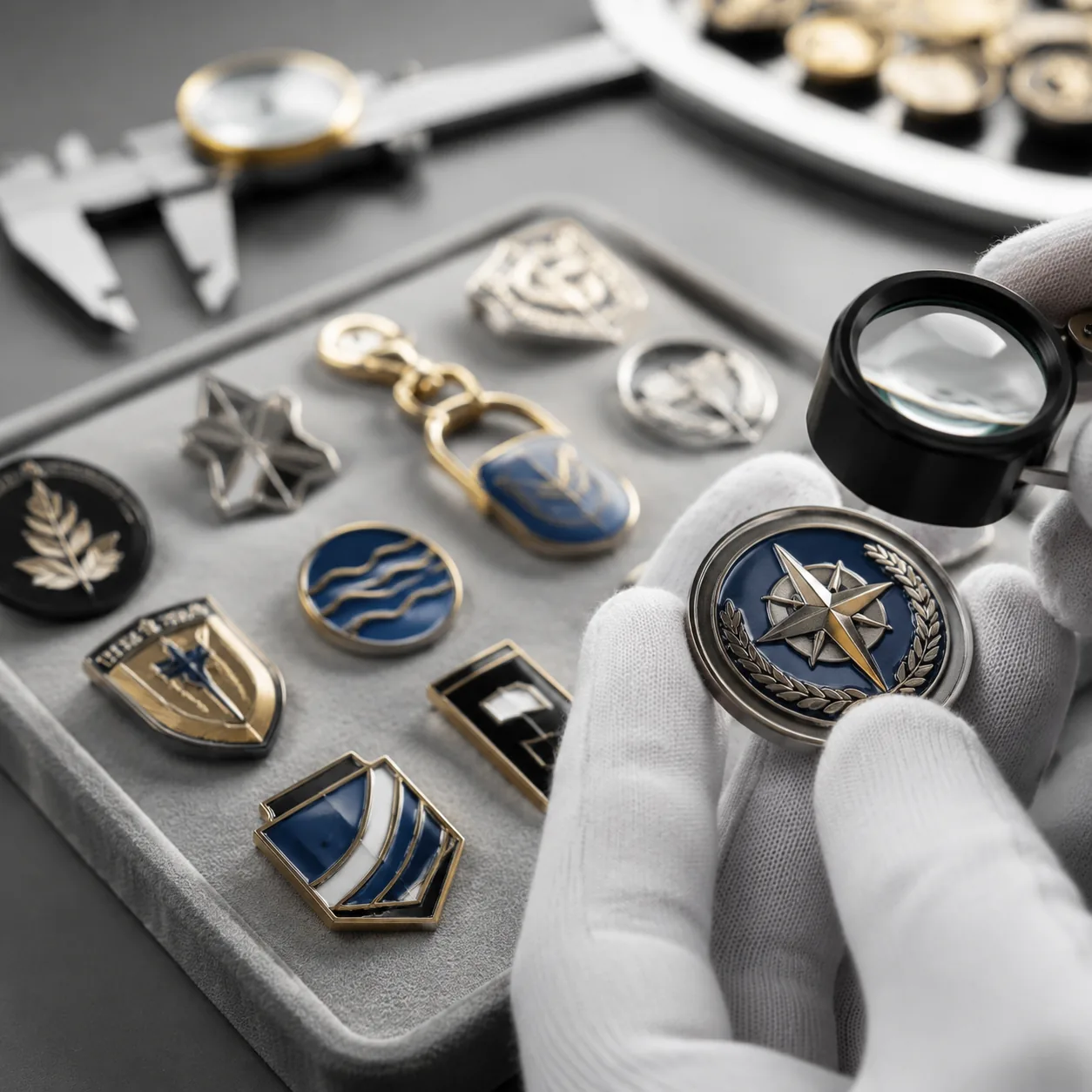
Why good samples still become bad shipments
A pre-production sample can look perfect and still be followed by cartons with bent posts, cloudy plating, loose split rings, enamel overflow or mixed backing cards. The usual cause is not fraud; it is an inspection plan that says “check quality” without defining sample size, defect classes, tolerances and release rules. Custom metal giveaways are small, highly handled items. A 0.5 mm enamel miss, a crooked pin post or a shade difference between two gold plating racks may look minor in a factory tray but obvious when the item is worn, photographed or packed into a retail kit.
The practical target is controlled variation, not zero variation. Die-struck brass, zinc alloy die-casting, iron stamping, electroplating, polishing and hand-filled enamel all create normal process spread. Final inspection must tie production pieces back to the approved artwork, CAD drawing, Pantone or plating reference, packing diagram and sealed golden sample. Without those anchors, the final decision becomes subjective and slow.
Use 100 percent inspection for VIP gifts, numbered coins, high-value retail sets or orders below about 300 pieces where one visible defect can damage the campaign. Use AQL sampling for most event, promotional and distributor orders from 500 to 50,000 pieces. AQL is efficient because it catches systemic failures without forcing inspectors to handle every unit, but it only works when the purchase order already states what counts as critical, major and minor.
Set AQL levels, MOQ tiers and timing up front
AQL means acceptable quality limit. It is not permission to ship defective goods; it is a statistical pass-fail method for deciding whether a completed lot is acceptable. For most custom lapel pins, challenge coins, keychains and magnets, specify General Inspection Level II, AQL 0 for critical defects, AQL 1.5 for major defects and AQL 4.0 for minor defects. For retail programs, child-facing packaging, premium plated coins or orders with strict brand review, tighten major defects to AQL 1.0 and minor defects to AQL 2.5.
MOQ and lead time also affect inspection risk. A 100-piece soft enamel pin order may be made as one small batch and sorted manually, while a 20,000-piece keychain order may run across several casting, polishing and plating batches. Write the inspection requirement before deposit, not after cartons are sealed. For typical China FOB custom metal programs, planning assumptions are: 100 to 299 pieces for sampling or VIP gifts, 300 to 999 pieces for small promotional runs, 1,000 to 4,999 pieces for standard event orders, and 5,000 pieces or more for distributor or retail programs.
| Product type | Typical MOQ | FOB price range | Production lead time | Inspection focus |
|---|---|---|---|---|
| Soft enamel pins, 25-35 mm | 100-300 pcs | US$0.45-1.40/pc | 12-18 days after artwork approval | Post strength, enamel fill, plating shade, card packing |
| Hard enamel pins, 25-35 mm | 100-300 pcs | US$0.75-2.20/pc | 15-25 days | Polish level, flush enamel, color separation, front scratches |
| Die-struck or cast coins, 40-50 mm | 100-500 pcs | US$1.20-4.80/pc | 18-30 days | Relief detail, antique contrast, weight, edge quality |
| Zinc alloy keychains, 35-60 mm | 300-500 pcs | US$0.85-3.50/pc | 18-28 days | Ring pull force, plating adhesion, swivel, carton weight |
| Magnetic badges or bottle openers | 300-500 pcs | US$1.10-4.20/pc | 20-32 days | Magnet retention, polarity, coating, functional fit |
Prices vary with metal, size, plating, enamel count, mold complexity, packaging, exchange rate and freight terms. The purpose of the range is not to quote every design; it gives the buyer a commercial sense of what is realistic. If a supplier offers a 50 mm antique coin at a price far below the range, inspect weight, plating thickness and edge finishing carefully.
Classify defects with measurable limits
Critical defects can injure a user, breach compliance requirements or make the item unsafe to distribute. Major defects make the item unfit for the intended use or visibly off-brand. Minor defects are small cosmetic issues that do not affect function and are not obvious at normal viewing distance, usually 40 to 50 cm under 600 to 800 lux neutral white light. Define examples before production because “scratch” alone is too vague.
| Defect class | Typical AQL | Concrete examples | Release decision |
|---|---|---|---|
| Critical | 0 | Sharp burr or exposed edge over 0.2 mm, exposed pin tip, loose small magnet, broken clasp with sharp edge, missing child-warning label where required | Fail lot; hold shipment and sort or remake 100 percent |
| Major | 1.0-1.5 | Wrong plating color, enamel missing over 1.0 mm, detached post, split ring opens after pull test, unreadable logo, wrong backstamp, wrong barcode | Fail lot or rework affected batch with buyer approval |
| Minor | 2.5-4.0 | Hairline scratch under 5 mm on non-focal area, plating dot under 0.3 mm, slight enamel meniscus, light bag wrinkle, tiny back-side mark | Accept only if within AQL allowance |
| Measurement | Usually major | Width, thickness, weight, hole position, card size or carton quantity outside agreed tolerance | Fail if function, fit, brand match or packing count is affected |
Use a simple rule for cosmetic judgment: front-face, brand-facing and retail-facing defects are graded stricter than hidden back-side defects. A 3 mm scratch across a mirror-polished coin face is major. The same length mark on the back under a backing card may be minor if it does not expose base metal or affect use. For QR codes, serial numbers and micro-text, inspect scanability and legibility separately instead of treating them as normal decoration.
Control dimensions, weight and plating thickness
Final inspection should compare production against the approved drawing and golden sample. For die-struck pins and coins, a practical width and height tolerance is ±0.20 mm for items under 30 mm, ±0.30 mm for 30 to 60 mm, and ±0.50 mm for larger medallions above 60 mm. Thickness tolerance is commonly ±0.20 mm for lapel pins and ±0.30 mm for coins or keychain fobs, unless the item fits into a box insert, retail blister or mechanical assembly.
Weight is a useful early warning for wrong material, thin casting or excessive polishing. For iron-stamped badges and zinc alloy castings, allow ±5 percent against the approved sample. For premium coins, numbered awards or bottle openers where hand feel matters, use ±3 percent. Measure at least 10 pieces from different cartons with a 0.1 g resolution scale. If a keychain approved at 35 g averages 30 g, the buyer will notice even if the artwork looks acceptable.
Plating thickness should be specified in microns, not only by color name. Standard promotional nickel, brass or copper base plating is often 3 to 5 microns total. Better corrosion resistance for outdoor keychains, coastal markets or retail goods usually calls for 5 to 8 microns total plating, plus a 24-hour neutral salt spray check on representative pieces. For harsh-use keychains or bottle openers, consider 8 to 12 microns, but confirm that fine recessed text, coin relief and enamel pockets are not softened by buildup.
Color tolerance must be realistic. For enamel, approve against a physical color chip or signed sample; Pantone coated references are helpful but do not perfectly predict enamel over metal. For printed cards and labels, a delta E target of 3 to 5 is practical when the buyer supplies a printed reference. For antique gold, antique silver and black nickel, define acceptable shade using sample photos and one sealed reference because process chemistry and polishing pressure create visible variation.
Inspect finish and enamel under factory-realistic conditions
Cosmetic inspection fails when the factory checks under dim yellow light and the buyer checks under office LEDs or retail lighting. Set the condition: 600 to 800 lux neutral white light, 40 to 50 cm viewing distance, 5 to 8 seconds per side, no magnification for normal cosmetic grading. Magnification is only justified for QR codes, serial numbers, safety markings, micro-text or engineering features.
For soft enamel pins, color fill normally sits 0.10 to 0.30 mm below the raised metal walls. That recess is not a defect if approved on the sample. Reject overflow onto metal lines, dust trapped in enamel, bubbles above 0.5 mm on the front face, missing fill above 1.0 mm, or color bleeding that changes the logo shape. For hard enamel, the polished surface should feel nearly flush with the metal, usually within ±0.05 to ±0.10 mm. Large color blocks may show slight waviness, but scratches from over-polishing or exposed base metal are major.
For challenge coins and antique badges, define contrast rather than asking for “good antique finish.” Raised logos should be clean and bright, recessed fields evenly dark, and black residue should not transfer to a white cotton cloth after five firm rubs. For mirror gold, silver and black nickel, inspect the front face strictly. Allow only very small non-focal marks on the back if they are hidden by packaging and do not expose base metal.
Glitter, glow, pearl, translucent and epoxy finishes need sample-based approval. Glitter density can vary by batch; glow pigment may look dull in daylight but strong after charging; transparent enamel changes over nickel, brass or antique plating. State which effect matters most: daylight color, night glow, particle density, transparency or surface smoothness.
Test attachments, packaging and cartons together
Hardware failures create immediate complaints because they occur during first use. Butterfly clutch posts should be straight within 3 degrees, located within ±0.5 mm of the drawing, and withstand a 2 kg pull for 10 seconds without detaching. Rubber clutches should grip securely without forcing users to bend the post during removal. Brooch bars should survive 10 open-close cycles and lock without scraping plating. Magnets should be tested on the intended surface, not only on a thick factory steel plate.
Keychains need their own checks. A standard promotional split ring is often 25 to 30 mm outside diameter with 1.5 to 2.0 mm wire. The ring should return closed after opening 3 to 4 mm; visible functional gaps above 0.2 mm are major. For fobs above 45 g, test the link, swivel or chain at 5 kg for 10 seconds. A low-cost split ring can save a few cents but create returns if the item is used daily.
- Pull-test at least 20 pieces per lot across different cartons for posts, magnets, rings, chains and brooch bars.
- Measure 10 pieces for width, thickness and weight; do not take all samples from the same inner bag.
- Scan every barcode, QR code and serial-number format used in the shipment.
- Check card size within ±1.0 mm and hang-hole position within ±1.0 mm for retail or display packs.
- Reject functional link gaps above 0.2 mm and pin posts displaced more than ±0.5 mm from the approved layout.
- Record all failures by carton number so sorting can target the affected batch instead of the whole shipment.
Packaging is part of the product. Define the pack exactly: one pin on one 300 gsm card in one 0.04 mm OPP bag, one keychain in one 0.06 mm resealable bag, or one coin in a 2 mm foam insert and velvet box. Heavy coins and sharp pin posts tear thin bags during sea shipment, so packaging thickness should match weight and edge profile. For retail-ready packs, run a simple carton drop check from 60 to 80 cm depending on gross weight and confirm products do not scratch each other inside the pack.
Master cartons should be checked for count, label accuracy and strength. A common export carton is 5-ply corrugated board, below 15 kg gross weight for small pins and below 18 kg for coins or keychains. Carton dimensions should be within ±10 mm of the packing spec. Carton marks should include item code, quantity, gross weight, net weight, carton number and country of origin when required. Heavy coin cartons should use 3-inch tape or reinforced tape.
Decide release, rework or remake before pressure builds
A failed inspection does not always mean the order must be remade. If defects are concentrated in one process or carton range, sorting may solve the issue. For example, if seven cartons contain cloudy gold pieces from one plating rack, isolate those cartons and re-plate or remake that batch. If defects are random across all cartons, 100 percent sorting becomes slow and unreliable because inspectors fatigue quickly on small cosmetic judgment calls.
Rework is suitable for replaceable hardware, loose jump rings, wrong cards, label errors, repacking, some polishing marks and certain enamel touch-ups before final baking. Remake is usually required for wrong mold size, wrong metal thickness, incorrect backstamp, severe plating shade mismatch, distorted 3D relief, baked-in wrong enamel colors or incorrect event dates. Re-plating can fix some finish issues, but it can also soften relief, fill fine recesses and shift dimensions by several microns. Approve one reworked sample before releasing the full batch.
| Issue found | Best response | Typical added time | Main risk |
|---|---|---|---|
| Missing clutch or loose rubber back | Sort and replace hardware | 1-3 days | Missed pieces if recounting is weak |
| Wrong backing card or barcode | Repack with corrected cards | 2-5 days | Event deadline or retail label mismatch |
| Light scratches on mirror plating | Polish or grade-sort | 2-4 days | Polishing through thin plating |
| Wrong enamel after baking | Remake affected pieces | 7-15 days | New color must match approved sample |
| Wrong mold dimension or logo relief | Correct tooling and remake | 10-20 days | New sample approval is required |
| Cloudy or tarnished plating across lot | Test re-plate, then rework or remake | 5-12 days | Detail loss and uneven shade |
Put the release rule in the PO: shipment is released only after the lot passes AQL, measurement checks, hardware tests, packing inspection and carton verification. Also state who pays for re-inspection if the lot fails. This avoids rushed decisions after vessel booking or event deadlines have already compressed the schedule.
Build the PO checklist before production starts
The cleanest final inspection is agreed before deposit. Attach a one-page inspection appendix to the purchase order covering sampling level, AQL limits, defect examples, measurement tolerances, plating thickness, golden sample reference, hardware tests, packing method, carton limits and release condition. Email comments alone often disappear when the order moves from sales to tooling, plating, assembly and packing.
For mixed-item kits, inspect each component and then inspect the finished kit. A lanyard, pin, coin and keychain can each pass alone but fail as a set because logo scale, plating shade, orientation or barcode sequence is inconsistent. Define kit-level major defects: missing component, wrong order in tray, mixed language labels, inconsistent logo color, wrong insert, barcode mismatch and carton quantity error.
- Seal one golden sample with the factory and keep one buyer sample with the same approval number.
- Add AQL 0 critical, AQL 1.0-1.5 major and AQL 2.5-4.0 minor to the PO before deposit.
- List dimensional tolerances, weight tolerance, plating micron target and color reference in the inspection sheet.
- Require pull tests for posts, magnets, split rings, jump rings, chains and brooch bars.
- Inspect packaging, labels, carton marks and quantities during final inspection, not after shipment booking.
- Plan correction time: 1-5 days for sorting or repacking, 7-20 days for remake depending on tooling and plating.
Before cartons are sealed, request production photos from at least three random cartons: front, back, side thickness, attachment, packaging, carton label and quantity count. For higher-risk orders, arrange internal final inspection or third-party inspection when goods are 100 percent produced and at least 80 percent packed. The more specific the checklist, the less subjective the shipment release discussion becomes.
Have a project? Send your artwork and target quantity and we’ll reply with a detailed quotation within 12 working hours.
Ready to get this made?
Send your sketch, target quantity and ship-date. Detailed quotation in 12 hours.



