Factory vs Trading Company for Custom Pins in 2026
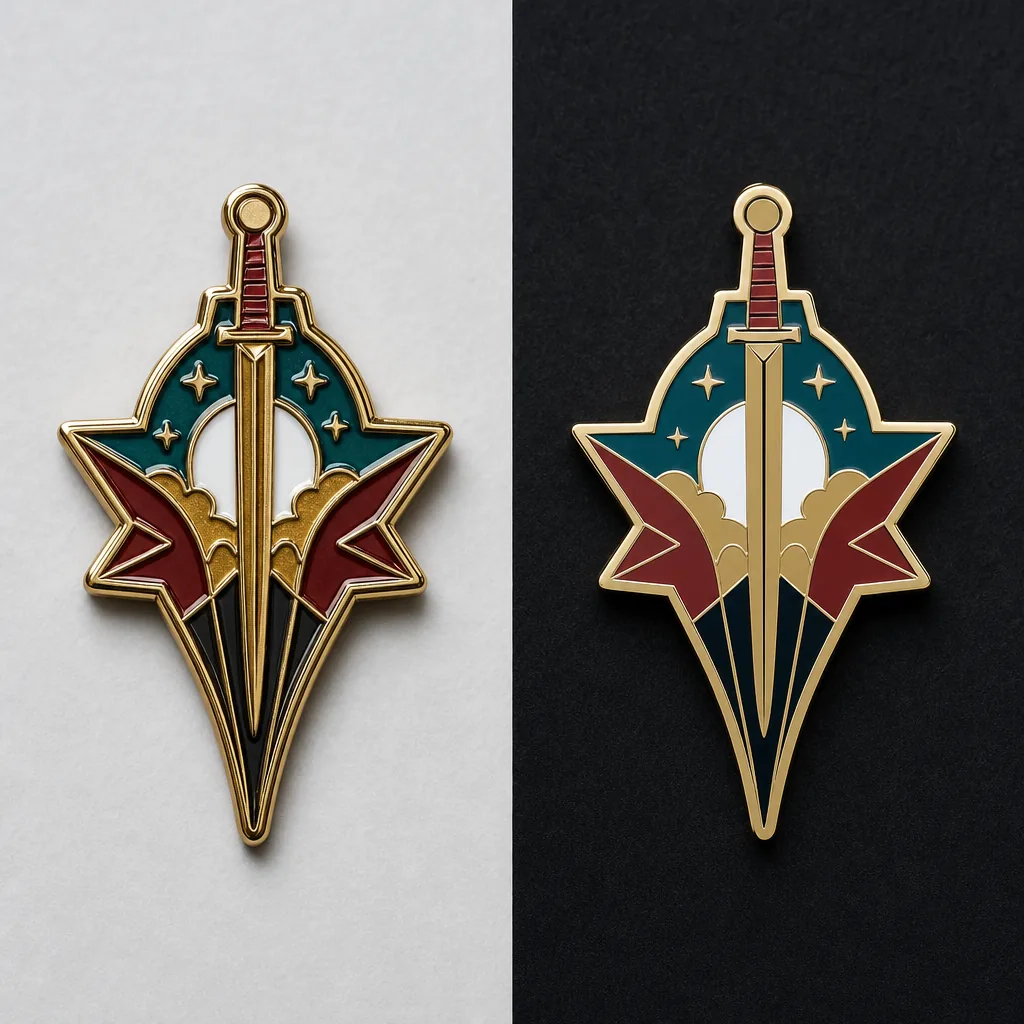
When the lowest pin quote creates the highest correction cost
A direct-factory quote and a trading-company quote can show the same 30 mm soft enamel pin at similar FOB pricing, but they do not represent the same control structure. The difference is not just margin. It changes who converts artwork into die lines, who confirms finished thickness before plating, who checks post spacing against the approved drawing, and who has authority to stop packing when the pre-production sample misses spec. In custom metal products, those control points determine whether an attractive unit price stays attractive after sample revisions, remake risk, sorting labor, and launch-date pressure are added.
Most failures in custom pins are not catastrophic. They are small process misses that become expensive because they surface after carding, barcoding, or freight booking: a post welded 0.6 to 1.0 mm off center, enamel fill sitting visibly low in one color block, black nickel reading charcoal gray under 4000 to 5000 K retail lighting, a recessed line closing because the die cannot reliably hold a 0.25 mm channel, or a backing card die-cut sized for a 10 mm butterfly clutch while production uses a 12 mm rubber clutch. Any one defect may be acceptable for a giveaway order. The same defect can trigger hand rework, retailer rejection, or a brand compliance dispute on a repeat program.
The decision is therefore not factory good, trader bad. The real question is which model matches the order profile. If you need repeatable lapel pins, challenge coins, keychains, or badges with stable Pantone references, plating appearance, and attachment tolerances, a factory with in-house stamping or die casting, polishing, coloring, plating coordination, and final inspection is usually lower risk. If you need a mixed event set with enamel pins, woven patches, printed inserts, polyester lanyards, acrylic charms, and consolidated export packing, a capable trading company may reduce buyer workload and shorten coordination time.
In 2026, disciplined buyers compare process ownership rather than labels. Ask who owns artwork breakdown, whether supplier-caused mold correction after first sample is included, how plating thickness and color are controlled, whether final release follows AQL 2.5 major / 4.0 minor or AQL 1.5 / 2.5 for premium retail, and who signs shipment release. Those answers matter more than whether the seller calls itself a manufacturer, exporter, or merchandiser.
Factory vs trader: compare control points, not sales language
| Decision point | Direct factory | Trading company |
|---|---|---|
| Typical MOQ for custom enamel pins | 100 to 300 pcs per design is standard; 50 pcs is possible with a 15 to 35% surcharge or simplified packing | 100 to 300 pcs common; low MOQ is often achieved by routing to whichever workshop has spare capacity |
| MOQ for mixed promo kit | Usually higher when products need different processes, printed inserts, and manual kitting | Often lower effective MOQ when combining pins, patches, lanyards, stickers, and cards under one coordinator |
| Tooling charge | USD 45 to 90 for standard stamped iron or brass mold; USD 90 to 180 for die-cast, spinner, slider, or 3D tooling | Usually upstream tooling plus 10 to 25% management margin |
| Sample lead time | 5 to 8 days for a standard sample; 7 to 12 days for cutouts, spinners, sliders, magnets, or epoxy dome | 7 to 14 days because approvals pass through an extra communication layer |
| Mass production lead time | 10 to 18 days after sample approval for standard pins; 18 to 25 days for complex assembly or retail kitting | 12 to 22 days typical; can extend if the upstream factory queue changes |
| FOB unit price, 30 mm soft enamel pin, 500 pcs | USD 0.34 to 0.72 at 1.2 to 1.5 mm thick, 2 to 6 colors, standard clutch, simple polybag | USD 0.43 to 0.92 for equivalent spec after markup and coordination |
| FOB unit price, 35 mm hard enamel pin, 500 pcs | USD 0.62 to 1.10 because polishing and color leveling are slower | USD 0.78 to 1.32 typical for the same spec |
| Thickness tolerance | Common target ±0.10 mm on stamped items; ±0.15 mm is more realistic on heavier die-cast pieces | Depends on whether the trader confirms actual factory capability in writing |
| Attachment placement tolerance | Common target ±0.50 mm; dual-post spacing should be approved from centerline | Often stated vaguely unless the drawing controls it |
| Plating specification | Decorative nickel, gold-tone, imitation gold, black nickel, or antique finishes typically around 0.03 to 0.08 micron | Usually based on factory declaration unless third-party QC or retained samples are used |
| QC release standard | Can inspect to AQL 2.5 major / 4.0 minor before sealing cartons; premium programs may run tighter visual limits | May use the same AQL target, but release authority varies by trader |
| Best use case | Repeat orders, technical designs, urgent engineering changes, retained tooling, stable reorders | Mixed-category kits, small sourcing teams, buyers wanting one coordinator |
| Main risk | Narrower range outside core metal products | Less visibility into which workshop actually builds, checks, and corrects the goods |
Pricing in 2026: compare normalized specifications, not headline FOB
The biggest pricing mistake is comparing quotes that sound equivalent but are built on different assumptions. A factory may quote USD 0.56 FOB for a 35 mm stamped iron soft enamel pin at 500 pcs, 1.5 mm thickness, black nickel plating, four Pantone colors, two welded posts, butterfly clutches, and individual polybag. A trader may quote USD 0.49 for what appears to be the same item, but the lower number may assume 1.2 mm thickness, one post instead of two, no backing card, one free artwork revision only, and no supplier-funded mold amendment if the first sample fails the approved drawing.
Once the specification is fixed, 2026 pricing is easier to benchmark. At 500 pcs, a 25 mm stamped iron soft enamel pin often falls in the USD 0.28 to 0.55 range. A 30 mm version is commonly USD 0.34 to 0.72. A 40 mm pin at 1.5 mm thickness with two posts and five to six colors typically runs USD 0.58 to 1.05. Brass usually adds a modest premium over iron but can hold sharper edges and cleaner polishing. Hard enamel is commonly 20 to 45% higher than comparable soft enamel because of extra stone polishing and stricter leveling. Offset print with epoxy can be cheaper than hard enamel for artwork with fine gradients or micro text under 0.35 mm, but epoxy adds risk of edge overflow, surface scratching, and yellowing if UV exposure or curing control is poor.
Add-ons move price faster than many buyers expect. Glitter, glow pigment, transparent enamel, pearl finish, screen-printed details, cutouts, spinners, sliders, danglers, bottle-opener cut features, magnets, safety-pin backs, and custom rubber clutches can each add several cents to more than USD 0.20 per piece depending on size and assembly labor. Retail-ready packing matters just as much. A printed backing card, barcode label, individual bagging, card insertion, and export carton assortment can add USD 0.06 to 0.18 per unit at 500 pcs, and more if carding is manual or if SKUs must be packed in exact ratios.
Volume discounts are real but not unlimited because metal weight, polishing time, plating, and hand assembly remain meaningful cost drivers. A straightforward stamped pin may drop about 8 to 12% from 500 pcs to 1,000 pcs, and 15 to 22% by 3,000 pcs if packaging stays simple. Savings are usually smaller on heavy challenge coins, bottle opener pins, or multi-part keychains. The practical commercial question is not what is your best price, but what exactly is included at each MOQ tier and what changes if we move from 300 to 500 or 1,000 pcs.
Lead times: most delays come from handoffs, approvals, and queue changes
Lead-time risk usually comes from cumulative handoffs, not one dramatic production failure. The common sequence is artwork clarification, die-line approval, mold engraving queue, first strike, polishing, enamel fill, baking, plating, attachment welding, packing, carton inspection, and export booking. A direct factory does not guarantee speed, but it usually removes one communication layer and makes schedule recovery faster when a step slips or when a die correction is needed after first sample.
For a standard enamel pin order, a practical planning model is 1 to 3 days for artwork confirmation, 5 to 8 days for a pre-production sample, 10 to 18 days for bulk production after sample approval, and 2 to 5 days for final packing plus booking preparation after balance clearance. Add 2 to 4 days for custom backing cards, barcode labels, or card insertion. Add 4 to 7 days for glow, glitter, transparent enamel, epoxy dome, spinner assembly, or mixed hardware. Add 5 to 8 days when the order is consolidated with patches, lanyards, inserts, or gift boxes into one event kit. During peak gifting and event periods, queue congestion can push total production 3 to 7 days beyond nominal lead times even when the supplier is otherwise competent.
A trading company can still be faster on the calendar when the order spans categories that no single workshop handles well. For example, 1,000 pins, 1,000 woven patches, and 1,000 sublimated lanyards may ship sooner through a disciplined trader running three specialist workshops in parallel than through one metal-focused factory trying to subcontract everything itself. The difference is whether the seller can issue one master schedule with sample dates, approval cutoffs, packaging readiness targets, carton-close deadlines, and final consolidation windows stated in calendar days rather than general promises.
Urgent programs need a compression plan, not a vague expedite promise. Ask which steps can overlap safely: backing-card printing during bulk production, carton marking before final count, partial packing by SKU while the balance finishes plating, or split shipment of approved completed SKUs. If the supplier cannot explain where time can compress and where it cannot, the quoted lead time is probably a sales estimate rather than an operations commitment.
Quality control: define measurable checkpoints before deposit
The most useful way to compare supplier models is to map defect ownership. On custom pins and related metal items, recurring defects include low enamel fill, plating haze, pinholes, rough edges after polishing, incorrect cutout geometry, wrong backstamp, epoxy overflow, attachment misalignment, weak welds, and incorrect quantity per inner bag. If the seller cannot identify who checks each stage and when, you are relying on goodwill instead of process control.
A capable factory should describe QC with numbers. Typical checkpoints include incoming metal sheet thickness verification, die cavity review before first strike, dimensional confirmation on the first stamped pieces, in-process enamel fill inspection, post-polish edge review, plating color comparison against the approved sample, clutch or magnet fit check, attachment pull test, and final AQL inspection before cartons are sealed. For standard stamped pins, many importers hold finished thickness to ±0.10 mm and attachment placement to ±0.50 mm. Die-cast items often need a looser dimensional expectation, especially on deep relief. Pull-force criteria vary by hardware, but buyers commonly ask for welded post adhesion sufficient to resist normal clutch removal without twisting off by hand. On visible front-face cosmetics, AQL 2.5 major / 4.0 minor is common; premium retail programs often tighten visual acceptance for plating blemishes, edge nicks, and enamel inconsistency.
Plating is where vague wording creates avoidable claims. Nickel, black nickel, gold-tone, imitation gold, silver-tone, and antique finishes used on promotional pins are decorative layers, not heavy-duty engineering coatings. They are commonly around 0.03 to 0.08 micron, so the practical performance questions are coverage, adhesion, color consistency, and whether the finish matches the retained approved sample under neutral light. If color repeatability matters across reorders, keep a sealed reference sample and require the seller to approve against that sample rather than a phone photo or an older production image.
A trading company can still deliver strong QC if it has its own inspectors and genuine release authority. The key distinction is whether inspection happens during production at the workshop or only after goods arrive at the trader's warehouse. Warehouse-only inspection still has value, but it catches problems later, when remake time is shorter, root cause is harder to prove, and responsibility can blur between the seller and the upstream factory.
Engineering response: convenience helps until technical detail gets diluted
Procurement teams buy response quality as much as unit price. A direct factory usually shortens technical loops because artwork breakdown, die feasibility, plating constraints, polishing limits, and packing methods can be discussed with the production side inside one organization. That matters when you need concrete answers such as whether a 0.30 mm recessed line will remain open after stamping, whether two posts set 18 mm apart will reduce rotation on a 40 mm pin, whether a 1.8 mm overall thickness is realistic after plating and polish, or whether black nickel will visually soften a backstamp with strokes under 0.40 mm.
The trade-off is administrative range. Many factories are efficient on their core metal processes but weaker on cross-category project management. If the order includes pins, embroidered patches, acrylic charms, fold-over header cards, barcode stickers, and retail assortment packing, a trading company may save several internal buyer hours by consolidating communication, invoicing, compliance paperwork, and shipment planning. That convenience is only worth paying for when the technical translation remains exact from RFQ to sample approval to mass-production release.
A practical screening method is to send every supplier the same five technical questions before deposit: material, finished thickness tolerance, plating type, sample lead time in days, and final inspection standard. Strong suppliers answer with numbers, conditions, and exceptions. Weak suppliers answer with generic catalog language, inconsistent statements across emails, or blanket no-problem replies without engineering detail. That pattern usually predicts how they will handle real production issues later.
RFQ checklist: the minimum data to request before choosing either model
- Lock one specification sheet for every quote: size in mm, material, finished thickness, plating, Pantone references or exact color count, attachment, and packaging.
- Request MOQ tiers at 100, 300, 500, 1,000, and 3,000 pcs so surcharge patterns and volume breaks are visible early.
- Ask for tooling cost in USD, tooling retention period, and whether reorders use the same mold cavity without recutting.
- Confirm pre-production sample lead time and bulk production lead time in calendar days, not phrases such as around two weeks.
- Set measurable tolerances where needed, such as ±0.10 mm thickness and ±0.50 mm attachment placement for standard stamped pins.
- Require the QC release standard, ideally AQL 2.5 major / 4.0 minor unless your retail program uses tighter cosmetic limits.
- Clarify what the FOB price includes: backing card, polybag, barcode label, carton marks, pre-shipment photos, and supplier-caused mold correction.
- Use a pre-production sample for all new designs, moving parts, magnets, complex cutouts, glitter, glow, epoxy dome, or retail-pack combinations.
The 2026 recommendation: buy the control model that fits the order
For most custom enamel pins, badges, challenge coins, and metal keychains, a capable direct factory is the safer structure when specification accuracy matters more than assortment breadth. The main advantages are shorter engineering loops, clearer accountability for tooling and sample correction, and fewer opportunities for details to drift as information passes through layers. That matters most on repeat brand programs where logo geometry, Pantone references, backstamp, packaging format, plating appearance, and reorder consistency must stay stable across multiple production cycles.
For distributor programs, event kits, and mixed merchandise sets, a trading company can be the better choice if it behaves like a real project manager rather than a forwarding mailbox. The stronger firms issue one normalized spec sheet, one approval path, one packing standard, one production calendar, and one escalation owner across all workshops. Without that discipline, the convenience premium rarely offsets the added opacity.
The practical sourcing method is straightforward. Normalize the specification first, then compare the supplier model second. Put both factory and trader against the same size, material, thickness, plating, attachment, packaging, AQL target, and delivery requirement. Once those inputs are fixed, the better partner usually becomes obvious because one side answers with process detail and the other answers with sales language.
On the next RFQ, score responses on four weighted factors: specification completeness, engineering clarity, lead-time realism, and total landed value. Price still matters, but on a branded and repeatable metal product it should not outweigh process visibility. If a supplier cannot answer direct technical questions before deposit, it is unlikely to become more precise after deposit.
Have a project? Send your artwork and target quantity and we’ll reply with a detailed quotation within 12 working hours.
Ready to get this made?
Send your sketch, target quantity and ship-date. Detailed quotation in 12 hours.



