Factory Acceptance Specs for Custom Pins in 2026
Why approved artwork still fails at factory acceptance
Artwork approval confirms design intent, not manufacturing conformance. A factory can follow the vector proof and still deliver pins that are undersized, too thin, poorly plated, underfilled, mis-posted, or packed with the wrong hardware. For custom pins, the real control document is the production specification attached to the PO and golden sample, because that is where measurable limits are defined.
That distinction matters because lapel pins behave like small metal components, not printed graphics. A thickness change of 0.20 mm is noticeable in hand. A post welded or cast 2.0 mm off center can make the pin rotate or sit crooked on a backing card. Decorative plating that is too thin can scuff through at raised edges during bagging and carding. Soft enamel that sits too low can make approved Pantone colors look dark and dull because the recessed cavity reflects less light.
A workable acceptance sheet therefore needs numeric controls for process route, finished dimensions, body thickness, base metal, plating finish, enamel system, line widths, hardware location, cosmetic thresholds, AQL, and pack-out. If each line has a number, tolerance, or pass-fail rule, the supplier, in-line QC team, and third-party inspector are all checking the same standard. If the spec stays vague, quality gets negotiated after production, which is the most expensive time to discover disagreement.
1-4: Lock product identity, process route, size, and weight
The first block should identify the item precisely enough that the factory cannot substitute a different build route without written approval. Weak wording is “1.5 inch custom pin.” Strong wording is: “Item PIN-026; stamped iron soft enamel; finished size 38.0 x 31.5 mm; body thickness 1.5 mm before plating; bright nickel finish; polished front; sandblasted back; one 8 mm butterfly clutch.” That single line fixes process, dimensions, finish, and hardware.
For stamped pins up to 50 mm on the longest side, a realistic finished-size tolerance is ±0.20 mm. From 50 to 70 mm, ±0.30 mm is more practical. Stamped iron or brass body thickness is typically 1.2 mm, 1.5 mm, or 1.8 mm, with finished tolerance of ±0.15 mm after stamping and polishing. Die-cast zinc alloy normally needs ±0.20 mm because casting shrink, gate trimming, and tumbling add variation. If the pin is positioned as a collectible or museum-store item, add reference weight with ±8% tolerance; a 40 mm stamped brass pin often targets 9.5-11.5 g depending on relief depth and post count.
Build route affects both price and yield. In 2026, stamped iron soft enamel remains the default for 20-50 mm promotional pins. A 30-40 mm design with one standard clutch and standard plating typically lands at USD 0.28-0.48 FOB at 1000 pieces, USD 0.33-0.72 at 300 pieces, and USD 0.58-1.10 at 100 pieces. Stamped brass usually adds about USD 0.05-0.15 per unit at the same size because raw material and die wear are higher. Imitation hard enamel is commonly 20-35% above soft enamel because of extra filling, curing, and polishing steps. Die-cast zinc becomes the better route when the art includes internal cutouts, deep sculpted relief, pierced voids, or sizes above roughly 55 mm where thin stamped sections may distort.
| Spec line | Recommended entry | Normal range | Risk if omitted |
|---|---|---|---|
| Build method | Stamped iron soft enamel / stamped brass / die-cast zinc alloy | Lock before sample approval | Factory may quote one process and ship another |
| Finished size | Width x height in mm | 20-50 mm standard; 55-70 mm special | Scale becomes subjective at inspection |
| Body thickness | Metal body only, excluding enamel and hardware | 1.2 / 1.5 / 1.8 mm common | Pin feels too light or too bulky |
| Tolerance | Size ±0.20 mm; stamped thickness ±0.15 mm | Relax above 50 mm | Shipment disputes move to final QC |
| Reference weight | Target grams with ±8% tolerance | Useful for premium retail | Hand-feel varies between batches |
5-8: Specify metal, plating, enamel system, and cosmetic surface rules
Base metal is a functional choice, not just a cost line. Iron is economical and stable for standard soft enamel. Brass holds finer die-struck detail and gives a denser feel, but usually costs 15-30% more than iron at the same size and quantity. Zinc alloy is better for cast contours and cutouts, but it does not hold very fine sharp borders as cleanly as stamped brass. As a practical rule, if your artwork contains metal lines under 0.35 mm, stamping in iron or brass is safer than zinc casting.
Plating should be called out by finish family and target decorative thickness. “Gold” is not enough. Use entries such as bright gold-tone, bright nickel, matte nickel, black nickel, antique brass, or antique copper. Typical decorative plating on promotional pins runs about 0.03-0.05 microns. For higher-handling retail programs, many buyers require 0.05-0.10 microns plus a clear e-coat or lacquer topcoat. That topcoat matters because these finishes are decorative; they improve appearance and short-term wear resistance but do not create jewelry-grade corrosion protection.
Enamel also needs its own exact process line. Soft enamel means the color fill remains recessed below the metal borders. Imitation hard enamel means colors are filled, baked, and polished nearly flush with the metal. If epoxy is required, state full-front dome coverage, no edge overflow, and no trapped bubble over 0.30 mm. For color control, do not rely on a paper Pantone chip alone. Specify visual match to the approved pre-production sample under D65 or neutral white light at 1000-1500 lux, because color on metal-bordered enamel almost never matches ink on coated paper exactly.
Surface rules should separate the front face from the back. A practical front standard is: no exposed base metal on visible areas, no blistering, no peeling, no pinhole over 0.15 mm in plated zones, no foreign-color contamination visible at 30 cm, and no scratch visible at 30 cm that breaks plating or crosses a key design feature. The back can allow light polishing marks and minor tone variation, but should not allow rust, sharp burrs, missing finish on standard plated areas, or loose posts.
9-12: Control fine detail, edge safety, posts, and pin orientation
Many approval failures start with artwork that exceeds the process capability. For stamped soft enamel, a disciplined supplier can hold 0.30 mm raised metal lines and 0.40 mm recessed color cells, but 0.35 mm lines and 0.50 mm cells produce better yield and more consistent fill. For imitation hard enamel, avoid isolated cavities below 0.45 mm because polishing can soften the border or pull color unevenly. For die-cast zinc with texture or 3D relief, raised detail should usually be 0.50-0.60 mm or wider.
Edge quality deserves its own acceptance line because handling complaints often come from the back and sides, not the front photo sample. State whether the edge is standard die-cut, beveled, rope edge, or polished smooth. Maximum accessible burr height should not exceed 0.10 mm, and no point should cut skin, snag fabric, or catch a polybag during random inspection. Retail programs should require back-face deburring, not front polish only.
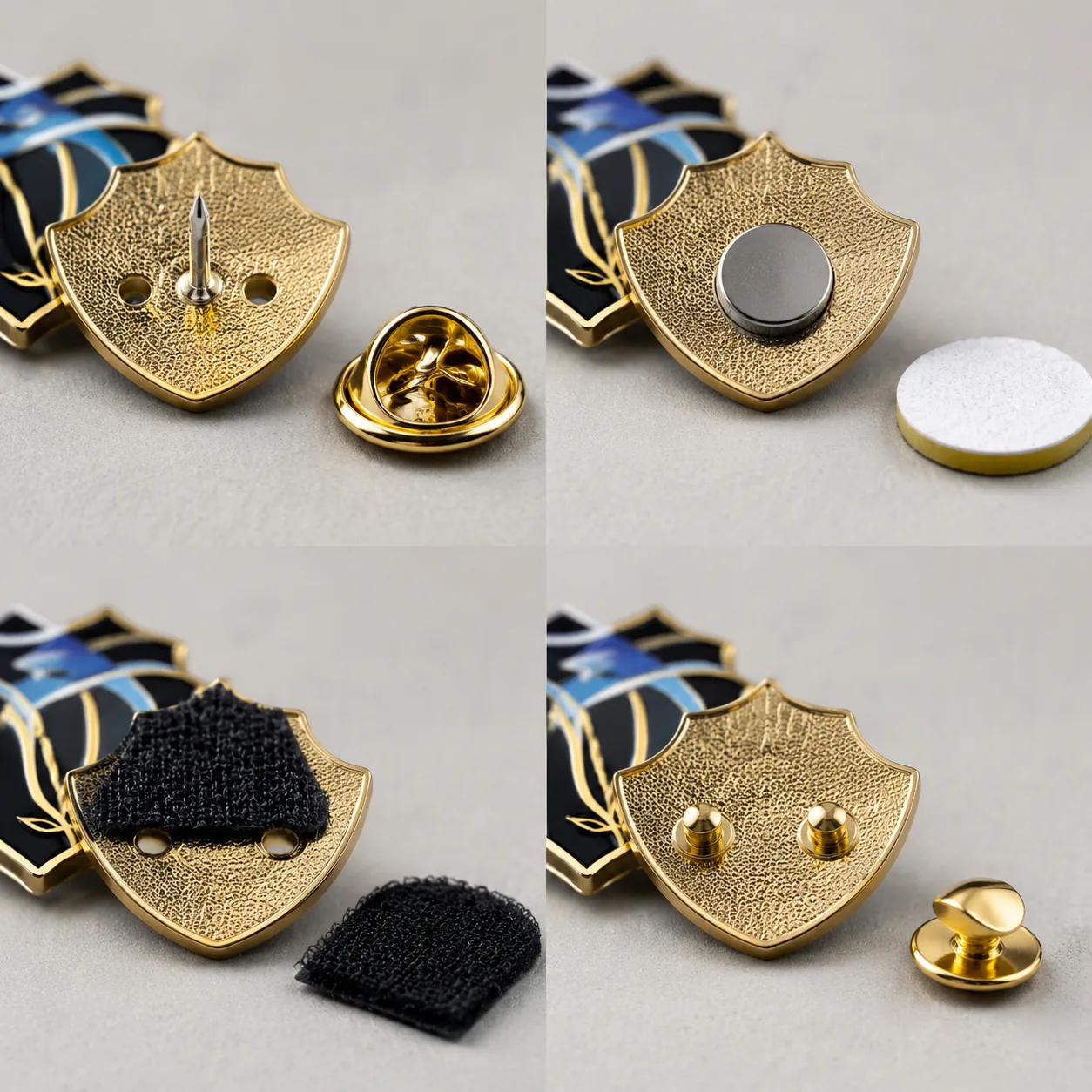
Hardware must be locked by type, count, and location. A vertical 25-30 mm pin can often use one post, but a 40-50 mm horizontal pin normally needs two posts to prevent rotation. Standard butterfly clutches are lowest cost; deluxe clutches and locking clutches improve retention but add roughly USD 0.03-0.12 per unit depending on type. Post location tolerance of ±1.0 mm from the approved layout is common. On backing-card programs, that tolerance is critical because even a 1.5-2.0 mm shift can misalign card holes and make the pin sit visibly crooked.
Orientation should be written as a use requirement. State whether the pin must hang level on a backing card, whether clutches are preinstalled, and whether engagement must hold through normal hand use without accidental release. If rubber clutches are specified for youth kits or employee packs, note that they reduce snagging but generally hold less securely than metal butterfly or locking types after repeated wear cycles.
13-16: Define defect thresholds, AQL, defect classes, and rework limits
Cosmetic inspection becomes manageable only when thresholds are numeric. A solid front-face standard is: no exposed base metal, no plating peel, no enamel overflow crossing a metal line, no color void over 0.20 mm, no contamination spot over 0.15 mm in the primary design area, and no front scratch over 2.0 mm visible at 30 cm. For imitation hard enamel, add flatness wording such as no visible sink, dip, or low-fill area when viewed at 45 degrees under neutral light.
For bulk custom pin orders, ANSI/ASQ Z1.4 single normal sampling is a practical framework. Inspection level II is common. AQL 2.5 for major defects and AQL 4.0 for minor defects is standard for promotional programs. Museum-store, licensed, and direct-to-consumer collectible programs often tighten to AQL 1.5 major and AQL 2.5 minor. Critical defects remain zero tolerance. In this category include wrong design, wrong plating family, missing or loose hardware, sharp-point hazard, mixed-SKU packing, wrong count in a fixed set, and incorrect country-of-origin marking where labeling is required.
Defect classes should be written in plain language. Critical defects are safety, identity, or functional failures. Major defects reduce saleability or normal use, such as loose posts, severe color mismatch against the signed sample, missing enamel section, plating peel, or post location outside tolerance. Minor defects are limited cosmetic issues that do not affect function, such as a light back-side polish mark or small acceptable tone variation within the approved sample range.
Rework rules should also include timing. Missing backing cards, absent barcode labels, or unclutched units can usually be reworked within 3-5 calendar days and reinspected. Post misplacement, mixed plating lots, mold-detail loss, or major color mismatch usually require partial remake and typically add 7-14 days, sometimes longer near holiday capacity peaks. Writing those limits into the PO spec helps purchasing teams protect launch dates instead of debating remediation after final inspection.
- Set AQL, defect classes, and inspection level before production starts
- Define inspection light at 1000-1500 lux and viewing distance at 30 cm
- Separate critical, major, and minor defects in writing
- State which failures are reworkable and the reinspection deadline
- Require inspection against both the written PO spec and the signed golden sample
17-20: Approve samples correctly, then lock MOQ tiers and lead times
Approval should be split into two gates. First is the pre-production sample, which confirms tooling, line detail, color layout, plating tone, and hardware choice. Second is the signed golden sample retained by both buyer and supplier as the shipment reference. If you approve only a digital proof, you still have no shared standard for enamel height, plating shade, edge polish, post placement, or clutch feel. On orders above roughly USD 2,000, the cost of a physical golden sample is trivial compared with the cost of a rejected shipment.
Sampling lead time in 2026 is commonly 5-8 calendar days for standard stamped soft enamel after final artwork sign-off and tooling confirmation. More detailed imitation hard enamel or zinc-alloy cast designs often take 6-10 days. Mass production is usually 10-18 calendar days for standard pins, depending on quantity, color count, plating type, and hardware count. If the order also includes backing cards, barcode labels, polybags, mixed-SKU assortments, gift boxes, or destination sorting, add 2-5 days for pack-out and state it separately in the PO.
MOQ should be defined per design, not per combined order. Many factories quote 50-100 pieces as a technical minimum, but pricing improves much more clearly at 300, 500, and 1000 pieces per SKU. Tooling for a simple stamped pin may be charged at USD 50-120 for iron and USD 80-180 for brass, though some suppliers waive or credit tooling after a reorder threshold. Buyers placing several SKUs can ask to combine plating runs, but they should not assume identical pricing if size, thickness, color count, or hardware count differs.
| Order size per design | Typical FOB unit price | Sample lead time | Mass production lead time |
|---|---|---|---|
| 100 pcs, 30-40 mm soft enamel iron | USD 0.58-1.10 | 5-8 days | 10-14 days |
| 300 pcs, 30-40 mm soft enamel iron | USD 0.33-0.72 | 5-8 days | 10-15 days |
| 500 pcs, 35-45 mm imitation hard enamel | USD 0.50-0.92 | 6-9 days | 12-18 days |
| 1000 pcs, 30-40 mm soft enamel iron | USD 0.28-0.48 | 5-8 days | 12-18 days |
| 500 pcs, 45-55 mm die-cast zinc alloy | USD 0.68-1.40 | 6-10 days | 14-20 days |
21-24: Write exact packing, carton, marking, and spare-quantity rules
Packing is where small metal goods create hidden downstream cost, so the unit pack should be written exactly: bulk polybag, individual OPP bag, pin on backing card, card plus polybag, velvet pouch, or rigid gift box. If a backing card is used, specify card size, board weight, print finish, hole position, barcode location, and whether the pin mounts through die-cut holes. A 350-400 gsm card is common for retail. Lighter cards often curl or tear during transport and hanging.
Carton rules matter for 3PL receiving and e-commerce prep. A practical export standard is 5-layer corrugate with gross carton weight capped at 12-15 kg and master carton drop resistance suitable for normal parcel handling. If the product may move through humid conditions or remain in storage for 6-12 months, require a sealed inner liner or moisture bag plus desiccant where practical. Shipping marks should include PO number, SKU, carton sequence, country of origin, and packed quantity. If multiple destinations are involved, add destination code by carton to avoid relabeling after import.
Spare quantity should be explicit whenever the order supports an event date, retail reserve, or kit assembly line. A practical rule is 1-2% extra units packed separately by SKU for orders above 1000 pieces, or a fixed 10-20 extra units for smaller runs. The incremental FOB value is usually minor compared with the cost of replacing short shipments, concealed transit damage, or customs losses.
Quantity tolerance also needs to be written. Many suppliers treat ±2% as acceptable on bulk custom goods unless exact count is stated. If your program requires strict inventory intake or fixed set assembly, write “exact quantity required; no short shipment allowed,” and clarify that spare units are in addition to, not part of, the invoiced order quantity. That avoids receiving disputes between the supplier invoice and warehouse count.
Use a short final acceptance block to decide shipment release
The final acceptance block should be short enough for the line supervisor, factory QC team, and inspector to use on shipment day without interpretation. A practical release standard is: approved against signed artwork revision and dated golden sample; dimensions, weight, and hardware within PO tolerances; cosmetic inspection under defined light and viewing distance; sampling per stated ANSI/ASQ Z1.4 plan and AQL levels; approved pack-out and carton marks confirmed; shipment released only after inspection pass or written buyer waiver.
Keep that factory-facing acceptance block separate from broader commercial PO terms. Production, in-line QC, and final random inspection teams need a one-page manufacturing standard they can use at the press, plating line, fill station, and packing table. That document prevents more disputes than a longer contract that never reaches the shop floor.
For first-time buyers, the most effective next step is to create a reusable 24-line template from one live SKU and send it with the RFQ or revised PO. Require the supplier to mark each line accepted, revised, or not recommended. That response quickly shows whether the factory actually controls tooling, plating, enamel, hardware, and pack-out, or is simply forwarding artwork to a subcontractor. Once the first run succeeds, keep that spec as the reorder master so future POs change only item code, quantity, and delivery terms, not the quality standard.
Have a project? Send your artwork and target quantity and we’ll reply with a detailed quotation within 12 working hours.
Ready to get this made?
Send your sketch, target quantity and ship-date. Detailed quotation in 12 hours.



