Epoxy Dome Coating for Pins and Keychains: Buyer Specs
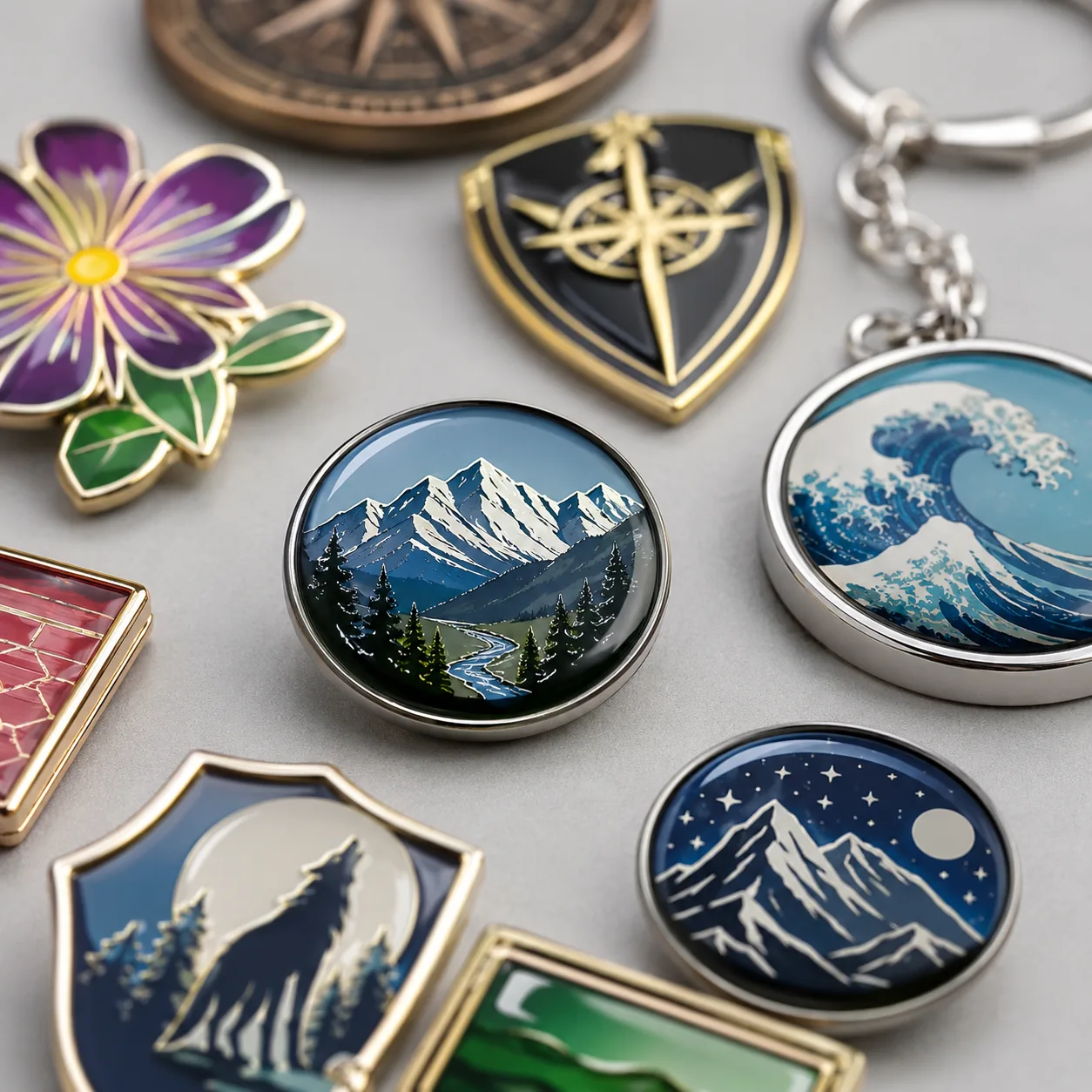
Use Epoxy When Surface Protection Matters
Epoxy dome coating is a clear resin layer dispensed over a finished pin, coin, magnet, or keychain to protect printed ink, soft enamel, or exposed color areas from abrasion. It is most useful when a product will be handled repeatedly at trade shows, shipped in bulk, attached to keys, or displayed in retail bins where coated faces rub against cards, rings, or other metal parts.
For custom metal items, the coating is normally a two-part clear epoxy or polyurethane resin. Standard dome height is 0.4 to 1.2 mm above the highest coated surface. For 20 to 35 mm pins, the most stable production range is 0.6 to 0.8 mm. For 40 to 70 mm keychains, 0.7 to 1.0 mm is common because larger printed fields need more resin volume to produce an even lens.
Epoxy should be specified as a functional coating, not a vague visual upgrade. It changes finished thickness, unit weight, curing time, packing method, inspection criteria, and defect risk. A purchase order that says only “add epoxy” leaves the factory to decide resin type, coverage, dome height, edge control, and rejection limits. Those assumptions can vary widely between suppliers.
Best and Worst Applications
Epoxy performs best where the surface needs rubbing protection rather than impact resistance. Good candidates include soft enamel event pins, offset-printed zinc alloy keychains, CMYK printed badges, fridge magnets with exposed graphics, and promotional pins with large color blocks below raised metal lines. The coating seals the surface, improves gloss, and reduces direct abrasion on ink or enamel.
Hard enamel pins usually do not need epoxy. In a true hard enamel process, color is polished flush with the metal partitions, so the surface is already smooth and durable. Adding resin over that finish can make a premium pin look cheaper, soften crisp metal edges, and produce a plastic reflection that is unsuitable for jewelry-style brooches or retail collector pins.
Epoxy is also a poor fit for antique-plated coins, high-relief 3D metal, reeded coin edges, and designs where tactile metal texture is part of the value. On very fine artwork, a thick dome can distort small text and QR codes near the edge. For strokes below 0.5 mm or QR modules below 0.35 mm, approve a scanned physical sample before mass production.
| Product type | Recommended epoxy use | Typical dome height | Avoid when |
|---|---|---|---|
| Soft enamel pin | Often useful for scratch protection and gloss | 0.6 to 0.8 mm | Raised metal texture must remain tactile |
| Hard enamel pin | Usually unnecessary | 0.3 to 0.5 mm only if requested | Premium retail or jewelry-style finish is required |
| Printed metal keychain | Strongly recommended over offset or screen print | 0.7 to 1.0 mm | Buyer wants a matte industrial surface |
| Fridge magnet | Useful when print surface is exposed | 0.4 to 0.7 mm | Envelope mailing has strict thickness limits |
| Challenge coin | Selective use on printed center logos only | 0.4 to 0.6 mm | Antique plating, 3D relief, or reeded edges are exposed |
RFQ Specifications That Prevent Guesswork
A reliable RFQ should define resin type, coverage, dome height, edge control, curing expectation, packing method, and inspection limits. For a 30 mm soft enamel pin, a practical default is: clear front epoxy, full recessed color coverage, 0.6 to 0.8 mm dome height, no resin overflow beyond the outer metal outline, no bubbles over 0.3 mm in the logo area, and individual OPP bagging after full cure.
For 40 to 70 mm printed metal keychains, specify 0.7 to 1.0 mm dome height and confirm whether the coating is one-sided or double-sided. Double-sided epoxy improves durability but requires more handling time because one face must cure before the second face is coated. For parts over 80 mm, ask whether the supplier will use one continuous dome or divided resin zones. Large one-piece domes are more likely to show waves, dust, trapped bubbles, or corner pullback.
Tolerance should be measurable. For small pins, use dome height tolerance of ±0.15 mm. For larger keychains and magnets, ±0.20 mm is realistic. Outer edge overflow should be 0 mm on shaped metal outlines. A consistent meniscus recession up to 0.2 mm from an internal raised border is normally acceptable if it is not visible at 30 cm under normal white light.
- Specify resin type: standard clear, UV-resistant clear, or matte clear if the supplier offers it
- Define coverage: full front, selected printed zones, recessed color only, or no epoxy on raised metal lines
- Set dome height: 0.6 to 0.8 mm for most pins and 0.7 to 1.0 mm for larger keychains
- Set visual limits: no bubbles over 0.3 mm in the logo area and no dust visible at 30 cm
- Confirm curing: pack only after the surface is fully cured and does not mark under light thumb pressure
- Confirm packing: one piece per OPP bag, with cards or separators that do not press into fresh domes
- Request one angled sample photo at 45 degrees to show dome height, edge control, and surface waves
MOQ, FOB Price, and Lead-Time Impact
Epoxy is a low-cost add-on compared with tooling, die casting, or plating, but it adds manual dispensing, curing space, tray handling, and extra rejection risk. For 25 to 35 mm enamel pins at 500 to 3,000 pieces, typical FOB epoxy adders are USD 0.03 to 0.08 per piece. For 40 to 70 mm printed metal keychains, the adder is usually USD 0.06 to 0.15 per piece for one side and USD 0.10 to 0.25 for two sides.
MOQ is normally tied to the base product MOQ, not a separate resin MOQ. Practical custom metal pin MOQs often start at 100 pieces for simple designs, but epoxy pricing becomes steadier from 300 to 500 pieces because setup, dispensing, and inspection time are spread across more units. Under 100 pieces, suppliers may quote case by case because manual preparation and QC time do not fall in proportion to quantity.
Standard clear epoxy usually adds 1 to 3 production days after coloring, printing, or plating is complete. UV-resistant resin, double-sided coating, or large domed keychains can add 3 to 5 production days. If epoxy is added after mass production starts, the order may require surface cleaning, re-traying, re-inspection, and repacking, which can easily delay shipment by a week.
| Order condition | Typical FOB epoxy adder | Lead-time impact | Main production risk |
|---|---|---|---|
| 25 to 35 mm soft enamel pins, 500 pcs | USD 0.03 to 0.08 each | 1 to 2 days | Dust or bubbles if trays are rushed |
| 40 to 70 mm printed keychains, 1,000 pcs | USD 0.06 to 0.15 each | 2 to 3 days | Uneven lensing on large flat areas |
| Double-sided epoxy keychains | USD 0.10 to 0.25 each | 3 to 5 days | Handling marks before full cure |
| UV-resistant resin over pale artwork | USD 0.05 to 0.12 extra each | 2 to 4 days | Sample may show slight color shift |
| Small batch under 100 pcs | Quoted case by case | 1 to 3 days | High unit cost from manual setup |
Design Rules for Clean Domes
Epoxy flows according to surface tension, so geometry affects yield. Rounded corners, smooth outlines, and raised rims hold resin more reliably than sharp external points. If a star tip, lightning bolt, or script letter narrows below 1.0 mm, resin may pull back from the tip or overflow past the metal edge. This is a design risk, not only a workmanship issue.
Raised metal borders improve control. For soft enamel pins, a metal border 0.8 mm wide and 0.3 to 0.5 mm higher than the recessed enamel is usually enough to contain a 0.6 to 0.8 mm dome. Internal gaps where resin must flow between raised details should be at least 0.5 mm wide. Narrower channels trap bubbles or leave dry lines.
White, transparent, mirror silver, and black nickel backgrounds require stricter cleanliness. Clear resin magnifies dust, plating scratches, and tiny fibers. A fiber that would be minor on a dark edge may be unacceptable in the center of a white logo. If the item will be displayed in sunlight for more than 6 months, specify UV-resistant resin and approve the exact resin over the final background color, not over a substitute sample.
- Use an outer raised metal border of at least 0.8 mm for full-surface epoxy
- Keep internal resin flow channels at least 0.5 mm wide
- Avoid sharp coated points below 1.0 mm unless edge pullback is acceptable
- Keep QR codes out of thick domes unless the physical sample scans at final size
- Use UV-resistant resin for white, pastel, silver, or outdoor-facing artwork
- Avoid epoxy over antique plating, fine relief, and textures meant to be touched
Curing and Quality Control Standards
Epoxy defects are mostly visual or curing-related, so inspection should happen after the coating is fully cured. Room-temperature cure commonly takes 12 to 24 hours, depending on resin formulation, coating thickness, humidity, and workshop temperature. Heat-assisted curing can shorten handling time, but excessive heat may increase yellowing, shrinkage, or edge recession.
For general promotional products, use ANSI/ASQ Z1.4 General Inspection Level II with AQL 2.5 for major defects and 4.0 for minor defects. Classify uncured or tacky resin, fingerprints embedded in the coating, bubbles over 0.8 mm in the logo area, obvious yellowing, and resin overflow onto the back as major defects. Classify bubbles under 0.3 mm near an edge, slight dome variation within tolerance, and pin-point dust outside the visual center as minor defects if they are not visible at 30 cm.
Inspection should include straight-on and angled viewing. A front photo can hide waves, low-fill areas, and edge pullback. Ask for at least one 45-degree sample photo under white light, plus a close-up of any white or mirror-plated area. For production inspection, check 10 pieces across multiple trays before accepting the first bulk carton, because tray position can affect dust exposure and curing uniformity.
| Defect | Suggested classification | Practical acceptance guide |
|---|---|---|
| Sticky or fingerprint-marking surface | Major | Reject; indicates incomplete cure or early packing |
| Bubble over 0.8 mm in logo area | Major | Reject if visible at 30 cm |
| Bubble under 0.3 mm near edge | Minor | Accept only within AQL limit |
| Resin overflow past outside edge | Major | Reject if it changes touch, outline, or packing fit |
| Dust fiber in central white area | Major or minor by visibility | Reject if clearly visible at 30 cm |
| Dome height within ±0.15 mm on small pins | Accept | Accept if visual effect remains consistent |
Packaging and Shipping Controls
Epoxy changes the packing requirement because domes can mark under pressure even after they are safe to handle. For pins, individual OPP bags are usually sufficient after full cure, but backing cards should not be stacked tightly against fresh domes. If retail cards are used, the pin should be mounted so the dome does not take direct pressure from adjacent products.
For keychains and magnets, avoid loose bulk packing where coated faces rub against split rings, chains, or other coated parts. A practical export method is one piece per OPP bag, 50 to 100 pieces per inner carton, and bubble sheet or paper dividers for products over 50 mm wide. For double-sided epoxy, separators are more important because both faces are vulnerable to pressure marks.
Confirm packed thickness if the order will be mailed individually. A 1.5 mm metal pin with 0.8 mm epoxy, clutch, backing card, and OPP bag can become a 10 to 14 mm packed item. That matters for fulfillment centers with envelope gauges, postal surcharge thresholds, or retail display hooks. Product thickness alone is not enough for mailing approval.
Approval Steps Before Mass Production
Start by deciding what problem epoxy is solving: scratch protection, printed-surface sealing, color leveling, or a glossy retail appearance. If the product is hard enamel, antique-plated, or designed to feel like metal, request a no-epoxy sample before paying for resin on the full order. For printed and soft enamel promotional items, epoxy is often worth the small added cost when the handling environment is rough.
A complete approval package should include the final artwork, base process, plating, resin type, coverage map, dome height, tolerance, defect limits, packing method, and deadline. For example: 30 mm soft enamel pin, nickel plating, clear front epoxy over recessed colors only, 0.6 to 0.8 mm dome, ±0.15 mm tolerance, no outside overflow, no central bubbles over 0.3 mm, individual OPP bag after full cure, production lead time 12 to 15 days after sample approval.
When comparing quotes, make each supplier confirm the same resin assumptions instead of comparing unit price alone. ZheCraft can review pin, keychain, coin, magnet, patch, or lanyard artwork and advise whether epoxy improves durability or creates unnecessary visual risk. The strongest process is simple: confirm geometry, approve one physical or high-resolution angled sample, lock the epoxy specification in the purchase order, and inspect mass production against that written standard.
Have a project? Send your artwork and target quantity and we’ll reply with a detailed quotation within 12 working hours.
Ready to get this made?
Send your sketch, target quantity and ship-date. Detailed quotation in 12 hours.



