Engineering Changes After Pin Sampling: Buyer Q&A and Checklist
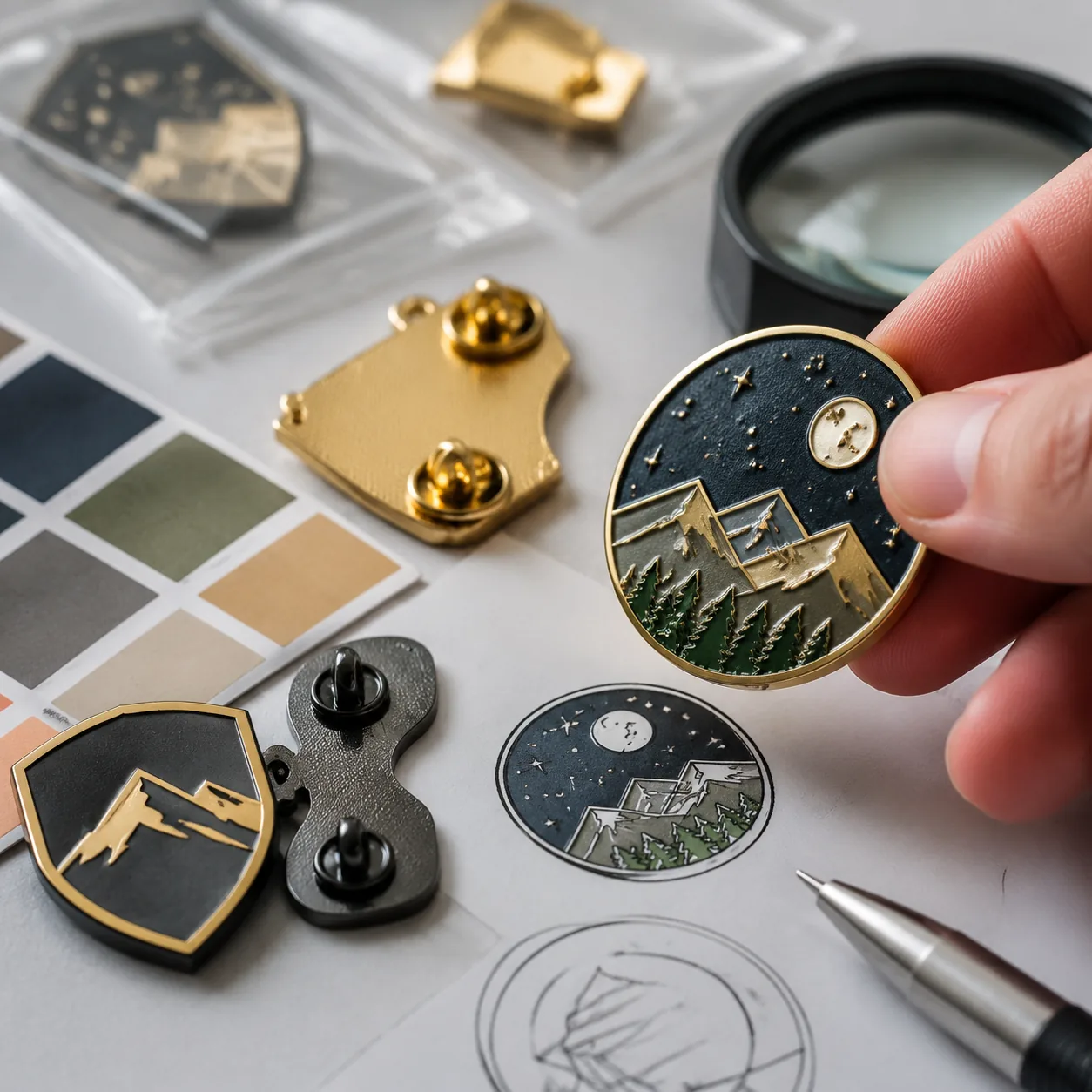
Q: After sample approval, is a logo edit still a small change?
Not necessarily. Once a custom metal pin, badge, coin or keychain has a physical pre-production sample, several decisions are already committed: die geometry, plating direction, enamel fill sequence, polishing allowance, attachment position and even how the item packs in the carton. A 0.3 mm logo shift may be harmless on a backing card. The same shift can require die re-cutting on a hard enamel pin if it changes a raised border, closes an enamel cell or moves a pin-post hole too close to the edge.
Factories usually separate post-sample changes into three groups. Artwork-only changes affect print files, laser data, QR codes, carton marks or card copy before those parts are printed. Process changes affect plating color, enamel mix, epoxy dome, magnet grade, attachment type or inspection criteria. Tooling changes affect the metal outline, cutouts, relief, raised lines, recessed areas, backstamp, spinner track, bottle-opener slot or formed mounting points. The more the change affects metal, the more likely it is to trigger a new tool or a new revision of the tool.
For B2B production, the change request should point to a dated approval file, not a chain of scattered email comments. A merchandiser, tooling engineer, production supervisor and QC inspector need the same revision code. This matters when marketing approves the front artwork, procurement approves a different quote, and compliance later asks for a warning label, country-of-origin mark or recycled-material statement that was never in the production file.
Q: Which post-sample changes usually require new tooling?
Any change to metal geometry is a tooling question first. That includes size, outline, thickness, openwork, raised logo line position, recessed enamel layout, edge text, coin rim, key-ring hole, bottle-opener opening, magnet recess, pin-post location and the depth of a backstamp. For stamped iron or brass pins, even a 0.2 mm move in a fine raised line can force re-cutting because the die defines the border that holds the enamel.
Die-cast zinc alloy offers a little more flexibility on surface treatment, but it does not remove tooling limits. A flat-back logo change can sometimes be handled by laser engraving, pad printing or a printed insert. Changes to sidewall profile, 3D relief, wall thickness, functional clearance or hidden attachment geometry usually need mold modification. Typical post-approval tolerances are about ±0.15 mm for stamped pins under 30 mm, ±0.25 mm for cast badges from 30 to 60 mm, and ±0.30 to ±0.50 mm for coins or keychains above 60 mm. Metal thickness is commonly held within ±0.10 mm on 1.2 to 1.8 mm stock.
Do not approve a tooling revision from a front rendering alone. Ask for a revised technical drawing with overall size, thickness, minimum line width, minimum enamel gap, plating finish, attachment coordinates and functional clearances. As a rule of thumb, a 3.0 mm key-ring hole should keep at least 1.2 mm of surrounding metal wall. A cutout bridge below 0.8 mm may look acceptable in artwork but can fail bend or pull testing. For soft enamel, a usable minimum metal line is usually 0.25 to 0.30 mm; for repeatable filling, 0.35 mm is safer.
| Change requested after sample | Likely factory action | Typical cost impact | Typical time impact |
|---|---|---|---|
| Pantone changed, same metal borders | Mix new enamel; approve color chip or resample | USD 0-35 before filling; filled goods may become scrap | 1-3 days for chip; 5-7 days for resample |
| Raised logo line moved 0.3 mm | Review die; modify or cut new mold | USD 40-180 modification; USD 80-350 new pin mold | 3-8 working days |
| Pin changed from 30 mm to 35 mm | New mold, new weight and revised quotation | Tooling plus 8%-20% unit-price increase | 5-10 working days |
| Butterfly clutch changed to magnet | Check back area, magnet recess or adhesive plan; run pull test | USD 0.03-0.18 per piece depending on magnet size and grade | 2-5 working days if no new mold |
| Nickel changed to black nickel | Revise plating instruction; approve finish sample | Usually no tooling; USD 0.01-0.05 per piece change | 2-4 working days |
| Backstamp added after approval | New die or secondary engraving if depth is shallow | USD 40-250 depending on size, depth and die type | 4-9 working days |
| Backing card copy corrected | Replace print file if cards not printed | USD 0-20 file/setup; printed card scrap if produced | 1-3 working days |
| Keychain ring position moved | New mold or drilling jig review; balance check | USD 40-200; may affect pull strength and hang angle | 3-8 working days |
Q: What can still change without breaking the schedule?
The safe window depends on the production stage. Before mold cutting, most specifications can still change, although price, MOQ and lead time may need to be requoted. After mold cutting but before plating, enamel filling and assembly, many finish decisions remain flexible. After plating, enamel filling, card printing or final packing, changes usually create scrap or rework rather than a clean edit. The later the change, the more it behaves like a stop-order, not a simple revision.
A standard 500 to 3,000 piece order usually needs 1 to 2 working days for file confirmation, 5 to 8 days for mold and pre-production sample, 7 to 15 days for mass production after approval, and 3 to 5 days for final inspection and export packing. Heavier zinc alloy keychains and challenge coins typically need 7 to 10 days for samples and 12 to 20 days for production. Rush orders do not make change control easier; they remove buffer and force faster yes-or-no decisions.
Separate cosmetic preferences from safety, legal and functional corrections. A shift from Pantone 186 C to 200 C may not justify missing a fixed event date. A sharp edge, weak magnet, wrong sponsor mark, missing legal text, unsafe pin attachment for children or incorrect charity logo usually does justify stopping production. If the revised item can injure a user, breach a brand guideline or fail a buyer compliance audit, treat it as a critical change regardless of schedule pressure.
- Before mold cutting: freeze outline, size, cutouts, relief, line widths, backstamp, hole position, thickness and attachment coordinates.
- Before plating: confirm nickel, gold, black nickel, antique brass, matte gold or dual plating; decorative nickel is commonly 3-5 microns.
- Before enamel filling: confirm Pantone numbers, enamel type, fill level, glitter, glow powder, translucent enamel and epoxy dome requirement.
- Before assembly: confirm butterfly clutch, rubber clutch, safety pin, brooch pin, split ring, lobster clasp, magnet or adhesive pad.
- Before packing: confirm backing card size, barcode, polybag, carton mark, inner-box quantity and master-carton target, often under 15 kg gross.
- Before shipment: confirm AQL level, inspection photos, carton count, gross weight and whether a sealed golden sample controls reorder matches.
Q: How should an ECN be written for a pin supplier?
A useful engineering change notice is short, numbered and measurable. It identifies the old approved version, the new requested version, the exact dimensions or materials changed, whether the old sample remains valid, what must be resampled, and who pays for tooling, scrap or freight if production has started. Avoid vague instructions such as “make the logo cleaner” or “adjust the blue.” Those comments create different interpretations in design, tooling and QC, which is how version-mixing starts.
For pins, badges and coins, include outside size in millimeters, thickness, minimum raised-metal line width, minimum enamel gap, plating finish, attachment type, backstamp depth, card size and carton quantity. Practical design limits are 0.25 mm minimum raised line for many stamped pins, 0.30 mm minimum enamel cell width for reliable filling, 0.80 mm minimum bridge width around cutouts and 0.20 mm minimum outside-corner radius where sharp edges could become a safety issue. If the change affects functional fit, add a pull-force or torque target as well.
Use one change-log table instead of long email threads. Each row should state item code, revision letter, reason, buyer approver, factory approver, sample rule and effective production quantity. This is especially important for promo kits where a lanyard, pin, backing card and carton label share a campaign logo but have different process limits and approval dates.
| ECN field | What to specify | Concrete example |
|---|---|---|
| Revision ID | Old and new version names with dates | From REV A dated Jan 8 to REV B dated Jan 12 |
| Affected item | SKU, size and process | 30 mm hard enamel pin, nickel plating, butterfly clutch |
| Changed area | Exact dimension, color, artwork or component | Move sponsor text down 0.5 mm; change Pantone 286 C to 2945 C |
| Tooling effect | No tooling, mold modification or new mold | Mold modification required because raised border changes |
| Sample rule | Photo sample, physical PP sample or waived sample | Physical PP sample required before mass production |
| Cost responsibility | Who pays tooling, scrap and freight | Buyer pays new mold; no scrap because mass production has not started |
| QC update | Inspection criteria and comparison sample | ANSI/ASQ Z1.4 general level II; AQL 2.5 major, 4.0 minor; inspect against REV B golden sample |
| Schedule impact | Added working days and revised FOB date | Add 6 working days; FOB Ningbo ready date moves to Feb 3 |
Q: What are the real costs of late changes?
Late changes cost more than mold fees. They can include scrapped semi-finished pieces, repeated plating setup, enamel remixing, reprinted backing cards, repacked polybags, extra inspection time and air-freight upgrades. On a 1,000 piece soft enamel pin order, a pre-production artwork correction may cost nothing. The same correction after enamel filling can waste USD 150 to 600, depending on size, color count, plating and labor already completed. If packaging has already been printed, add the cost of reprint and the delay created by the print queue.
As FOB reference ranges, 25 to 35 mm soft enamel pins at 500 pieces often quote around USD 0.55 to 1.10 each, depending on plating, colors, epoxy and attachment. Hard enamel commonly runs USD 0.75 to 1.45 because polishing is heavier and rejection risk is higher. Die-cast zinc alloy keychains or badges often fall around USD 0.90 to 2.40 at 500 pieces. Challenge coins can range from USD 1.80 to 5.50 depending on diameter, thickness, edge style, antique finish and single- or double-sided relief.
MOQ changes the economics. At 100 to 300 pieces, tooling can represent a large share of total landed cost, so a new mold may feel disproportionate. At 5,000 to 10,000 pieces, stopping a wrong design before mass production is usually cheaper than accepting a defect across every unit. Retail packaging also matters: a 300 gsm backing card with barcode and matte lamination may add USD 0.04 to 0.12 per piece, while reprinting can add 2 to 5 working days if the print queue is full. A small artwork correction at the wrong stage can be more expensive than a modest tooling change made early.
| Order tier | Typical MOQ decision | Change-control implication |
|---|---|---|
| 100-300 pcs | Often accepted for events, prototypes or VIP sets | Tooling is a high percentage of cost; avoid cosmetic die changes unless essential |
| 500-1,000 pcs | Common MOQ for commercial pin orders | Resampling is usually justified for tooling, attachment or color-critical changes |
| 3,000-5,000 pcs | Production efficiency improves; unit price drops | Stop production early if the revision affects every unit or retail packaging |
| 10,000+ pcs | Often scheduled in batches with stricter QC gates | Use signed ECN, sealed golden sample and carton-level revision control to prevent mixing |
Q: How do we inspect the revised order so the old version does not ship?
The largest QC risk after a change is version mixing. Old samples, old PDFs, obsolete card artwork and old carton labels can remain in the workflow unless the factory removes them. The revised golden sample must be marked with item code, revision, date and buyer approval name. Final inspection should compare goods against the new approved file and sealed sample, not against the first sample or the sales rendering. If one revision is still visible on the line, treat the batch as mixed until proven otherwise.
For promotional metal products, a practical inspection plan is ANSI/ASQ Z1.4 general inspection level II, AQL 2.5 for major defects and AQL 4.0 for minor defects, with critical defects at zero acceptance. Major defects include wrong logo, wrong plating, missing attachment, unsafe sharp edge, incorrect backstamp, failed magnet, failed key ring or mixed revision. Minor defects include small polishing marks, slight enamel underfill within agreed limits, tiny plating specks away from the logo or light card scuffs below the approved threshold.
Add targeted checks for the revised area. Measure 10 to 20 pieces with calipers for changed dimensions, hole position and thickness. Test 10 attachments for pull or rotation where relevant. Compare at least 5 pieces per carton against the revised golden sample when version-mixing risk is high. For magnets, test polarity and holding strength on the intended surface; a late switch from pin back to magnet changes the functional requirement, not just the component list. Decorative plating should usually be checked at 3 to 5 microns on nickel or black nickel, and any customer-facing edge should be free of burrs and plating burn.
- Remove obsolete approval files from the active production folder and label them “do not produce.”
- Mark the revised golden sample with item code, revision, approval date and buyer approver.
- Require first-article photos from mass production showing front, back, side, attachment and packaging.
- Use calipers for revised size, hole location and thickness instead of visual comparison only.
- Check plating thickness when corrosion risk matters; decorative nickel is often 3-5 microns.
- Segregate old-version scrap before packing so mixed cartons cannot pass final inspection.
- Retain one sealed sample at the factory and one buyer-held sample for reorder comparison.
Q: When should a supplier refuse or redirect a requested change?
A supplier should push back when a requested change makes the item weak, unsafe or impossible to inspect consistently. Risky examples include enamel islands under 0.30 mm, raised metal lines below 0.25 mm on stamped pins, cutout bridges below 0.80 mm, sharp corners below a 0.20 mm radius, a magnet too small for the finished weight or a key-ring hole with insufficient surrounding metal. These may look clean in vector artwork but fail in production or use. A good supplier should explain which limit is being violated and propose the nearest manufacturable alternative.
Buyers should also reject changes that solve one department's preference while creating a larger supply-chain problem. Increasing a pin from 30 mm to 42 mm may improve logo readability, but it can raise weight, bend lighter backing cards, require a larger polybag and push carton weight beyond a 15 kg handling target. Switching from bright nickel to antique brass may look premium, but it can reduce contrast on small black enamel details. Changing to epoxy can protect soft enamel but may soften fine debossed detail. The best revision is the one that improves the product without creating new failure points.
Sometimes the clean answer is to create a new SKU instead of revising the old one. If the outline, size, backstamp and attachment all change after PP sample approval, a new SKU gives clearer costing, cleaner QC and less reorder confusion. A practical threshold is to open a new SKU when more than two critical specifications change or when the revised item cannot be inspected fairly against the original golden sample. That keeps repeat orders from drifting into a different product under the same code.
What should buyers do before approving or changing a sample?
Before approving a sample, freeze the items that are expensive or risky to change: metal outline, size, thickness, relief, cutouts, raised line positions, backstamp, attachment and packaging dieline. Keep a smaller approval window for lower-risk items such as card wording, carton marks, shipment labels or barcode placement, provided those components have not entered production. If the change touches the metal or the safety function, treat it as an ECN, not a quick note.
If a change is already needed, send one consolidated ECN instead of scattered comments. Attach the old approved file, revised file, exact change list, required sample type, acceptable time impact and decision on scrap responsibility. Ask the factory to answer three questions in writing: whether tooling changes, how many working days are added, and whether any units have entered an irreversible process such as plating, enamel filling, printing or final packing. Once that answer is clear, the buyer can decide whether to resample, rework or open a new SKU.
For a clean purchase order, attach the final technical drawing, Pantone list, plating specification, attachment specification, packaging artwork, AQL requirement and golden sample rule. For combined orders that include pins, brooches, coins, keychains, magnets, patches or lanyards, use one revision-controlled specification sheet so every item moves through sampling, approval, production and inspection under the same change log. That is the simplest way to keep late edits from turning into scrap.
Have a project? Send your artwork and target quantity and we’ll reply with a detailed quotation within 12 working hours.
Ready to get this made?
Send your sketch, target quantity and ship-date. Detailed quotation in 12 hours.



