Enamel Pins vs Printed Badges for Bulk Brand Orders
Choose By Process Limits, Not Artwork Preference
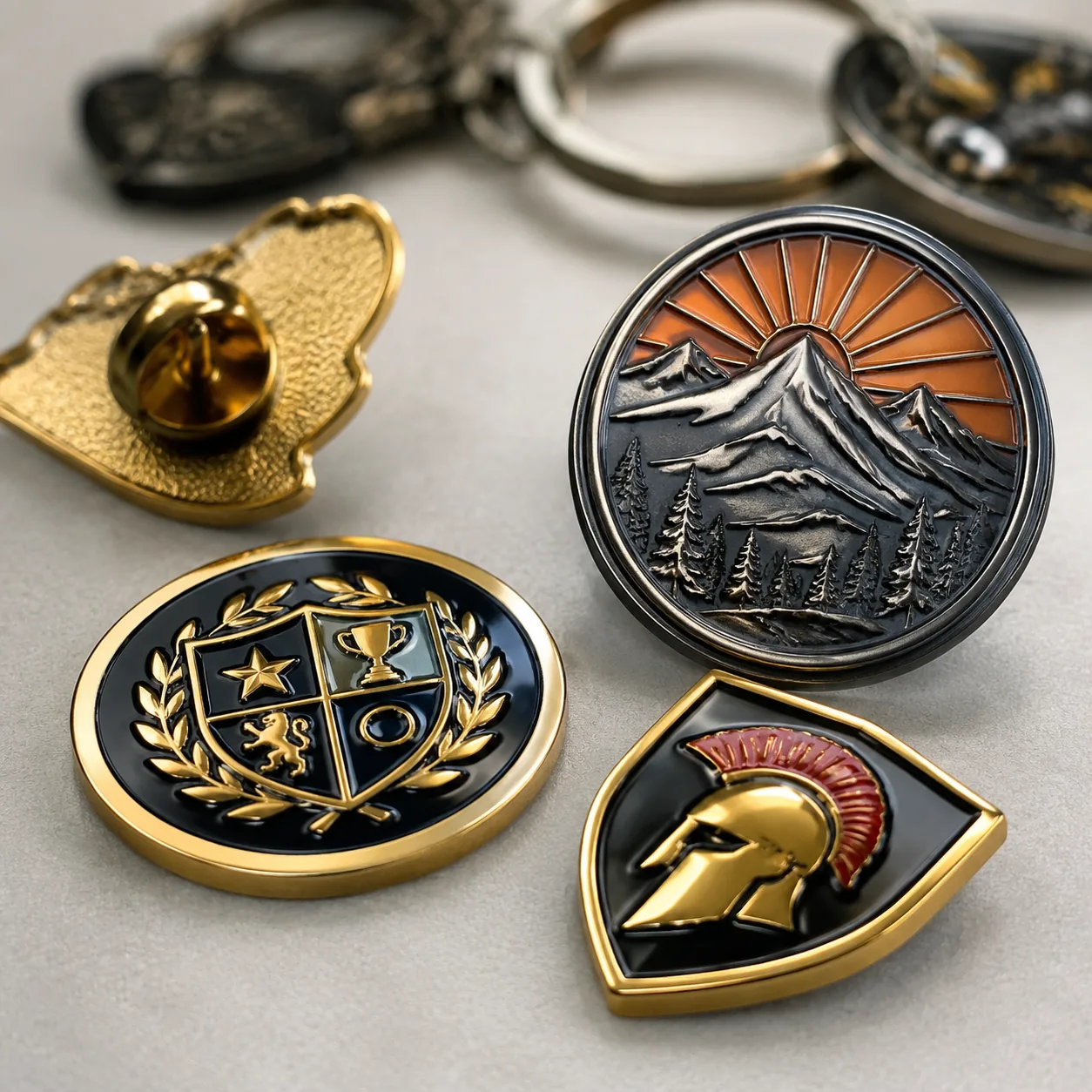
Enamel pins and printed metal badges can look similar in a quote sheet, but they are engineered differently. Enamel pins are stamped or die-cast metal pieces with recessed color cells divided by raised metal lines. Printed badges reproduce artwork as ink on a prepared metal surface, usually sealed with clear epoxy, varnish, or film lamination. The right choice depends less on the logo file and more on line width, color system, surface protection, attachment strength, and inspection standard.
Most sampling failures are predictable. Enamel loses tiny text, gradients, thin outlines, and photographic shading because every color must sit in a defined cell. Printed badges handle detail well, but can fail through ink adhesion, epoxy glare, resin bubbles, scan problems on QR codes, and a flatter retail feel. For 1,000 to 20,000 pieces, buyers should approve technical limits before opening a mold or releasing print films.
For a factory in Yiwu or Guangdong, the two workflows share some steps: artwork engineering, mold or die preparation, blank forming, plating, decoration, curing, assembly, packing, and final inspection. The controls are different. Enamel needs metal-line accuracy, fill level, polishing control, and plating durability. Printing needs registration, white underbase density, scratch resistance, coating clarity, and controlled resin flow.
30 mm Badge Specification Benchmark
The table below assumes a 30 mm round or custom-shaped badge, 0.8 to 1.8 mm metal base, one butterfly clutch or rubber clutch, individual OPP bag, and export carton packing. FOB prices are typical China factory ranges for iron, brass, or zinc alloy orders from 1,000 to 10,000 pieces. They exclude brand audits, laboratory testing, custom retail boxes, rush air freight, and third-party inspection charges.
| Spec Item | Enamel Pin | Printed Metal Badge |
|---|---|---|
| Best artwork fit | Flat logos, mascots, club crests, anniversary icons, 1 to 8 solid colors | Gradients, photos, sponsor logos, fine text, QR codes, full-color event graphics |
| Minimum raised metal line | 0.20 mm preferred; 0.15 mm only for short non-critical detail | Not required unless the design uses a raised rim, metal border, or cutout frame |
| Minimum color cell or gap | 0.25 mm for soft enamel; 0.30 mm safer for hard enamel polishing | 0.10 to 0.20 mm registration tolerance on flat print areas |
| Small text limit | 1.2 mm cap height minimum; 1.5 mm safer after plating and polishing | 0.8 to 1.0 mm cap height possible with strong contrast and limited epoxy glare |
| Color control | Pantone spot enamel; Delta E 2 to 4 against approved golden sample | CMYK, UV, offset, or screen print; Pantone simulation depends on white base and coating |
| Surface profile | Recessed soft enamel with raised metal, or polished flush hard enamel | Flat print sealed by varnish or 0.30 to 0.70 mm clear epoxy dome |
| Base thickness | 1.2, 1.5, 1.8, or 2.0 mm common; zinc alloy for 3D relief | 0.8 to 1.0 mm economy iron; 1.2 to 1.5 mm for heavier shaped badges |
| Plating thickness | Flash plating 0.03 to 0.08 microns; 0.10 to 0.20 microns for better tarnish resistance | Same requirement where metal edge, rim, or back is exposed |
| MOQ tiers | 100 pcs sample run; 300 to 500 pcs practical MOQ; 1,000 pcs cost-efficient | 100 pcs possible for UV print; 500 pcs practical for offset/screen; 1,000 pcs better epoxy yield |
| Tooling and setup | Mold USD 45 to 120 per design; 3D relief or cutouts can reach USD 150+ | Shape mold USD 35 to 90; print setup or proofing USD 20 to 80 |
| FOB at 1,000 pcs | USD 0.62 to 1.40 for 25 to 35 mm, 4 to 6 colors, standard clutch | USD 0.48 to 1.12 for 25 to 35 mm, full color, clear epoxy |
| FOB at 5,000 pcs | USD 0.39 to 0.95 depending on size, plating, color count, and backing | USD 0.31 to 0.82 depending on print method, epoxy height, and packing |
| Sample lead time | 7 to 10 days after artwork, Pantone, and mold drawing approval | 5 to 8 days after artwork, white-base proof, and print proof approval |
| Mass lead time | 12 to 22 days after sample approval for 1,000 to 10,000 pcs | 10 to 18 days after sample approval for 1,000 to 10,000 pcs |
| Main durability risk | Underfilled enamel, chipped edges, polishing marks, plating wear on high points | Surface scratches, ink lift, epoxy bubbles, yellowing, edge overflow |
| Best QC focus | Metal-line clarity, fill level, plating, burrs, clutch pull, color match | Print sharpness, QR scan, resin clarity, registration, tape adhesion |
The practical rule is simple: enamel is better when the badge must feel like a lasting metal product; printing is better when the badge must carry dense visual information. Printed badges are not always cheaper. A shaped die, opaque white underprint, high dome epoxy, retail card, barcode label, and SKU sorting can narrow or erase the price advantage.
Use Enamel For Premium, Durable Identity
Soft enamel is the common choice for staff recognition, tourism pins, sports trading pins, club crests, and campaign collectibles. It gives a tactile surface because the plated metal remains raised and the enamel sits slightly lower. Hard enamel costs more but is polished flush, producing a smoother jewelry-like finish for museums, corporate anniversaries, membership programs, and retail pins with a higher perceived value.
The process favors simplified vector artwork. Avoid strokes below 0.20 mm, enamel islands below 0.40 mm, and text below 1.2 mm cap height. On a 30 mm pin, a 0.20 mm raised metal line is already near the realistic limit after stamping, plating, color fill, curing, and polishing. If the brand team will not approve simplified artwork, enamel will create more sample rounds and possible mold revisions.
Material selection also matters. Iron is economical for flat pins and works well at 1.2 to 1.5 mm thickness. Brass gives cleaner stamping for fine premium detail but usually increases cost. Zinc alloy is preferred for thicker, sculpted, or 3D pieces because it casts complex relief more easily. For daily wear, specify rounded edges, no sharp burrs, and a clutch pull target of 2.0 to 3.0 kgf depending on backing style.
For reorders, control the golden sample record. A useful file includes finished size tolerance of plus or minus 0.30 mm, thickness tolerance of plus or minus 0.15 mm, attachment placement tolerance of plus or minus 1.0 mm, Pantone colors, plating finish, backstamp location, clutch type, carton label format, and neutral-light photos. Without these controls, repeat batches can drift in rim width, enamel shade, or post position.
Use Printing For Detail, Gradients, And QR Codes
Printed metal badges are stronger when artwork includes sponsor walls, event graphics, shaded illustrations, small legal text, flags, portraits, or QR codes. Direct UV printing is flexible for short and medium runs because it prints full color with relatively low setup cost. Offset or screen printing can be better for larger runs when the buyer needs smoother solids, repeatable color, or higher output speed.
A white underbase is often the difference between acceptable and dull print. CMYK printed directly over gold, black nickel, brushed metal, or colored plating will shift and lose contrast. For brand-critical colors, ask for a physical proof on the same plated substrate, not only a PDF mockup. A realistic color tolerance for printed badges is often Delta E 3 to 5 against the approved sample; tighter requirements may increase waste and sorting time.
QR codes need their own rules. On a 30 mm badge, keep the QR image at least 18 to 20 mm square if it must scan after epoxy. Use black on a white field, preserve the quiet zone, and avoid metallic or patterned backgrounds. During sample approval, scan with at least three phone models under office lighting, phone flashlight, and a 45-degree glare angle. If the code links to event registration, landing pages, or warranty data, treat unreadability as a major defect.
Printed badges age through the surface system rather than the metal. Buyers should specify cross-hatch tape adhesion with no visible ink lift, 300 to 500 dry-rub cycles for standard promotional use, and visual limits for bubbles above 0.30 mm in the logo area. Keep important text at least 1.5 mm inside the badge edge because epoxy domes thin and flow at the perimeter. On sharp cutouts, ask the factory to draw the epoxy boundary instead of assuming the resin can follow every corner.
Cost, MOQ, And Lead-Time Drivers
At 1,000 pieces, a 30 mm soft enamel pin with five colors, gold flash plating, one butterfly clutch, and OPP bag commonly falls around USD 0.70 to 1.18 FOB, plus a mold charge of USD 60 to 100. Hard enamel may add USD 0.12 to 0.35 per piece because of polishing, longer finishing time, and higher rejection risk. A printed metal badge of the same size with epoxy usually falls around USD 0.55 to 1.00 FOB, with mold and print setup of USD 50 to 130.
Color count affects enamel directly. Moving from three enamel colors to eight can add USD 0.08 to 0.22 per piece at mid-volume, especially when small cells slow filling and inspection. Printing absorbs multiple colors in one pass, but white underprint, metallic ink, double-sided print, anti-scratch varnish, or a high epoxy dome can add USD 0.03 to 0.16 per piece.
MOQ tiers change the real economics. At 100 pieces, tooling and setup dominate unit cost, so the badge may look expensive regardless of process. At 300 to 500 pieces, a factory can stabilize setup and reduce scrap. At 1,000 pieces, unit pricing becomes more predictable. At 5,000 to 10,000 pieces, packaging labor, SKU separation, carton labeling, and inspection time can matter as much as the decoration method.
Lead time should be quoted in calendar days from clear approval points. A practical schedule is 1 to 2 days for engineering review, 5 to 8 days for printed sample or 7 to 10 days for enamel sample, then 10 to 22 days for mass production depending on quantity and finish. Add 2 to 4 days for retail card printing, barcode labeling, or mixed-SKU sorting. Rush orders increase the risk of weak curing, epoxy marks, and incomplete inspection.
Artwork And RFQ Checklist
A strong RFQ removes assumptions before sampling. Send the original vector file, target size in millimeters, required thickness, base metal, plating finish, attachment, packing method, order quantity, delivery deadline, inspection standard, and whether the mold must be kept for reorders. Ask for pricing at 500, 1,000, 3,000, 5,000, and 10,000 pieces when final campaign volume is uncertain.
- For enamel, keep raised metal lines at 0.20 mm or wider and avoid enamel cells below 0.40 mm.
- For cutout enamel shapes, keep narrow bridges at 0.80 mm or wider to reduce bending and sharp edges.
- For printed badges, supply raster artwork at 300 dpi minimum at final size and check text at actual scale.
- Keep QR codes 18 to 20 mm or larger on a 30 mm badge and test scans after epoxy, not before.
- Define size tolerance, usually plus or minus 0.30 mm, and thickness tolerance, usually plus or minus 0.15 mm.
- State Pantone references for enamel and require a physical print proof for critical CMYK or brand colors.
- Confirm attachment type, attachment location, backstamp, epoxy boundary, retail card, barcode, and carton labeling before sample approval.
Do not approve mold drawings only on appearance. Check the actual dimensions of lines, gaps, holes, posts, and safety edges. For printed badges, review the white-base layer and coating boundary. For enamel, confirm whether registered trademark symbols or tiny legal marks should move to the backstamp rather than fail on the front.
QC Standards And Defect Limits
AQL should match commercial risk. For standard promotional orders, many importers use general inspection level II with AQL 2.5 for major defects and 4.0 for minor defects. For licensed, retail, or brand-critical programs, AQL 1.5 major and 2.5 minor is more appropriate. Tighter AQL levels require more sorting time and should be agreed before mass production.
Major enamel defects include wrong plating color, missing enamel, large underfill, sharp burrs, wrong backing, visible front scratches, incorrect backstamp, and color outside the approved golden sample range. Minor enamel defects include tiny dust points, slight fill unevenness, or small polishing marks not visible from 30 to 40 cm under normal light. For hard enamel, inspectors should check that polishing has not cut through plating on raised edges.
Major printed badge defects include blurred logos, unreadable QR codes, ink peeling, epoxy overflow, large bubbles, wrong attachment, and print shift beyond plus or minus 0.30 mm. Minor defects include small dust specks under epoxy, slight dome-height variation, or tiny surface marks outside the main logo area. A practical epoxy limit is no front-facing bubble above 0.30 mm in the logo or QR area and no bubble cluster near small text.
Functional inspection is essential. Clutch backs should sit straight and meet the approved pull force. Magnets should be checked for polarity and holding force on the intended surface. Safety pins and brooch pins should open smoothly without sharp edges. If the item is child-facing or sold in regulated markets, confirm CPSIA, EN71, nickel-release, lead, cadmium, and phthalate requirements before the supplier selects plating, paint, or epoxy systems.
Packing, Shipping, And Final Selection
Enamel pins are dense and scratch easily when loose. Standard export packing is individual OPP bag, then 50 to 100 pieces per inner bag or box, with master cartons kept around 10 to 15 kg gross weight. Mirror gold, rose gold, black nickel, and polished nickel show abrasion more than antique finishes, so retail orders may need tissue separation, backing cards, or compartment trays.
Printed epoxy badges need protection from pressure and heat. Epoxy should cure fully before tight packing; otherwise the dome can imprint against bags or cards. In warm seasons, cartons should not sit in direct sun, closed vehicles, or hot warehouse corners, especially when dome height exceeds 0.50 mm. If clear, bubble-free epoxy is a retail requirement, include curing and packing intervals in the production schedule.
Choose enamel when the priority is premium feel, long wear, collectible value, or controlled brand recognition. Choose printed metal when the priority is fine detail, gradients, QR function, fast artwork changes, or multi-sponsor graphics. For borderline artwork or retail programs above 1,000 pieces, a side-by-side sample is often cheaper than a wrong production run. The better supplier will mark technical risks on the drawing before mold opening or print setup, not after defects appear in finished cartons.
Have a project? Send your artwork and target quantity and we’ll reply with a detailed quotation within 12 working hours.
Ready to get this made?
Send your sketch, target quantity and ship-date. Detailed quotation in 12 hours.



