Enamel Fill Levels for Custom Pins: Specs That Prevent Uneven Color
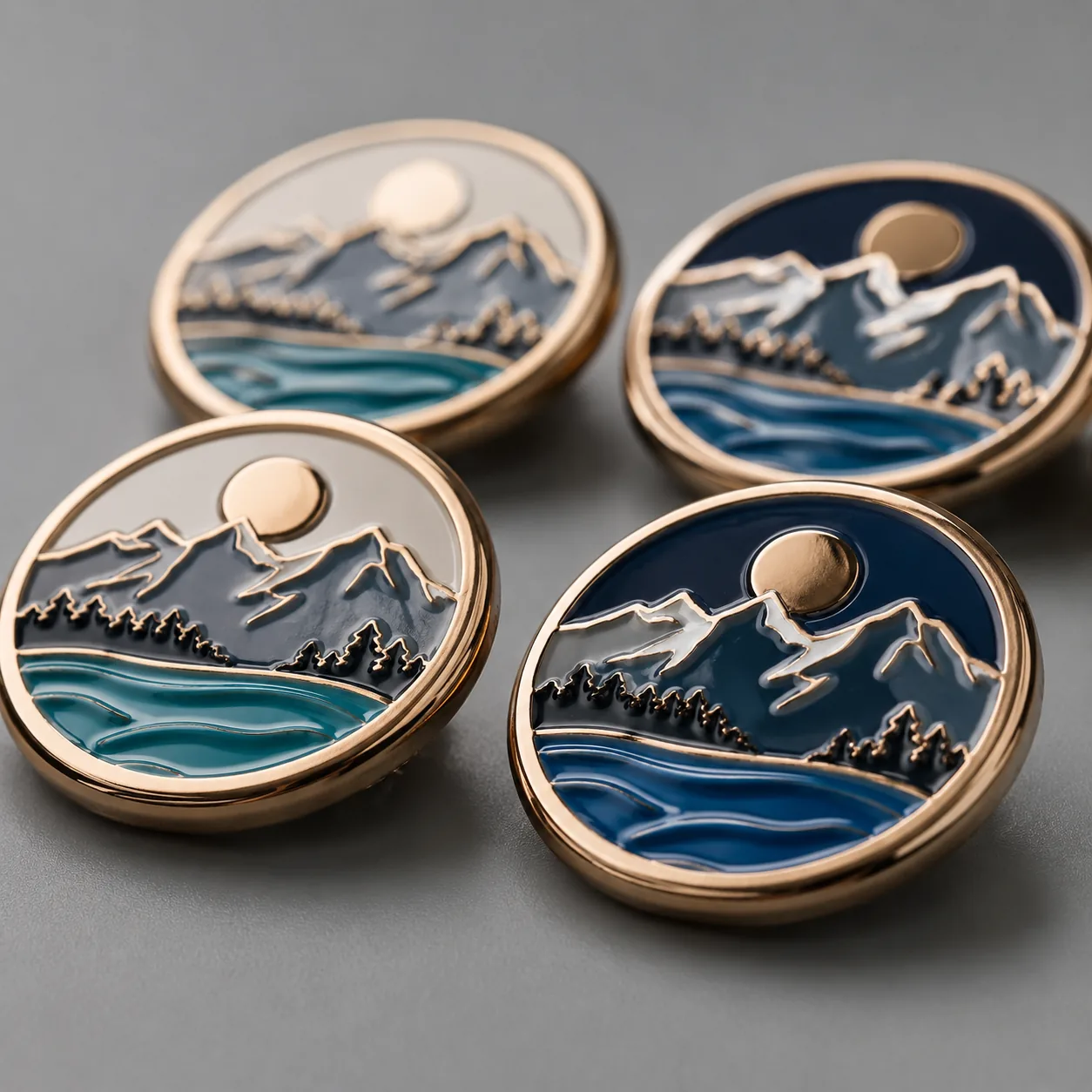
Why Good Pin Artwork Still Produces Uneven Enamel
Many custom pin disputes are not caused by the wrong Pantone color or plating finish. They start with inconsistent enamel fill: one carton has clean recessed color, another has sunken areas, waves, pinholes, or enamel riding over the metal dams. The approved rendering looked sharp because it was flat artwork; the production lot failed because the buyer never defined the finished enamel height.
Enamel is a deposited material, not printed ink. It changes with viscosity, cell depth, curing time, plating buildup, polishing pressure, and the width of each raised metal line. A design that looks simple on screen can become unstable if it has 0.25 mm color cells, 20 mm open fields, or thin gold dividers that disappear during hard enamel polishing.
For most 20-50 mm zinc alloy, iron, or brass lapel pins, the problem can be prevented before tooling. The RFQ and PO should state the enamel process, target height relative to metal, minimum line width, inspection distance, allowable bubbles, and AQL level. Those details give the factory a measurable finish target instead of a subjective instruction such as “make it smooth” or “premium quality.”
Specify Enamel Height Before Tooling
Soft enamel is designed to sit below the raised metal. A normal commercial target is 0.10-0.25 mm below the metal ridge after curing. At less than 0.05 mm recess, the surface often looks unintentionally uneven; at more than 0.30 mm recess, dark colors can look shadowed, dusty, or underfilled. For retail pins, define the maximum recess by key logo area, not only by average depth.
Hard enamel is overfilled, cured, sanded, and polished until the enamel is flush with the metal. A realistic surface step is within ±0.05 mm on small cells under 8 mm and within ±0.08 mm on larger cells up to about 18 mm. “Perfectly flat” is not an inspection standard; “no visible step at 30 cm under 5000-6500 K light and no fingertip catch on the main logo” is much easier to enforce.
Minimum metal dams matter as much as fill height. For soft enamel, use 0.25 mm as an absolute minimum and 0.30 mm as the safer production width. For hard enamel, specify 0.30 mm minimum and 0.35 mm preferred because polishing can thin raised lines. For text below 5 pt, punctuation, eyelashes, or small facial details, use screen print or offset print instead of trying to enamel every feature.
| Process | Enamel height target | Metal dam recommendation | Practical tolerance |
|---|---|---|---|
| Soft enamel | 0.10-0.25 mm below raised metal | 0.25 mm minimum; 0.30 mm preferred | No key color cell deeper than 0.30 mm unless approved |
| Hard enamel | Flush with polished metal | 0.30 mm minimum; 0.35 mm preferred | Surface step within ±0.05-0.08 mm |
| Soft enamel with epoxy | Recessed enamel sealed under clear dome | 0.25 mm minimum | Dome even, no edge overflow, no bubbles over 0.20 mm in logo |
| Large coin or badge enamel area | Flush or 0.05-0.20 mm recess by design | 0.35 mm minimum | Visual consistency prioritized over single-point gauge readings |
Match the Process to the Buyer’s Finish Standard
Soft enamel is economical and intentional when texture is part of the product. It suits club pins, event trading pins, cartoon artwork, municipal badges, school campaigns, and low- to mid-cost promotional programs. For a 25-35 mm iron or zinc alloy soft enamel pin with 4-6 colors, typical FOB China pricing is about USD 0.32-0.78 at 500 pcs, USD 0.22-0.58 at 1,000 pcs, and USD 0.16-0.43 at 5,000 pcs, excluding retail cards, special clutches, or multiple molds.
Hard enamel is better for premium brand pins, museum retail, corporate recognition, and designs that must feel smooth. A 30 mm hard enamel pin normally adds USD 0.08-0.25 per piece over comparable soft enamel because of extra filling, sanding, polishing, and rejection risk. Typical FOB ranges are about USD 0.48-1.10 at 500 pcs, USD 0.35-0.82 at 1,000 pcs, and USD 0.26-0.62 at 5,000 pcs, depending on material, plating, thickness, and attachment.
Do not choose hard enamel only because it sounds higher grade. It is weaker for distressed textures, gradients, very small isolated cells, and artwork with ten or more enamel colors in a 25 mm pin. Soft enamel with epoxy or printed detail over metal may produce a cleaner result when color cells are below 0.60 mm or when the design includes shadows, faces, or tiny lettering.
Control Artwork Cells, Dams, and Open Fields
Production artwork should be closed vector geometry, not only a PNG mockup. Each enamel color needs a contained cell deep enough to hold material and wide enough for controlled dispensing. As a working rule, avoid enamel cells narrower than 0.50 mm for soft enamel and 0.60 mm for hard enamel. Cells below 0.40 mm often clog, trap bubbles, or disappear after polishing.
Large fields need the opposite control. A single pale enamel area wider than 18-20 mm can show sink marks, ripples, or color pooling, especially in white, cream, pastel yellow, transparent enamel, and glitter enamel. If the brand permits it, add a 0.25-0.35 mm metal divider line to break the field without changing the artwork’s visual balance. For a 40 mm pin, two smaller 10 mm fields usually cure more evenly than one 22 mm open field.
The factory proof should show metal dams, cutouts, attachment position, plating, and fill areas. A sales rendering that only shows color is not enough for approval. Ask for a production proof with minimum line widths labeled and with risky cells marked before mold cutting.
- Send AI, EPS, PDF, or SVG vector artwork with closed enamel cells.
- State Pantone Solid Coated references for every enamel color, including black and white.
- Flag all color cells under 0.60 mm for manufacturability review.
- Specify whether fine text is enamel, raised metal, debossed metal, laser mark, or print.
- Use 0.25-0.35 mm divider lines to stabilize large enamel fields over 18 mm.
- Approve a hard enamel version with stronger dams to allow for polishing loss.
Account for Plating, Material, Thickness, and Epoxy
Base material affects how cleanly enamel sits and how much detail survives finishing. Stamped brass gives the cleanest premium hard enamel surface but costs more. Iron is economical for simple 2D pins and magnets. Zinc alloy is useful for irregular outlines, thicker badges, 3D relief, and larger parts, but very fine flush enamel is usually less crisp than stamped brass. A 30 mm stamped pin is commonly 1.2-1.5 mm thick; zinc alloy badges are often 1.5-2.0 mm.
Decorative plating also changes the surface reading. Standard promotional plating for nickel, gold-tone, rose gold, black nickel, or antique finishes is commonly about 0.10-0.30 microns. Thicker plating may be requested for durability, but it can visually widen metal lines and make enamel cells look smaller. Dark plating increases shadow in recessed enamel, so navy, burgundy, and black enamel can appear darker than the Pantone target.
Epoxy over soft enamel creates a smooth clear dome, but it is not hard enamel. It typically adds 0.3-0.8 mm height, improves scratch resistance, and brightens color, but it can trap dust, show bubbles, overflow edges, or pull away from sharp internal corners. If epoxy is specified, add acceptance limits: no overflow visible from the front, no bubbles over 0.20 mm in logo areas, no sticky edge, and no yellow tint under daylight inspection.
| Surface option | Best application | Main production risk | Typical FOB add-on |
|---|---|---|---|
| Soft enamel, no epoxy | Textured event and trading pins | Dust in recessed areas; visible fill variation | Base cost |
| Soft enamel with epoxy | Bright giveaways and school pins | Doming variation, bubbles, edge overflow | USD 0.03-0.10 per pc |
| Hard enamel | Retail and premium brand pins | Polishing loss, thinner dams, sanding marks | USD 0.08-0.25 per pc over soft enamel |
| Printed detail over enamel or metal | Faces, gradients, small text | Abrasion if unprotected | USD 0.04-0.15 per pc depending coverage |
Set Sampling Rules and Lead Times in Days
A pre-production sample should be evaluated as a physical part, not only as a phone photo. Check it at 30 cm under daylight or 5000-6500 K white light, then tilt it under side light to see waves, sunken cells, polishing scratches, or epoxy bubbles. A depth gauge, microscope, or calibrated comparator is useful for disputed premium work, but most promotional pin lots are controlled by consistent visual standards plus a few measurable limits.
For a new mold, normal sample lead time is 7-10 calendar days after artwork approval and mold payment. Basic mass production for 500-5,000 pcs is usually 12-20 days after sample approval. Hard enamel, epoxy, retail carding, PMS correction, split shipments, or multiple SKUs can add 3-7 days. Orders above 10,000 pcs, mixed designs, or holiday-season schedules should be planned at 25-35 production days.
Keep one approved master sample with the buyer and one retained sample at the factory. Label both with size, thickness, base material, plating, enamel process, Pantone numbers, attachment, packaging, date, and order version. This prevents reorder arguments where one side refers to a digital proof and the other refers to a mass-production photo.
- Inspect the approved sample at 30 cm under 5000-6500 K light.
- Check the largest enamel fields, smallest cells, and all brand-critical logo areas.
- Rub a clean cotton cloth across the face to catch burrs, dust, or uncured enamel.
- Compare cured enamel to Pantone references, not wet enamel or screen color.
- Photograph the approved master sample with a ruler, order code, and lighting note.
- Confirm carton quantity, inner bagging, backing cards, and clutch type before production.
Write AQL Limits for Enamel Defects
Inspection language should separate critical, major, and minor defects. A common structure for promotional metal products is AQL 0 for critical defects, AQL 2.5 for major defects, and AQL 4.0 for minor defects under ANSI/ASQ Z1.4 or ISO 2859-1 sampling. Stricter limits are possible, but they should be priced and scheduled because difficult artwork can create a higher natural reject rate.
Critical defects include sharp edges that can cut skin, detached pin posts, wrong attachment that creates a safety risk, or noncompliant restricted materials where testing has been agreed. Major enamel defects include wrong color, missing enamel, overflow into a logo, bubbles over the specified limit, hard enamel steps visible at 30 cm, or epoxy overflow on the front edge. Minor defects include tiny specks outside logo areas, slight waviness in large cells, and very small color variation within the approved master sample range.
A practical enamel clause is: no missing enamel; no bubbles over 0.30 mm in main logo areas; no more than two bubbles under 0.20 mm per unit outside key areas; no enamel overflow wider than 0.10 mm onto raised metal; no soft enamel recess over 0.30 mm in brand-critical areas; and no hard enamel step over 0.08 mm if visible or felt by fingertip.
| Defect | Classification | Acceptance limit |
|---|---|---|
| Missing enamel in any color cell | Major | Reject affected unit |
| Bubble over 0.30 mm in main logo | Major | Reject affected unit |
| Speck under 0.15 mm outside logo | Minor | Accept within AQL 4.0 |
| Soft enamel recess over 0.30 mm | Major if visible | Reject if color appears sunken or shadowed |
| Hard enamel step over 0.08 mm | Major on premium orders | Reject if visible at 30 cm or felt by fingertip |
| Epoxy overflow onto front edge | Major | Reject if visible, sticky, sharp, or yellowed |
Use a Complete PO Specification
Before price comparison, decide whether the buyer experience requires a textured promotional surface, a smooth jewelry-like surface, or a low-cost giveaway finish. Soft enamel, hard enamel, epoxy, and printed detail are different processes, not interchangeable quote labels. The cheapest quote is often the one that omitted polishing, epoxy control, inspection time, or retail packaging.
A strong PO for a 30 mm hard enamel brass pin might read: 30.0 mm width ±0.20 mm; 1.5 mm thickness ±0.10 mm; brass base; nickel plating 0.10-0.30 microns; hard enamel flush within ±0.05 mm in logo areas; minimum metal dam 0.30 mm, 0.35 mm preferred; Pantone Solid Coated colors as listed; butterfly clutch; individual polybag; pre-production sample required; mass production to match approved master sample; inspection at AQL 0/2.5/4.0.
For ZheCraft or any factory, send the vector file, target quantity, market, delivery deadline, packaging plan, and any compliance requirement before tooling. Ask the supplier to mark risky enamel cells, suggest line-width changes, and quote soft enamel, hard enamel, epoxy, and printed alternatives side by side when the design is borderline. Enamel fill problems are cheapest to solve in the artwork file; after mold cutting and mass production, every correction costs extra days, material, and freight risk.
Have a project? Send your artwork and target quantity and we’ll reply with a detailed quotation within 12 working hours.
Ready to get this made?
Send your sketch, target quantity and ship-date. Detailed quotation in 12 hours.



