Edge Treatments for Custom Coins, Pins and Keychains
Why Edges Fail Before the Front Face
On custom metal coins, enamel pins, badges and keychains, the perimeter usually takes more abuse than the artwork surface. It rubs against fingers, garments, split rings, cartons and polybags. It is also where polishing, plating and assembly defects first become visible. A coin can pass front-view artwork approval but still feel sharp in the hand; a keychain can look correct in a photo but chip at the corner after the split ring is installed; a staff badge can snag fabric because a small burr was left on the back edge.
A reliable RFQ should not describe the edge as simply “smooth” or “premium.” It should define the edge profile, minimum radius, finished thickness, burr limit, plating thickness, inspection method and whether decorative edge work is formed in the die or added by secondary cutting. These details are especially important on thick coins above 3.0 mm, zinc alloy keychains with internal openings, and small badges below 25 mm where sharp corners sit close to pins, magnets or clutch hardware.
This guide focuses on the outside boundary and side face of metal promotional products: how the edge is formed, rounded, decorated, plated and inspected. It does not replace normal artwork review, but it prevents a common sourcing problem: approving a beautiful front face while leaving the highest-contact surface undefined.
Select the Edge Profile Before Tooling
Edge profile decisions belong in the first artwork and tooling review. For stamped brass, iron or stainless pins, the standard perimeter is a lightly rounded stamped edge followed by polishing before plating. Typical finished thickness is 1.2-1.8 mm for lapel pins, 1.5-2.2 mm for badges, and 1.8-2.5 mm for flat metal keychains. Practical outside-profile tolerance is ±0.15 mm for simple outlines and ±0.25 mm for complex outlines with tight curves, small points or multiple cutouts.
Die-cast zinc alloy behaves differently. It is useful for 3D badges, bottle opener keychains, thick logos and irregular novelty shapes, but the casting parting line runs around the edge and must be polished out. If the design uses a sharp outside corner below R0.20 mm, plating can thin, burn or chip on that corner. For normal handling, specify at least R0.25 mm; for pocket or bag use, R0.40-R0.60 mm is safer.
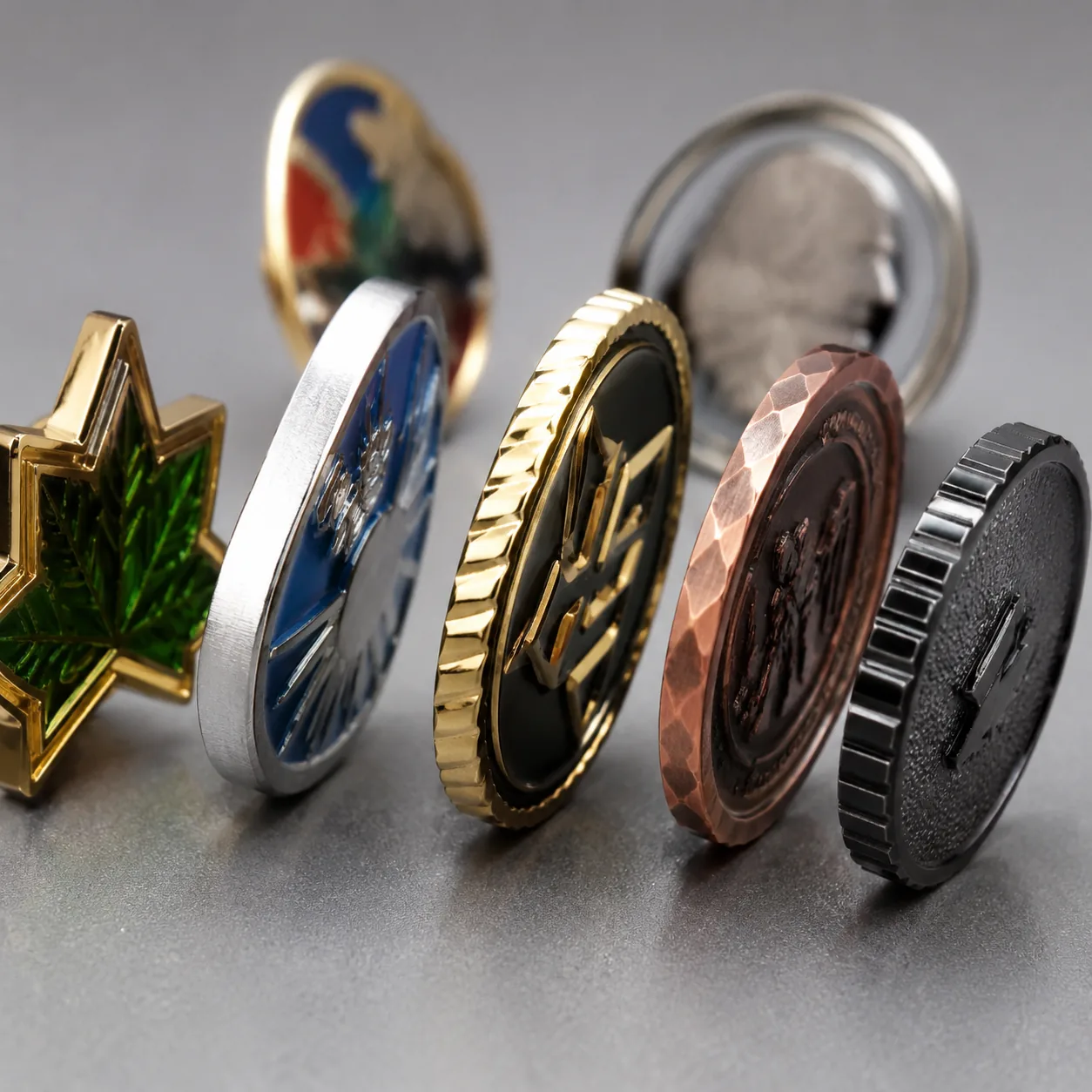
Challenge coins treat the edge as a visible design element. A 40-45 mm coin at 3.0 mm thickness can normally accept smooth, reeded, rope, oblique line, scalloped or diamond-cut edge work. Decorative edge depth becomes inconsistent below 2.5 mm thickness. Above 4.0 mm, the coin feels substantial but raw material, die pressure, polishing time and freight all increase. For most B2B challenge coins, 3.0-3.5 mm is the cost-effective range.
| Edge profile | Best use | Typical specification | Trade-off |
|---|---|---|---|
| Smooth rounded | Pins, badges, standard keychains | R0.20-R0.40 mm; no burr above 0.03 mm wearable or 0.05 mm handheld | Safest and lowest cost, but not decorative |
| Flat bevel | Premium coins and medallions | 30-45° bevel; 0.5-1.2 mm visible bevel width | Reduces usable front artwork area |
| Reeded | Challenge coins | 0.40-0.80 mm pitch; 0.20-0.50 mm groove depth | Needs stable thickness and clean side plating |
| Rope | Commemorative coins | Raised twist height 0.30-0.70 mm | Higher die wear and more polishing control |
| Scalloped | Novelty coins, openers | 3-6 mm repeat spacing; R0.35 mm minimum on peaks | Can feel sharp if peaks are not rounded |
| Diamond-cut | Premium coins and awards | Secondary cut depth 0.20-0.60 mm | Adds machining cost and exposes weak plating if overcut |
Dimensions That Prevent Sharpness
The safest edge is not the sharpest visual outline; it is the outline that survives handling without cutting, snagging or losing plating. External artwork points below 60° should be rounded to at least R0.25 mm for pins and R0.35 mm for keychains. If the item will be carried with keys or clipped to a bag, use R0.40-R0.60 mm. For child-facing giveaways, avoid knife-point shapes entirely and keep outside angles above 45° after radius correction.
Internal cutouts need more clearance than outside edges because polishing wheels, plating solution and enamel filling tools reach them less evenly. For stamped brass or iron, use R0.30 mm minimum on internal corners. For zinc alloy casting, use R0.50 mm minimum. Narrow slots should generally be at least 1.2 mm wide when the part is 2.0 mm thick, 1.8 mm wide when the part is 3.0 mm thick, and 2.2 mm wide when the part is 4.0 mm thick. Smaller slots are possible, but they raise scrap rate and make plating defects more likely.
Burr limits should be written as measurable acceptance criteria. For wearable pins, brooches and badges, a burr or raised plating bead above 0.03 mm can catch fine cotton, polyester uniforms or lanyards. For coins and keychains, 0.05 mm is usually acceptable. Any burr visible from 30 cm under normal daylight, any sharp point that catches a cotton cloth, or any edge that scratches skin during a light fingertip pass should be rejected or reworked.
- Specify outside radius: R0.25 mm minimum for pins; R0.40 mm preferred for keychains and bag charms.
- Specify internal radius: R0.30 mm minimum for stamped metal; R0.50 mm minimum for zinc alloy casting.
- Set burr limits: 0.03 mm maximum for wearable products; 0.05 mm maximum for handheld products.
- Avoid fragile artwork points: no finished outside angle below 45° unless rounded and approved by sample.
- Control thickness: ±0.10 mm for pins and badges; ±0.15 mm for coins and keychains; ±0.20 mm for thick cast zinc pieces.
- Request side-view sample photos: front, back, full perimeter and the tightest corner or narrowest slot.
Cost, MOQ and Lead-Time Impact
A simple rounded edge is usually included in standard tooling and finishing. For stamped soft enamel pins, die charges commonly run USD 45-120 for 20-40 mm sizes and USD 120-220 for larger or more detailed badges. Standard MOQ is often 100 pieces, but price becomes more stable at 300-500 pieces because setup, plating rack loading and color filling are spread across more units. A 25-35 mm soft enamel pin with rounded edge is typically USD 0.45-1.20 FOB at 500 pieces, depending on plating, number of enamel colors, epoxy, backing and packaging.
Decorative coin edges add tooling, rolling, CNC cutting or extra polishing. A 40-45 mm challenge coin at 3.0 mm thickness typically falls around USD 1.60-3.80 FOB at 300 pieces for standard plating and enamel. Reeded or rope edges may add USD 0.10-0.25 per piece when formed consistently in the die or edge tool. Diamond-cut, deep oblique cuts or tight inspection requirements can add USD 0.25-0.45 per piece. For low quantities below 100 pieces, the edge setup can cost more than the visual benefit unless the edge is central to the design.
For zinc alloy keychains, edge cost depends on casting complexity and hardware. A simple 45-55 mm die-cast keychain with one split ring is commonly USD 0.85-1.90 FOB at 500 pieces. A bottle opener keychain with internal openings, polished safety edges and stronger plating may add USD 0.15-0.35 per piece. Shapes with many teeth, spikes, narrow bridges or small text near the perimeter should go through DFM review before quoting; catalog prices often fail on those designs.
Lead time also changes. Normal pre-production samples take 7-10 days after artwork approval for pins and keychains, and 10-14 days for coins with decorative edge tooling. Mass production is usually 12-20 days for standard pins and keychains, 18-28 days for decorative challenge coins, and 25-35 days when the order includes custom packaging, multiple plating colors, or 100% edge screening. Rush production should avoid diamond-cut and complex reeded edges unless a physical sample already exists.
Plating and Paint Risks on Edges
Electroplating does not deposit evenly across every surface. Sharp outside corners are high-current areas where plating can thicken, burn or look rough. Recessed internal corners are low-current areas where plating can be thin. For nickel, black nickel, gold, brass, copper and antique finishes, standard promotional plating is often 3-8 microns. For keychains, bag charms and retail coins that receive heavier handling, 8-12 microns is a better target when the finish and substrate allow it.
The edge radius affects plating life. A base metal corner sharper than R0.20 mm is difficult to polish consistently, and the finished plating layer may chip during tumble handling, ring assembly or carton vibration. Antique plating hides minor side-face variation better than bright gold or mirror nickel, but antique paste can collect in rough edge texture and look dirty if the cleaning standard is not defined. Black nickel and dyed finishes are attractive but less forgiving on hard-contact corners.
Paint and enamel also need clearance from the edge. Keep enamel pools at least 0.30 mm from a finished outside edge on pins and at least 0.50 mm from edges on keychains that will be handled often. If color runs to the perimeter, polishing can expose metal, plating can bridge unevenly, and epoxy domes may leave a thin raised lip. On small pins, it is usually better to simplify the border than force color into a narrow edge-adjacent channel.
| Edge defect | Likely cause | Better specification |
|---|---|---|
| Burnt bright plating | Corner too sharp or polishing uneven | Use R0.30 mm minimum and approve side-view sample under daylight |
| Black nickel chips first | Thin deposit on high-contact edge | Specify 5-8 microns minimum and inspect after split-ring assembly |
| Antique edge looks dirty | Paste trapped in rough casting line | Require clean wipe standard and no visible residue at 30 cm |
| Gold color varies on side face | Polishing marks or mixed base exposure | Add pre-plating polishing check for premium orders |
| Enamel bleeds to perimeter | Color area too close to edge | Keep enamel 0.30-0.50 mm inside finished edge |
| Plating missing in slot | Internal opening too narrow | Increase slot width or accept controlled cosmetic risk in writing |
When Decorative Edges Are the Wrong Choice
Decorative edges are not automatically better. For staff badges worn on thin shirts, rope, scalloped or aggressive reeded edges can increase snagging and make the badge feel bulky. For high-volume event giveaways packed quickly in individual polybags, a smooth rounded edge is usually safer, faster and cheaper than a novelty outline with many sharp peaks.
Avoid diamond-cut and deep reeded edges on rush orders unless the factory has made the same part before. These features need side-view sample approval, stable thickness and careful plating inspection. A front-only photo is not enough. If the order is under 100 pieces, setup cost and sample risk may outweigh the upgrade, especially when the buyer’s main requirement is fast delivery.
Very small products also limit edge decoration. A 20 mm pin does not have enough perimeter length for rope or reeded detail to read clearly, and a bevel can crowd the artwork. On small pins, the better investment is clean enamel separation, secure attachment, controlled plating and a smooth wearable edge. For products with magnets, safety pins or butterfly clutches near the edge, prioritize clearance and comfort over machining detail.
QC Requirements to Put in the PO
Edge quality should be controlled at sample approval, during production and after assembly. For most export promotional orders, General Inspection Level II with AQL 2.5 for major defects and AQL 4.0 for minor defects is a practical baseline. For wearable, child-facing or retail-premium products, tighten edge-related major defects to AQL 1.5 or require 100% screening for sharp burrs, exposed base metal and flaking plating.
Define major and minor defects clearly. Major edge defects include sharp burrs, exposed base metal longer than 0.5 mm, flaking plating, cracked perimeter features, broken decorative grooves, unsafe points and any edge that catches cloth repeatedly. Minor defects can include light polishing waves, slight side-face color variation, or shallow decorative groove variation that is not visible from 30 cm under normal daylight.
Use practical inspection tools. Calipers can check outside dimensions and thickness. A radius gauge or approved golden sample can verify edge rounding. A 10x loupe can confirm burrs, plating skips and cracking. A white cotton cloth dragged across the perimeter is a simple garment-snag test; if fibers catch in the same location twice, the part should fail wearable inspection. Always inspect after hardware assembly because split rings, chains and jump rings can damage plating that looked acceptable before assembly.
- Approve a physical golden sample showing the final edge profile, plating coverage and side-face finish.
- Measure thickness at three points and record tolerance against the approved drawing.
- Inspect the tightest internal slot and sharpest outside corner on every sampled unit.
- Reject exposed base metal longer than 0.5 mm on any outside edge or attachment point.
- Reject wearable badges that catch cotton cloth, scratch skin or show burrs above 0.03 mm.
- Inspect after assembly and packaging simulation, not only after plating.
- Request side-view photos in final QC reports for coins with reeded, rope or diamond-cut edges.
RFQ Details That Prevent Rework
Before sending an RFQ, mark the required edge directly on the drawing: smooth rounded, bevel, reeded, rope, scalloped, oblique cut or diamond-cut. Add finished size, thickness, material, minimum radius, burr limit, plating thickness, enamel clearance and expected use. State whether the item touches fabric, skin, pockets, bags or keys. A factory cannot choose the safest edge from a front-view logo alone.
For a normal promotional pin, start with 1.2-1.8 mm thickness, smooth rounded edge, R0.25-R0.40 mm and AQL 2.5/4.0 inspection. For a keychain, use 1.8-2.5 mm thickness for stamped metal or 2.5-4.0 mm for zinc alloy, R0.40 mm or larger, and inspection after ring assembly. For a challenge coin, choose the decorative edge before tooling; changing from smooth to rope or reeded after sampling usually means modifying or remaking the die.
For quoting, provide artwork, target size, thickness, base metal preference, plating finish, enamel type, order quantity, packaging and usage scenario. For realistic budgeting, ask suppliers to separate tooling, sample cost, unit FOB price, decorative edge surcharge, packaging and freight weight. A complete edge specification reduces sample revisions, protects plating performance and gives QC inspectors objective limits instead of subjective comments such as “make it smoother.”
Have a project? Send your artwork and target quantity and we’ll reply with a detailed quotation within 12 working hours.
Ready to get this made?
Send your sketch, target quantity and ship-date. Detailed quotation in 12 hours.



