Edge Quality Specs for Custom Metal Giveaways
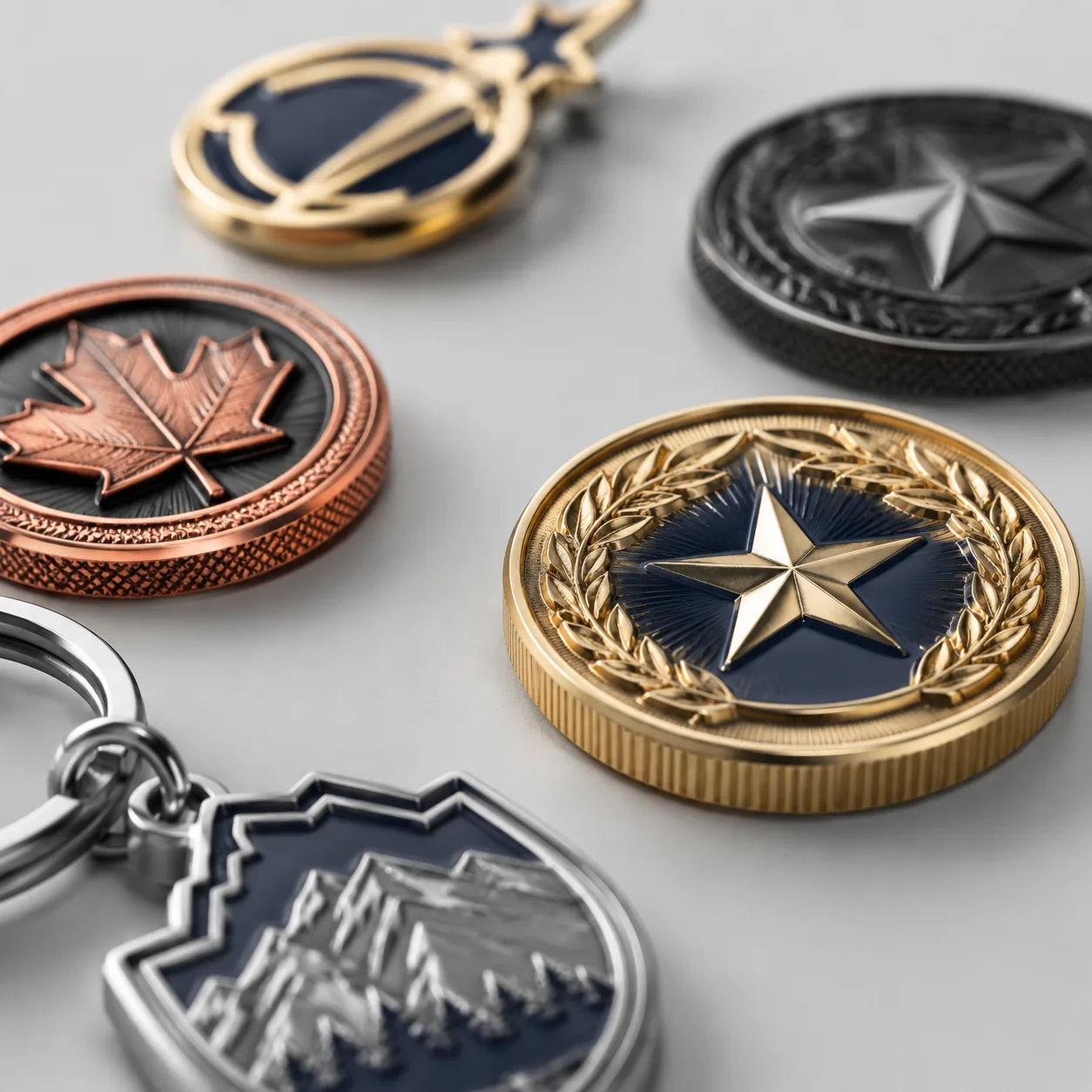
Why edge quality fails after a good sample
A buyer can approve an attractive enamel pin or challenge coin sample and still receive a bulk shipment that feels cheap because the perimeter scratches fingers, catches on fabric, chips through plating, or tears the inner polybag. The root cause is usually not the artwork. It is an incomplete specification. Many RFQs define size, metal color, enamel colors and attachment, but omit edge radius, burr allowance, hole finishing, polishing route, plating thickness and inspection method.
For handled items such as keychains, event coins, brooches, badges and metal fridge magnets, edge quality is a functional requirement. It affects user safety, perceived value, hardware life, packaging damage and return rates. A 35 mm pin with a sharp back edge may pass a front-view photo check, but it can still snag a scarf. A 50 mm coin with an unpolished bevel can look acceptable in a tray, then show rim chips after a short shipping vibration test.
At ZheCraft, edge complaints are most common on custom silhouettes with acute outer points, thin zinc alloy castings below 2.0 mm, die-struck brass pins with internal cutouts, and keychains where the jump-ring hole is too close to the perimeter. These risks are controllable before tooling. After the die or mold is cut, increasing an edge radius, widening a cutout or moving a ring hole can require retooling. For simple pin dies, that usually adds 3 to 7 calendar days and USD 60 to USD 180. For larger coins, 3D molds or multi-cavity zinc tools, the correction can exceed USD 250 and delay production by 7 to 12 days.
Choose the edge geometry before polishing
The first decision is the intended edge geometry. Buyers often write “smooth edge,” but a smooth vertical badge edge, a 45-degree beveled coin rim and a fully rounded pocket keychain edge require different tooling and finishing. A crisp corporate logo badge may need a clean sidewall to preserve the silhouette. A bottle-opener keychain carried in a pocket should prioritize comfort and chip resistance over maximum front-face area.
For die-struck iron or brass pins, the perimeter is normally blanked from strip, coined or struck, then deburred and polished before plating. For zinc alloy castings, the perimeter comes from the mold cavity and parting line; gate trimming, tumbling and local hand polishing determine the final feel. For etched or laser-cut stainless steel tags, the edge may be dimensionally accurate but tactilely sharp, especially at 0.6 to 0.8 mm thickness unless brushing or radius tumbling is specified.
| Edge style | Measurable target | Best use | Avoid when |
|---|---|---|---|
| Crisp vertical edge | Burr removed; radius below 0.05 mm | Formal logo pins, name badges, flat labels | Pocket keychains, children’s items, textile-contact brooches |
| Softened edge | Radius 0.10 to 0.20 mm | Standard enamel pins, brooches, fridge magnets | Very small silhouettes where detail loss is unacceptable |
| Coin bevel | 0.30 to 0.80 mm bevel at 30 to 45 degrees | Challenge coins, medallions, premium key fobs | Items thinner than 1.2 mm or designs with narrow borders |
| Comfort round | Radius 0.30 to 0.60 mm | Daily-use keychains, opener coins, safety-focused giveaways | Small pins where the rounded side reduces visible artwork area |
Set burr, sharpness and tolerance limits
A burr is raised excess metal left after stamping, shearing, casting trim, drilling or laser cutting. A small burr can be removed by tumbling before plating. A large burr often becomes a plated ridge, making it harder and more likely to cut skin or chip at the high point. “No burrs” is not a useful mass-production requirement because every metal process has measurable variation. A better specification defines maximum burr height, inspection magnification and defect classification.
For premium pins, coins and keychains, specify maximum visible-edge burr height of 0.03 mm and non-visible back-edge burr height of 0.05 mm. For standard promotional iron pins at 0.8 to 1.2 mm thickness, a 0.05 mm visible burr limit is more realistic at high-volume pricing. For brooches, scarf pins and children’s promotional items, add a functional rule: no edge may cut skin under normal finger pressure, snag 75D polyester fabric, or tear a 0.03 mm polybag during normal packing and handling.
Inspection should combine touch, visual review and spot measurement. A 10x loupe is enough for routine incoming or final inspection. A digital microscope or profile gauge is useful for first-off approval and disputed lots. At FOB USD 0.35 to USD 1.20 for many standard pins, full microscope inspection on every unit is not practical. Instead, classify unsafe sharpness as a critical defect with zero acceptance in the inspected sample, use AQL 1.5 or 2.5 for major edge defects depending on retail risk, and use AQL 4.0 for minor polishing inconsistency that does not affect safety or visible quality.
- Define maximum visible burr height: 0.03 mm for premium goods or 0.05 mm for standard promotional goods.
- Treat any edge that cuts skin, snags fabric, tears packaging or exposes wire-sharp flash as a critical defect.
- Require 10x loupe checks on first-off samples, pre-shipment random inspection and any reworked batch.
- Photograph the outer perimeter, back edge, ring hole, clasp area and internal cutouts during sample approval.
- State whether non-visible back burrs are acceptable only when they cannot contact skin, fabric, packaging or hardware.
Match the process to the edge requirement
The same edge requirement has different cost and risk by base metal. Iron is economical for stamped enamel pins, but blanking burrs are harder on sharp outer corners and small cutouts. Brass strikes cleanly and polishes well, making it a strong choice for premium badges and coins, but material cost is higher. Zinc alloy supports rounded 3D forms and thicker keychains, yet parting lines, gate marks and hole flash must be planned away from touch points. Stainless steel gives corrosion resistance and a modern brushed look, but laser-cut or etched sheet edges require deburring if the item will be worn or carried.
For a daily-use giveaway, it is often cheaper to choose a process that naturally produces the right edge than to force a low-cost process to meet a premium hand-feel requirement. For example, a 2.5 mm zinc alloy keychain with a molded comfort radius may cost more than a 1.2 mm stamped iron version, but it reduces ring-hole wear, edge chipping and customer complaints. Conversely, a flat 25 mm lapel pin may not benefit from heavy zinc casting if a stamped brass or iron pin meets the edge and artwork requirements.
| Material and process | Practical thickness | Main edge risk | FOB impact for improved finishing |
|---|---|---|---|
| Stamped iron pin | 0.8 to 1.5 mm | Blanking burrs on sharp corners and cutouts | Add USD 0.02 to USD 0.06 per unit at 1,000 pcs for extra tumbling and hand deburr |
| Die-struck brass badge | 1.2 to 2.0 mm | Detail softening if over-polished | Add USD 0.04 to USD 0.10 per unit versus basic polish |
| Zinc alloy cast keychain | 2.0 to 4.0 mm | Parting line, gate mark and hole flash | Add USD 0.05 to USD 0.15 per unit for trim, tumble and local hand polish |
| Stainless steel etched tag | 0.6 to 1.2 mm | Sharp sheet edge and laser heat tint | Add USD 0.03 to USD 0.12 per unit for brushing, edge deburr and passivation where needed |
| Brass or zinc challenge coin | 2.5 to 4.0 mm | Rim dents and plating buildup on bevels | Add USD 0.08 to USD 0.25 per unit for premium bevel polish and rim protection |
Design rules that prevent sharp edges
Many edge defects are designed into the product before sampling. A star-shaped pin with twelve needle points will never feel like a round badge of the same diameter. Internal cutouts below 1.2 mm, acute angles below 30 degrees, narrow bridges under 0.8 mm and ring holes too close to the perimeter all increase burr, polishing and plating risk. These details should be corrected in the production dieline, not improvised by a polishing worker after tooling.
For enamel pins, keep outside corner radii at 0.30 mm or larger wherever the brand shape allows. If the logo has unavoidable points, approve factory-added micro-radii of 0.10 to 0.20 mm before tooling. For keychain holes, keep at least 2.0 mm of metal between the hole edge and the outside edge on zinc alloy, and at least 1.5 mm on brass or iron. A 3.0 to 3.5 mm inner hole suits common 1.0 to 1.2 mm jump rings. Smaller holes can be produced, but they increase plating blockage, ring scratches and assembly rejection.
Openwork designs need special control because tumbling media does not always reach deep internal walls. For standard finishing, specify internal cutout channels of at least 1.2 mm. For premium finishing or retail collectibles, use 1.5 mm or more. If a cutout must be narrower, ask the factory to confirm whether hand filing or pin tools are needed and whether the added cost is included in the FOB price.
Control tumbling, polishing and plating together
Tumbling and hand polishing solve different problems. Tumbling uses ceramic, resin, walnut-shell or stainless media to remove small burrs and soften edges in batches. It is economical and consistent for standard pins, coins and keychains, but excessive tumbling can round fine relief, flatten raised text or thin enamel barriers. Hand polishing is more precise for bevels, cutouts and gate marks, but it adds labor variation and cost, especially on irregular silhouettes.
A practical route for stamped iron pins is blanking, rough deburr, surface polish, cleaning, copper or nickel underlayer where required, decorative plating, enamel fill or print, baking, attachment and final inspection. For zinc alloy keychains, the route is casting, gate trimming, tumble deburr, local hand polish, copper underplating if needed, final plating, color fill or print, assembly and final inspection. Edge finishing must occur mainly before plating. Polishing after plating can expose base metal, while poor pre-plating deburr traps sharp ridges under the finish.
Plating thickness should match the wear level. Standard decorative plating on pins and badges is commonly 3 to 5 microns total. Higher-wear keychains and coins normally benefit from 5 to 8 microns, with nickel, copper or other underlayers selected for the base metal and finish. More plating is not automatically better: if the base edge is sharp, thick plating can build up at high points and chip more easily. For antique finishes, the approved sample must define intended highlight rub versus unacceptable exposed base metal.
| Control point | Recommended standard | Defect class |
|---|---|---|
| Outer edge sharpness | No cutting or painful feel under normal finger pressure | Critical if unsafe; major if rough |
| Visible burr height | 0.03 mm premium or 0.05 mm standard | Major above limit |
| Plating chip on A-grade edge | None larger than 0.30 mm | Major |
| Decorative plating thickness | 3 to 5 microns standard; 5 to 8 microns for high-wear keychains and coins | Major if below agreed range and wear is visible |
| Ring-hole wear | No base metal after 100 ring rotations and 1.0 kg pull for 10 seconds | Major |
| Coin rim dent | None visible at 30 cm on front rim; back rim tolerance controlled by sample | Major or minor by location |
Sampling, MOQ tiers and lead times
Edge quality must be checked at pre-production sample stage. Request close-up photos of the front rim, back rim, sidewall, ring hole, clasp solder point, magnet cup and internal cutouts. For complex silhouettes or retail products, approve a physical sample because edge feel cannot be judged reliably from a rendering. Keep one signed golden sample at the factory and one with the buyer, with written notes such as “softened outer edge 0.10 to 0.20 mm” or “no tactile sharpness at ring hole.”
Typical MOQ for custom metal giveaways is 100 pcs for simple pins or coins, but better pricing and more stable finishing start at 300 to 500 pcs. For standard enamel pins, common FOB ranges are USD 0.45 to USD 1.20 at 500 pcs, USD 0.32 to USD 0.85 at 1,000 pcs, and USD 0.25 to USD 0.70 at 3,000 pcs, depending on size, colors and attachment. Zinc alloy keychains are often USD 0.85 to USD 2.20 at 500 pcs and USD 0.60 to USD 1.60 at 3,000 pcs. Premium challenge coins commonly run USD 1.40 to USD 4.50 depending on diameter, thickness, plating, enamel and edge detail.
Sample lead time is usually 5 to 8 days for simple die-struck pins, 7 to 10 days for zinc alloy keychains, and 8 to 12 days for 3D coins or antique-finished badges. Mass production is typically 12 to 18 days for 500 to 3,000 pins, 15 to 22 days for keychains with hardware assembly, and 18 to 28 days for large coin orders or multi-process items. Extra edge finishing normally adds 1 to 3 days for hand polishing, reinspection and possible rework.
For final inspection, use ANSI/ASQ Z1.4 general inspection level II unless the order is very small, very high value or safety-sensitive. Unsafe sharpness should have zero acceptance in the sample. For retail or paid collectibles, set major edge and plating defects at AQL 1.5. For standard promotional items, AQL 2.5 for major defects and AQL 4.0 for minor cosmetic variation is usually practical.
- Approve one golden sample with written edge notes, not only front-view photos.
- Keep one unassembled sample when the item uses rings, chains, magnets, pins or clasps.
- Inspect after final plating and assembly because earlier checks miss ring-hole wear, clasp scratches and rim chips.
- Separate defect locations: front rim, back rim, sidewall, hole interior, cutout wall and hardware contact point.
- Specify packing that prevents edge-to-edge rubbing, such as individual polybags, paper interleaving or molded trays for premium coins.
RFQ wording that factories can quote
A useful RFQ gives the supplier measurable targets before tooling. Include base metal, thickness, edge style, maximum burr height, plating thickness, inspection level, AQL and any functional tests. Mark high-risk points on the artwork: sharp outer corners, internal cutouts, ring holes, clasp areas and narrow bridges. Ask the factory to confirm achievable radius and any required artwork engineering before issuing the tooling deposit.
For a standard promotional enamel pin, a practical starting specification is: 1.2 to 1.5 mm iron or brass, softened outer edge radius 0.10 to 0.20 mm, visible burr below 0.05 mm, decorative plating 3 to 5 microns, no plating chip over 0.30 mm on A-grade visible edges, and AQL 2.5 for major edge defects. For a daily-use keychain, use 2.0 to 3.0 mm zinc alloy or brass, comfort edge radius 0.30 to 0.60 mm where possible, 5 to 8 microns plating, 3.0 to 3.5 mm ring hole, no base metal after 100 ring rotations, and zero acceptance for unsafe sharpness.
When comparing suppliers, do not compare unit price alone. Ask whether hand deburring of cutouts is included, whether the quoted FOB price covers edge brushing or bevel polishing, whether the sample and mass production use the same polishing route, and whether reorders will follow the same golden sample. ZheCraft can review artwork for edge-risk points before sampling, then lock the approved radius, polishing route, plating range and inspection notes into the production file so future orders match the original hand feel.
Have a project? Send your artwork and target quantity and we’ll reply with a detailed quotation within 12 working hours.
Ready to get this made?
Send your sketch, target quantity and ship-date. Detailed quotation in 12 hours.



