Edge Quality Specs for Custom Metal Badges and Coins
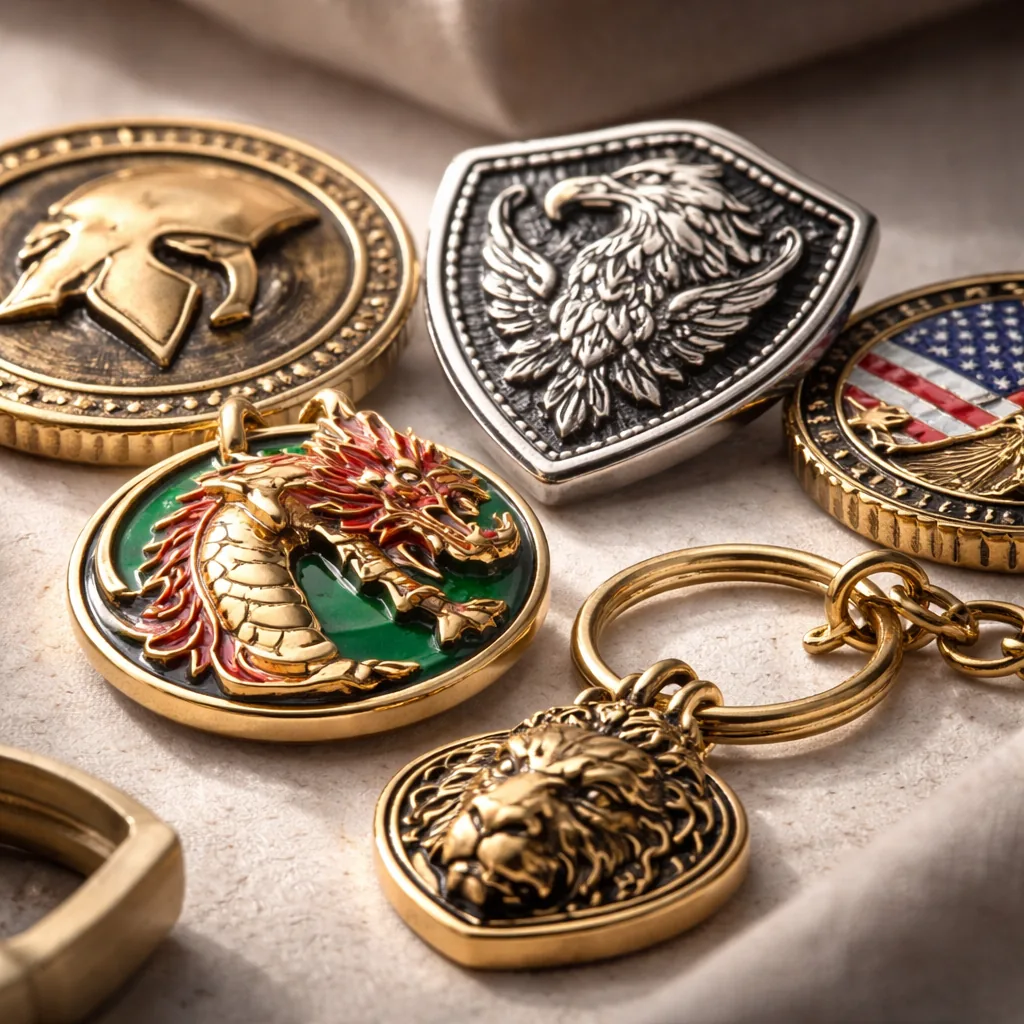
Why Edge Quality Fails After the Front Face Passes
A custom badge or coin can pass artwork approval, Pantone matching and front-face plating, then still fail in the user’s hand. The first contact point is usually not the enamel or logo; it is the perimeter, cutout, ring hole or back edge. If that area feels sharp, catches fabric or exposes base metal, the product reads as low quality even when the visible face looks correct.
Edge defects are common on challenge coins, lapel pins, keychains, bottle openers, brooches and irregular promotional shapes. Risk increases with thin borders, internal cutouts, sharp geometric corners, reeded coin edges, openwork logos and zinc alloy pieces below 2.0 mm finished thickness. These features concentrate polishing pressure and make plating coverage less uniform.
The fix is not to write “smooth edge” in the purchase order. A usable specification defines edge type, burr limit, chamfer or radius, plating coverage, inspection method, reject level and production trade-off. Those details should be agreed before tooling, because changing the edge after sample approval can require mold adjustment, extra polishing, secondary machining or a new plating run.
Choose the Edge Type Before Quoting
The edge type affects tooling cost, polishing time, plating reliability and the final hand feel. A flat vertical edge is economical and suitable for many small lapel pins, but it feels unfinished on heavier coins and keychains. A light edge break removes sharpness with minimal visual change. A chamfer or rounded edge gives a more premium feel but reduces the available flat artwork area.
For die-struck brass or iron pins, a 0.10 to 0.20 mm edge break is usually enough to remove the cutting burr without softening the silhouette. For 3.0 to 4.0 mm challenge coins, a 0.30 to 0.60 mm chamfer on both faces is common. For cast zinc alloy, a 0.30 to 0.80 mm radius is easier to hold than a perfectly square corner because casting, tumbling and plating naturally soften the edge.
Do not specify a heavily rounded edge for puzzle sets, nested badges, QR-code coins or shapes that must fit a foam insert. Rounding can remove 0.10 to 0.30 mm per side from the perceived outline. If the product fits into a case, backing card slot or collector tray, confirm the maximum finished size after edge treatment, not only the tooling size.
| Edge specification | Typical use | Factory target | Cost and production impact |
|---|---|---|---|
| Flat deburred edge | Low-cost pins, small badges, simple magnets | Burr below 0.05 mm; no fiber catch on cotton-glove wipe | Lowest cost; weakest premium feel; edge plating may be thinner |
| Light edge break | Most lapel pins, medals and wearable badges | 0.10 to 0.20 mm softened corner; outline tolerance ±0.20 mm under 50 mm | Usually included or +USD 0.01–0.03 per piece at 500+ pcs |
| Chamfered edge | Challenge coins, bottle openers, premium keychains | 0.30 to 0.60 mm chamfer per face; chamfer width tolerance ±0.10 mm | Adds tooling control and 1–3 days polishing time |
| Fully rounded edge | Cast zinc alloy, children’s items, soft-touch giveaways | 0.40 to 0.80 mm radius depending on 2.5–5.0 mm thickness | Better safety; can blur fine silhouettes and reduce flat artwork area |
| Reeded or patterned edge | Commemorative coins and collector pieces | Pitch 0.8–1.5 mm; groove depth 0.15–0.35 mm | Higher mold cost; plating inside grooves needs tighter inspection |
Control Burrs by Process, Not by Guesswork
Burr sources differ by manufacturing route. Stamped iron or brass produces a sheared wall with rollover on the punch side and a burr on the die-exit side. Cast zinc alloy creates parting-line flash, gate marks and seam ridges. Laser-cut stainless steel may have heat tint and micro-burrs even when the outline is dimensionally accurate. Each process needs a different deburring method.
For stamped badges under 50 mm, specify burr height below 0.05 mm after deburring, with no continuous sharp ridge visible under 5x magnification. For larger plates, luggage tags or opener blanks, below 0.08 mm is more realistic because the blanking force and edge length are higher. For laser-cut stainless steel, add brushing, vibratory tumbling or electropolishing when the item is handled frequently or worn against fabric.
The RFQ should identify critical edge zones. On a lapel pin, the outer perimeter, pin-post solder area and back edge matter most. On a coin, the full circumference and both rim transitions matter. On a keychain, the ring hole, split-ring slot and bottle-opener lip need separate inspection because metal-on-metal wear will expose weak plating quickly. Internal cutouts should be checked the same way as outside edges, not treated as hidden areas.
Typical MOQs also affect what is practical. For custom soft enamel pins, many factories accept 100 pcs, but tighter edge sorting is more economical from 300 pcs upward. For zinc alloy coins with chamfers or patterned edges, 300–500 pcs is a common MOQ because mold setup, polishing racks and plating trials must be amortized. Below those quantities, expect either a higher unit price or a simplified edge finish.
Protect Artwork When Adding Chamfers or Radii
A chamfer changes the usable face area. On a 50 mm coin with a 0.50 mm chamfer on both faces, the flat top diameter is about 49.0 mm before any raised rim is added. If the raised rim is 1.2 mm wide, the inner artwork field falls to roughly 46.6 mm. This reduction can affect QR codes, serial numbers, micro text, enamel islands and legal copy.
Keep laser-engraved text at least 0.80 mm from the start of a chamfer. Keep enamel cells at least 0.60 mm from the edge where possible, and use a raised metal wall of at least 0.30 mm to protect soft enamel from polishing and handling damage. For hard enamel near an edge, allow additional polishing tolerance because over-polishing can flatten the metal wall and expose small color gaps.
For high-relief coins and 3D cast pieces, require a side-view drawing or rendered section before sample tooling. A front view will not show whether the chamfer cuts into the sculpted relief, reduces rim height or weakens a thin raised border. Approval drawings should show overall diameter, finished thickness, rim width, chamfer width, edge pattern, plating finish and any no-polish areas.
Dimensional tolerances should be realistic. For die-struck or cast pieces under 50 mm, finished outline tolerance of ±0.20 mm is common. For irregular keychains, openwork badges or coins above 60 mm, ±0.30 mm is more practical. Chamfer width tolerance of ±0.10 mm is normally acceptable for decorative metal goods; holding tighter than ±0.05 mm may require CNC machining and a different price tier.
Specify Plating Thickness and Edge Coverage
Edges are the weakest plating area because current density, racking contact and polishing pressure are not uniform. A bright gold front face can pass visual inspection while the side edge shows dark burn marks, exposed zinc, cloudy nickel or thin copper. Sharp corners and deep reeded grooves increase the risk because polishing can cut through the deposit before final finishing.
For standard promotional pins and badges, a copper or nickel underlayer is commonly controlled at 3–5 microns before the decorative top layer. Decorative imitation gold, silver-tone, black nickel or antique finish may add only 0.05–0.20 microns, so the underlayer and edge radius do more for durability than the color layer itself. For high-touch keychains or coins, ask for 5–8 microns total underplating where the budget allows.
A practical edge plating requirement is: no exposed base metal, no dark burn marks over 0.5 mm, no loose plating flakes, and no visible rack marks on customer-facing edges. For antique finishes, distinguish intentional dark recesses from plating gaps. Blackening inside a groove is acceptable only if the base metal is sealed and the finish is consistent across the batch.
Avoid mirror-polished sharp edges for outdoor, children’s or high-touch products. A 0.15 to 0.30 mm radius often improves plating coverage and reduces tarnish complaints more effectively than changing from gold to nickel or adding a clear coat. If salt-spray resistance is required, define the test separately, such as 24 hours neutral salt spray for indoor promotional goods or 48 hours for heavier keychains, with no red rust or blistering on edges.
Set Price, MOQ and Lead-Time Expectations
Edge quality has a real cost. A basic flat deburred pin may only need blanking, tumbling and standard polishing. A thick coin with chamfers, reeded edge and antique plating needs tighter mold work, longer polishing, more careful racking and slower final inspection. If those steps are not priced into the quote, they are unlikely to be controlled consistently in mass production.
For reference, 25–35 mm soft enamel iron pins at 300–500 pcs often fall around USD 0.45–1.20 FOB China per piece depending on plating, colors, backer and packaging. Zinc alloy challenge coins at 40–50 mm and 3.0–4.0 mm thickness commonly range from USD 1.80–4.50 FOB at 300–1,000 pcs. Premium coins with 3D relief, reeded edges, sequential numbering, antique plating or epoxy can run USD 3.50–7.50 FOB in mid-size batches.
Lead times should also be stated in days, not vague phrases. Standard samples for pins and coins usually take 7–12 calendar days after artwork approval. Mass production for 300–1,000 pcs normally takes 12–20 days after sample approval. For 3,000+ pcs, patterned edges, heavy hand polishing, dual plating or strict edge sorting, plan 20–30 days. Air shipment inspection and rework buffers should be added separately.
Use MOQ tiers to control expectations. At 100 pcs, the supplier may only offer standard deburring and visual inspection. At 300–500 pcs, a documented burr limit, side-view sample photos and AQL inspection are reasonable. At 1,000+ pcs, it is practical to request retained golden samples, edge defect photos, batch inspection records and tighter sorting for ring holes or cutouts.
Write an RFQ That a Factory Can Inspect
A strong RFQ converts hand feel into measurable checkpoints. Instead of “premium smooth edge,” write: “50 mm zinc alloy coin, 3.5 mm finished thickness, 0.40 mm chamfer both faces, burr below 0.05 mm, no sharp fiber catch on cotton-glove wipe, no exposed base metal on circumference, AQL 1.5 major and AQL 4.0 minor.” This wording gives production, polishing and QC teams the same target.
Approve the edge separately from the front face during sampling. Ask for front, back, side, ring-hole and cutout close-ups under neutral light, plus one short hand-rotation video. Include a caliper photo showing thickness and a close-up showing chamfer width. If the sample is borderline sharp, do not assume production will improve; variation usually increases across a full batch unless the requirement is written into the approval record.
- State finished size after edge treatment, including maximum size for cases, foam inserts or backing cards
- Specify the edge type: flat deburred, light edge break, chamfered, rounded, reeded or patterned
- Set burr limits by zone, such as below 0.05 mm on handled edges and below 0.08 mm on large blanks
- Define critical no-go areas: perimeter, cutouts, pin-post area, ring holes, split-ring slots and bottle-opener lips
- Require no exposed base metal, no plating flakes and no dark burn marks above 0.5 mm on customer-facing edges
- Use AQL 1.5 for sharp-edge, exposed-metal and loose-plating major defects; use AQL 4.0 for minor cosmetic edge marks
- Keep a signed golden sample and side-view photos as the production reference
Inspect Edges With Tools and Touch Checks
Edge inspection should combine measurement, magnification and tactile checks. Calipers confirm thickness, overall size and chamfer width, but they will not reliably detect a fine cutting burr. A cotton-glove wipe or soft-cloth wipe is a simple screening method: if the edge catches fibers, the lot needs closer review. For high-risk products, add 5x magnification at ring holes, cutouts and sharp corners.
Classify defects before inspection starts. Critical defects should be zero tolerance for children’s items, direct skin contact items or any edge that can cut the user. Major defects include sharp burrs, exposed base metal, loose plating flakes, cracked edge plating, unsafe ring holes and edges that cut packaging. Minor defects include slight polishing waves, isolated dull spots on non-visible side edges or micro-dents that do not affect safety, branding or corrosion resistance.
For a typical export lot, apply AQL 1.5 to major edge defects and AQL 4.0 to minor cosmetic edge defects. If the product is a low-cost event giveaway, that standard is usually sufficient. If it is a retail collector coin, staff uniform badge or brand merchandise sold at a premium, tighten the acceptance criteria and require defect boundary samples before production.
The final decision should match product use. A giveaway badge used once may only need a flat deburred edge below 0.05 mm burr height. A keychain, coin or brooch handled daily needs a defined radius or chamfer, stronger underplating, closer ring-hole inspection and realistic lead time. Treating the edge as a functional specification prevents the most common complaint: the product looked approved on paper but failed the moment someone picked it up.
Have a project? Send your artwork and target quantity and we’ll reply with a detailed quotation within 12 working hours.
Ready to get this made?
Send your sketch, target quantity and ship-date. Detailed quotation in 12 hours.



