Edge Profiles for Custom Coins and Badges: Buyer Specs
Why Edge Specs Fail Late in Production
Buyers often approve the front artwork, Pantone colors and plating finish first, then leave the sidewall as “standard edge,” “smooth border” or “premium rim.” That wording is not enough for a factory to price, tool or inspect consistently. The supplier may choose the fastest mold setup, the pre-production photos may look acceptable from the front, and the finished order may still feel sharp, look thin, snag fabric or fail to match a previous coin program.
On a 38 to 50 mm challenge coin, the edge affects perceived weight, grip, plating coverage, die wear, carton abrasion and hand feel. On a 25 to 45 mm badge or brooch, the edge often decides whether the item feels retail-ready or cheap. A thin badge with a square, over-polished or burred perimeter can damage clothing even if the front enamel is correct.
Lock the edge before tooling. A purchase order should state the face size, final thickness, base metal, edge style, rim or bevel width, radius, deburring requirement, plating thickness and inspection standard. For zinc alloy, brass and iron promotional items, practical tolerances are usually ±0.15 mm on edge or bevel width, ±0.20 mm on final thickness for coins, and ±0.10 mm for smaller die-struck badges when the geometry is simple. Changing edge style after a steel mold or die is cut commonly adds a new tooling charge and 5 to 8 calendar days before mass production can resume.
Match Edge Choice to Metal and Thickness
The right edge begins with product type, alloy and sidewall height. A 45 mm zinc alloy coin at 3.0 mm thick has enough sidewall for reeded, rope, oblique or diamond-cut patterns. A 28 mm soft enamel pin at 1.2 to 1.5 mm thick does not; it needs a smooth polished perimeter, small bevel or rounded corner. Trying to force decorative coin geometry onto thin badges usually creates weak cuts, exposed base metal after polishing, or burrs along the back edge.
Common pre-plating thicknesses are 1.2, 1.5, 1.8 and 2.0 mm for die-struck brass or iron badges; 2.5, 3.0, 3.5 and 4.0 mm for zinc alloy coins; and 2.0 to 3.0 mm for medals where weight is less critical. For a premium 45 mm challenge coin, 3.0 mm is the normal starting point. For 50 mm coins with two-sided relief and edge numbering, 3.5 or 4.0 mm gives better sidewall definition and more stable handling during polishing.
Avoid heavy decorative side edges below 2.5 mm unless the supplier confirms a sample with the same alloy and plating. If the item must stay lightweight, specify a rounded or beveled perimeter and spend the budget on clean relief, enamel fill accuracy, stronger clutch hardware or better packaging. Edge design should support the product’s function, not compete with the face artwork.
| Product type | Typical size | Practical thickness | Best edge choices | Avoid |
|---|---|---|---|---|
| Soft enamel pin | 20-35 mm | 1.2-1.8 mm | Rounded perimeter, 0.3-0.6 mm bevel, polished edge | Rope, reeded or deep side cuts below 2.0 mm |
| Hard enamel badge | 25-45 mm | 1.5-2.0 mm | Flat polished edge, soft bevel, rounded back edge | Sharp square corners on wearable badges |
| Challenge coin | 38-50 mm | 3.0-4.0 mm | Reeded, rope, oblique, diamond-cut, raised rim | Deep cuts on low-cost thin coins |
| Brooch or retail badge | 35-60 mm | 1.5-2.5 mm | Rounded edge, protective bevel, smooth back perimeter | Aggressive ridges that catch fabric |
| Medal or pendant | 40-70 mm | 2.5-4.0 mm | Thick bevel, rope edge, raised rim, smooth loop transition | Thin plain edges when premium weight is expected |
Use Plain, Rounded and Beveled Edges Correctly
Plain flat edges are the safest option for enamel pins, badges, keychains and budget coins. They are economical because the tool is simpler, polishing is predictable and plating coverage is easier to control. On a 40 mm zinc alloy item, a plain edge normally adds little or no tooling complexity. Decorative edge tooling may add 30 to 120 USD depending on diameter, pattern depth and whether a secondary operation is required.
A plain edge should still be specified. State whether it is square-polished, lightly rounded or deburred only. For most wearable metal items, a truly sharp 90-degree back edge is not acceptable. Specify no burrs catching cotton cloth, no edge deformation visible at 30 cm, and no exposed base metal after plating. For school, charity, children’s event or uniform badges, use a minimum finished corner radius of 0.40 mm where the outline has points or star shapes.
Rounded edges improve handling and reduce snagging. For standard badges, specify a finished radius of 0.20 to 0.35 mm. For brooches, medals worn against fabric or youth programs, 0.40 to 0.60 mm is safer. Do not over-round geometric logos: a shield, crest or letter-shaped outline can lose its intended profile if the factory removes too much metal during tumbling or hand polishing.
Beveled edges create a thicker visual profile without increasing total weight as much as a full thickness upgrade. A practical bevel width is 0.4 to 0.8 mm on 1.5 to 2.0 mm badges and 1.0 to 1.5 mm on 3.0 mm coins. Keep enamel cells, printed text, QR codes and serial numbers at least 0.8 mm from the bevel start line on badges and 1.0 mm on coins. If the bevel cuts into a color fill area, polishing can thin the plating at the transition and cause uneven color reflection.
Specify Decorative Coin Edges with Numbers
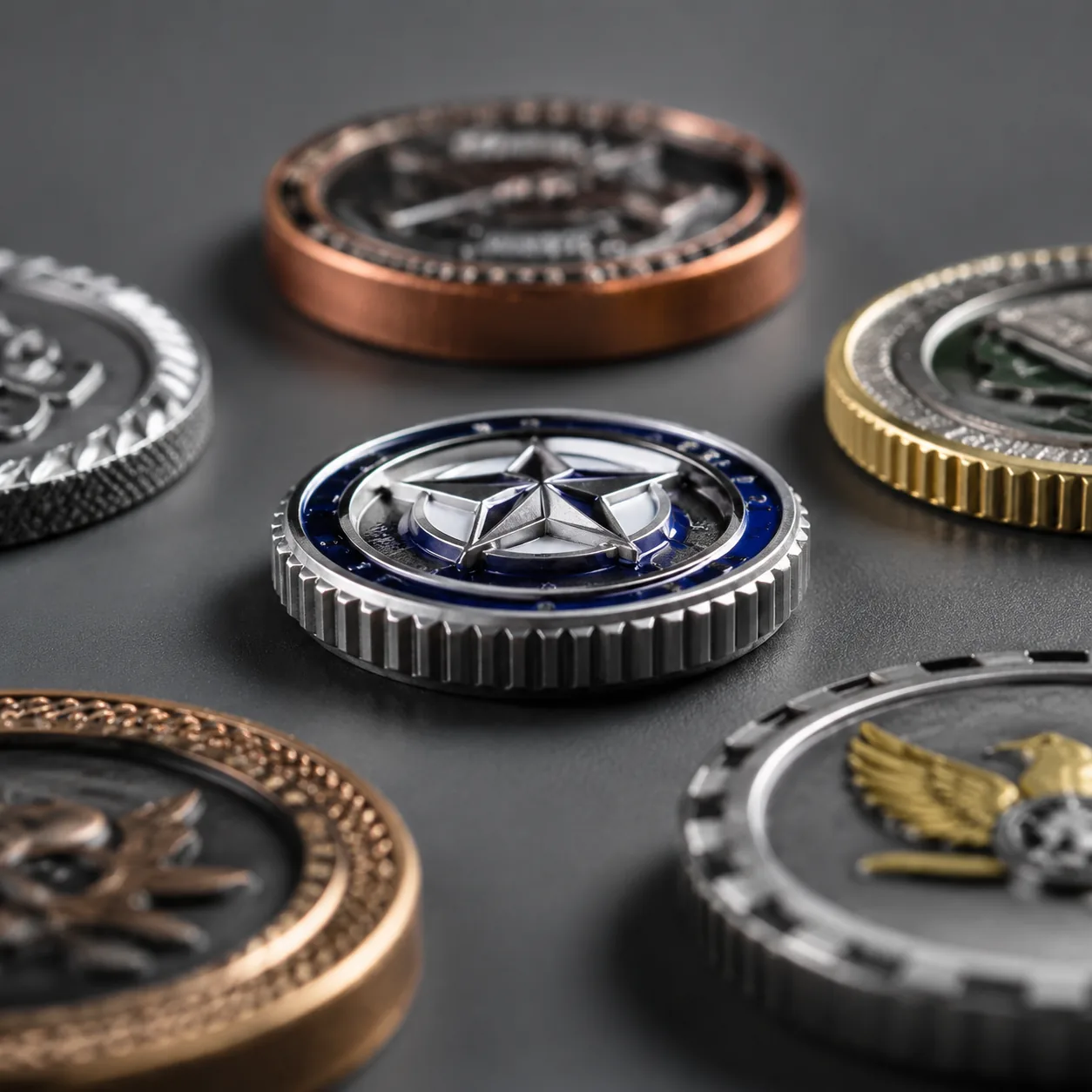
Reeded, rope, oblique and diamond-cut edges work well on challenge coins because they add grip and make the sidewall look intentional. They also hide minor parting lines better than a plain polished side. However, a decorative edge is only premium when the pitch, depth and plating are consistent around the full circumference.
For 40 to 50 mm coins, a practical reeded edge uses 0.8 to 1.2 mm pitch and 0.15 to 0.30 mm cut depth. Finer reeds can look elegant in CAD but may fill with plating, flatten during polishing or leave burrs. Rope edges need more sidewall height. Use at least 3.0 mm total thickness, with the rope band occupying about 1.8 to 2.4 mm of the sidewall. Oblique cuts can work at 2.5 mm, but the pattern looks stronger at 3.0 mm and above.
Diamond-cut edges reflect light strongly and suit awards, collector coins and retail medals. They also reveal polishing lines, plating thin spots and small dents more clearly than antique finishes. If a bright gold or bright nickel coin uses diamond cuts, request a plated pre-production sample and inspect the edge under normal viewing distance and under angled light. Do not rely on an unplated blank for final approval.
Decorative edges are not always worth the cost. If the coin needs edge numbering, QR codes or laser text, leave a plain panel or use a smooth edge. If the FOB target is below about 0.90 USD at 1,000 pieces, a plain edge with clean antique plating may deliver better perceived value than a shallow rope edge. For military, club and event coins where recipients handle the coin repeatedly, a deeper reeded or rope profile is usually justified.
| Edge style | Best use | Minimum thickness | Typical added FOB at 1,000 pcs | Key inspection risk |
|---|---|---|---|---|
| Plain polished | Pins, badges, budget coins | 1.2 mm | 0.00-0.03 USD/pc | Looks thin on large coins if no raised rim |
| Rounded | Wearable badges, brooches | 1.2 mm | 0.01-0.04 USD/pc | Outline becomes too soft after polishing |
| Single bevel | Premium badges, medals | 1.8 mm | 0.02-0.06 USD/pc | Artwork crowds the bevel line |
| Reeded | Challenge coins | 2.5 mm | 0.03-0.08 USD/pc | Burrs or uneven pitch |
| Rope | Military, club and commemorative coins | 3.0 mm | 0.05-0.12 USD/pc | Weak detail on thin sidewalls |
| Diamond-cut | Awards and collector coins | 3.0 mm | 0.06-0.15 USD/pc | Plating flaws become highly visible |
Control Plating, Polishing and Final Feel
The edge approved in CAD will not match the finished part exactly. Polishing removes metal, plating adds thickness, and clear coating can slightly soften tactile detail. Bright nickel, imitation gold, rose gold and black nickel show edge defects more clearly than antique brass, antique copper or antique silver. Antique finishes hide minor surface variation, but heavy antiquing can fill fine reeds or rope valleys.
For normal promotional badges and coins, economical nickel or color plating is often 3 to 5 microns over a base layer. For higher-wear coins, keychains and medals handled frequently, specify 5 to 8 microns minimum on raised areas. Premium retail or long-service awards may justify 8 to 10 microns, but thicker plating is not a cure for poor edge tooling; it can reduce fine pattern sharpness if the cut depth is too shallow.
Polishing control is critical. Heavy polishing can flatten reeds, blur rope detail and over-round corners. Light polishing can leave burrs, parting lines or abrasive scratches. Treat the first off-tool sample as a geometry check only. The plated pre-production sample is the real approval for edge feel, color coverage and snag risk. Keep one sealed approved sample for comparison during reorders, because sidewall finish is difficult to judge from front-view photographs.
For black nickel, gunmetal and matte finishes, ask how parts are racked. Inconsistent rack contact can cause edge tone variation, especially on deep cuts. For antique finishes, define whether the sidewall valleys should retain dark oxidation or be polished bright. Without that instruction, two batches can both pass a generic “antique silver” description while looking different on the edge.
Budget, MOQ and Lead-Time Benchmarks
Edge choice has less cost impact than metal, size, enamel count or packaging, but it affects both tooling and inspection time. Simple pins and badges commonly start at 100 pieces, though 300 pieces is usually more efficient. Challenge coins are more economical from 300 pieces upward because molds, plating racks, polishing fixtures and sampling time are heavier. Decorative edge coins at 50 or 100 pieces are possible, but unit pricing can look high because fixed tooling is spread over fewer pieces.
As working FOB benchmarks, a 40 mm soft enamel badge with a plain or rounded edge may run 0.55 to 1.20 USD at 500 pieces, depending on plating, color count, backing and carding. A 45 mm zinc alloy coin at 3.0 mm with two-sided relief, antique plating and a reeded edge may fall around 1.20 to 2.40 USD at 500 pieces. A 50 mm coin at 4.0 mm with rope edge, dual plating, edge numbering and capsule packaging can reach 2.20 to 4.50 USD. At 3,000 pieces, the same decorative edge may add only a few cents per unit because tooling is diluted.
Typical tooling and sample time is 5 to 7 days for simple badges and 7 to 10 days for decorative-edge coins. Mass production after sample approval is commonly 12 to 18 days for plain-edge badges, 15 to 22 days for standard challenge coins and 18 to 28 days for complex rope, diamond-cut, numbering or dual-plated projects. Add 3 to 5 days if the first sample shows weak edge detail and the tool must be adjusted. Rush orders should avoid unproven decorative edges unless the buyer accepts narrower correction time and higher cosmetic risk.
| Quantity tier | Plain badge FOB guide | Decorative coin FOB guide | Procurement note |
|---|---|---|---|
| 100 pcs | 0.95-2.20 USD/pc | 2.20-5.80 USD/pc | Tooling dominates unit cost |
| 300 pcs | 0.70-1.60 USD/pc | 1.55-3.60 USD/pc | Good tier for sampling programs |
| 500 pcs | 0.55-1.20 USD/pc | 1.20-2.80 USD/pc | Common production MOQ |
| 1,000 pcs | 0.42-0.95 USD/pc | 0.95-2.20 USD/pc | Decorative edge becomes more efficient |
| 3,000 pcs | 0.32-0.75 USD/pc | 0.78-1.80 USD/pc | Best tier for recurring programs |
Inspection Rules That Prevent Disputes
Edge defects are difficult to resolve if the purchase order only says “smooth edge.” Define measurable defects, sampling level and viewing method before production. For standard promotional orders, AQL 2.5 for major defects and AQL 4.0 for minor defects is a practical baseline. Classify sharp burrs, exposed base metal, cracked plating, deformation affecting assembly, and snagging edges as major defects. Minor defects may include faint polishing direction marks under 0.5 mm that are not visible at 30 cm under normal light.
For dimensions, allow ±0.15 mm on badge edge width or bevel width and ±0.20 mm on thick coin final thickness unless the design requires tighter control. For visible reeded or rope patterns, define missing, crushed or flattened pattern longer than 3.0 mm continuous length as major. For diamond-cut edges, define dull or uncut segments longer than 2.0 mm as major if visible at normal viewing distance. On plated pieces, any exposed base metal on a handled edge should be major, not cosmetic.
Inspection should include tactile checks, not only photos. Run a clean cotton cloth over the full perimeter; if fibers catch, the edge is likely unsafe for clothing or packaging. For brooches and wearable badges, rub the back edge against a woven fabric swatch for 10 cycles with light hand pressure. For coins packed in capsules, check that the edge does not scrape the capsule wall or shed plating dust.
- Confirm edge style, thickness and radius on signed artwork, not only in email comments.
- Measure final thickness after plating at three points with calibrated calipers.
- Check bevel width, reed pitch or rope band height against the approved plated sample.
- Inspect pieces from at least three cartons for burrs, exposed base metal and flattened pattern.
- Use AQL 2.5 for major edge defects and AQL 4.0 for minor cosmetic marks unless the buyer requires stricter limits.
- Seal one approved plated sample as the reference for reorder edge feel, plating tone and pattern depth.
Write the RFQ So Factories Quote the Same Edge
A strong RFQ makes it impossible for two suppliers to quote different builds under the same description. State base metal, face size, final thickness, edge style, bevel or radius, plating thickness, polishing level, sample requirement, AQL level and quantity tiers. If the job is a reorder, provide the previous physical sample or side-view photos with caliper readings. Front artwork alone is not enough to match hand feel.
For a coin, a clear specification would read: “45 mm zinc alloy challenge coin, 3.0 mm final thickness after plating, antique silver, reeded edge, reed pitch 1.0 mm ±0.15 mm, cut depth 0.20 mm ±0.05 mm, no exposed base metal, no burrs catching cotton cloth, AQL 2.5 major and 4.0 minor, quote 300/500/1,000/3,000 pcs FOB China.” For a wearable badge: “38 mm brass badge, 1.5 mm final thickness, polished nickel plating 5 microns minimum, rounded perimeter radius 0.30 mm minimum, smooth back edge, no sharp points, butterfly clutch, quote with and without backing card.”
Ask each supplier whether the edge is formed in the main mold, produced by secondary cutting, achieved by CNC machining, or shaped mainly through polishing. That answer affects consistency, cost and reorder risk. If the artwork is borderline, such as a rope edge requested on a 2.5 mm coin, request two options: the original thickness and a 3.0 mm upgrade. The price difference is often small compared with the improvement in sidewall definition and lower rejection risk.
Before approving the order, add one side-view page to the artwork file. Show total thickness, edge profile, bevel or radius dimension, safe artwork distance from the edge, and any edge numbering or packaging clearance. This single page prevents most edge disputes because it turns a subjective finish request into a measurable production requirement.
Have a project? Send your artwork and target quantity and we’ll reply with a detailed quotation within 12 working hours.
Ready to get this made?
Send your sketch, target quantity and ship-date. Detailed quotation in 12 hours.



