Edge Finishing Specs for Pins, Coins and Keychains
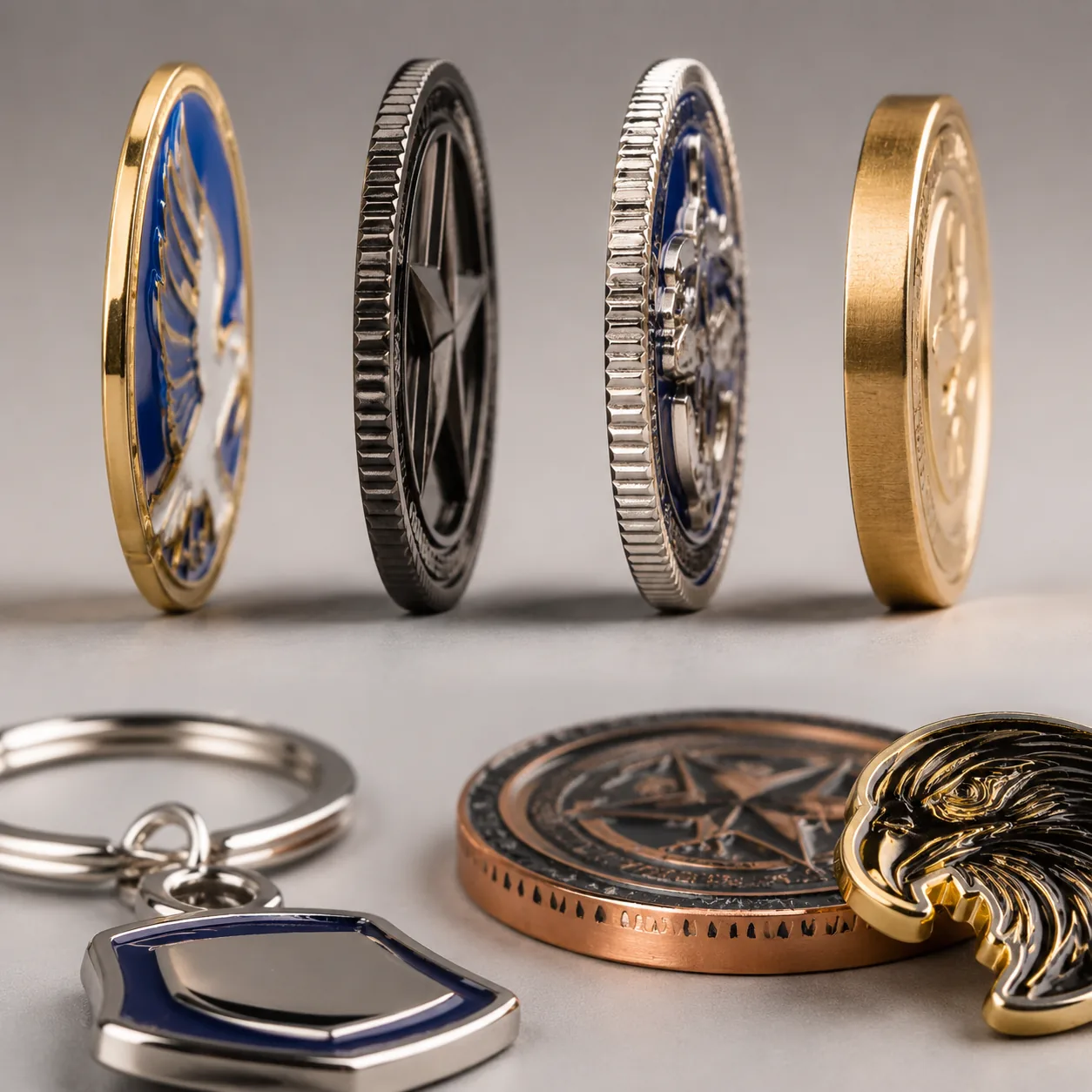
The buyer problem: good artwork, painful edges
A pin, coin or keychain can pass color approval and still fail in hand. The complaints are usually small but expensive: a coin rim feels knife-like, a keychain catches a pocket lining, a brooch snags fabric, or plating wears through on the first high spot. These are edge-finishing defects, not artwork defects.
For B2B orders, edge quality matters most on items people touch every day: keychains, challenge coins, bottle openers, luggage tags, brooches, uniform badges and fridge magnets with exposed metal shells. A purchase order that says only “smooth edges” is too vague. The supplier needs edge radius, burr height, polishing method, plating build and inspection criteria before tooling starts.
At ZheCraft in Yiwu, the most common edge problems appear on aggressive cutouts, thin zinc alloy castings, sharp 90-degree coin rims and dark plating on high-relief designs. These issues are solvable, but only if they are specified early.
Define edge risk by product type
Not every metal giveaway needs the same edge standard. A 25 mm lapel pin worn on fabric has a different risk profile from a 50 mm keychain tossed in a bag with keys and a phone. A 45 mm challenge coin may look premium with a crisp rim, while a brooch back must avoid any burr that can scratch skin or cut thread.
For stamped iron or brass pins, the highest-risk areas are the outer die-cut edge, cutout bridges, clutch post weld points and raised plating borders around enamel cells. For zinc alloy keychains and magnets, risk concentrates at parting lines, gate-trim marks, split-ring holes and thin decorative projections. For challenge coins, rim knurling, reeded edges and 3D relief peaks need separate checks because each one wears differently.
| Product type | Typical size and thickness | Main edge risk | Recommended edge target |
|---|---|---|---|
| Soft enamel pin | 20-35 mm wide, 1.2-1.8 mm thick | Stamped burrs, sharp outline corners, plating ridges | Outer edge radius 0.10-0.20 mm; burr under 0.05 mm |
| Hard enamel pin | 20-40 mm wide, 1.5-2.0 mm thick | Polished enamel-metal transition, corner rub-through | Flush polish within ±0.05 mm; softened outline edge |
| Zinc alloy keychain | 40-70 mm long, 2.0-4.0 mm thick | Parting line, gate mark, split-ring hole burr | Hole fully deburred; edge radius 0.20-0.35 mm |
| Challenge coin | 38-50 mm diameter, 3.0-4.0 mm thick | Rim feels sharp, plating thin on peaks | Rim edge radius 0.15-0.30 mm unless reeded |
| Metal brooch | 35-65 mm wide, 1.5-3.0 mm thick | Fabric snagging, pin stem scratch points | Back edge burr under 0.03 mm; smooth pin channel |
| Fridge magnet shell | 40-80 mm wide, 0.8-2.5 mm metal face | Thin shell edge and plating peel | Softened or rolled edge; no exposed base metal |
Choose the right forming process for clean edges
Stamped iron and brass can produce very clean outlines when the die is sharp and the material thickness is appropriate. For pins, common thicknesses are 1.2 mm, 1.5 mm and 1.8 mm. If the design has many small outside teeth or narrow bridges below 1.0 mm, stamping may leave fragile corners that need heavier polishing, which can distort fine detail.
Die-cast zinc alloy is better for thicker keychains, 3D forms and rounded shapes. Typical zinc alloy thickness is 2.5-4.0 mm, with local minimum walls around 1.2 mm if the part is not load-bearing. The trade-off is that every casting has a parting line and a gate-trim area, so the RFQ should state exactly where those marks are allowed and where they are not.
Photo-etched brass or stainless steel works for very thin bookmarks, nameplates and flat badges, usually 0.4-0.8 mm thick. The edge can be precise but also feels sharp because the section is thin. For handheld products, etched metal below 0.5 mm is rarely a good choice unless it is mounted on backing card, laminated, or used only as a decorative insert.
A practical rule: use stamping for flat pieces with clean contours, die-casting for rounded or 3D parts, and etching only when ultra-thin detail matters more than edge comfort.
Specify measurable edge and burr limits
A useful edge specification gives the inspector something to measure and the polishing team something to target. For general promotional metal items, an outer edge radius of 0.10-0.30 mm is realistic. Below 0.10 mm, the edge may still feel crisp. Above 0.30 mm, small artwork can lose definition, especially on 20-25 mm pins.
Burr height should be defined separately from edge radius. For pins and brooch backs that contact fabric, set visible or tactile burrs at no more than 0.03-0.05 mm. For keychains and coins, 0.05-0.08 mm is usually acceptable if the burr is not in a hole, slot or finger-contact point.
Hole edges need tighter language because split rings magnify roughness. For a keychain hole, specify a minimum hole diameter of 3.0 mm for a 25 mm split ring and 3.5-4.0 mm for a 30 mm split ring. Require both sides of the hole to be deburred, with no plating nodules that block ring movement or scrape the ring wire.
If the design includes sharp points or thin bridges, define the minimum tip thickness. For a pocket-carried item, avoid outside points sharper than 30 degrees unless they are clearly decorative and not load-bearing.
- State the outer edge radius target, such as 0.20 mm ±0.10 mm for a zinc alloy keychain.
- Set burr limits by contact area: 0.03 mm for brooch backs, 0.05 mm for pins, 0.08 mm for coin rims.
- Mark high-risk edges on the artwork proof: cutouts, holes, sharp tips, bottle-opener lips and thin bridges.
- Ask the factory to confirm whether edge rounding changes final dimensions by more than ±0.2 mm.
- Require hole deburring on both faces, not only the visible face.
Balance polishing with artwork detail
Polishing removes burrs, but it also removes metal. On soft enamel pins, excessive polishing can lower raised borders until enamel appears overfilled. On antique coins, too much tumbling can flatten relief peaks and weaken contrast between recessed dark areas and raised bright metal.
The normal sequence for stamped pins is die strike, trimming, manual edge cleaning, plating, enamel fill, baking and final touch-up. Hard enamel adds grinding and flat polishing after baking, so it needs enough raised metal width to survive finishing. A minimum metal line width of 0.30 mm is safer than 0.20 mm when the design must end flush after polishing.
For cast zinc alloy keychains, vibratory tumbling is efficient for medium and large lots, usually 1,000 pieces and above. Manual polishing is better for premium 3D pieces or designs with fragile projections, but it adds labor cost and can create variation. On a 50 mm zinc alloy keychain, manual edge finishing often adds about USD 0.03-0.08 per piece compared with basic tumbling, depending on geometry and surface condition.
A good supplier will polish the edge without rounding away lettering, serial numbers or micro text. If the design has fine engraving, ask for a pre-polish sample and a post-polish sample before mass production.
Plating thickness and edge coverage
Edges are where plating is most likely to look thin. Current density is not perfectly even during electroplating, and polishing after plating can expose base metal on sharp corners. That is why bright gold, black nickel and rose gold usually show edge defects faster than antique brass or antique nickel.
For standard promotional pins and keychains, a total decorative plating thickness of 3-5 microns is common. For higher-handling items such as keychains, coins and bottle openers, 5-8 microns gives better wear resistance, especially on nickel or brass underlayers. If the item will rub against keys every day, flash plating is not enough even when the sample looks fine.
A practical stack for zinc alloy keychains is copper underplate 5-8 microns, nickel layer 3-5 microns and final decorative top layer 0.1-0.3 microns for gold-tone or similar finishes. For black nickel, specify full coverage in recessed corners and no grey break on the outer edge. If nickel-free is required, agree on the plating route and test method separately because the finish, cost and lead time can all change.
On dark finishes, ask the supplier to inspect under neutral white light, not only warm workshop lighting. A corner that looks acceptable in warm light can appear patchy in retail lighting.
| Finish choice | Edge appearance risk | Typical plating approach | When not to choose it |
|---|---|---|---|
| Bright gold | High; rub-through is obvious on corners | Copper plus nickel plus gold-tone top layer, total 5-8 microns for keychains | Daily-use keychains at the lowest budget |
| Black nickel | High; thin areas turn grey or brown | Nickel base with black nickel finish and careful rack position | Deep narrow recesses without enough drainage |
| Antique brass | Medium; wear blends into the finish | Copper or nickel base with antique treatment and relief polishing | Designs that need a clean modern luxury look |
| Antique silver | Low to medium; forgiving on relief products | Nickel base with antique wash and controlled highlight polishing | Tiny text where dark wash may clog detail |
| Matte nickel | Medium; scratches show under direct light | Nickel plating with satin or bead-blasted effect | Low-relief artwork that needs strong contrast |
| Painted edge color | High; chipping risk on contact points | Base plating plus sprayed or filled color on selected edges | Split-ring holes, opener lips or coin rims |
Sampling and inspection before mass production
A flat digital proof cannot prove edge quality. The pre-production sample should be checked by hand, by sight under strong light and with simple gauges. For custom metal items, approve one golden sample and keep one duplicate at the factory line for production comparison.
Use ISO 2859-1 sampling or a comparable AQL plan. A common B2B level is General Inspection Level II with AQL 2.5 for major defects and 4.0 for minor defects. Sharp edges that can scratch skin, snag fabric, cut packaging or expose base metal should be classified as major defects, not as cosmetic issues.
Dimensional tolerance should also account for edge finishing. For pins and coins, ±0.2 mm on length and width is practical for most shapes. For keychain holes, require +0.2/0.0 mm if ring movement is critical, because an undersized hole causes assembly problems and may force rework.
Good inspection should include both touch and visual checks. A cotton cloth rub test catches burrs that the eye misses. A 5x magnifier helps identify plating nodules inside holes and at sharp corners. For packed goods, carton shake and abrasion checks matter too, because an edge that passes on the bench can still scratch the bag during transit.
- Rub the outer edge with a cotton cloth; any pulled fibers indicate burrs or sharp points.
- Run a fingertip around the rim with light pressure; discomfort or scratching is a major defect.
- Inspect holes and slots from both sides at 5x magnification for burrs, plating nodules and exposed base metal.
- Check dark plating at outer corners under neutral white light, not only warm factory lighting.
- Measure thickness after finishing, not only raw casting or stamping thickness.
- Confirm that backing cards, polybags or foam inserts are not scratched by the product edge during carton vibration.
Cost, MOQ and lead-time impact
Edge finishing is not usually the biggest cost driver, but it affects labor planning. For pins under 35 mm with a simple outline, standard deburring is usually included in the FOB price. Typical FOB ranges are USD 0.35-0.90 for 25-35 mm soft enamel pins at 300-1,000 pieces, depending on plating, color count, attachment and packaging.
Complex outlines change the calculation. A pin with ten narrow cutouts, sharp star points or multiple internal windows may add USD 0.02-0.06 per piece for extra cleaning, and it may need 2-3 additional production days. For zinc alloy keychains, a complex 3D shape with manual edge polishing often ranges from USD 0.75-1.80 FOB at 500-1,000 pieces, excluding premium packaging.
MOQ also affects edge consistency. Below 300 pieces, factories may rely more on hand finishing and visual sorting. At 300-999 pieces, a defined burr limit, hand-feel check and golden sample are usually enough. At 1,000-4,999 pieces, AQL inspection, an edge-risk map and controlled tumbling batches become worth the setup time. At 5,000 pieces and above, tool maintenance and in-process checks matter because a slightly dull die can create burrs across the whole lot.
Lead time depends on whether edge requirements are known before sampling. For most metal pins and keychains, sampling takes 5-8 days after artwork approval, and mass production takes 12-20 days after sample approval. If edge defects are discovered only after production starts, rework can add 3-7 days and still leave inconsistency in the lot.
| Order tier | Recommended edge control | Typical added cost | Lead-time impact |
|---|---|---|---|
| 100-299 pcs | Manual visual check plus basic deburring | Often included or USD 0.03-0.08 per pc | Usually none, or up to 2 extra days |
| 300-999 pcs | Defined burr limit, hand-feel check, golden sample | Usually included for simple pins; USD 0.02-0.06 for complex outlines | 1-3 days if extra polishing is needed |
| 1,000-4,999 pcs | AQL inspection, edge-risk map, controlled tumbling batch | USD 0.01-0.05 per pc depending on geometry | 2-4 days for tighter sorting |
| 5,000 pcs and above | Tool maintenance plan, in-process checks, carton abrasion test | Quoted case by case; savings possible with better tooling | Plan 18-30 days total for complex metal items |
What to do next before issuing the PO
Before final pricing, separate artwork approval from edge-performance approval. Send the supplier a marked PDF showing which edges touch skin, fabric, fingers, packaging or split rings. This prevents the factory from polishing every area equally or protecting the wrong detail.
In the RFQ, include product size, base metal, thickness, finish, attachment, packing and edge targets in one place. For example: 50 mm zinc alloy keychain, 3.0 mm thick, black nickel, 30 mm split ring, hole diameter 3.5 mm minimum, outer edge radius 0.20-0.35 mm, no tactile burrs, total plating 5-8 microns, individual OPP bag. That is far clearer than “premium quality, smooth edge.”
If you are sourcing mixed products, ask for one edge standard per item rather than one general standard for the whole set. ZheCraft can review artwork for pins, coins, brooches, magnets and keychains before tooling and flag edge-risk areas such as thin bridges, sharp points and undersized holes. The best time to solve edge quality is during design review, not during final inspection.
- Add edge radius, burr height and hole-deburring requirements to the RFQ.
- Approve a physical sample by hand feel, not only by photo.
- Classify sharp edges, exposed base metal and snagging points as major defects in inspection.
- Choose thicker plating for high-handling keychains, coins and bottle openers.
- Allow extra lead time for complex cutouts, 3D castings or dark plating finishes.
Have a project? Send your artwork and target quantity and we’ll reply with a detailed quotation within 12 working hours.
Ready to get this made?
Send your sketch, target quantity and ship-date. Detailed quotation in 12 hours.



