Edge Finishing Specs for Custom Metal Giveaways
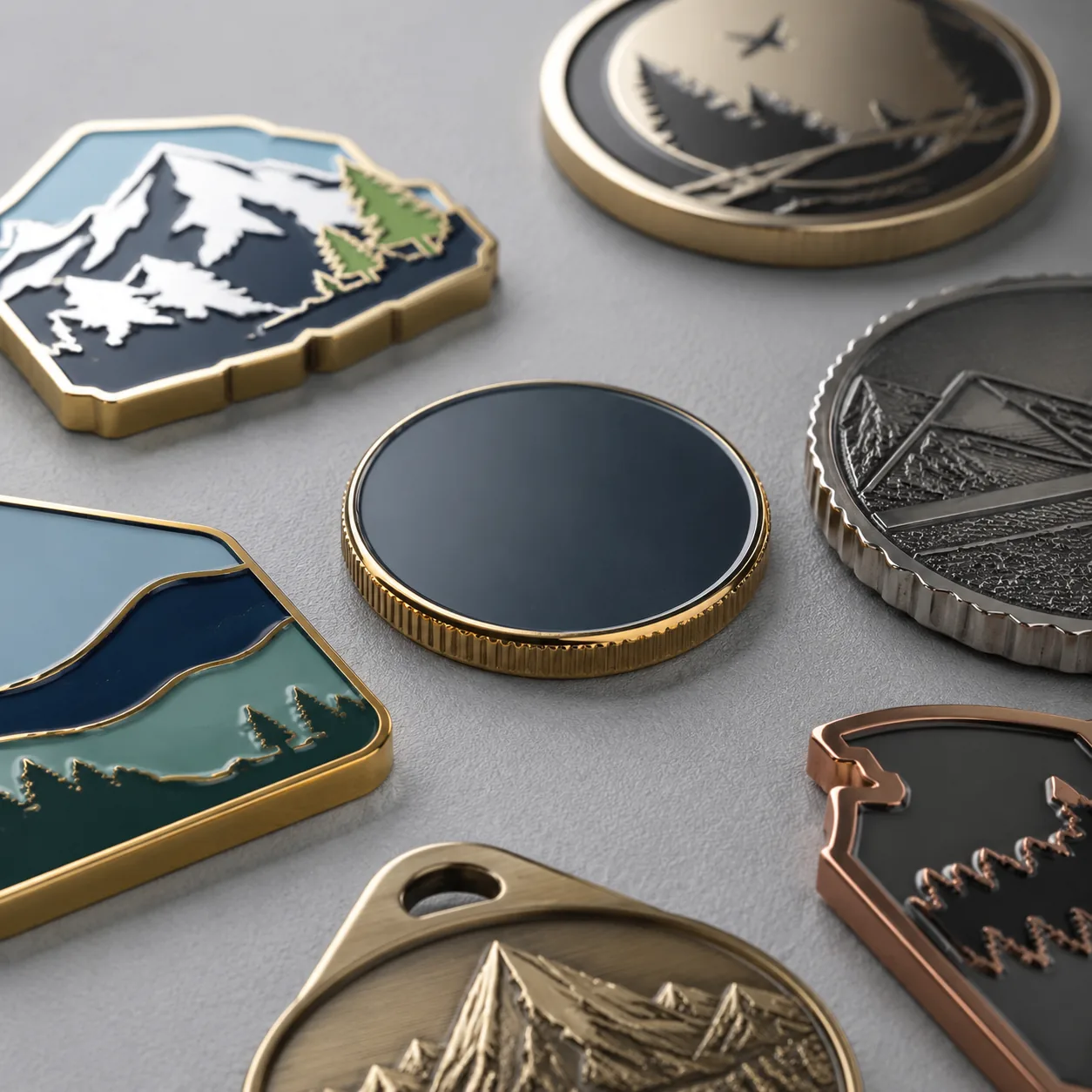
Why Edge Finish Fails Even When Artwork Looks Right
Many metal giveaway problems are not caused by bad artwork. They start when the RFQ defines size, plating and enamel colors but says only “smooth edges.” The supplier then chooses the fastest process that can pass a basic visual check. The finished pin, coin or keychain may look acceptable in a photo yet scratch backing cards, snag fabric, chip at the ring hole or feel sharp in the hand.
Edge quality is controlled by die clearance, stamping pressure, casting gate position, trimming, media type, tumbling time, manual polishing and plating build. A 30 mm soft enamel pin and a 55 mm zinc alloy keychain require different edge controls. The pin needs a clean perimeter that will not damage a garment or printed card. The keychain needs a stronger radius at the hole because a split ring repeatedly cuts against the plating during use.
At ZheCraft, edge finishing is reviewed before tooling for enamel pins, brooches, challenge coins, fridge magnets, bottle openers and keychains. The best specification is not always the highest polish. It is a measurable finish that matches the base metal, thickness, user contact areas, packaging method, inspection level and target FOB cost.
Map Critical Edge Zones Before Quoting
The word “edge” covers several different features. A metal giveaway can have an outside perimeter, internal cutout walls, raised logo borders, recessed enamel cells, keyring holes, brooch bar ends, pin posts, magnet pockets and backstamp edges. These zones are formed and finished differently, so one general tolerance will not control the real failure points.
Start by marking critical and non-critical edges on the artwork. Critical edges are touched by fingers, fabric, cords, cards or children: outside profiles, openwork cutouts, keyring holes, bottle-opener mouths, brooch hardware and the bottom rim of coins. Non-critical zones may include shallow raised artwork inside the face where heavy polishing would blur a logo or reduce enamel wall height.
A practical RFQ note is: user-contact edges must be free of tactile burrs, burr height must not exceed 0.05 mm, outside perimeter radius target 0.10-0.20 mm for wearable pins and 0.20-0.35 mm for keychains or coins, with no sharp plating nodules visible at 30 cm under neutral light. For very small pins under 20 mm, do not force a large radius that distorts the silhouette. Specify “light break edge, burr-free” instead.
| Edge Zone | Common Failure | Workable Specification | When to Tighten |
|---|---|---|---|
| Outside perimeter | Sharp hand feel, card scratches, plating chips | Burr under 0.05 mm; radius 0.10-0.20 mm for pins, 0.20-0.35 mm for heavier pieces | Wearable pins, school items, premium boxed gifts |
| Internal cutout | Snagging, dark residue, unplated wall | No hanging burr; cutout wall visibly plated; cotton cloth must not catch | Openwork slots under 2.0 mm or walls over 3.0 mm deep |
| Keyring hole | Split ring scrapes plating or exposes base metal | Hole edge radius 0.15-0.30 mm; no bare metal after 10 ring rotations | Daily-use keychains, bottle openers, luggage tags |
| Back attachment area | Fabric damage, unstable pin post, solder lump | Post base smooth; solder overflow under 0.20 mm; no sharp hardware ends | Brooches, lapel pins for uniforms, thin garments |
| Raised logo edge | Detail loss from over-polishing | Clean edge with no loose flash; preserve minimum stroke width | Fine text under 0.8 mm or small registered logos |
Match the Edge Standard to the Manufacturing Process
Stamped iron and brass are common for enamel pins, medals and thin badges from 0.8 mm to 2.0 mm thick. Stamping creates a controlled outside profile, but a shear burr can form on the exit side if die clearance is too large or the tool is worn. For most 25-35 mm pins, vibration tumbling for 20-45 minutes plus light hand cleanup is enough. For narrow cutouts below 1.5 mm, stamping may leave fragile bridges; etched brass or zinc casting may be safer depending on the design.
Die-cast zinc alloy is better for thicker keychains, magnets, bottle openers and 3D coins from 2.0 mm to 5.0 mm. The risk is different: parting lines, gate marks and thicker corners must be trimmed before polishing. A low-cost quote may include only 20-40 minutes of bulk tumbling. A premium hand-feel item often needs 60-120 minutes of staged tumbling plus manual wheel polishing around gate marks, holes and perimeter corners.
Photo-etched brass or stainless steel suits thin nameplates, fine-line badges and flat charms from 0.3 mm to 0.8 mm. It gives crisp detail but can feel knife-like if left flat. Specify micro-deburring and a light edge break, not heavy rounding. CNC-cut or laser-cut stainless parts may require extra work because heat tint, hard burrs and oxide at the cut wall can interfere with plating or passivation.
| Process | Typical Thickness | Edge Behavior | FOB Impact for Better Edge Work |
|---|---|---|---|
| Stamped iron or brass | 0.8-2.0 mm | Clean outline with possible exit burr | Usually included; add about $0.01-$0.04 per piece for extra hand cleanup |
| Die-cast zinc alloy | 2.0-5.0 mm | Parting line, gate scar and bulky corners | Add about $0.04-$0.18 per piece depending on size and polishing time |
| Photo-etched brass | 0.3-0.8 mm | Crisp but sharp flat edge | Add about $0.01-$0.05 per piece for micro-deburring |
| Laser-cut stainless steel | 1.0-3.0 mm | Heat tint and hard burr at cut wall | Add about $0.06-$0.25 per piece for full edge finishing |
| CNC-machined coin or token | 2.0-6.0 mm | Accurate profile but tool marks remain | Add about $0.08-$0.30 per piece for radius polishing and cosmetic cleanup |
Specify Deburring, Tumbling and Radius Without Overprocessing
Tumbling is not a single standard. Ceramic media removes heavier burrs and casting flash but can soften small relief. Plastic media is gentler for zinc alloy and detailed faces. Stainless pins or balls improve burnish but can peen delicate raised lines. Walnut shell and dry polishing media improve shine but will not remove a sharp stamped burr by themselves.
For soft enamel pins, a normal sequence is stamping, trimming, vibration tumbling for 20-45 minutes, plating, enamel filling, baking and final cleaning. For hard enamel imitation or polished flat pins, additional surface polishing may be needed before plating. For zinc alloy keychains, the common route is casting, gate trimming, coarse deburring, 45-90 minutes of tumbling, manual polishing at holes and corners, then plating. If the part needs a mirror rim, plan for hand polishing and a higher reject allowance.
Do not specify aggressive rounding everywhere. Over-polishing can thin enamel borders, reduce small text legibility, change the outside dimension and create wavy flat borders. For most promotional metal items, a final dimensional tolerance of ±0.20 mm is realistic after polishing. Tight ±0.10 mm control may be possible for simple stamped shapes but should be confirmed before tooling, especially when enamel walls, cutouts or plated edges are involved.
A clear production note is: all user-contact edges lightly rounded; no tactile burr when rubbed with cotton cloth; no exposed base metal after plating; no polishing waves on flat border visible at 30 cm; critical outside dimensions within approved drawing tolerance. This is easier to inspect than subjective wording such as “premium smooth finish.”
Control Plating Build at Corners and Holes
Edges are where plating problems appear first. Current density concentrates on high points, while recesses and cutout walls may receive less deposit. A sharp corner can look bright during inspection but chip after a split ring rotates, a backing card rubs against it or multiple pins move inside a polybag. Correct edge finishing before plating is more reliable than trying to hide burrs with thicker plating.
For nickel, gold, brass, copper and black nickel decorative finishes on promo metal items, a normal total plating build is about 3-8 microns. Premium coins, bottle openers and heavy-use keychains may justify 8-12 microns, especially when zinc alloy uses a copper underlayer for leveling. Very thick decorative plating is not a cure for poor deburring. It can create nodules on sharp corners, close fine enamel cells and make black nickel chips more visible.
Antique finishes require a separate note. Oxide is intended to stay in recessed detail, but it should not remain as dirty residue on grip edges, ring holes or cutout walls. For antique silver, antique gold and antique copper, specify that high-contact edges are polished clean after antiquing while recessed texture may retain contrast. Approve a physical sample when possible because photos often hide dark residue inside narrow slots.
- Standard wearable pins: 3-6 microns decorative plating, burr under 0.05 mm and light edge break on the outside perimeter.
- Daily-use keychains: 5-8 microns plating, 0.15-0.30 mm radius at ring holes and no base-metal exposure after ring rotation.
- Premium challenge coins: 6-10 microns plating, polished rim and no sharp tactile step between face, reeded edge and outer rim.
- Bottle openers: reinforced polishing at the opener mouth and ring hole because both zones experience repeated metal contact.
- Black nickel items: avoid razor-sharp borders because small chips expose contrast against the darker finish.
- Antique finishes: inspect cutouts and holes for transferable residue, not only front-face contrast.
Use Inspection Criteria QC Teams Can Repeat
If the standard says only “no sharp edges,” inspection will vary by person and by factory. Use visual, tactile and functional checks that can be repeated on the production floor. The goal is not laboratory-level perfection. It is a shared acceptance standard that prevents unsafe pieces, protects packaging and reduces arguments during final inspection.
For general B2B promotional orders, ANSI/ASQ Z1.4 general inspection level II is a common starting point, with AQL critical 0, major 2.5 and minor 4.0. Sharp burrs that scratch skin, cut thread, tear packaging or expose base metal in a use area should be major defects at minimum. For child-facing products, treat skin-cutting burrs, sharp pin backs and loose metal fragments as critical defects. Cosmetic polishing variation on a hidden back edge can be minor if it does not affect handling or use.
Build simple tests into the QC checklist. Rub cotton cloth across outside edges and cutouts; the cloth should not snag or leave fibers. Sweep a fingertip around ring holes and openwork walls. Inspect at 30 cm under neutral 500-700 lux light. For keychains, rotate the split ring through the hole 10 times and check for scraping, flakes or exposed base metal. For lapel pins and brooches, push the item through a fabric swatch similar to the intended garment and check for snagging or rough contact at the back hardware.
| Defect | Class | Acceptance Guidance |
|---|---|---|
| Burr scratches skin or catches cotton strongly | Major or critical | Reject affected pieces; review die condition, tumbling and hand deburring |
| Exposed base metal at keyring hole | Major | Reject if visible or likely to expand during normal ring movement |
| Plating nodule on outside edge | Major | Reject if tactile, sharp or visible at 30 cm on a user-contact edge |
| Small polishing line on hidden back edge | Minor | Accept if smooth, non-tactile and not visible in normal use |
| Rounded fine logo or illegible text | Major | Reject if brand mark, date or required text readability is affected |
| Antique residue transfers to fingers or packaging | Major | Reject or re-clean; residue in recessed relief only may be acceptable |
Price, MOQ and Lead-Time Effects
Edge finishing rarely changes MOQ by itself, but it affects labor, reject rate and sampling discipline. For custom enamel pins, many factories accept 100 pieces for simple designs, with better unit economics at 300, 500 and 1,000 pieces. For zinc alloy keychains, coins and bottle openers, MOQ often starts around 100-300 pieces, but premium edge consistency is easier to control at 500 pieces and above because setup, polishing sequence and inspection can be standardized across the batch.
For a 25-35 mm soft enamel pin, typical FOB pricing may range from $0.45-$1.20 per piece depending on quantity, colors, plating, backing and packaging. Stricter edge inspection plus extra hand cleanup usually adds $0.01-$0.06 per piece. For a 45-60 mm zinc alloy keychain or coin, normal FOB pricing may run $1.00-$3.80 per piece. Enhanced edge finishing, ring-hole polishing and thicker plating can add $0.06-$0.25 per piece because the labor time is higher.
Lead-time impact is modest if the edge requirement is included before sampling. A normal custom metal order often needs 7-12 days for tooling and pre-production samples, then 12-25 days for mass production after approval. Extra edge work may add 1-3 production days for pins and 2-5 days for thick cast items. If the requirement is added after the plated sample is rejected, the delay can be longer because the factory may need tool adjustment, re-polishing trials or a new sample run.
RFQ Checklist for Smooth, Safe Metal Giveaways
The best time to control edge quality is before the die, mold or cutting program is released. After tooling, deburring can improve the part, but it may not solve narrow slots, fragile bridges, poor gate placement or a keyring hole too close to the outside edge. A good RFQ gives the supplier enough information to quote the correct process instead of hiding the issue until final inspection.
Include product use, target age group, base metal, thickness, plating finish, package type and the surfaces users will touch. If the item goes on clothing, identify the garment: denim tolerates more than silk, school uniforms or event lanyards. If it ships on printed backing cards, specify that the edge must not scratch the card under normal packing pressure.
- Mark outside perimeter, cutouts, ring holes, opener mouths and brooch hardware as user-contact edges on the drawing.
- State maximum burr height, such as no tactile burr and no burr over 0.05 mm on critical edges.
- Define radius targets, such as 0.10-0.20 mm for small pins and 0.20-0.35 mm for keychain grip areas.
- Ask whether the quote includes tumbling only or tumbling plus manual polishing at gates, holes and cutouts.
- Request a pre-production sample with final plating and packaging, not only raw metal, because plating changes edge feel.
- Set inspection level and AQL, and classify skin-scratching burrs as major defects or critical defects for child-facing items.
- Confirm whether extra polishing may soften fine text, enamel borders, reeded coin edges or 3D relief before approving tooling.
- Provide quantity tiers such as 100, 300, 500 and 1,000 pieces so the supplier can price labor and reject allowance realistically.
For a normal promotional pin, use a short note: burr-free outside perimeter, light edge break, no snagging on cotton cloth and final plated sample required before mass production. For keychains, coins, brooches and bottle openers, add hole radius, plating thickness range, functional rotation or fabric tests, and defect classification. For child-facing products or items used on delicate clothing, treat edge safety as a critical requirement rather than a cosmetic preference.
Have a project? Send your artwork and target quantity and we’ll reply with a detailed quotation within 12 working hours.
Ready to get this made?
Send your sketch, target quantity and ship-date. Detailed quotation in 12 hours.



