Edge Finish Specs for Custom Pins, Coins and Keychains
Why the Edge Fails After the Front Is Approved
Most custom metal product complaints are not about the logo, Pantone color, or plating shade. They come from the edge: a lapel pin scratches fabric, a keychain feels sharp in the palm, a challenge coin has dark plating in the grooves, or a magnet cuts through its backing card during transit. These defects usually appear late because many RFQs define only the front artwork, size, attachment, and plating finish. The edge is left to factory interpretation.
For procurement teams, the edge is a functional surface. It affects user safety, perceived quality, corrosion resistance, plating coverage, bag abrasion, and whether the item feels premium or unfinished. On a 25 mm pin or 40 mm keychain, a 0.10 to 0.20 mm burr is enough to be noticed by touch. On a 3.0 mm zinc alloy keychain, an unrounded square wall can feel harsher than the buyer expected even when the front face looks correct.
At ZheCraft, we treat edge finish as a drawing-controlled feature, not a polishing afterthought. The right time to define it is before mold cutting, die striking, or casting tool approval. Some edge styles require different draft angles, deeper engraving, extra hand polishing, stronger plating control, or a different base metal thickness. Changing the edge after samples are made often means re-polishing the tool or cutting a new insert, which can add 3 to 7 days and avoidable cost.
Define the Edge Style Before Quotation
The phrase “smooth edge” is too vague for quoting. One supplier may assume simple tumble deburring, another may quote hand buffing, and a third may leave a sheared edge with light polishing. All three can pass in a front-view photo, but they do not perform the same in the hand or during wear.
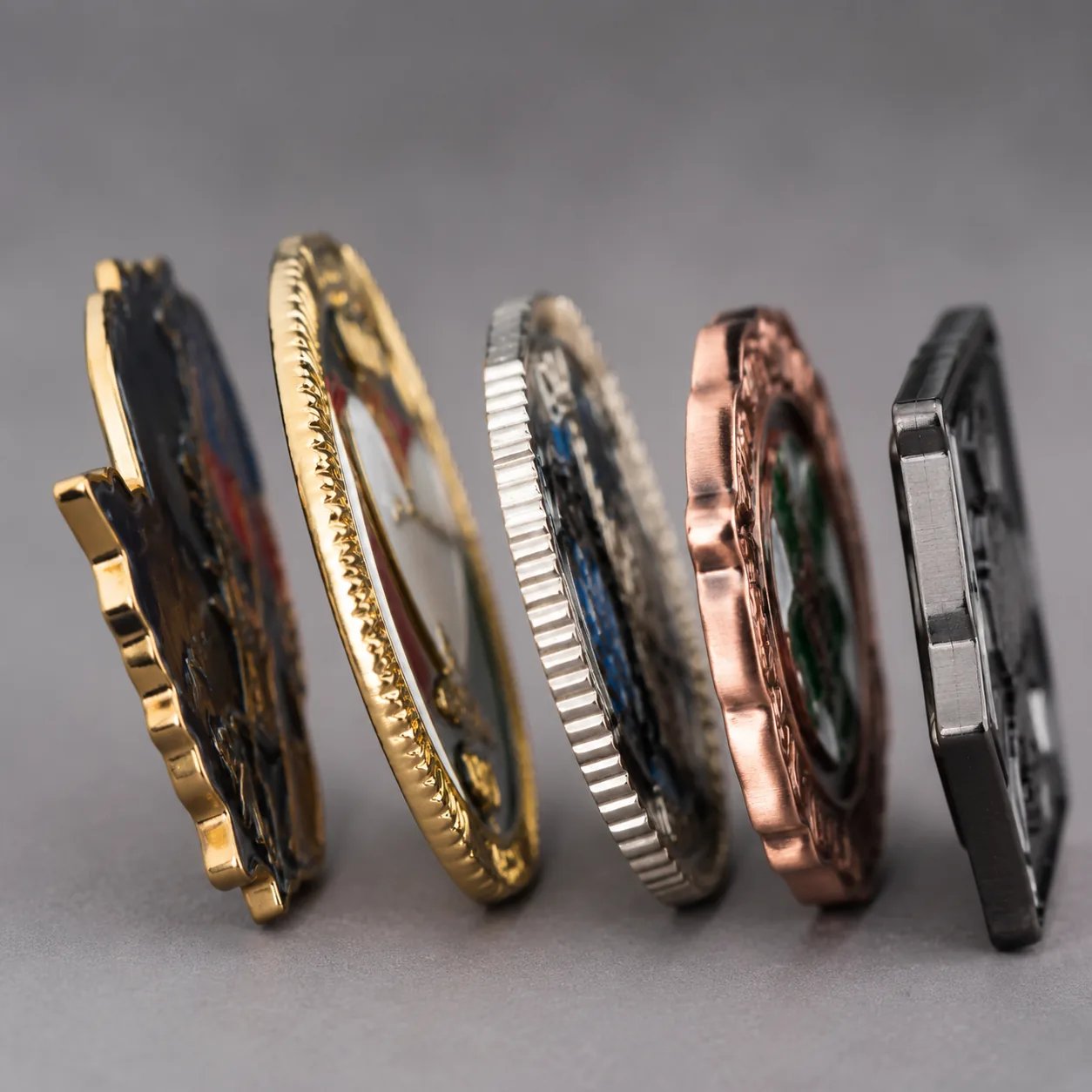
For enamel pins, the standard edge is a flat vertical wall with light deburring and full perimeter plating. For challenge coins, common options include a raised rim, flat polished edge, reeded edge, rope edge, diamond-cut bevel, or antique recessed rim. For keychains and zipper pulls, a rounded or chamfered hand-contact edge is usually safer than a square wall, especially when the item is 2.5 mm or thicker.
| Edge style | Typical use | Measurable spec | Production trade-off |
|---|---|---|---|
| Flat deburred edge | Pins, badges, low-cost keychains | Burr height ≤0.05 mm premium, ≤0.10 mm standard; vertical wall maintained | Lowest cost, but can feel plain on thick products |
| Soft rounded edge | Keychains, zipper pulls, bag charms | Outside radius 0.3 to 0.8 mm depending on thickness | Comfortable in hand, but may soften sharp silhouettes |
| Straight bevel | Coins, medallions, premium badges | Bevel width 0.5 to 1.5 mm at 30° to 45°; width tolerance ±0.15 mm | Refined look, but reduces flat artwork area |
| Reeded edge | Challenge coins, commemorative coins | Groove pitch 0.8 to 1.2 mm; depth 0.15 to 0.35 mm | Good grip, but plating must cover groove bottoms |
| Rope edge | Coins, award medallions | Raised twisted rim 1.0 to 2.5 mm wide; minimum coin thickness 3.0 mm recommended | Premium appearance, but not suitable for tiny rim text |
| Painted or enamel edge | Novelty keychains, thick cast badges | Coating 15 to 30 microns; color tolerance Delta E ≤3 for controlled colors | Distinctive, but less abrasion-resistant than plated metal |
If the edge is part of the product value, name it in the RFQ and show it in a side-view drawing. If it is only a safety requirement, define the burr height, minimum radius, and plating coverage instead of adding a decorative edge that may increase cost without improving the design.
Match Edge Finish to the Manufacturing Method
Stamped iron, brass, stainless steel, and die-cast zinc alloy do not produce the same edge. A stamped enamel pin made from 0.8 to 1.2 mm iron sheet has a sheared perimeter after blanking. It needs deburring and pre-polishing before plating. Brass pins and coins can hold finer die-struck detail and polish cleaner, but the material cost is higher. Zinc alloy keychains, usually 2.0 to 4.0 mm thick, can include rounded edges directly in the mold, but parting lines, gates, and ejector marks still require removal.
Process order matters. For hard enamel pins, heavy edge polishing after color baking and stone grinding can affect the flatness of enamel fills or expose raised metal lines. For soft enamel pins, aggressive buffing can reduce thin metal borders and make color cavities look uneven. A safer sequence is stamping, trimming, deburring, pre-polishing, plating, enamel filling, curing, and final inspection. After color, handling should be light and controlled.
For die-cast zinc alloy keychains, the mold should include a radius or chamfer wherever the user touches the item. Relying only on post-cast polishing is risky on internal cutouts because polishing wheels cannot reach every corner evenly. Gate marks should be placed away from visible or hand-contact edges where possible. If the gate must sit on an edge, the approval drawing should call out “gate mark fully removed, no flat scar over 1.5 mm visible at 30 cm.”
For coins, edge pattern and thickness should be designed together. A 2.0 to 2.5 mm coin can carry a flat or shallow reeded edge. A 3.0 to 4.0 mm coin is more suitable for rope, diamond-cut, or deeper reeding. A 1.8 mm coin with a detailed rope edge will usually look shallow, fragile, or crowded. If the buyer wants a heavy premium coin, specify diameter, finished thickness, rim width, edge pattern, and target weight range together.
Set Measurable Limits for Sharpness
“No sharp edges” is not an inspection standard. A better requirement gives the factory measurable limits and tells QC what to reject. For most hand-contact metal promotional products, specify burr height under 0.05 mm for premium orders and under 0.10 mm for standard orders. No continuous burr should run longer than 3 mm. The edge should not catch a dry cotton cloth during a firm wipe test across the front edge, back edge, internal cutouts, and attachment area.
Minimum radius should reflect how the product is used. A lapel pin can usually use a 0.2 to 0.3 mm outside radius because it is viewed more than handled. A keychain or zipper pull should use at least 0.5 mm on primary hand-contact edges. Child-facing novelty shapes should avoid needle-like tips and should use an external tip radius of at least 0.8 mm where the design allows. For bottle opener keychains, the opener slot needs a functional edge, but surrounding hand-contact edges should still be rounded.
- State maximum burr height: ≤0.05 mm for premium hand-contact items, ≤0.10 mm for standard promotional pieces.
- Define minimum outside radius: 0.2 mm for pins, 0.5 mm for keychains, 0.8 mm or more for child-facing shapes.
- Require a cotton cloth snag test on front edge, back edge, cutouts, jump rings, and attachment points.
- Reject die-break spikes, hook-like inner corners, unpolished casting gates, and raised parting lines over 0.10 mm.
- Ask for side photos at 45° and 90° during sample approval because top-view photos hide burrs.
- For complex silhouettes, approve one raw tool trial before plating so edge risks are visible early.
These limits are realistic in normal production, but they affect cost. A simple 30 mm enamel pin may need only tumble deburring and light buffing. A 60 mm keychain with ten internal cutouts may require hand polishing in every corner. That can add about 0.03 to 0.12 USD per piece at 1,000 pieces, and more if the geometry is narrow or deep. If the budget is tight, simplify the outline before asking the supplier to polish impossible corners.
Specify Plating Coverage on the Edge
Plating failures often start at edges. Sharp corners increase current density, polishing compound can remain in grooves, and thin plating wears fastest where the item rubs against keys, bags, or backing cards. Decorative nickel, gold, rose gold, black nickel, antique brass, and antique silver finishes commonly use 3 to 8 microns total plating depending on the finish stack. For higher-wear keychains and coins, 6 to 10 microns is a better target when budget allows.
The edge should have the same visual acceptance criteria as the front face unless the design intentionally uses antique contrast. Common edge defects include cloudy plating, exposed base metal on corners, copper strike showing through after buffing, dark shadows in reeded grooves, and black nickel pooling in recesses. These are not reliably visible in a flat product photo, so side-view inspection must be part of sample approval and final QC.
| Product type | Practical plating spec | Edge inspection focus | Typical USD FOB range |
|---|---|---|---|
| Soft enamel pin, 25 to 35 mm | 3 to 6 microns decorative plating; epoxy optional | No exposed base metal on outline; burr ≤0.10 mm standard | 0.28 to 0.75 USD at 500 to 3,000 pcs |
| Hard enamel pin, 25 to 35 mm | 4 to 8 microns; polish controlled after grinding | No polish-through on raised border; edge shine consistent | 0.45 to 1.10 USD at 500 to 3,000 pcs |
| Zinc alloy keychain, 45 to 70 mm | 5 to 10 microns for daily handling; clear coat optional | No visible gate scar; radius ≥0.5 mm on hand-contact edges | 0.65 to 1.80 USD at 500 to 5,000 pcs |
| Challenge coin, 40 to 50 mm | 5 to 10 microns plus antique wash if specified | Grooves covered; rim color matches approved sample | 1.20 to 3.80 USD at 300 to 3,000 pcs |
| Metal fridge magnet, 40 to 70 mm | 3 to 6 microns unless humidity exposure is expected | No sharp edge near magnet, backing board, or printed insert | 0.55 to 1.60 USD at 500 to 3,000 pcs |
For humid, outdoor, or high-touch use, decorative plating alone may not be enough. Consider stainless steel, thicker nickel underplating, electrophoretic clear coating, epoxy protection, or a design that avoids bright plating on sharp external corners. Mirror gold on a deeply reeded keychain edge may look attractive in the sample box, but it is less forgiving after months of abrasion on a keyring.
Balance Thickness, Weight, and Edge Comfort
Increasing thickness can make a product feel more valuable, but it also makes edge comfort more important. A 1.0 mm pin can feel acceptable with a flat deburred wall. A 3.0 mm keychain with the same square wall may feel unfinished. A 4.0 mm coin with a sharp rim may look heavy in photos but feel harsh when rolled between fingers.
For enamel pins, 0.8 to 1.2 mm base metal is common for 20 to 35 mm designs. Larger brooches and badges above 45 mm often use 1.2 to 1.5 mm to reduce bending, but fabric weight and attachment strength must be checked. For zinc alloy keychains, 2.0 to 3.0 mm is a practical range for durability and comfort. Above 4.0 mm, freight cost, pocket comfort, and casting shrinkage control become more important. For challenge coins, 3.0 mm is a common premium baseline; 3.5 to 4.0 mm is used when a heavier hand feel or more detailed edge is required.
Tolerance should be written on the approval drawing. A reasonable finished thickness tolerance is ±0.10 mm for stamped pins and ±0.15 mm for die-cast zinc alloy keychains. Coin thickness can usually be held within ±0.10 to ±0.20 mm depending on diameter and edge pattern. Bevel width tolerance should be about ±0.15 mm for normal decorative work. Reeded groove pitch variation should stay within ±0.10 mm if the edge pattern is visually important.
Weight targets are also useful for premium items. A 45 mm zinc alloy keychain at 3.0 mm thickness may weigh about 25 to 40 g depending on cutouts. A 50 mm challenge coin at 3.0 mm brass may weigh about 45 to 60 g, while a thicker zinc alloy coin may feel bulkier but not necessarily more premium. If the product will be mailed, packed in sets, or attached to clothing, define a target weight range before approving thickness.
Use AQL Rules for Edge Acceptance
Edge defects are easy to miss when inspection focuses only on front artwork. For production QC, use AQL sampling with separate classification for safety, function, and appearance. A practical plan is AQL 2.5 for major defects and AQL 4.0 for minor cosmetic defects, with any hazardous sharp point classified as critical and not allowed. For premium retail or child-facing items, buyers may tighten major defects to AQL 1.5 and require 100% screening for sharp points.
Define examples before production starts. Major edge defects include exposed base metal longer than 2 mm, burrs that cut or snag fabric, missing plating inside a reeded groove, a gate scar visible from normal handling distance, or an edge mismatch that changes the approved silhouette. Minor defects include slight polishing waves under 3 mm, faint darkening in deep internal corners, or tiny plating dots not visible at 50 cm under normal lighting.
For sample approval, ask for at least five pieces when the edge is complex. One perfect hand-finished sample does not prove mass-production consistency. Review one piece under side lighting, one under touch inspection, and one packed in the intended OPP bag, card, velvet pouch, or clamshell. Packaging can reveal abrasion risks that the loose sample does not show.
Lead time should reflect edge complexity. Simple enamel pins and flat-edge keychains commonly need 5 to 8 days for sampling and 12 to 18 days for mass production after approval. Challenge coins with rope, diamond-cut, or deep reeded edges often need 7 to 10 days for sampling and 15 to 25 days for production. Add 2 to 4 days for stricter AQL inspection, electrophoretic coating, or complex gift-box packing.
Choose Simple Edges When Cost or Schedule Is Tight
A decorative edge is not always worth the cost. For event pins under 30 mm, a rope edge or heavy bevel can steal space from the logo and raise the unit price without improving recognition. For fine outside lettering, a flat border is usually safer than a patterned edge that competes with the text or reduces legibility after plating.
Reeded, rope, and diamond-cut edges are also poor choices for urgent delivery. They increase tool review time and can add 1 to 3 production days because polishing and plating checks take longer. If the order must ship within 18 calendar days from artwork approval, use a flat deburred edge, light bevel, or simple rounded edge unless the decorative edge is central to the product value.
Painted edges should be specified carefully. They work well for bold novelty keychains, color-blocked magnets, and thick cast badges, but they scratch faster than plated metal during key contact. If the product will live on a keyring for months, a rounded plated edge with 6 to 10 microns total plating is usually more durable than a painted edge, even if the painted sample looks more distinctive.
MOQ also affects edge decisions. For simple pins, small runs of 100 to 300 pieces can be practical for sampling, influencer drops, or internal campaigns. For keychains and coins with custom edge tooling, 300 to 500 pieces is a more efficient starting point because setup and polishing fixture time are spread across more units. Standard production pricing is usually most stable from 500 to 5,000 pieces, with better unit cost above 1,000 pieces when the edge requires hand finishing.
RFQ Wording That Prevents Edge Disputes
The fastest way to prevent edge problems is to write the edge requirement into the RFQ and approval drawing. A practical pin specification is: “Finished edge to be flat deburred, burr height ≤0.05 mm, outside corner radius ≥0.2 mm, full plating coverage on perimeter, no exposed base metal, side-view sample photo required.” For a keychain, replace the radius with ≥0.5 mm on all hand-contact edges and add “gate marks fully removed.” For a coin, specify rim width, edge pattern, groove pitch, bevel width, and finished thickness.
Send the supplier front artwork, back artwork, finished size, finished thickness, base metal, plating finish, edge style, intended use, packaging method, and target inspection level together. Packaging matters because sharp or high-relief edges can rub against backing cards, neighboring pieces, or OPP bags during transit. For mixed sets, state whether all items should have the same edge feel or whether each shape can be optimized separately.
- For pins: specify flat deburred or lightly rounded edge, burr limit, plating coverage, and side-view sample photos.
- For keychains: specify hand-contact radius, gate-mark removal, attachment-hole finish, and stronger plating for daily wear.
- For coins: specify rim width, edge pattern, groove pitch, bevel width, thickness tolerance, and target weight range.
- For magnets: specify no sharp metal near the magnet, printed card, or backing board.
- For urgent orders: choose flat deburred, light bevel, or rounded edges instead of rope, deep reeding, or painted edges.
- For premium orders: approve at least five samples and inspect side views, touch feel, packaging abrasion, and plating coverage.
If you are unsure which edge is realistic, ask the factory to mark the proposed edge directly on the technical drawing before tooling. ZheCraft can provide edge recommendations during quotation for enamel pins, brooches, keychains, fridge magnets, bottle opener keychains, and challenge coins. Typical MOQ tiers are 100 to 300 pieces for sampling or small campaigns, 500 to 1,000 pieces for standard promotional production, and 3,000 to 5,000 pieces for better FOB pricing. For most custom metal items, plan 5 to 10 days for sampling and 12 to 25 days for mass production after sample approval, with extra time for complex edge patterns, thicker plating, or tighter AQL inspection.
Have a project? Send your artwork and target quantity and we’ll reply with a detailed quotation within 12 working hours.
Ready to get this made?
Send your sketch, target quantity and ship-date. Detailed quotation in 12 hours.



