Edge Finish Specs for Custom Pins, Coins and Keychains
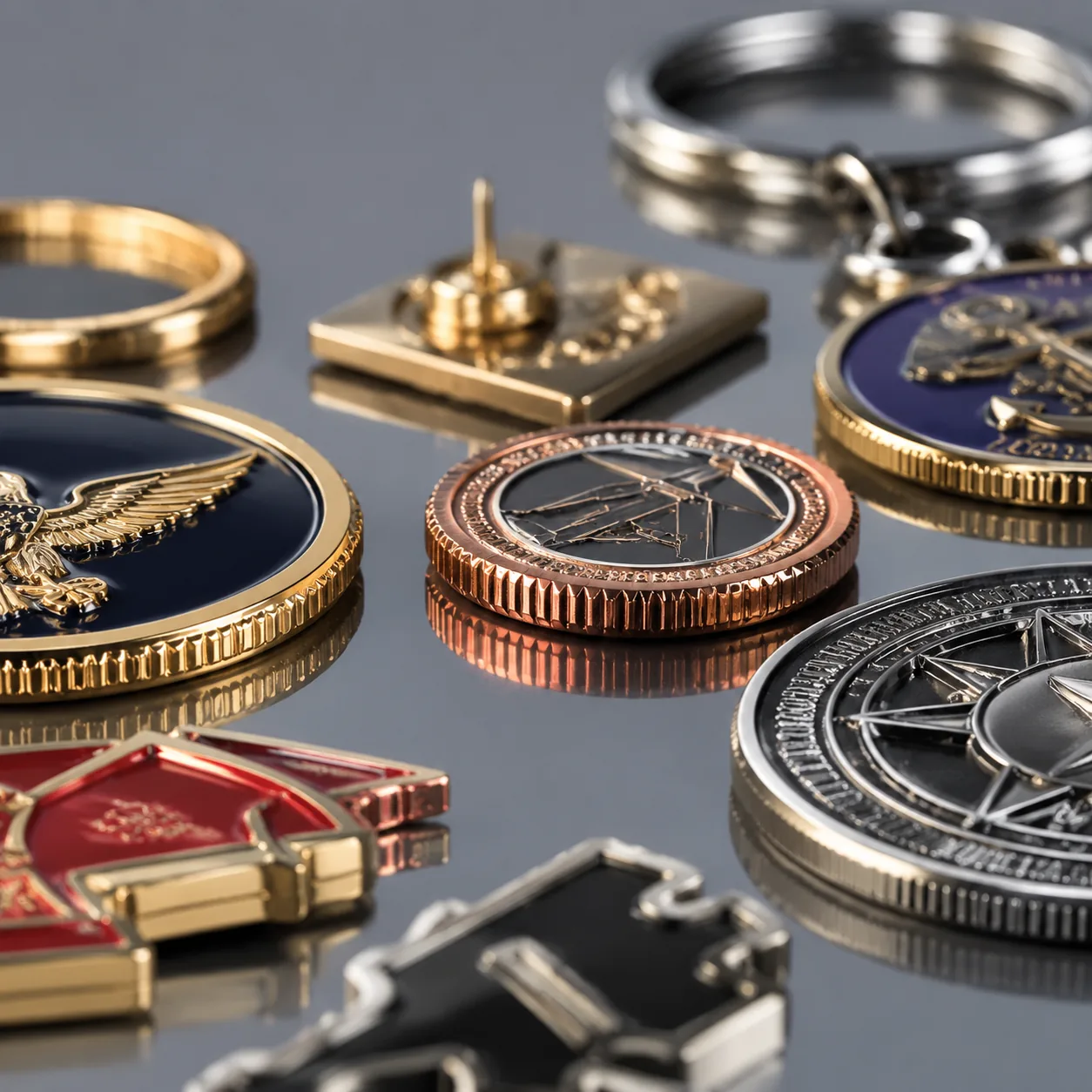
Why Approved Artwork Still Fails at the Edge
Most artwork approvals show the front face, enamel colors, logo detail and plating finish. They rarely define the outside edge, pierced cutouts, split-ring hole, coin rim or back perimeter. Those unmarked areas often create the first complaint: a pin scratches its backing card, a keychain cuts through an OPP bag, or a challenge coin feels unfinished because a rim burr sits under the plating.
Edge finish is a functional quality requirement, not only a cosmetic preference. A sharp 90 degree metal edge concentrates plating stress, traps polishing compound, wears through topcoat faster and can damage fabric, paperboard or plastic packaging during transit. For corporate gifts, uniform accessories, museum retail, sports merchandise and event giveaways, the buyer should define edge condition before tooling starts.
The practical specification is not complicated. The drawing should state the required radius or chamfer where geometry allows, the maximum burr height, the deburring method, the plating expectation at corners and the inspection method. If these points are left until final inspection, the factory may have only two poor options: over-polish the part and soften the logo, or ship a product that passes visually but feels sharp in use.
Where Edge Defects Start in Production
Stamped iron and brass pins usually create the sharpest edges at the blanking perimeter and pierced holes. The die shears the sheet and leaves a rollover zone on one side and a fractured zone on the other. With correct die clearance, burrs on 1.2 to 1.8 mm iron are usually controllable below 0.03 to 0.05 mm after tumbling. With worn tooling or excessive clearance, the fractured edge becomes jagged and remains visible after nickel or gold plating.
Zinc alloy die-cast keychains and 3D badges have different risks. The parting line, gate trim, ejector-pin marks and drilled or cast ring holes can leave raised seams or small tear marks. Antique brass can hide some visual texture, but bright nickel, black nickel and mirror gold reveal waves, drag marks and gate repairs. For keychains, the ring hole is a high-wear zone because the split ring rotates against the plating during use.
Etched stainless steel, brass charms and thin nameplates can feel knife-like because the starting sheet is often only 0.3 to 0.8 mm thick. Chemical etching gives accurate profiles, but it does not naturally create a soft edge. If the item will be worn, handled or packed loose in bags, specify perimeter deburring rather than accepting an as-etched edge.
| Process | Typical thickness | Common edge risk | Practical edge spec |
|---|---|---|---|
| Stamped iron soft enamel pin | 1.2 to 1.8 mm | Reverse-side blanking burr | Burr below 0.05 mm; soft tumble before plating |
| Stamped brass badge | 1.0 to 2.0 mm | Sharp pierced holes and cutouts | Inside edge radius 0.10 to 0.20 mm where tool allows |
| Zinc alloy keychain | 2.5 to 4.5 mm | Parting line, gate scar, rough ring hole | Parting line polished flush within +0.05 mm; ring hole deburred |
| Die-struck brass challenge coin | 3.0 to 5.0 mm | Rim burr, reed tip sharpness | Rim chamfer 0.20 to 0.30 mm or burr below 0.03 mm |
| Etched stainless charm | 0.3 to 0.8 mm | Thin, cutting outside profile | Full perimeter deburr; no cotton-glove snag |
Define Radius, Chamfer and Burr Limits Before Tooling
The safest way to prevent sharpness is to define an edge radius or chamfer on the production drawing. For most enamel pins and small badges, a 0.10 to 0.20 mm soft radius is enough to remove cutting feel without visibly changing the outline. For thicker zinc alloy keychains and 3.0 to 5.0 mm coins, 0.20 to 0.40 mm is more realistic because the user handles the side wall as much as the front face.
Do not over-specify the edge on fine artwork. A 0.30 mm radius on a 0.50 mm raised line can erase detail during polishing. For narrow letters, star points, skyline outlines and openwork bridges, use a performance requirement instead: no loose burr, no cutting feel, no fiber snag, and no raised burr above 0.05 mm unless approved on the pre-production sample.
A chamfer is often better than a full roundover when the product needs a crisp premium look. A challenge coin with a 0.25 mm by 45 degree chamfer on both faces can look cleaner than a heavily rounded coin. On enamel pins, however, too much chamfer can reduce metal wall height and make enamel fills appear shallow near the perimeter.
| Product area | Recommended edge condition | When to avoid it | Inspection note |
|---|---|---|---|
| Outside pin outline | 0.10 to 0.20 mm soft radius | Very thin etched items below 0.8 mm | Touch check and 10x loupe |
| Keychain outer edge | 0.20 to 0.40 mm radius or chamfer | Brand shapes requiring sharp angular geometry | No OPP bag cutting after packing trial |
| Coin rim face edge | 0.20 to 0.30 mm chamfer | Text or reeding too close to rim | Check with caliper or radius gauge |
| Internal cutouts | Deburred; no loose burr above 0.05 mm | Slots below 1.0 mm width | Cotton swab snag test |
| Split-ring hole | Rounded entry edge; no plating flake | Thin sheet below 1.0 mm | Fit ring and rotate 20 cycles |
Choose the Deburring Method by Geometry and Finish
Vibratory tumbling is the standard low-cost method for small metal giveaways. Parts run with ceramic or plastic media, water and compound until high burrs are knocked down. Typical cycle time is 20 to 60 minutes for simple stamped pins and flat keychains. It is efficient, but it can dull raised text, thin lines and sharp logo corners if the design has fragile detail.
Hand polishing gives more control on premium pieces, thick die-cast keychains, 3D coins and parts with visible gates. Workers can target the perimeter, parting line and ring hole without flattening the artwork face. The trade-off is labor cost and consistency. At 1,000 pieces, hand edge polishing may add about USD 0.03 to 0.08 per simple pin and USD 0.08 to 0.20 per complex cast keychain, FOB China, depending on perimeter length and number of holes.
Barrel polishing is economical for simple stamped blanks but risky for enamel pins with posts, thin protruding points or openwork. Magnetic polishing can reach small internal holes and thin stainless parts, but it is less effective on heavy die-cast pieces. The plating finish also changes the decision: bright nickel, black nickel and mirror gold need cleaner metal preparation than antique brass or matte black because reflective finishes magnify waves and scratches.
- Use vibratory tumbling for simple stamped pins, coins and flat keychains with starting burrs below 0.10 mm.
- Use hand polishing for thick cast parts, visible gates, premium coins and sharp brand silhouettes.
- Avoid heavy tumbling on star points, small letters, openwork bridges below 1.2 mm and raised lines below 0.3 mm.
- Request one raw metal sample when the design has many cutouts; it shows edge risk before plating hides defects.
- Confirm that main deburring happens before plating; post-plating cleanup should be limited and controlled.
- Ask the factory to flag artwork areas where edge softening may change logo accuracy before mold cutting.
Plating Thickness and Edge Coverage
Plating does not fix a burr. It makes the burr brighter, harder and more likely to flake when the item rubs against a split ring, backing card or fabric. If raised metal remains on iron, brass or zinc alloy, copper and nickel build over the defect. The top finish then cracks at the high point during handling or packing.
A common decorative stack for pins and keychains is copper strike, 5 to 10 microns of nickel, then a thin top finish such as gold, black nickel, imitation rhodium or color electrophoresis. Premium coins or outdoor-use keychains may require thicker nickel or a clear protective coating, but buyers should not rely on plating thickness alone. Edge preparation before plating is still the main control.
Edges and corners are difficult areas for uniform plating coverage. A sharp corner can receive high current density on the point while adjacent valleys remain thinner. For products used on keys, bags or uniforms, specify both smoothness and coverage: no exposed base metal at the perimeter, no black spots after neutral salt spray if corrosion testing is required, and no flaking after the ring rotation or tape test agreed in the inspection plan.
| Finish | Edge sensitivity | Suggested buyer note | Typical cost impact |
|---|---|---|---|
| Bright gold or nickel | High | No visible burrs, pits or polishing waves on perimeter | Low to medium; mainly polishing time |
| Black nickel | Very high | No raised burrs; defects show as bright scratches | Medium when hand polishing is needed |
| Antique brass or antique nickel | Medium | Edges smooth by touch; antique wipe consistent | Low |
| Matte black paint or e-coating | Medium | Deburr before coating; no chipped corners | Low to medium |
| Epoxy dome on pin face | Low on face, high at perimeter | Epoxy must not overflow onto sharp outside edge | Low if artwork allows clearance |
RFQ Wording That Factories Can Quote
A useful RFQ does not say only smooth edge. Smooth is subjective, and the factory cannot estimate labor accurately. Define the critical zones: outside perimeter, internal cutouts, split-ring hole, brooch pin area, coin rim and any point that contacts packaging, apparel or the user’s hand.
For standard promotional pins, a practical mass-production requirement is: no burr visible at 10x magnification, no burr felt by fingertip, and no raised metal burr above 0.05 mm on the back edge. For premium retail, uniform or collector products, tighten the visual requirement and add a cotton-glove or cotton-swab snag test. For low-cost event giveaways, minor polishing marks on the reverse may be acceptable if the front edge is safe and the backing card is not damaged.
Also specify tolerances that support the edge requirement. A 30 mm pin with an outside size tolerance of +/-0.20 mm cannot keep a perfectly sharp geometric outline after tumbling. A reeded coin should state whether reed tips must remain crisp or softened; aggressive polishing can reduce reed depth by 0.05 to 0.15 mm.
- State construction clearly: for example, 1.5 mm iron soft enamel pin, 3.0 mm zinc alloy keychain or 4.0 mm brass coin.
- Mark critical edge zones on the drawing: perimeter, cutouts, ring hole, rim, pin back and attachment points.
- Set a measurable burr limit: no loose burrs, no sharp feel and raised burr below 0.05 mm unless approved.
- Define inspection method: fingertip check, cotton swab snag test, 10x loupe or caliper check for chamfer size.
- Provide packaging details because an edge that is safe in a tray may still puncture an OPP bag in transit.
- Ask whether polishing may soften fine artwork so the trade-off is approved before tooling starts.
Inspection Plan: Sample, Inline and Final AQL
Edge quality should be checked at three stages. First, inspect a raw metal or unfilled sample before plating when the design has openwork, deep relief, reeded edges or a functional ring hole. Second, approve a pre-production sample after final plating, enamel, epoxy and assembly. Third, include edge criteria in final inspection so the shipment does not pass only because the front artwork looks correct.
For final inspection, a common approach is General Inspection Level II with AQL 1.5 for major defects and AQL 4.0 for minor defects on standard promotional orders. A cutting edge, loose metal burr, plating flake at the edge, broken attachment, cracked ring hole or exposed base metal on a visible perimeter should be major. Slight polishing haze on a non-visible reverse side may be minor if it does not affect safety, plating adhesion or packaging.
Functional tests should be simple enough for a production inspector to repeat. Run a cotton swab around the outside edge and internal cutouts; fibers should not catch. Rotate the split ring through the keychain hole 20 cycles; plating should not flake and no burr should scrape the ring. For pins, press the product against its backing card and slide it 30 mm under normal hand pressure; it should not cut the card or scrape printed ink.
| Check point | Tool or method | Accept | Reject |
|---|---|---|---|
| Outside perimeter | Fingertip and 10x loupe | Smooth touch; no raised burr | Sharp feel, lifted metal or cutting point |
| Internal cutout | Cotton swab snag test | No fiber snag or loose burr | Fiber catches or metal sliver visible |
| Split-ring hole | Ring rotation 20 cycles | No flake and no scraping burr | Plating chip, rough scraping or exposed base metal |
| Coin rim | Visual, touch and caliper check | Uniform chamfer or reed depth | Uneven seam, sharp reed or rim burr |
| Packed sample | Shake test in final bag or card | No bag puncture, card scratch or debris | Punctured OPP, scratched card or loose metal |
MOQ, FOB Price and Lead-Time Impact
Edge finishing rarely changes MOQ by itself, but it can change the best production route. For enamel pins, brooches and small badges, sampling or small runs often start at 100 pieces, while 300 to 500 pieces is usually more efficient for mass production. Zinc alloy keychains and custom coins can also start around 100 pieces, but 300 pieces and above normally gives steadier unit pricing because tooling, polishing setup and plating rack loading are spread across more units.
FOB pricing depends on size, metal, finish, color count, attachment and packaging, but edge requirements can be estimated. As a practical China factory range, a 30 mm soft enamel iron pin at 500 pieces may be USD 0.45 to 0.95 FOB. Adding hand cleanup to a complex outline may add USD 0.03 to 0.08 per piece. A 50 mm zinc alloy keychain at 500 pieces may be USD 1.10 to 2.40 FOB, with premium gate, perimeter and ring-hole polishing adding USD 0.08 to 0.20 per piece.
Lead-time impact is usually modest when the requirement is known before production. Extra tumbling or standard polishing may add 0 to 2 days. Hand finishing on complex cast parts can add 2 to 4 days. If tooling must be remade because cutouts are too narrow, text is too close to the rim or the drawing did not allow enough radius, the delay can be 5 to 10 days. Edge specifications belong in the RFQ and proof stage, not in the final complaint.
| Order type | Typical MOQ | Normal lead time | Edge-spec impact |
|---|---|---|---|
| Simple enamel pin | 100 to 300 pcs | 12 to 18 days after artwork approval | Add 0 to 2 days if standard tumble is enough |
| Complex openwork badge | 300 to 500 pcs | 15 to 22 days | Add 1 to 3 days for sample review and hand cleanup |
| Zinc alloy keychain | 300 to 500 pcs | 18 to 25 days | Add 2 to 4 days for gate and ring-hole polishing |
| Challenge coin | 100 to 300 pcs | 18 to 28 days | Add 1 to 3 days for rim inspection and polishing |
| Etched thin charm | 500 pcs | 12 to 20 days | Add 1 to 2 days for full perimeter deburr |
For standard promotional orders, a compact requirement is enough: no sharp edges, no loose burrs, burr height below 0.05 mm, no cotton-swab snag and no OPP bag puncture after packing trial. For premium retail, uniform or collector products, add a defined radius or chamfer, 10x loupe inspection, split-ring rotation test and AQL defect classification. If the design has openwork below 1.2 mm, fine points or bright plating, ask the factory to comment on edge risk before mold cutting.
Have a project? Send your artwork and target quantity and we’ll reply with a detailed quotation within 12 working hours.
Ready to get this made?
Send your sketch, target quantity and ship-date. Detailed quotation in 12 hours.



