Edge Finish Specs for Custom Pins, Coins and Keychains
Why Edge Finish Fails After Artwork Approval
Sharp edges are one of the most common quality complaints on custom pins, coins and keychains because they are rarely visible in flat artwork. A bulk order can match the approved Pantone colors, plating tone and logo shape but still feel unsafe if the rim catches fabric, scratches a phone case or cuts a backing card during packing. For products handled repeatedly at trade shows, retail counters, school events or membership programs, edge condition is a functional specification, not a cosmetic preference.
Factories normally include deburring in production, but the result depends on material, thickness, die wear, casting quality, polishing time and plating build-up. A 1.2 mm stamped iron soft enamel pin may need only light tumbling. A 4.0 mm zinc alloy keychain with cutouts, a bottle-opener slot and a direct split-ring hole may need trimming, hand filing and separate hole polishing before plating. If the purchase order only says “smooth edge,” one supplier may interpret that as no visible flash, while another may hold burr height below 0.05 mm on every user-contact edge.
A practical RFQ should define four items before sampling: which edges users touch, the required edge radius or bevel, the maximum burr height and the inspection method. The approved sample should then become the retained edge standard as well as the color and plating standard. This prevents the common dispute where the buyer sees a safety defect and the factory sees normal metalwork variation.
Specify The Edge Profile Before Tooling
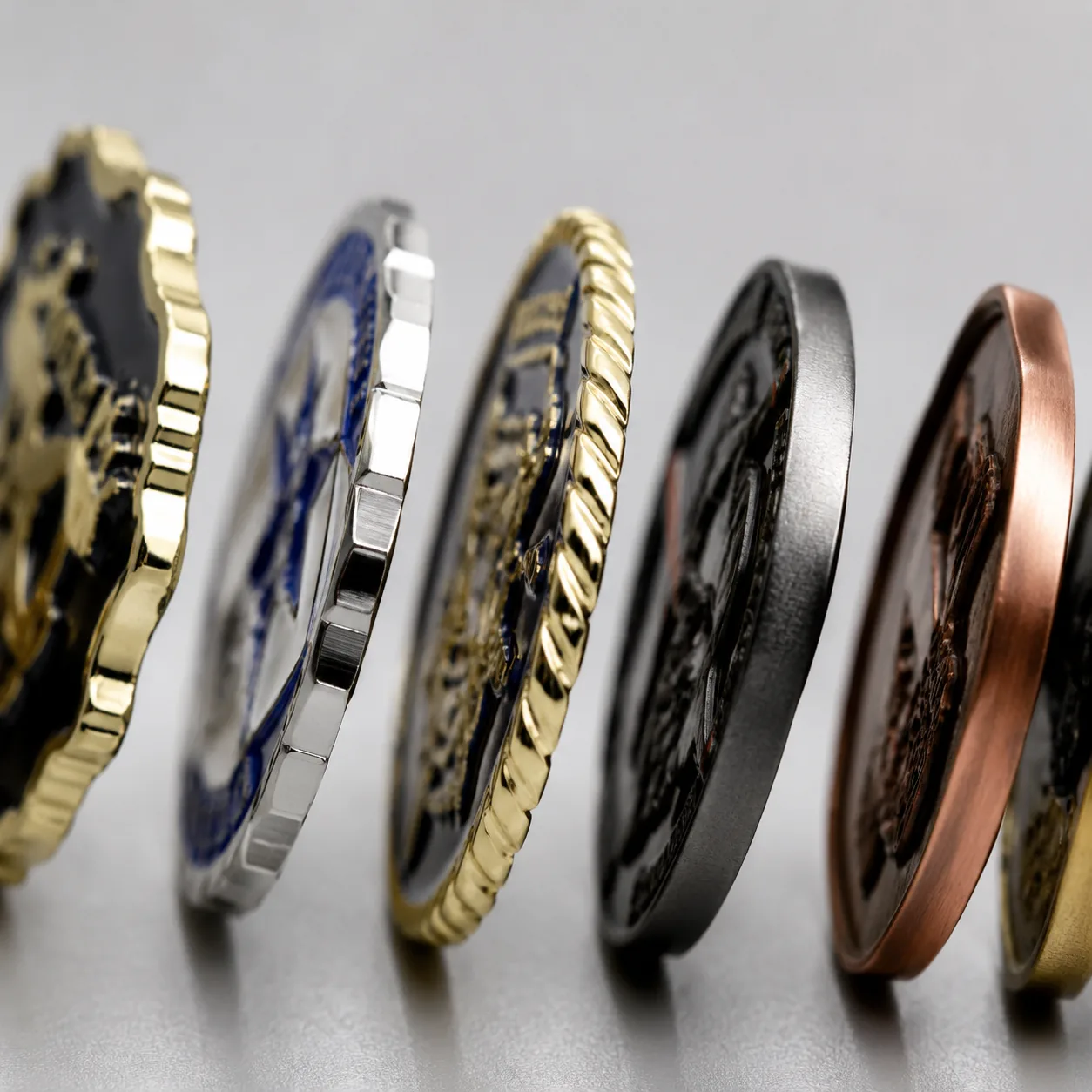
The best edge is not always the roundest edge. Soft enamel pins need raised metal walls to hold enamel, so over-rounding the face edge can narrow color cells and make small text look weak. Hard enamel pins are polished flush after enamel curing, so the outer perimeter must be softened without rounding away the plated outline. Challenge coins are handled between fingers, so a controlled bevel, reeded edge, rope edge or rounded comfort rim can improve perceived weight and finish quality. Keychains need additional control at the hole because that area rubs against hardware and keys.
For die-struck brass or iron pins, typical thickness is 1.2 to 1.8 mm, with an outer edge radius of 0.10 to 0.20 mm after polishing. For hard enamel pins, 1.5 to 2.0 mm thickness is common, and an edge radius of 0.15 to 0.25 mm gives a better hand feel without flattening the design. For zinc alloy keychains, 2.5 to 4.0 mm is common; a 0.20 to 0.35 mm rounded edge is more realistic because cast parts are thicker and often have parting lines. For challenge coins, 3.0 to 4.5 mm thickness is typical, with diameter tolerance usually held to plus or minus 0.20 mm for standard coins and plus or minus 0.10 mm for tighter retail-grade work.
| Product Type | Recommended Edge Spec | Risk If Underspecified |
|---|---|---|
| Soft enamel pin, 1.2-1.6 mm thick | Light deburr; outer edge radius 0.10-0.20 mm; burr height under 0.05 mm | Heavy rounding can weaken enamel cells under 0.35 mm wide |
| Hard enamel pin, 1.5-2.0 mm thick | Flush-polished face; softened perimeter 0.15-0.25 mm; no raised plating burr | Aggressive tumbling can scratch mirror gold, nickel or black nickel |
| Zinc alloy keychain, 2.5-4.0 mm thick | Rounded outer edge 0.20-0.35 mm; hole deburred both sides; burr under 0.05 mm | Square cast edges can scratch phones, bags and car interiors |
| Challenge coin, 3.0-4.5 mm thick | Flat, bevel, rope, reeded or rounded edge defined before mold cutting; profile tolerance plus or minus 0.15 mm | Late edge changes require new tooling or hand rework |
| Brooch or badge, 1.5-2.5 mm thick | Smooth back perimeter; no burrs near hinge, catch or solder point; radius 0.15-0.25 mm | Back burrs can snag garments even when the front looks acceptable |
Set Burr Limits In Measurable Terms
A burr is a raised metal lip left by stamping, casting, trimming, drilling or polishing. On handled promotional metal products, the normal working limit should be maximum 0.05 mm burr height on user-contact edges and maximum 0.10 mm on hidden non-contact areas. Burrs above 0.10 mm can usually be felt with a fingernail and may scratch backing cards, polybags, lanyards, clothing or skin. For premium retail pins, coins or children’s accessories, specify 0.03 mm maximum on handled edges and budget for more sorting.
Stamped brass and iron parts tend to show burrs around the outside outline, tight inside corners and thin logo protrusions. Zinc alloy castings tend to show flash along mold parting lines and inside holes. Drilled or punched keychain holes need front and back inspection because the entry side can look clean while the exit side has a sharp raised lip.
Use direct language in the PO: “All user-contact edges must be free of sharp burrs. Maximum burr height 0.05 mm, checked under 5x magnification and confirmed by cloth snag and fingernail wipe tests.” Avoid vague terms such as “nice edge,” “high quality finish” or “no rough feeling” unless they are supported by a sample and measurable acceptance criteria.
- Mark user-contact edges on the artwork: outer outline, keyring hole, coin rim, brooch back edge, magnet perimeter and bottle-opener slot.
- Set burr limits: 0.05 mm maximum for handled edges and 0.10 mm maximum for hidden non-contact edges.
- Require both front and back checks on holes, cutouts, hinge areas, catches and split-ring attachment points.
- Add a practical packing test: no edge may scratch a white 250 gsm backing card under light hand pressure.
- Retain one approved sample as the golden standard for edge feel, not only for color, enamel and plating tone.
Match Deburring To Material And Geometry
Material choice drives the finishing route. Q195 or SPCC iron is cost-effective for stamped enamel pins and magnets, but worn dies or short polishing cycles can leave sharper back edges. H65 brass gives cleaner die-struck detail and polishes well for premium pins and coins, though it costs more than iron. Zamak 3 zinc alloy is suitable for 3D keychains, thick badges and complex shapes, but the mold parting line and holes usually need more hand work. 304 stainless steel is durable and corrosion-resistant, but laser-cut stainless edges require mechanical rounding if the product will be handled frequently.
Tumbling is efficient for simple outlines and large batches. It usually adds 1 to 2 production days for pins and small coins, depending on load size and media. It can, however, soften raised lines below 0.20 mm or dull mirror-polished plating if the process is too aggressive. Hand filing and bench polishing are slower but necessary for deep cutouts, spinner parts, bottle openers, thick zinc alloy pieces and jewelry-style brooches where tumbling media cannot reach the internal edge.
The geometry matters as much as the metal. Avoid inside corners sharper than R0.30 mm unless the factory confirms tooling access. Keep raised metal lines at least 0.20 mm wide for plated detail and enamel walls at least 0.30 to 0.35 mm wide for stable color fill. A design that looks precise on screen may need a 0.15 to 0.25 mm artwork adjustment to survive stamping, polishing and plating without creating sharp fragile points.
| Material | Typical Use | Edge-Finish Notes | Indicative FOB Range |
|---|---|---|---|
| Q195 or SPCC iron | Budget soft enamel pins, badges, magnets | Good for stamping; inspect back edge and outline burrs | USD 0.35-0.95 at 300-1,000 pcs for standard 25-35 mm pins |
| H65 brass | Premium pins, coins, badges | Clean die-struck detail; polishes well for gold, nickel and antique finishes | Usually 15-35% higher than comparable iron parts |
| Zamak 3 zinc alloy | 3D keychains, thick badges, shaped coins | Control parting lines, hole edges and cut-through slots | USD 0.80-2.40 at 300-1,000 pcs for common keychains |
| 304 stainless steel | Industrial tags, durable keychains | Laser edges need secondary rounding; slower to polish | USD 1.20-3.50 depending on thickness, size and finish |
Control Plating Build-Up And Edge Wear
Plating does not hide a poor edge. In many cases it makes the defect more obvious. Current density is higher on corners, raised rims and protruding points, so nickel, gold-tone, black nickel and copper layers can build faster on edges than in recessed areas. A 0.06 mm base-metal burr may become more tactile after plating because the coating follows the raised lip and can form a bright nodule.
For most custom pins, coins and keychains, total plating thickness is commonly 3 to 8 microns. A typical stack may include 2 to 5 microns of nickel underplate plus a decorative layer of gold tone, silver tone, black nickel, copper or antique finish. Premium challenge coins or retail keychains may specify 8 to 12 microns total plating for better wear resistance, but thicker plating is not a substitute for deburring. The base edge should pass the burr requirement before plating starts.
Finish selection also affects inspection. Black nickel shows scratches and edge rub more quickly than bright nickel or imitation gold. Antique brass, antique copper and antique silver can visually hide small edge variation, but darkening solution may collect unevenly around burrs and rough cutouts. If the item will be carried on keys, specify both plating thickness and edge smoothness: for example, “total plating 5-8 microns; no tactile nodules on rim, hole or raised outline; cloth snag test required after plating.”
Engineer Holes, Cutouts And Attachment Areas
Most sharp-edge failures occur where polishing access is poor: internal cutouts, keyring holes, bottle-opener slots, spinner gaps, chain slots and narrow negative spaces inside logos. A 2.0 mm cutout may look clean in vector art, but after casting, trimming, polishing, enamel filling and plating, the remaining metal bridge may be too thin or the inside wall may stay sharp. For stamped iron or brass, internal cutouts should generally be at least 1.5 mm wide. For zinc alloy casting, use at least 2.0 mm and preferably 2.5 mm where the part is thicker than 3.0 mm.
For keychains, a 3.0 mm hole is the practical minimum for small jump rings. Direct split-ring assembly usually needs 4.0 to 5.0 mm hole diameter, depending on ring wire thickness. Leave at least 1.2 mm of metal around the hole for light parts under 15 g and at least 1.8 mm for zinc alloy pieces above 25 g. If the hole is too close to the edge, polishing can distort the shape and plating wear will appear early around the thinnest area.
Attachment hardware should be reviewed as part of edge quality. Jump rings commonly use 0.8 to 1.2 mm wire for light keychains, while heavier items may need 1.4 mm wire or a stronger split ring. The ring should rotate without scraping a sharp hole edge. For brooches and badges, the pin hinge and catch area must be free of solder spikes, plating nodules and back-edge burrs because these points contact fabric first.
- Use at least 1.5 mm internal cutout width for stamped iron or brass parts.
- Use at least 2.0 mm internal cutout width for zinc alloy casting, and 2.5 mm for thick 3D shapes where possible.
- Specify keychain holes at 3.0 mm minimum, or 4.0-5.0 mm for direct split-ring assembly.
- Leave 1.2 mm metal around holes for light pieces and 1.8 mm or more for heavy zinc alloy pieces.
- Avoid inside corners below R0.30 mm unless the supplier confirms tooling, polishing and plating access.
Use AQL Inspection For Edge Defects
Edge inspection should be built into the quality plan instead of handled as a subjective complaint after delivery. For promotional metal goods, a common inspection basis is ANSI/ASQ Z1.4 or ISO 2859-1, general inspection level II, with AQL 2.5 for major defects and AQL 4.0 for minor defects. Sharp burrs on user-contact edges should be classified as major defects because they can damage users, clothing, cards or packaging. A minor polishing mark on a hidden back edge may be minor if it does not affect use.
For a 1,000 piece lot inspected at general level II, the standard sample size is 80 pieces. Under AQL 2.5, the usual acceptance number is 5 and rejection number is 6 for major defects. If the order is for retail, children’s merchandise or high-touch loyalty gifts, tighten sharp-edge defects to AQL 1.5 or require 100% sorting of holes and outer rims. That requirement should be agreed before mass production because it adds labor and lead time.
A practical inspection sequence is simple. Run a clean cotton cloth over the perimeter, hole, rim and back attachment area; snagging indicates a burr or plating nodule. Slide the product across a white 250 gsm card under light pressure; visible scratching indicates an edge that is too sharp for packing or use. Inspect holes, cutouts and raised outlines under 5x magnification and measure questionable burrs with a burr gauge, optical comparator or calibrated microscope where available.
| Defect | Classification | Acceptance Guidance |
|---|---|---|
| Outer edge scratches card or skin | Major | Use AQL 2.5 or tighter; sort or reject if above limit |
| Burr over 0.05 mm on keyring hole | Major | Rework before shipment or reject affected pieces |
| Plating nodule on rim, hole or raised outline | Major if tactile; minor if visual only | Define during golden sample approval |
| Uneven bevel width over plus or minus 0.20 mm | Minor or major depending on product | Major for retail coins; minor for low-cost event giveaways |
| Light polishing mark on hidden back edge | Minor | Use AQL 4.0 if not visible in normal handling |
Budget MOQ, Price And Lead-Time Trade-Offs
Better edge finishing adds cost because it consumes abrasive media, polishing wheels, labor, inspection time and rework capacity. For simple stamped pins, standard deburring is usually included in the base unit price. A tighter edge requirement, such as 0.03 to 0.05 mm burr control with documented inspection, may add USD 0.03 to 0.08 per piece at 300 to 1,000 pieces. For zinc alloy keychains with multiple holes, bottle-opener slots or deep cutouts, extra hand finishing can add USD 0.08 to 0.25 per piece depending on geometry.
Lead time changes as well. A standard enamel pin order normally runs 12 to 18 production days after sample approval. Pins with tighter edge sorting or premium mirror plating may need 15 to 22 days. Zinc alloy keychains with heavy hand polishing usually require 18 to 25 days. Challenge coins with custom edge patterns, antique plating, enamel fill and retained golden samples commonly need 20 to 30 days after artwork and sample approval. Air shipment time is additional and usually 3 to 7 days depending on destination and service level.
MOQ affects consistency and pricing. At 100 pieces, the factory can rely more on manual correction, but the unit price is higher. At 300 pieces, controlled edge finishing becomes practical for corporate orders. At 1,000 pieces and above, stable tooling, repeatable polishing cycles and AQL inspection data matter more than individual hand correction. Typical MOQ tiers are 100 pieces for prototypes or VIP gifts, 300 pieces for standard pins and keychains, and 1,000 pieces for stable FOB pricing and repeat orders.
A complete RFQ line should read like a production instruction: “1.5 mm stamped iron soft enamel pin, polished raised metal, outer edge radius 0.10-0.20 mm, burr height under 0.05 mm on all handled edges, nickel or gold-tone plating 3-8 microns, no tactile plating nodules, AQL general level II with 2.5 major and 4.0 minor.” For keychains, add hole diameter, metal thickness around the hole, ring size and two-sided hole inspection. For challenge coins, define the edge style before tooling: flat, bevel, rope, reeded or rounded comfort edge.
Have a project? Send your artwork and target quantity and we’ll reply with a detailed quotation within 12 working hours.
Ready to get this made?
Send your sketch, target quantity and ship-date. Detailed quotation in 12 hours.



