Edge Finish Specs for Custom Metal Pins, Coins and Keychains
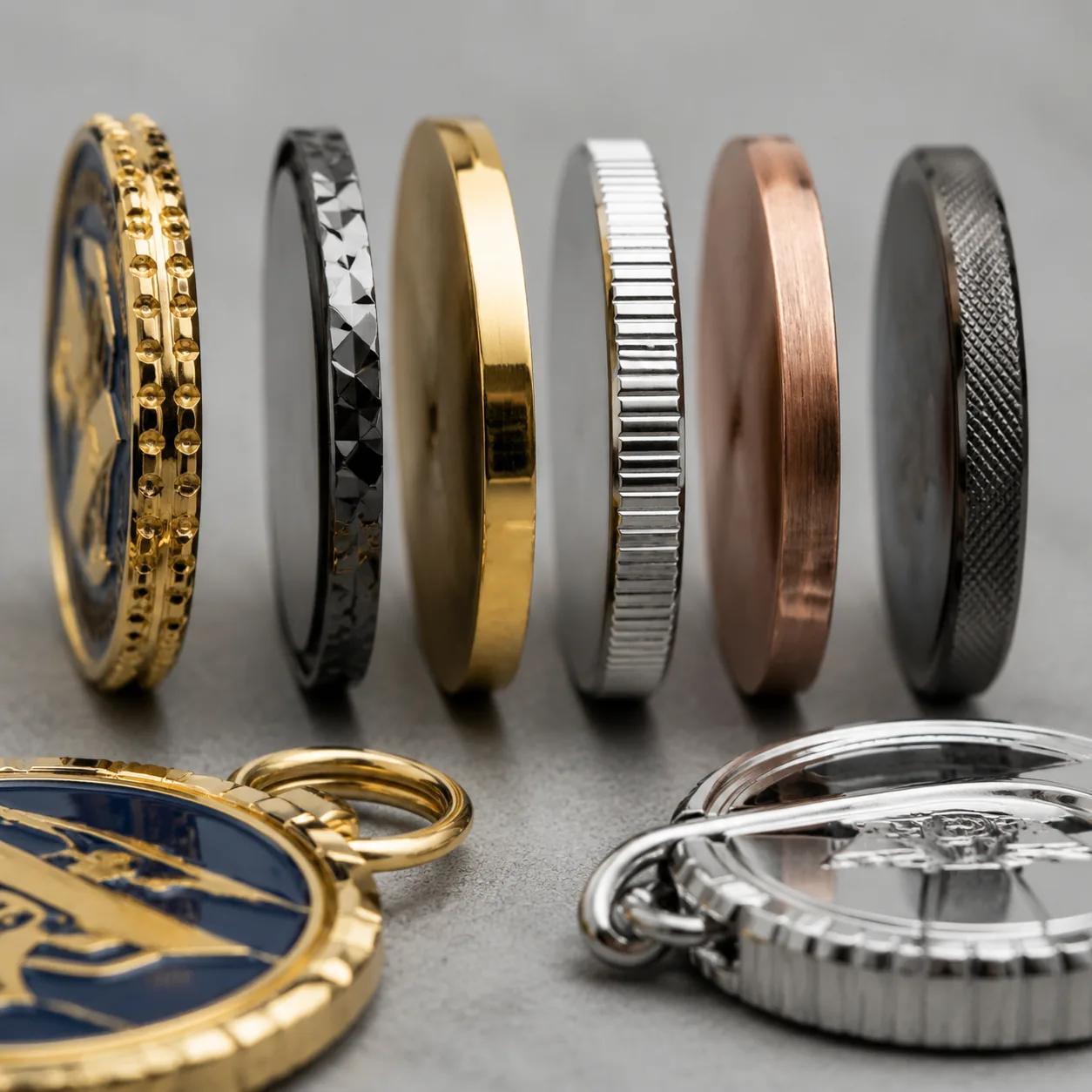
Why Edge Finish Causes Rejections After the Front Looks Approved
Custom metal pins, challenge coins and keychains often pass logo detail, enamel color, plating shade and packing checks, then fail receiving inspection because the perimeter feels sharp. The issue is most common on hand-contact products: zinc-alloy keychains, 40-50 mm coins, brooches, bottle openers, trolley tokens and large badges. A purchase order that says “smooth edge” is not enough. It does not tell the factory whether a 0.05 mm burr is acceptable, whether the rim should be rounded, or whether polishing may soften a sharp logo silhouette.
Edge finish affects safety, perceived value and durability. A raised burr can cut a 0.03 mm OPP bag, scratch neighboring pieces in bulk cartons, snag a scarf or uniform, or become the first point where nickel, black nickel or antique plating chips after a drop. The end client may not know the term “burr height,” but they will feel the defect immediately.
For B2B programs, edge finishing should be specified as a measurable inspection item, not treated as a hidden factory polishing step. A useful RFQ defines four points: maximum burr height, target edge radius, deburring or polishing method, and AQL defect classification. Those details make quotations comparable and prevent one supplier from pricing basic tumbling while another includes hand finishing and extra QC.
Where Burrs and Sharp Edges Form
Stamped iron, brass and stainless steel parts create burrs on the punch-exit side. For 1.2-2.0 mm stamped pins or badges, unfinished burrs commonly measure 0.03-0.12 mm. Worn dies, hard stainless, narrow internal corners and small cutouts can push burrs above 0.15 mm. The first warning sign is usually a ragged edge on concave curves, where polishing media cannot reach evenly.
Die-cast zinc alloy creates a different edge risk. Parting lines, gate trimming points and vent marks can leave seams of 0.05-0.20 mm before finishing. The problem is more visible on 3D keychains and coins because draft angles and metal-flow paths are not shown in flat artwork. If the gate is placed on a hand-contact edge, the operator must trim and polish that area without flattening the design.
Etched brass and stainless steel items can look clean from the front but feel sharp because chemical etching forms near-vertical walls. Thin name badges, bookmarks, tags and ruler-style giveaways in 0.3-0.8 mm sheet need light edge softening. Aggressive polishing on these parts can bend the sheet, round corners unevenly or reduce the perceived precision of the outline.
Coin rims and decorative edges need special attention. Reeded, rope, diamond-cut and oblique-line edges add value, but they also create many small ridges. If the ridge tops are too sharp, coins scratch each other in transit and feel harsh in the hand. Antique finishing makes this worse because darkening compound gathers around burrs and highlights uneven metal.
Numbers to Put in the RFQ
The two most useful edge numbers are burr height and edge radius. Burr height is unwanted raised metal left after stamping, trimming, casting or etching. Edge radius is the intentional rounding of the outside corner. Both are small dimensions, but they drive tooling choice, polishing time, reject rate and final hand-feel.
For standard promotional enamel pins and badges, a commercial target is maximum burr height of 0.05 mm after finishing, with no continuous sharp burr longer than 3 mm. For premium brooches, daily-use keychains and hand-held coins, specify burr height at 0.03 mm maximum on exposed edges and a touch-safe radius of 0.10-0.25 mm. For bottle opener slots or internal cutouts, require “no cutting feel” and state whether the inside edge may show a slight polished flat.
Dimensional tolerance must leave room for edge work. If a 30.00 mm pin is specified at ±0.05 mm finished width, the polishing team has almost no material allowance. For most 20-40 mm die-struck or die-cast promotional metal goods, ±0.15 mm is realistic. For parts above 60 mm, openwork shapes or heavy 3D casting, ±0.25 mm is more practical. Tighten only the dimensions that truly matter, such as a trolley-token diameter or bottle-opener slot.
| Product type | Recommended burr limit | Target edge radius | Practical finished tolerance | Typical FOB range |
|---|---|---|---|---|
| Soft or hard enamel pin, 20-35 mm | ≤0.05 mm; no sharp continuous burr >3 mm | 0.05-0.15 mm | ±0.15 mm | USD 0.45-1.20 at 500-1,000 pcs |
| Brooch or badge, 35-60 mm | ≤0.03-0.05 mm on exposed edges | 0.10-0.25 mm | ±0.20 mm | USD 0.90-2.80 at 500 pcs |
| Challenge coin, 38-50 mm, 3 mm thick | ≤0.03 mm on rim and edge pattern | 0.15-0.30 mm on rim corners | ±0.15 mm diameter | USD 1.30-3.50 at 500-1,000 pcs |
| Zinc-alloy keychain, 40-70 mm | ≤0.05 mm after tumble or hand polish | 0.15-0.30 mm on hand-contact edges | ±0.25 mm | USD 0.80-2.20 at 1,000 pcs |
| Etched stainless tag, 0.5-0.8 mm thick | ≤0.03 mm; no cutting feel | 0.05-0.12 mm | ±0.10 mm | USD 0.60-1.80 at 1,000 pcs |
Choose the Deburring Method by Geometry, Not Habit
Barrel or vibratory tumbling is the normal high-volume method for cast zinc keychains, simple badges and coins. Parts run with ceramic, plastic or stainless media, water and compound, usually for 30-90 minutes before plating. It is cost-efficient and consistent, but it can soften raised lettering, fine borders and logo corners. For text strokes below 0.6 mm, ask the supplier to confirm that tumbling will not reduce legibility.
Hand wheel polishing is used when only certain edges are critical: brooch points, bottle opener mouths, mascot cutouts, corners near magnets or the back edge of a pin that touches fabric. It gives better control but adds labor variation. At 1,000 pieces, hand polishing usually adds USD 0.03-0.12 per piece depending on size, number of cutouts and access. At 5,000 pieces and above, use marked critical-edge drawings so the factory does not waste labor polishing low-risk areas.
Magnetic polishing is useful for small iron or stainless components and internal corners, especially when standard media cannot reach. Manual deburring with a knife, file or abrasive stick may be needed for openwork or deep slots, but it must be controlled; overwork leaves visible flats and inconsistent shine after plating. If the same burr appears on every sample, tooling or mold correction is usually better than adding labor to every production piece.
| Method | Best use | Added cost at 1,000 pcs | Lead-time effect | Main risk |
|---|---|---|---|---|
| Barrel or vibratory tumbling | Cast keychains, coins, simple badges | USD 0.01-0.04/pc | Usually none if planned | Softened fine detail |
| Hand wheel polishing | Brooches, premium pins, functional slots | USD 0.03-0.12/pc | +1-3 days | Operator variation |
| Magnetic polishing | Small stainless or iron parts | USD 0.02-0.06/pc | +1-2 days | Thin parts can deform |
| Manual knife, file or abrasive stick | Openwork, bottle openers, deep cutouts | USD 0.02-0.10/pc | +1-3 days | Visible flats if overdone |
| Die or mold correction | Repeat burrs from tooling | Case by case | +2-5 days | Sampling delay |
Plating Does Not Hide a Bad Edge
Decorative plating is measured in microns, while many burrs are measured in hundredths of a millimeter. A common stack for promotional metal goods may include copper at 5-8 microns, nickel at 3-5 microns and gold flash at 0.03-0.10 microns. Even a heavier 8-15 micron total decorative build will not cover a 0.10 mm burr. It can make the burr brighter, harder and easier to feel.
Edges also receive higher current density in electroplating than recessed areas. This can build a slightly thicker and more brittle layer on sharp corners. During packing, a corner impact concentrates stress at that thin line, causing nickel, black nickel, dyed black or antique finishes to chip. On enamel pins, the result is often a silver or dark exposed line on the outer contour after bagging or shipment.
For standard indoor promotional products, 3-5 microns of nickel underplate is common. For daily-use keychains, coins or products expected to rub against keys, specify 5-8 microns nickel underplate and confirm salt-spray expectations if corrosion resistance matters. A 24-hour neutral salt-spray target may be enough for basic giveaways; 48-72 hours is more appropriate for premium keychains or humid-market retail programs. Heavy plating should improve durability, not compensate for poor deburring.
When Crisp Is Better Than Fully Rounded
Not every product should be heavily rounded. A die-struck coin with a high rim, a geometric logo badge, a bottle opener keychain or a reeded-edge challenge coin may lose definition if the factory polishes every corner aggressively. The right wording is often: “remove burrs and cutting feel; preserve visible edge definition.” This allows a crisp appearance while still controlling safety and handling comfort.
For enamel pins, excessive polishing before plating can reduce the height and width of metal dams that separate color fields. If a raised line is designed at 0.25 mm width and polishing removes too much, enamel can bleed, plating can look weak, or small text can lose contrast. For pins under 20 mm, heavy tumbling may also round the outer silhouette enough that the approved artwork no longer matches the delivered part.
Functional products need separate edge criteria. A bottle opener mouth must remain sharp enough to engage a cap but not sharp enough to cut a finger; the critical area is usually the inside working edge, not the entire outline. A trolley token must hold diameter tolerance so it works in carts; over-polishing the circumference can cause fit problems. Mixed-material sets also need separate standards: a PVC keychain may allow flash up to 0.2 mm, while a metal keychain in the same kit should use burr and radius limits.
Inspection Language That Prevents Subjective Disputes
Turn “too sharp” into a defined inspection method. Use normal daylight or D65 light at 30-40 cm for visual review, then a tactile check using a bare finger or clean cotton glove. The edge should not cut skin, scratch a glove, snag woven fabric, or tear a 0.03 mm OPP bag during normal handling. For high-risk products such as children’s badges, brooches or pocket keychains, add a cotton-snag test on the back and outside contour.
For shipment inspection, ISO 2859-1 general inspection level II is common. A practical AQL setup is critical defects 0, major defects 1.0 or 1.5, and minor defects 2.5 or 4.0 depending on brand sensitivity. Classify loose metal shards, cutting burrs, sharp brooch points, exposed base metal on hand-contact edges and plating chips as major or critical according to end use. A faint edge polishing mark that is not visible from the front and does not affect touch can usually be minor.
Edge checks should happen at pre-production sample approval, not only at final inspection. Once plating, enamel or epoxy are complete, reworking a sharp edge can damage the finish and increase scrap. For premium programs, keep a signed golden sample at both the polishing station and QC table so operators compare hand-feel, rim softness and edge definition, not only caliper dimensions.
- State maximum burr height in millimeters instead of writing only “smooth edge”.
- Mark hand-contact edges, cutouts, brooch tips and functional slots on the drawing.
- Define each edge as crisp, lightly softened or rounded; do not apply one rule everywhere.
- Set finished outline tolerance wide enough for deburring, typically ±0.15 mm to ±0.25 mm.
- Classify cutting burrs, loose shards and plating chips as major or critical defects in AQL.
- Approve a physical golden sample for edge feel before mass production starts.
- Use individual poly bags, paper interleaving or trays for heavy coins and sharp-edged keychains.
MOQ, Lead Time and Quotation Impact
Basic deburring is normally included in custom metal promotional quotations. Cost changes when the buyer requires tighter burr limits, selective hand polishing, special coin edging, extra plating thickness or additional inspection. For a standard 25-35 mm enamel pin, typical MOQ is 100-300 pieces, but stable unit pricing usually starts at 500 pieces. At 500-1,000 pieces, FOB China pricing commonly falls around USD 0.45-1.20 per piece, with premium edge inspection adding about USD 0.02-0.06 per piece.
For zinc-alloy keychains, many factories accept 300-500 pieces, while 1,000 pieces gives better hardware and plating efficiency. FOB pricing at 1,000 pieces often ranges from USD 0.80-2.20 depending on size, thickness, plating, attachment and packing. Internal cutouts, bottle opener slots and thick 3D relief can add USD 0.03-0.12 per piece for extra deburring. Challenge coins in 40-50 mm diameter and 3.0 mm thickness usually range from USD 1.30-3.50 FOB at 500-1,000 pieces; rope, reeded or diamond-cut edges may add tooling cost and 1-3 days of inspection time.
Lead time should be stated in calendar days after artwork approval. A normal metal pin, coin or keychain program needs about 7-10 days for tooling and pre-production sampling, then 12-18 days for mass production after sample approval. Edge-specific golden sample approval, mold correction or extensive hand polishing can add 2-5 days. For urgent event orders, simplify the outer contour, avoid deep cutouts, choose standard plating and keep the edge spec realistic instead of forcing a luxury finish into an unworkable schedule.
Before sending the next RFQ, define the use case: decorative display, pocket carry, garment wear, child-facing retail, bottle-opening function or premium gift. Then ask the supplier to quote the production method, deburring process, target burr height, edge radius, plating thickness, AQL level and packing method. If those answers are numeric, the factory can control the edge. If they remain vague, expect variation when production scales.
Have a project? Send your artwork and target quantity and we’ll reply with a detailed quotation within 12 working hours.
Ready to get this made?
Send your sketch, target quantity and ship-date. Detailed quotation in 12 hours.



