Edge Finish Specs for Custom Coins, Pins and Keychains
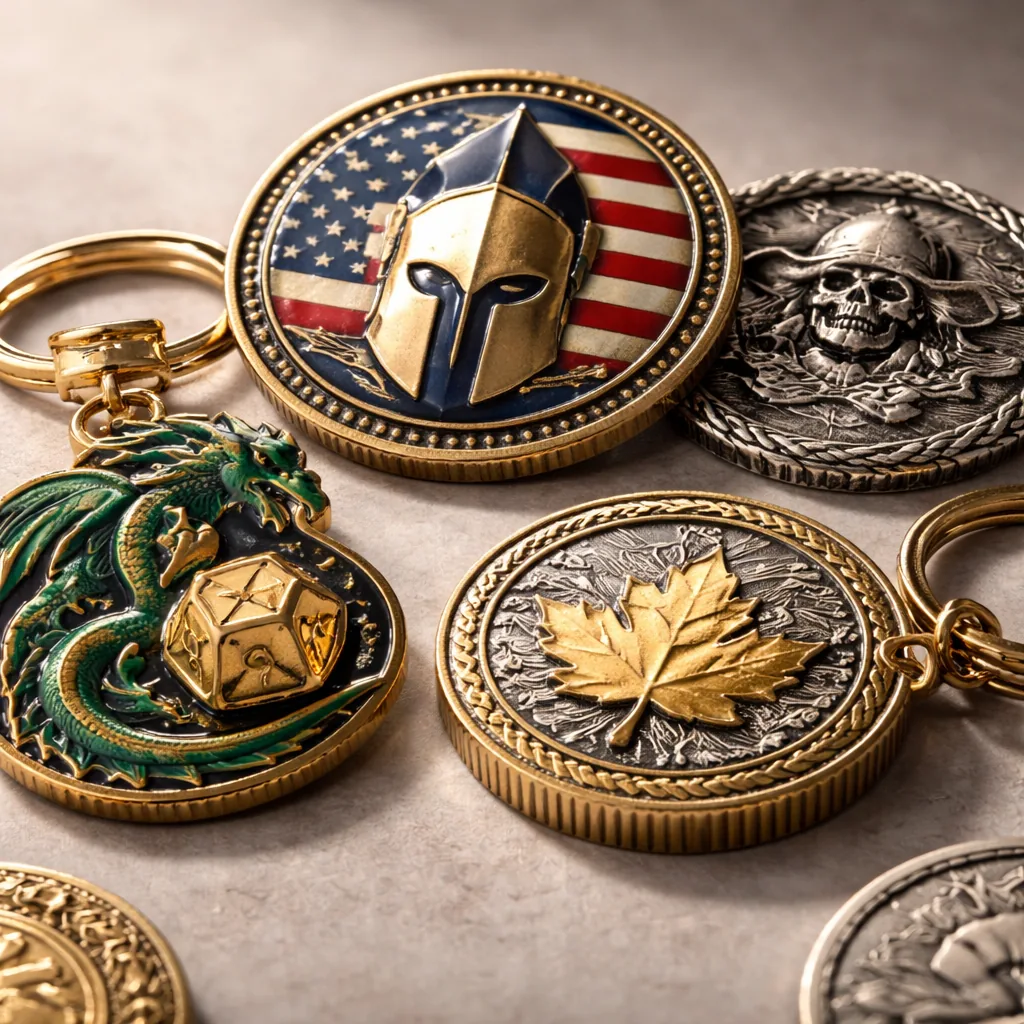
Start with the user-contact requirement
Edge complaints usually trace back to an unclear specification, not a bad factory. A coin feels light because the bevel consumed too much visual mass. A keychain scratches a phone because the split-ring hole was polished but the outer edge was left sharp. A pin snags knitwear because the perimeter radius was never defined. Terms such as polished edge, premium edge or same as sample are not enough for production; the supplier still has to infer bevel width, radius, texture depth, plating coverage and burr limits.
Define the edge by use first. A 45 mm challenge coin displayed in a case can use a crisper decorative edge than a 55 mm bottle-opener keychain carried with cards and a phone. A brooch worn on wool should have a soft R0.4-R0.8 mm perimeter, while a commemorative coin may use 0.6-0.9 mm reeding to increase perceived value. For school, airline, luggage and child-facing items, specify no sharp user-contact edges and confirm by fingertip test on the approved sample.
Freeze edge requirements before 3D relief, enamel separation and logo placement. The edge consumes real metal width. On a 25 mm pin, a 0.4 mm bevel removes about 0.8 mm from usable diameter. On a 50 mm coin, a 1.5 mm rope edge can reduce the main artwork field to about 47 mm before any raised rim or text ring. If edge style is decided after artwork approval, the redesign usually affects text size, enamel walls or the position of attachment hardware.
Match edge style to base metal process
Stamped brass, zinc alloy die casting and photo-etched iron do not behave the same at the edge. Stamped brass gives dense, clean edges and reliable plating on flat, low-bevel and reeded coins. It is the better route for premium challenge coins where weight, crisp lettering and consistent rim geometry matter. Zinc alloy casting allows thicker 3D borders, sculpted rope edges and bottle-opener shapes, but cast edges need controlled tumbling and polishing because soft zinc corners can round unevenly. Photo-etched iron is economical for thin pins, but it cannot deliver deep tactile reeding on 0.8-1.2 mm stock.
For genuine tactile detail, use enough thickness. Coins should be at least 2.5 mm finished thickness for reeding and 3.0-4.0 mm for strong rope or diamond-cut effects. Keychains need 2.0-3.5 mm depending on size and hole design. Pins can use a soft radius or small bevel at 1.2-1.8 mm, but deep edge texture on pins below 25 mm normally looks weak after plating and polishing.
| Product and use | Recommended edge | Finished thickness | Minimum practical size | FOB impact at 500 pcs |
|---|---|---|---|---|
| Presentation challenge coin | Reeded, rope or 0.8-1.2 mm bevel | 3.0-4.0 mm | 38 mm diameter | +USD 0.08-0.35/pc |
| Corporate lapel pin | Soft R0.3-R0.5 mm radius or low bevel | 1.2-1.8 mm | 20 mm width | +USD 0.02-0.08/pc |
| Metal keychain | Rounded bevel, polished radius, deburred hole | 2.0-3.5 mm | 35 mm length | +USD 0.04-0.18/pc |
| Fridge magnet badge | Flat polished or shallow 0.5 mm bevel | 1.5-2.5 mm | 30 mm width | +USD 0.03-0.12/pc |
| Brooch or wearable badge | Large soft R0.5-R0.8 mm radius | 1.5-2.5 mm | 30 mm width | +USD 0.04-0.15/pc |
Reserve enough edge and artwork space
Decorative edge detail is not free artwork space. A rope edge on a 50 mm coin normally needs 1.2-2.0 mm radial width on each side. A reeded edge affects the side wall more than the front face, but it still needs a raised rim or border strong enough to protect the artwork during polishing. A bevel usually needs 0.5-1.2 mm, while a plain polished edge preserves the largest face area.
Before approving artwork, calculate the usable field. A 45 mm coin with a 1.5 mm rope edge leaves about 42 mm for the central design if the rope is visible from the front. Add a 0.8 mm raised rim and the usable area falls to about 40.4 mm. That can make 1.0 mm microtext, QR codes, portraits and multi-color enamel crowded. For QR codes on metal, keep the printed or enamel code at least 12 x 12 mm, avoid placing it inside a heavy bevel shadow, and request a scannability check from a physical sample.
State which dimension is critical: total outside diameter, usable artwork field, edge width or attachment-hole location. Typical outside tolerance after plating and polishing is +/-0.15 mm for stamped or die-cast promotional metal items, with +/-0.10 mm possible on simple round coins under stable polishing control. Bevel width is less exact because polishing removes metal unevenly; a realistic tolerance is +/-0.10 mm for simple bevels and +/-0.20 mm for sculpted rope or irregular shapes.
Specify measurable edge geometry
A strong RFQ uses measurable values, not style names only. For a bevel, specify width and approximate angle: 0.8 mm at 35-45 degrees is a common coin or keychain target. For a rounded edge, specify radius: R0.3-R0.5 mm for small pins and R0.5-R0.8 mm for keychains or wearable brooches. For a flat polished edge, specify maximum burr condition and whether the side wall must be mirror-polished or only smoothly deburred.
For reeded edges, define pitch and depth. A common 3.5 mm thick coin uses 0.6-0.9 mm pitch and 0.15-0.30 mm depth. Finer pitch can disappear under copper, nickel and final plating; overly coarse pitch can feel rough in the hand. For rope edges, specify front-visible width, side depth and direction if the twist must match an existing sample. On irregular keychains, also define the ring-hole edge: hole diameter tolerance is commonly +/-0.10 mm, and the hole should be free of burrs on both faces.
| Spec item | Practical range | Risk if vague | Inspection method |
|---|---|---|---|
| Outside dimension tolerance | +/-0.15 mm typical; +/-0.10 mm on simple coins | Finished goods may not fit capsules, boxes or trays | Digital caliper, 10-32 pcs per lot |
| Bevel width | 0.5-1.2 mm | Small bevel disappears or large bevel reduces artwork | Caliper check against golden sample |
| Rounded radius | R0.3-R0.8 mm | Edge may feel sharp or outline may look too soft | Profile gauge plus fingertip test |
| Reeded pitch | 0.6-1.0 mm | Texture may look weak or feel abrasive | Count reeds across 10 mm section |
| Reeded depth | 0.15-0.35 mm | Deep cuts trap compound or antique residue | 10x magnifier and wipe test |
| Rope edge width | 1.2-2.0 mm | Rope competes with text or looks shallow | Side-view photo and sample comparison |
Control plating, antique finish and enamel clearance
Plating magnifies edge quality. Bright gold, silver and black nickel show waves, dents, polishing lines and burn marks more clearly than antique finishes. For most promotional metal items, total electroplated thickness is typically 5-12 microns, with a nickel underlayer before gold, silver, black nickel or antique top finishes. Premium programs may request 10-15 microns total plating or 24-48 hour neutral salt spray testing, but this increases cost and should be agreed before quotation.
Textured edges need special attention because recesses plate thinner than flat faces. Reeding and rope grooves can trap polishing compound, antique blackening or wax residue. For antique silver, antique brass and antique copper, the dark recess improves relief, but excess residue can transfer to white foam, paper cards or fingers. Add a dry white cloth rub test: 10 cycles across the edge with no obvious black transfer. For higher-risk retail packaging, request a 3M tape pull or alcohol wipe test on the plated edge.
Keep enamel away from bevel transitions. For soft enamel and imitation hard enamel, leave at least 0.3-0.5 mm metal clearance from the edge of the color fill to the bevel or side wall. Use 0.6 mm or more if the piece requires heavy hand polishing or antique wiping. If enamel runs too close to the perimeter, polishing can thin the enamel wall, expose base metal, or leave uneven plating at the color boundary.
Set realistic MOQ, price and lead time
Edge choice rarely sets MOQ by itself, but it changes where pricing becomes efficient. For custom coins, 100 pcs is feasible for sampling or small events, 300-500 pcs is the practical tier for stable unit cost, and 1,000 pcs or more improves tooling amortization. For pins and keychains, 100 pcs can be produced, but edge-controlled inspection and custom packaging are more economical from 300 pcs upward.
At 500 pcs, a 40-50 mm zinc alloy or brass coin with standard soft enamel, plating and basic bevel may sit around USD 1.20-3.20 FOB per piece depending on thickness, enamel count and finish. Reeded or rope edges commonly add USD 0.08-0.35 per piece. Diamond-cut or secondary-machined edges can add USD 0.20-0.60 per piece and may require a higher setup charge. Small enamel pins with controlled radius are usually USD 0.55-1.60 FOB at 500 pcs, with edge control adding USD 0.02-0.08 per piece. Metal keychains are often USD 0.90-2.80 FOB at 500 pcs, with deburring, bevel and ring-hole finishing adding USD 0.04-0.18 per piece.
Lead time changes when the edge requires tooling changes, machining or extra QC. A standard flat or low-bevel edge order normally fits a 12-18 production-day window after sample approval for 500-1,000 pcs, excluding international shipping. A pre-production sample usually takes 5-8 days after artwork and mold confirmation. Reeded, rope or diamond-cut edges usually add 2-5 production days. For 5,000 pcs or more, add 3-7 days if the order requires carton-level inspection, salt spray testing, retail barcode labels or mixed SKU packing.
Use AQL and sample controls for edge defects
The approved sample must be judged by hand and from the side, not only by front-view photos. Ask for a short rotating video under light and close-up side photos after plating and antique wipe. Edge sharpness, fabric snagging and pocket feel are difficult to identify from a flat proof. Keep one golden sample per SKU and attach side-profile notes to the purchase order so the factory QC team is not relying only on artwork.
Define edge defects separately from face defects. Major edge defects include exposed base metal, sharp burrs felt by fingertip, plating burn, black spots, dents on the visible rim, rough split-ring holes and weak or missing texture on reeded sections. Minor defects include slight bevel-width variation within tolerance, small polishing direction changes and antique shade variation that does not transfer during rub testing. For premium coins, wearable badges and keychains, use AQL 1.5 for major defects and AQL 2.5 for minor cosmetic defects unless your incoming QC standard is stricter.
- Approve one physical sample before mass production when the edge is decorative, wearable or safety-related.
- Keep side-view photos, edge dimensions and plating finish in the purchase order file.
- Specify no fingertip-detectable burrs on all user-contact edges and attachment holes.
- Measure finished diameter after plating and polishing, not from CAD or mold drawings only.
- Inspect ring holes, bottle-opener mouths and brooch edges because burrs often form there.
- Run a dry white cloth rub test for antique rope or reeded edges before bulk approval.
- Use AQL 1.5 for major edge defects on premium, retail or frequently handled products.
Write the RFQ in production language
A clear RFQ tells the supplier whether the edge is functional, decorative or cost-controlled. If the edge is functional, specify radius, bevel width, burr standard and user-contact risk. If it is decorative, specify pitch, depth, edge width, plating finish and allowable antique residue. If it is cost-controlled, state that a standard polished or low-bevel edge is acceptable as long as it is smooth to touch.
A production-ready line is specific: 50 mm zinc alloy coin, 3.5 mm finished thickness, antique silver, 1.5 mm front-visible rope edge, outside diameter tolerance +/-0.15 mm, no sharp burrs, AQL 1.5 major defects, dry white cloth rub test on antique edge, individual PVC pouch. For a keychain, write: 48 mm brass keychain, 2.5 mm thickness, R0.6 mm outer radius, split-ring hole deburred both sides, bright nickel 8-12 microns total plating, no edge scratches visible at 30 cm inspection distance.
If the design is not final, compare two edge options instead of asking for several vague premium alternatives. A useful comparison is flat polished bevel versus reeded edge on the same size, thickness, plating and MOQ. ZheCraft can normally advise from artwork whether the edge will conflict with text height, enamel fills, magnet contact area, brooch hardware, bottle-opener geometry or keychain rings before tooling starts.
Have a project? Send your artwork and target quantity and we’ll reply with a detailed quotation within 12 working hours.
Ready to get this made?
Send your sketch, target quantity and ship-date. Detailed quotation in 12 hours.



