Edge Finish Specifications for Custom Coins, Badges and Keychains
Why Edge Finish Fails After Artwork Approval
A custom coin, badge or keychain can pass artwork approval and still fail in the hand. The front face may look correct, while the side wall scratches a phone, catches fabric, exposes base metal, or feels unfinished. These failures usually appear after bulk delivery because artwork files show the logo, enamel areas and plating color, not the edge profile or burr condition.
For low-cost giveaways, a basic deburr may be acceptable. For retail merchandise, staff badges, school products, children’s promotions, luggage tags and challenge coins, edge finish needs to be specified before tooling. Reworking sharp or poorly plated edges after mass production is slow, inconsistent and often more expensive than doing the right deburring, polishing or chamfering before plating.
A useful edge specification defines the hand-contact surfaces, burr limit, chamfer or radius, side-wall polish level, plating coverage and inspection method. The aim is not to over-engineer every order. The aim is to prevent vague instructions such as “smooth edge,” which may mean light tumbling to one factory and hand-polished chamfers to another.
How Edge Defects Are Created
Most edge defects start during blanking, stamping, die casting, CNC machining, laser cutting or trimming. A stamped iron badge typically has a rollover side and a breakout side; the rollover side feels slightly rounded, while the breakout side can be sharp if the tool clearance is too large or the die is worn. Zinc alloy castings may show flash, gate marks and parting lines. Laser-cut stainless steel can have heat tint, oxide residue and micro-burrs unless the edge is brushed, tumbled or polished after cutting.
Plating does not hide a bad edge. Decorative nickel, brass, gold, black nickel or antique plating follows the base metal surface. A typical decorative system may include a copper strike or nickel underlayer plus 3 to 8 microns of final color plating; it makes burrs brighter, not smoother. If a burr is above about 0.03 mm, it is usually still visible or detectable after plating. Heavy polishing after plating is risky because raised corners can lose coverage and expose iron, brass or zinc alloy.
For most custom metal promotional products, a practical exposed-edge requirement is burr height below 0.05 mm, no cotton cloth snag, no loose plating flakes and no exposed base metal at normal viewing distance of 30 to 40 cm. For daily-use products such as keychains, bottle openers and coins, specify a chamfer or radius instead of relying only on deburring.
Select the Correct Edge Style
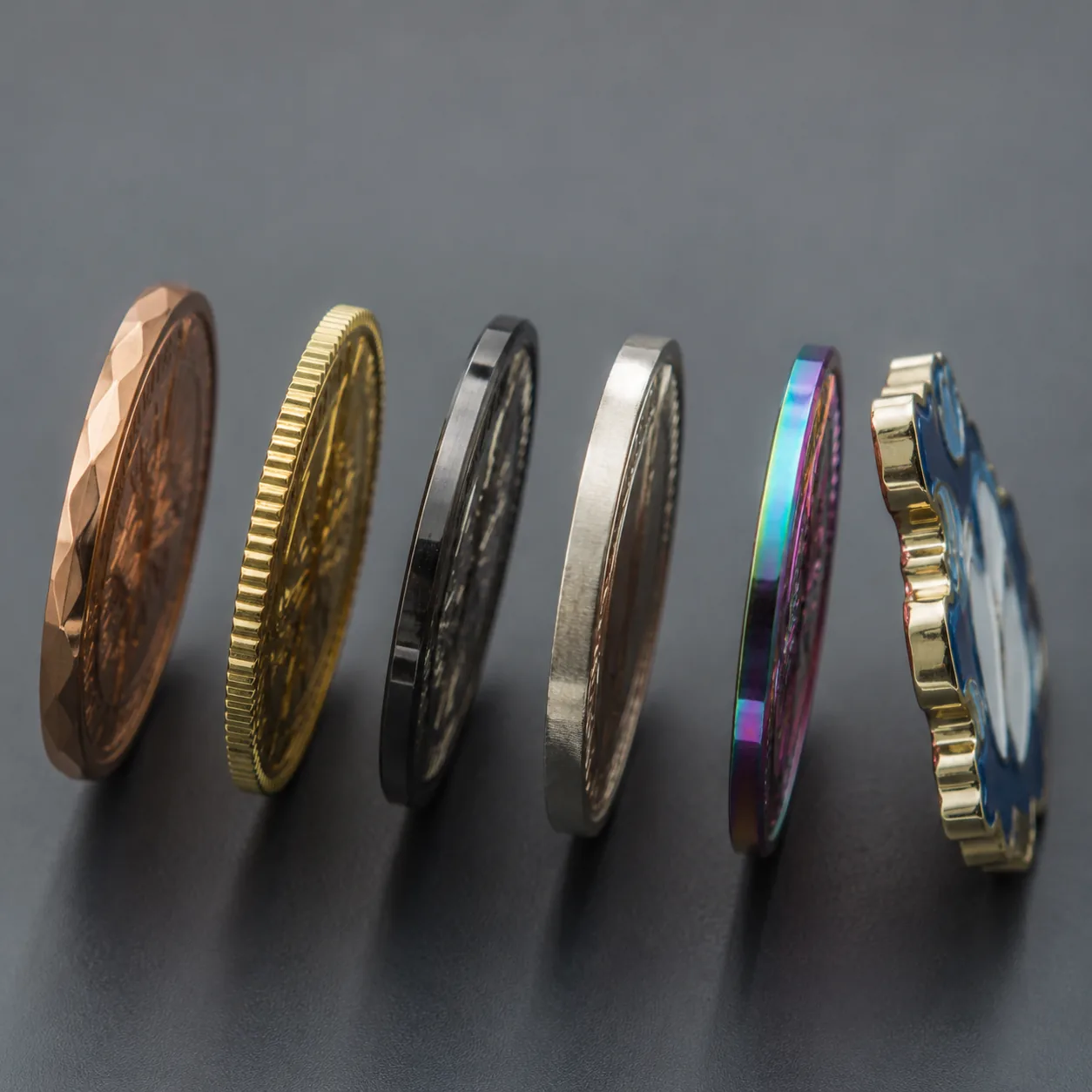
The four common edge options are square deburred, light chamfer, rounded radius and decorative milled edge. Square deburred is the lowest-cost option: the edge remains visually square, but loose burrs and sharp breakout are removed before plating. It is suitable for budget pins, magnets and badges where the side wall is not a selling feature.
A light chamfer cuts a narrow flat surface at the edge, commonly 0.2 to 0.4 mm wide at 30 to 45 degrees. It improves hand feel without changing the silhouette too much. For a 40 mm coin or keychain, 0.3 mm ±0.1 mm is a practical RFQ note. If text, enamel borders or raised metal lines sit within 0.5 mm of the outline, the chamfer must be reviewed because it can visually reduce the border.
A rounded radius removes the hard corner completely and is better for bag charms, keychains and children’s items. For zinc alloy castings from 2.5 to 5.0 mm thick, R0.3 to R0.6 mm is usually realistic. For stamped brass or iron pieces under 1.5 mm thick, a full radius may thin the edge or soften the face detail, so a controlled chamfer is often more stable.
Decorative milled edges, including rope, reeded, wave and diamond-cut patterns, are mainly visual features for challenge coins and premium tokens. They add tooling, CNC or secondary cutting time and should be approved on a physical sample. For coins under 30 mm diameter or below 2.5 mm thick, the pattern can look crowded or shallow and high points may wear faster during handling.
| Edge style | Practical specification | Best use | Cost and process impact |
|---|---|---|---|
| Square deburred | Burr <0.05 mm; no cotton snag on exposed edge | Budget pins, badges, magnets, flat tags | Usually included in base price if specified clearly |
| Light chamfer | 0.2-0.4 mm at 30-45 degrees; common callout 0.3 mm ±0.1 mm | Coins, keychains, thick badges, bottle openers | Adds about USD 0.03-0.12/pc depending on size and quantity |
| Rounded radius | R0.3-R0.6 mm on hand-contact edges | Daily-use keychains, bag charms, children’s items | Adds tumbling or hand-polishing time; may soften outline |
| Decorative milled edge | Reeded, rope or diamond pattern approved by sample | Challenge coins and premium tokens | Adds about USD 0.08-0.45/pc and 3-6 production days |
Material and Process Limits
Iron is economical for stamped pins and badges, but it is the most sensitive to exposed corners because unplated iron can rust. For iron items from 1.0 to 2.0 mm thick, specify deburring before plating, no exposed base metal after finishing, and a copper or nickel underlayer suitable for the final finish. Avoid aggressive post-plating edge polishing on iron because it can cut through the coating at corners.
Brass gives cleaner stamped edges and better corrosion resistance than iron. It suits premium badges, challenge coins, enamel pieces and products with visible side walls. Brass commonly runs from 1.2 to 3.0 mm for badges and coins, with thickness tolerance around ±0.10 mm on stamped parts when tooling and polishing are controlled.
Zinc alloy is preferred for 3D cast shapes, thick keychains, bag charms and sculpted medals. It casts well at 2.5 to 5.0 mm thickness, but the gate position and parting line directly affect edge finishing. Buyers should approve where the gate will be trimmed and whether the parting line sits on a visible outside edge, a back edge or a lower-risk internal area.
Stainless steel is strong and corrosion resistant, but it is harder to stamp and polish. Laser-cut stainless keychains should call for burr removal on both faces, edge brushing direction if visible, and removal of heat tint where it affects appearance. Acrylic, PVC and silicone do not need plating, but they still need edge control: acrylic may need a 0.2 mm bevel or flame-polished edge, while soft PVC needs clean mold parting and flush trimming.
| Material | Typical thickness | Main edge risk | Recommended RFQ note |
|---|---|---|---|
| Iron | 1.0-2.0 mm | Rust if corners are exposed after polishing | Deburr before plating; no exposed base metal; inspect plated corners |
| Brass | 1.2-3.0 mm | Higher polishing cost than iron | Light chamfer or polished side wall to match approved sample |
| Zinc alloy | 2.5-5.0 mm | Flash, parting line and gate trim marks | Approve gate location; remove flash; radius R0.3-R0.6 where handled |
| Stainless steel | 0.8-2.0 mm | Laser burr, heat tint and sharp cutouts | Deburr both faces; brush or polish visible edges |
| Acrylic | 2.0-5.0 mm | Chipping, sharp laser edge and smoke marks | Bevel 0.2 mm or flame polish visible edges if required |
MOQ, FOB Cost and Lead-Time Impact
Edge finishing is labor and machine time, so the cost impact is highest on small orders. At ZheCraft, typical MOQs are 100 pcs for custom metal pins or badges, 100 to 300 pcs for challenge coins, 300 pcs for custom metal keychains, and 500 pcs for mixed-material keychains with special hardware. Lower quantities may be possible for simple designs, but special edge work can require a separate setup or tooling charge.
For a 40 mm zinc alloy keychain at 3 mm thickness, standard deburring is often included in the base quote when the burr limit is normal. A rounded or hand-polished edge can add about USD 0.06 to 0.18/pc at 1,000 pcs. For a 45 mm challenge coin with a reeded or rope edge, the premium can range from USD 0.12 to 0.45/pc depending on coin thickness, pattern depth and whether the edge is cut before or after plating.
Lead time should be planned in days, not assumed. Standard samples usually take 7 to 10 days after artwork confirmation. Mass production for common metal badges, coins and keychains typically takes 12 to 25 days after sample approval. Add 2 to 4 days for rounded hand-polished edges, 3 to 6 days for decorative milled coin edges, and 2 to 3 days for additional rub, thickness or salt-spray checks.
| Order size | Standard deburred FOB range | Premium edge FOB range | Typical mass lead time |
|---|---|---|---|
| 100-299 pcs | USD 1.20-3.80/pc | USD 1.45-4.50/pc | 14-24 days after sample approval |
| 300-999 pcs | USD 0.75-2.60/pc | USD 0.88-3.10/pc | 12-22 days after sample approval |
| 1,000-4,999 pcs | USD 0.38-1.80/pc | USD 0.44-2.15/pc | 14-25 days after sample approval |
| 5,000+ pcs | USD 0.22-1.20/pc | USD 0.26-1.45/pc | 18-30 days after sample approval |
Write a Measurable RFQ Edge Specification
The RFQ should separate functional edges from decorative edges. A hidden back edge on a lapel pin may only need standard deburring, while a keychain ring hole needs stronger control because it rubs against a split ring. If a badge will be worn on silk, wool, fleece or sportswear, state the fabric risk because snag resistance matters more than the side-wall shine.
Use measurable language. A strong specification might read: outside hand-contact edge light chamfer 0.3 mm ±0.1 mm; exposed burr height below 0.05 mm; no cotton cloth snag; no exposed base metal after plating; side wall polish to match approved sample; key ring hole deburred both faces. For zinc alloy keychains, keep hole-to-edge distance at 2.0 mm or more where possible. For brass or stainless steel, 1.5 mm can be acceptable if the design is not heavily loaded.
Do not require premium finishing everywhere. Mark “A edges” for hand-contact or fabric-contact surfaces, “B edges” for visible but low-contact surfaces, and “C edges” for hidden backs, recessed areas or non-critical internal cutouts. This reduces unnecessary polishing, protects plating thickness and keeps scrap rates under control.
- State base metal, thickness, plating color and whether the edge is visible in use.
- Mark hand-contact edges, ring holes, fabric-contact areas and internal cutouts.
- Specify burr limit, such as <0.05 mm with no cotton cloth snag.
- Define the edge geometry, such as 0.3 mm ±0.1 mm chamfer or R0.3-R0.6 radius.
- Require no exposed base metal, loose plating or sharp breakout after finishing.
- Ask for side-view macro photos before approving bulk production.
- Confirm whether the golden sample locks the edge finish for reorders.
Inspect Edges Before Shipment
Edge defects should be checked with physical tests and visual inspection under consistent light. For most B2B promotional orders, AQL 2.5 for major defects and AQL 4.0 for minor defects is practical. A sharp burr on a handled or worn product should be treated as a major defect. For children’s items, retail merchandise or premium coins, AQL 1.5 for major defects is more appropriate, but inspection time and cost should be reflected in the quote.
The cotton cloth snag test is simple and effective: wipe exposed edges in both directions with woven cotton and reject pieces that catch or pull fibers. A fingernail check can detect raised plating flakes and sharp breakout, but it is subjective, so it should support—not replace—the burr limit and approved sample. For higher-value coins, use calipers to check thickness; stamped brass or iron coins often hold ±0.10 mm, while zinc alloy castings commonly need ±0.15 mm unless tighter control is quoted.
Plating inspection should include corners, side walls and ring holes, not only the front face. For daily-use items, add an edge rub test and consider 24 to 48 hours neutral salt spray for corrosion-sensitive combinations such as iron with gold, antique brass or black nickel. If the item is a reorder, compare the new batch against the golden sample because polishing pressure, tool wear and operator technique can change the edge feel even when the artwork is unchanged.
When Standard Deburring Is Enough
Premium edge finishing is not always the best use of budget. A 20 to 25 mm lapel pin with a butterfly clutch and limited side-wall visibility usually needs clean deburring, stable plating and secure hardware more than a hand-polished radius. For low-cost event giveaways with short service life, a clear standard—no sharp burrs, no loose plating, no fabric snag and no visible rust—is often better than adding decorative edge work.
Avoid decorative milled edges on pieces below about 2.5 mm thick because the pattern may look weak and can expose base metal on high points. Avoid deep chamfers when raised text, enamel borders or cutouts sit close to the outline. For antique finishes, over-polishing the edge can remove the darkened recess effect and create batch-to-batch inconsistency.
Before sending the next RFQ, add one side-view note to the artwork or spec sheet. State the required edge style, burr limit, plating coverage expectation and which edges matter in real use. For example: “All exposed hand-contact edges deburred below 0.05 mm; outside edge light chamfer 0.3 mm ±0.1 mm; no exposed base metal after plating; ring hole deburred both faces; AQL 2.5 major and 4.0 minor; side wall to match approved sample.” This gives the factory a measurable target before tooling, sampling and mass production begin.
Have a project? Send your artwork and target quantity and we’ll reply with a detailed quotation within 12 working hours.
Ready to get this made?
Send your sketch, target quantity and ship-date. Detailed quotation in 12 hours.



