Dual-Sourcing Custom Pins in 2026: Control Cost Without Spec Drift
Start with process risk, not the artwork file
The most expensive dual-sourcing mistake in custom pins is assuming one vector file equals one repeatable SKU. In practice, two factories can quote the same art and build very different products: stamped iron at 1.2 mm or 1.5 mm, brass die-struck at 1.5 mm, or zinc alloy die-cast at 1.8 to 2.0 mm. All may be described as a custom enamel pin, but they differ in weight, edge radius, line sharpness, recessed-fill depth, plating durability, tooling route, and reject risk.
Those differences are not cosmetic. On a 30 to 35 mm pin, a 1.2 mm stamped iron body can feel visibly lighter and produce sharper side edges than a 1.5 mm body. Zinc alloy die-casting handles deep cutouts and irregular outer contours better, but usually yields a softer edge profile and higher mold cost. Brass generally supports cleaner die-struck detail and better polish for imitation hard enamel, but unit cost is higher than iron. A unit-price gap of USD 0.05 to USD 0.12 at 1,000 pieces usually signals a process change, not a small efficiency gain.
Plating is another hidden variable. A bright nickel finish built at roughly 3 to 5 microns on exposed areas will not wear like one specified at 8 to 12 microns, especially on raised borders, pin posts, and clutch contact points. The same issue applies to black nickel, gold-tone, and antique finishes: if thickness, adhesion, and color standard are not written down, each supplier will optimize cost differently and quote a different product.
In 2026, the buying pressure is clear: procurement wants continuity, brand teams want visual consistency, and regional teams want shorter replenishment cycles. A backup supplier only protects the program if it can reproduce the approved build within written tolerances. Otherwise, the buyer is not dual-sourcing one SKU; the buyer is funding two separate development paths that happen to share artwork.
The objective is simple: one controlled manufacturing standard that two factories can execute with minimal drift in dimensions, thickness, enamel height, plating tone, hardware position, and pack-out. That work must be done before RFQ, not after a late shipment or mixed-lot complaint.
Write one RFQ that removes interpretation
A usable RFQ for custom pins should fit on one page and force every bidder onto the same route. At minimum, lock finished dimensions in millimeters, base metal, forming method, raw body thickness, plating finish, target plating build where relevant, Pantone references, minimum raised-line width, minimum text height, attachment style, post location, packing method, carton weight limit, inspection standard, overrun allowance, and shipping term. If those items stay open, suppliers will quote different constructions and the comparison will be misleading.
For a mainstream soft enamel lapel pin, a strong baseline spec in 2026 might read: finished size 32.0 mm x 28.0 mm; stamped iron; 1.5 mm body thickness before plating with tolerance of plus or minus 0.10 mm; soft enamel recessed fill; bright nickel finish; nickel target 8 to 12 microns on exposed front-face metal; one 8 mm post centered on the vertical axis with butterfly clutch; minimum raised metal line width 0.30 mm; minimum readable text height 0.90 mm; no exposed base metal on front face; individual OPP bag; 100 pieces per inner bag; export carton maximum 14 kg gross; AQL 2.5 major / 4.0 minor; FOB Ningbo.
If the program is more premium, the route changes and the RFQ must say so. A 35 mm imitation hard enamel brass pin with polished flush surface may price around USD 0.68 to USD 0.95 FOB at 1,000 pieces, with tooling around USD 60 to USD 110. A standard 32 mm stamped iron soft enamel pin is more commonly USD 0.38 to USD 0.56 FOB at 1,000 pieces, with tooling around USD 35 to USD 80. A zinc alloy die-cast version with deep cutouts may land at USD 0.58 to USD 0.88 FOB and mold cost of USD 70 to USD 140. These are not interchangeable offers unless the RFQ explicitly permits alternatives.
- Lock size, base metal, thickness, and forming method before collecting quotes
- Specify plating finish and target build, especially for nickel, black nickel, gold-tone, antique brass, or dyed black
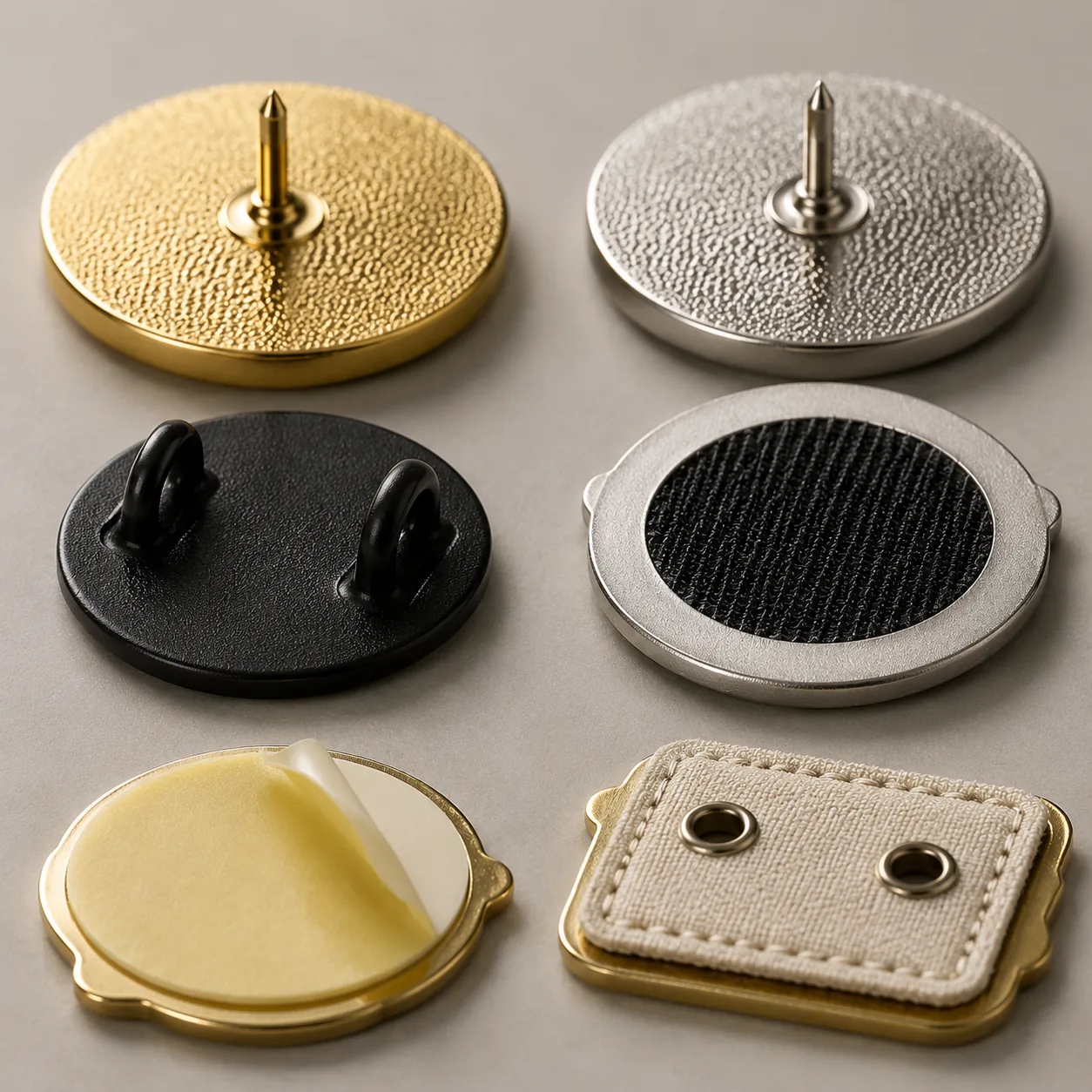
- Define hardware exactly: butterfly clutch, deluxe clutch, rubber clutch, magnet grade, screw length, or safety-pin assembly
- Write pack-out details clearly, including backing card stock, barcode label, polybag count, and carton gross-weight limit
- Set measurable QC terms in advance: AQL level, dimensional tolerances, overrun allowance, and cosmetic acceptance criteria
Compare quotes by route, MOQ, and lead time
Once quotations arrive, compare them line by line. A factory that is USD 0.07 cheaper may be using thinner stock, fewer polishing passes, lower plating thickness, or looser cosmetic sorting. Those savings often reappear later as enamel pinholes, rough sidewalls, scratches on raised metal, plating shade variation, or weak post welds. Ask every supplier to break out tooling, unit price by quantity tier, sample cost, sample lead time, bulk lead time, and any surcharge for special packing, epoxy, glitter, or alternate plating.
For 2026 production planning, realistic timing for a standard custom pin is usually 2 to 4 calendar days for artwork proof, 7 to 10 days for a pre-production sample made from actual tooling, and 12 to 18 days for mass production after sample approval at up to 5,000 pieces. More complex features such as transparent enamel, screen print, epoxy dome, danglers, sliders, or spinner assemblies usually add 2 to 5 days. If a factory promises 7-day bulk lead time on a new custom pin, verify whether that excludes plating queue, final packing, export documents, or the period after sample approval.
MOQ also needs to be verified at SKU level. Many suppliers advertise 100 pieces MOQ, but that usually assumes one design, one plating finish, and simple OPP bagging. Add a backing card, custom barcode label, split plating, magnetic attachment, or a separate retail pack, and the workable MOQ often rises to 300 or 500 pieces per SKU. For dual sourcing, confirm MOQ by design, by finish, and by pack configuration so the backup source is commercially usable, not just available on paper.
| Quote item | Supplier A | Supplier B | What buyer should verify |
|---|---|---|---|
| Construction | Stamped iron, 1.5 mm | Zinc alloy die-cast, 1.8 mm | Not equivalent; compare weight, edge profile, tooling route, and fine-detail capability |
| Plating | Bright nickel, not stated | Bright nickel, 8-10 microns | Ask both for target build and minimum acceptable wear/corrosion expectation |
| Color process | Soft enamel recessed | Soft enamel plus epoxy dome | Surface gloss, scratch resistance, and total thickness are different |
| MOQ | 100 pcs | 300 pcs | Confirm whether MOQ applies per design, per finish, or per retail pack |
| Lead time | 10 days bulk | 16 days bulk | Check whether the clock starts from art approval, sample approval, or deposit receipt |
| FOB unit at 1,000 pcs | USD 0.44 | USD 0.53 | Price gap may be justified if the specifications are materially different |
Approve one master sample with written tolerances
A dual-source program becomes unstable when the buyer approves one sample from Factory A and a slightly different sample from Factory B. Those differences accumulate in inventory. One source may fill enamel lower, another may polish edges more aggressively, and another may plate gold-tone warmer. The result is mixed stock that looks inconsistent in event kits, subscription boxes, or retail replenishment.
The safer approach is to approve one physical master sample against the final spec and use it as the reference for both factories. Record measurable criteria in the approval file. For pins under 40 mm, practical tolerances are often overall size within plus or minus 0.15 mm, body thickness within plus or minus 0.10 mm, post position within plus or minus 0.50 mm from drawing center, and backing-card trim within plus or minus 1.0 mm. Keep minimum raised-line width at or above 0.30 mm and minimum text height at or above 0.90 mm unless the design has already been production-tested below that threshold.
Color needs commercial language, not a vague instruction to match the proof. If the design uses Pantone Solid Coated references, require side-by-side review under D50 or D65 lighting and ask for sample photos next to both the Pantone chip and the approved master sample. For difficult shades such as saturated reds, pale grays, skin tones, and dark navy fields, define acceptable variance before mass production. If the design includes transparent enamel, glitter, screen print, or text below 1.0 mm, the secondary source should not move to bulk until it visually matches the approved sample under the same light condition.
This is what removes opinion from later disputes. If a lot arrives with colder nickel tone, shallower fill, exposed base metal, or off-center hardware, the discussion ties back to one approved sample, one drawing revision, and one set of measurable tolerances.
Use a pilot order to test repeatability, not just appearance
Do not move directly from sample approval into a 5,000- or 10,000-piece split unless the design is very simple. A pilot order of 300 to 1,000 pieces per supplier exposes what samples often hide: plating drift across racks, enamel curing consistency, post-weld strength, count accuracy, backing-card insertion errors, and actual packing discipline. This is especially important on black nickel, imitation hard enamel, cutout shapes, spinner pins, magnetic backs, and designs with many small color cells.
During the pilot, inspect more than appearance. Confirm the current artwork revision, approved attachment position, clutch type, backing card stock, barcode placement, inner-bag quantity, and carton markings. Check that overrun or shortage stays within the purchase-order allowance, typically plus or minus 3 percent unless otherwise stated. For warehouse handling, keep export cartons around 12 to 15 kg gross to reduce crush damage, manual-handling issues, and receiving delays.
Reasonable pilot expectations for a standard lapel pin are concrete: less than 1.0 percent obvious hardware failures, no systematic plating discoloration, no recurring enamel voids, and results that remain within AQL 2.5 major / 4.0 minor. If a supplier shows repeated post misalignment, loose clutches, mixed bag counts, or backing-card size drift during a 500-piece pilot, that supplier is not qualified for a larger split yet, regardless of how strong the initial sample looked.
The pilot also reveals landed-cost truth. A lower FOB quote can disappear once the buyer adds sorting labor, repacking time, replacement claims, or an event-delay penalty. In dual sourcing, reliable execution usually matters more than a nominal USD 0.03 to USD 0.05 unit saving.
Split volume by proven risk, not a theoretical 50-50
An initial allocation does not need to be even. For most repeat pin programs, 70-30 or 80-20 is safer. Keep the larger share with the supplier that produced the approved master sample and passed the pilot with the fewest deviations. Give the secondary supplier enough live volume to keep tooling active, maintain process familiarity, and prove repeatability across real orders.
Use the same purchase-order architecture for both factories: same drawing revision, same QC standard, same pack-out instructions, same label format, same overrun allowance, and the same Incoterm. If one supplier quotes EXW and the other quotes FOB Ningbo or FOB Shanghai, the comparison is distorted by domestic freight, export documentation, terminal handling, and consolidation timing. In East China clusters, port choice alone can shift handoff timing by 1 to 3 days.
Dual sourcing usually makes the most sense for stable programs with at least two reorder cycles per year and annual demand above roughly 3,000 to 5,000 pieces across a design family. Below that level, qualification effort, sample cost, tooling duplication, and inventory segmentation can outweigh the benefit. Reserve the model for SKUs where continuity, repeatability, and regional supply flexibility create measurable operating value.
Install a short incoming inspection that catches drift fast
Once two sources are active, the main control point shifts from quoting to receiving. Build an incoming inspection sheet that a warehouse team or third-party QC provider can complete in about 10 minutes per lot. It should cover count, packaging, dimensional spot checks, plating-tone comparison against the master sample, enamel-fill review, and a quick attachment-security test. If the form is too long, it will not be used consistently.
A practical routine is to inspect to the same AQL family written into the PO, then add a side-by-side comparison against the approved sample. Measure a small sample set with digital calipers, verify backing-card dimensions, inspect for voids, contamination, scratches, and exposed base metal, and test clutches or magnets on a spot basis. If any drift appears, quarantine by lot code immediately rather than mixing near-matching stock. Once lots are mixed, traceability is lost and supplier accountability weakens.
- Verify lot code, PO number, and drawing revision before stock is received
- Count cartons and random inner bags to confirm pack quantity and label accuracy
- Measure size, thickness, and post position on spot samples with digital calipers
- Compare plating tone and enamel fill directly against the approved master sample
- Quarantine any lot with visible drift before it is mixed with existing inventory
For larger multi-SKU programs, one documented primary supplier can still reduce daily management load even when a backup source exists. If that factory maintains the core spec library, tooling archive, approval photos, and reorder history across related metal items, the buyer lowers the risk of plating-tone drift, backing-card mismatch, and carton-label inconsistency across reorders.
Know when not to dual-source
Dual sourcing is useful, but it is not always the best commercial model. Avoid live volume splits on products that depend heavily on manual finishing, ultra-fine detail, or multi-material assembly unless the buyer is prepared to run a stricter and more expensive qualification process. High-variance examples include jewelry-style brooches with stones, hinged keychains, translucent enamel combined with screen-print gradients, and gift sets that combine metal with PVC, ribbon, leather, or fabric.
In those cases, one strong primary supplier with a locked golden sample, tooling history, and disciplined reorder control often performs better than two half-aligned sources. The buyer can still maintain a backup RFQ file, alternate-tooling plan, and second-source shortlist without forcing permanent split orders. The practical rule is simple: if the cost of inconsistency is higher than the disruption risk of single sourcing, do not force a live dual-source program.
For simpler products such as standard stamped soft enamel pins, basic die-struck coins, flat bottle-opener keychains, or simple fridge magnets, dual sourcing works when the specification is tight and the pilot is real. Start with one repeat SKU, issue one controlled RFQ template, approve one master sample, run pilot orders at both factories, and only then decide the long-term split. The real asset is not the artwork file. It is the documented build standard that makes two factories manufacture the same product on purpose.
Have a project? Send your artwork and target quantity and we’ll reply with a detailed quotation within 12 working hours.
Ready to get this made?
Send your sketch, target quantity and ship-date. Detailed quotation in 12 hours.



