Domed Epoxy vs Flat Finish: Which Spec Fits Your Order?
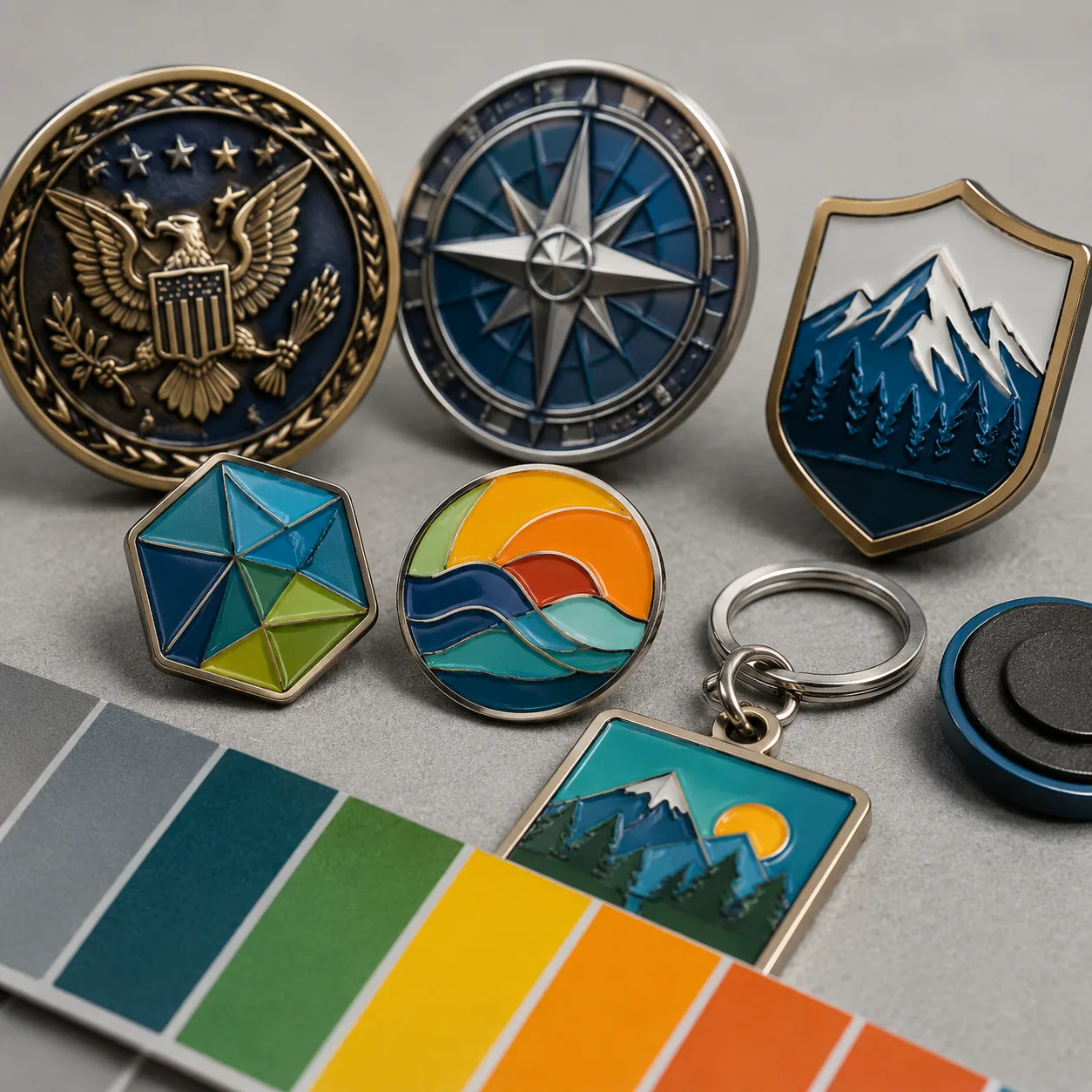
Why buyers get stuck between two finishes
Domed epoxy and flat finish are not simply aesthetic options. In production, they change how fine detail reads, how the item wears, how much cosmetic risk sits in curing and inspection, and how close the finished piece stays to the approved artwork. Flat finish keeps the metal, print, or plating as defined by the tooling. Domed epoxy adds a clear resin layer that creates depth and gloss, but it also softens edges and tightens the tolerance window.
That trade-off matters most on custom pins, keychains, magnets, badges, and printed promo items. A buyer often approves a render that looks strong at 100% scale, then loses text clarity once the part is reduced to 25-30 mm. The finish choice should be driven by measurable limits: minimum line width, smallest text height, dome height, inspection standard, MOQ, and lead time—not by a mockup alone.
In practical sourcing terms, the right finish is the one that protects the smallest acceptable feature. If the design depends on crisp lettering and hard borders, flat finish is usually safer. If it depends on a glossy retail look or on sealing a printed face, domed epoxy usually carries less appearance risk.
Spec sheet comparison
| Spec item | Domed epoxy | Flat finish |
|---|---|---|
| Top layer thickness | 0.20-0.60 mm typical; 0.70 mm is possible on larger flat panels | No added layer; surface follows the metal, print, or plating |
| Minimum readable line width | 0.25-0.30 mm recommended; below 0.20 mm is high risk | 0.15-0.20 mm possible on sharp tooling and stable plating |
| Small text threshold | 3 pt equivalent is risky; 4-5 pt is safer | 2-3 pt equivalent can remain legible if the tool is clean |
| Surface appearance | High gloss, deeper color, slightly magnified image | Sharper borders, more metal-forward look, less depth |
| Wear behavior | Protects print from light scuffing; resin can chip on impact | No resin layer to chip, but exposed print/plating wears sooner |
| Typical MOQ | 500-1,000 pcs on new orders; 300 pcs on repeat tooling is sometimes accepted | 300-500 pcs common; lower is possible for existing molds |
| Typical lead time after sample approval | 12-18 days | 10-16 days |
| Typical FOB price range | USD 0.18-0.60/pc for small promo items | USD 0.14-0.50/pc for comparable sizes and quantities |
| Common QC risks | Uneven dome height, bubbles, dust inclusion, edge pooling | Surface scratches, visible tooling marks, plating variation, print wear |
These figures are directional, not a factory quote. Final pricing shifts more with size, shape, color count, plating, packaging, and process method than with finish alone. A 25 mm soft enamel pin with a simple logo may sit near the low end, while a 50 mm printed keychain or magnet with full doming, extra polishing, and individual packing can move quickly toward the top of the range.
When domed epoxy is the better call
Domed epoxy is the stronger option when the decoration is print-based or when the buyer wants a sealed, glossy surface. It is common on flat metal keychains, fridge magnets, badges, coasters, and printed promotional discs where the artwork includes gradients, photos, or full-color logos. The resin acts as a visual enhancer and a light protective layer, especially when the item will move through packing, shipping, and retail display before reaching the end user.
The geometry has to support it. On a flat panel with enough border margin, a 0.30-0.50 mm dome is usually manageable. On narrow or irregular shapes, resin can run toward the edge during leveling or curing, especially if the part is not perfectly horizontal. Tiny text, barcodes, QR codes, and dense negative spaces are high-risk because the clear layer behaves like a lens and slightly softens the boundary.
A concrete example: a 45 mm printed keychain for a retail giveaway with a bold logo, a solid border, and a single background image is a good doming candidate. The same artwork reduced to 20 mm with small legal text and multiple line breaks will usually need a flatter build, a larger size, or a redesigned layout.
- Use domed epoxy for printed, gradient-heavy, or photo-style artwork.
- Use it when the buyer wants a glossy retail look without an extra sleeve.
- Use it on handled items that are not heavily abraded, such as desk giveaways, bag tags, and light-use keychains.
- Avoid it when the smallest line is below 0.25 mm or the text is below about 3 pt equivalent.
- Avoid it when the design has tight edges, tiny islands, or deep recesses that can trap resin.
When flat finish is the better call
Flat finish is the right choice when detail integrity matters more than surface protection. On pins, coins, badges, and metal tags with fine text or thin line work, skipping the resin layer preserves edge clarity and keeps the artwork closer to the original tool. It also simplifies production because there is no mixing, dispensing, leveling, or curing stage for epoxy.
Flat finish is especially useful for challenge coins, lapel pins, commemorative medals, and brand tags where the buyer wants a more formal, metal-forward look. It works well for designs that rely on contrast between raised borders and recessed enamel or print. The trade-off is wear: without a domed layer, printed surfaces, plated highlights, and polished tops are more exposed to scratches, fingerprints, and abrasion during packing or daily use.
If the item will live in a pocket, ship in bulk, or rub against hardware, flat finish can still work, but the buyer should accept faster cosmetic wear. In that case, the real controls are the substrate, plating, and packaging. A finish choice alone will not save a weak wear spec.
Durability and quality control
Domed epoxy usually fails first at the edges, not in the center. Common defects are meniscus buildup, uneven dome height, dust specks, and small bubbles that are amplified because the clear layer acts like a lens. On lower-cost runs, edge pooling appears when the part is not leveled well or when too much resin is dispensed. That is why factories often inspect domed items under angled light before packing.
Flat finish fails more simply: scratches, dulling, and exposed wear on contact points. Keychains and badges are the most vulnerable because they rub against keys, zippers, rings, and bag hardware. If the item will be handled often, the base material and plating need to be specified with wear in mind. For decorative brass or zinc alloy promo items, common plating thickness is roughly 0.1-0.2 microns for standard finishes; higher-wear programs may require a stronger substrate and tighter cosmetic acceptance limits.
QC language should be explicit. AQL 2.5 is common for general appearance inspection, while critical defects such as cracking, peeling, missing parts, or severe contamination are often controlled at AQL 1.0 or by 100% visual inspection on the visible face. Buyers should define what counts as a pass before production starts, including acceptable bubble size, scratch length, plating blotch limits, and whether tiny edge overflow is allowed.
For both finishes, inspect the most failure-prone zone first: edges on domed items, and high-contact points on flat items. That is where returns usually begin.
Artwork limits and tolerance thresholds
The finish choice should track the smallest feature in the artwork. Flat finish supports finer edges because the surface is not softened by a resin lens. Domed epoxy is more forgiving on bold logos, but once line width drops below about 0.25-0.30 mm, the risk of visual distortion rises quickly. Dense negative spaces, tiny type, and thin borders are the first details to disappear when the dome is too high or the layout is too compact.
Color separation matters as well. Flat finish is better for designs that depend on precise borders, small lettering, and hard geometric divisions. Domed epoxy can slightly blend adjacent shapes, especially when the piece is small or the dome rises above 0.40 mm. A design that looks clean at 50 mm can fail at 25 mm without any change to the artwork itself.
If a program includes multiple SKUs, test the smallest one first. A logo that works on a 30 mm pin may not survive unchanged on a 20 mm keychain or compact magnet. The smallest part usually sets the real detail limit, and it is cheaper to discover that at sample stage than after the full PO is released.
Cost, MOQ, and lead time in real terms
Domed epoxy adds steps: mixing, dispensing, dust control, leveling, curing, and extra visual inspection. That usually adds a small premium and about 2-4 days to the process versus flat finish. Flat finish is faster because it skips the resin stage and is easier to line up in production, which makes it a better fit for urgent campaigns or tighter budgets.
For standard custom metal promo items, a practical sourcing range is 300-500 pcs MOQ for flat finish and 500-1,000 pcs for domed epoxy on new orders. If tooling already exists and the artwork is simple, some factories will go lower, but the unit price usually rises. Typical lead time after sample approval is 10-16 days for flat finish and 12-18 days for domed epoxy. If new tooling is required, add roughly 3-7 days before production starts.
In FOB terms, simple pieces often land around USD 0.14-0.50/pc for flat finish and USD 0.18-0.60/pc for domed epoxy. Larger sizes, extra colors, printed gradients, special packaging, and complex shapes can push pricing above those ranges. For small runs, packaging and freight can matter more than the finish delta; for repeat programs, the bigger savings usually come from fewer sample revisions and faster approval cycles.
Example: a 30 mm logo keychain in a simple shape may cost only a few cents more with doming, but if the sample needs two rounds of correction because the text softens, the real cost is schedule, not resin.
Approval checklist for the sample
- Confirm the smallest line width and the smallest text height on the artwork.
- State whether the visual priority is crisp detail or glossy protection.
- Set the target dome height if epoxy is used, usually 0.20-0.60 mm.
- Specify the inspection standard for bubbles, dust, scratches, and edge pooling.
- Lock plating type and target thickness before color approval.
- Ask for a pre-production sample or golden sample on dense artwork.
- Confirm whether the product will be mailed, pocket-carried, or worn daily.
- Align the finish choice across all SKUs in the same campaign.
What to do next
If the artwork is detailed, start with flat finish and move to domed epoxy only if the buyer accepts some softening of edges. If the artwork is printed, glossy, or meant to feel more protected in transit, domed epoxy is usually the better production fit. For mixed campaigns, compare the smallest SKU against the largest one before placing the order, because the smallest part usually sets the real limit.
The safest next step is to request two matched quotes from the factory: one flat and one domed, built from the same drawing, the same size, and the same plating spec. That creates a clean comparison on price, lead time, and risk. On the sample approval sheet, ask the supplier to state the finish, dome height, tolerance, and inspection standard in writing before mass production starts.
Have a project? Send your artwork and target quantity and we’ll reply with a detailed quotation within 12 working hours.
Ready to get this made?
Send your sketch, target quantity and ship-date. Detailed quotation in 12 hours.



