Die-Struck vs Printed Pins for Fine Logo Detail
Start With Detail Risk, Not Unit Price
Most lapel pin problems are designed into the order before production starts. A logo that is clean at 120 mm on a PDF can become unreadable at 25 or 30 mm after it is converted into stamped metal ridges, enamel cells, plating, print registration and a protective clear coat. The usual risk areas are sponsor lines, ® and ™ marks, QR-style patterns, thin negative spaces, hairline script, small facial features, shadows and gradient backgrounds.
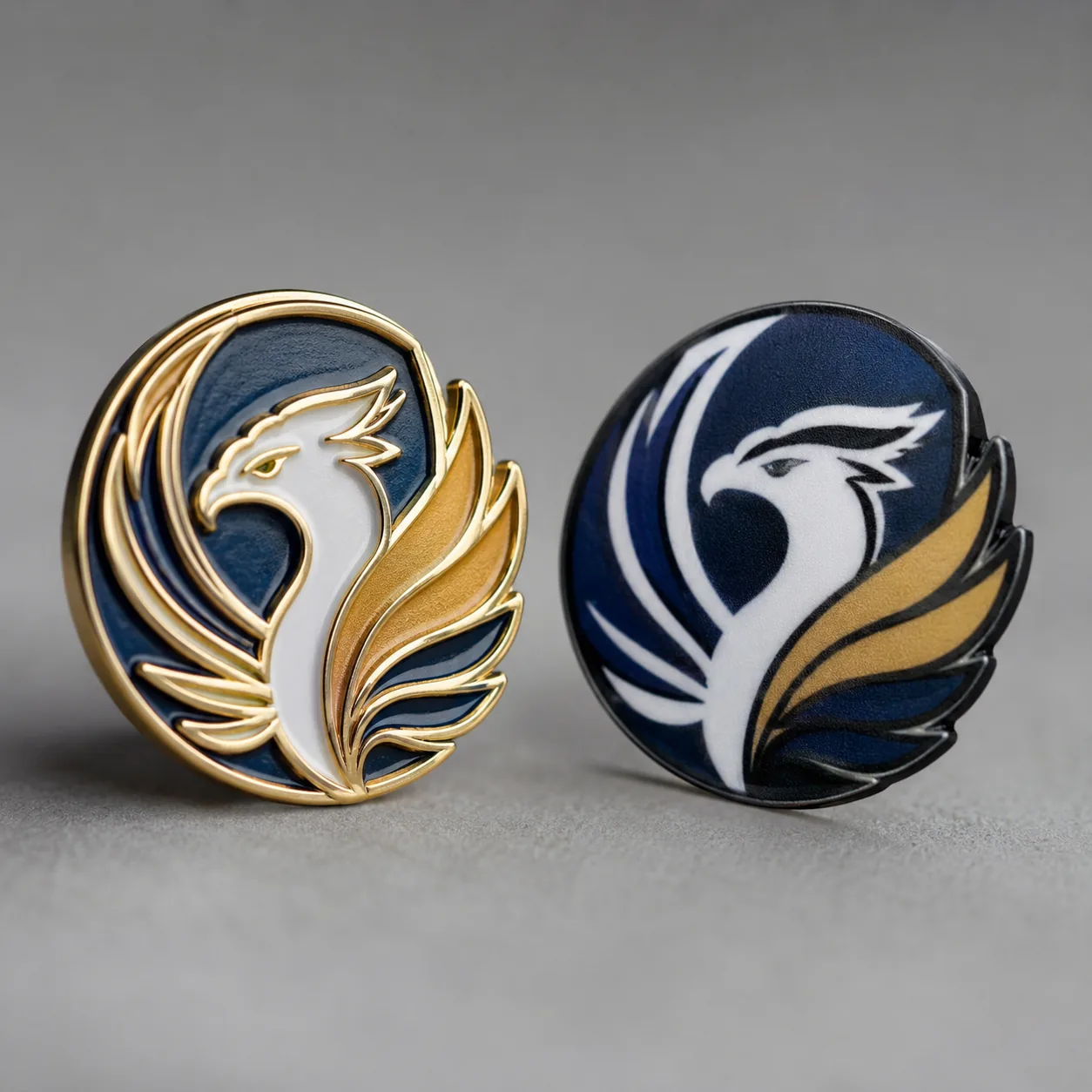
Die-struck enamel pins and printed pins can use similar base materials, including iron, brass, zinc alloy and stainless steel, but they reproduce detail differently. Die-struck pins build the design with raised and recessed metal. Printed pins reproduce the design as ink on a flatter surface, usually protected by epoxy, polyurethane or lacquer. The correct choice is therefore not simply premium versus low cost. It is relief detail versus graphic detail.
For B2B orders, the practical question is which defect is easier to control for the artwork. Die-struck pins risk clogged letters, weak enamel separation, polishing loss and filled-in fine lines. Printed pins risk color drift, banding, dust under epoxy, surface scratches and edge registration movement. A useful RFQ identifies those risks before the steel die is cut or a pre-production sample is approved.
Practical Specification Limits for 20–45 mm Pins
The ranges below reflect normal commercial production for custom lapel pins in the 20 to 45 mm range. They are not jewelry-grade tolerances, oversized medal standards or ultra-low-cost stock badge limits. Final feasibility still depends on the base metal, plating color, enamel type, print method, outline complexity, clear coat and inspection level.
| Specification | Die-Struck Enamel Pin | Printed Pin |
|---|---|---|
| Best artwork fit | Solid logos, crests, icons, badges, separated color blocks and bold text | Gradients, photos, mascots, dense sponsor locks, tonal artwork and fine outlines |
| Minimum practical line width | 0.15 mm raised metal possible; 0.18–0.20 mm preferred for repeatable production | 0.08–0.10 mm printed line possible; 0.12 mm safer for repeat orders |
| Minimum readable text height | 1.5–1.8 mm for raised or recessed metal letters; 2.0 mm preferred for black nickel | 0.8–1.2 mm with high contrast, clean vector art and stable print setup |
| Minimum enamel cell width | 0.25 mm workable; 0.35 mm preferred for small isolated fills | Not applicable, but keep critical detail 0.8–1.0 mm from trim edge |
| Artwork color control | Pantone spot enamel; gradients must be simplified into solid color steps | CMYK, UV digital, offset or screen print; gradients and shadows are possible |
| Surface feel | Tactile raised metal with recessed soft enamel or polished hard enamel | Flat print with epoxy dome, flat epoxy, polyurethane or lacquer clear coat |
| Typical thickness | 1.2–1.8 mm under 35 mm; 1.5 mm common for corporate pins | 0.8–1.5 mm metal blank plus 0.3–0.8 mm clear coat or epoxy |
| Plating specification | Nickel underplate often 3–8 microns; decorative gold, nickel or black nickel top layer commonly 0.05–0.20 micron unless upgraded | Same for plated metal blanks; acrylic or stainless printed versions may skip decorative plating |
| Tooling cost | Steel die typically USD 45–120 for 25–40 mm; USD 150+ for 3D relief, cutouts or complex contours | Outline die, laser file or print setup typically USD 20–70; lower cost for artwork-only revisions |
| Typical MOQ tiers | 100 pcs accepted; 300 pcs improves unit cost; 500–1,000 pcs spreads tooling efficiently | 50–100 pcs possible for digital print; 300 and 1,000 pcs are stronger commercial tiers |
| FOB unit price at 100 pcs | USD 0.95–1.90 for 25–35 mm soft enamel; hard enamel often USD 1.30–2.40 | USD 0.75–1.60 for 25–35 mm printed metal with epoxy |
| FOB unit price at 500 pcs | USD 0.55–1.35 for soft enamel; USD 0.90–1.90 for hard enamel | USD 0.45–1.20 for printed metal with epoxy |
| Sample lead time | 7–10 days after approved artwork and tooling payment | 5–8 days after approved artwork; 7–10 days if metal outline tooling is needed |
| Mass production lead time | 12–18 days after sample approval for 500–3,000 pcs | 10–16 days after sample approval for 500–3,000 pcs |
| Inspection baseline | AQL critical 0, major 2.5, minor 4.0; define plating and enamel defects | AQL critical 0, major 2.5, minor 4.0; add print, dust and epoxy limits |
For fine logos, the decisive rows are text height, line width and edge clearance. If legal copy, sponsor names or sub-brand marks fall below 1.2 mm high at final size, printed pins usually reproduce them more cleanly. If the design can be simplified and needs a premium metal feel, die-struck enamel is usually the better product.
Where Die-Struck Enamel Pins Perform Best
Die-struck pins work best when the buyer wants a small metal object with weight, relief and perceived value. Raised ridges separate enamel colors, catch light on polished plating and give the pin a tactile feel on jackets, caps, uniforms, lanyards and retail backing cards. Corporate anniversary pins, service awards, museum badges, membership emblems and donor recognition pins often justify this construction.
A stable 30 mm die-struck design normally uses raised metal dividers of at least 0.18 mm, enamel-filled areas of at least 0.25 to 0.35 mm and lettering above 1.8 mm when letters are formed in metal. Soft enamel is more forgiving because the enamel sits recessed below the metal walls. Hard enamel is polished flat, which improves perceived quality but can reduce the height and sharpness of extremely fine ridges during finishing.
The process demands artwork discipline. Gradients must become solid Pantone steps. Hairline typography must be enlarged, converted to print or removed. Small counters inside letters such as A, e, o and R can close during stamping, plating or enamel filling. Dark plating also tightens the visual result: black nickel, antique nickel and antique brass usually need slightly heavier separations than bright nickel or gold.
Die-struck pins are less suitable when the brand owner refuses simplification. A factory cannot preserve 0.07 mm strokes, photographic shading or transparent shadows by using a better die. Once tooling is cut, changing line widths, contours or metal separations may require a new die, a new sample and another approval loop.
Where Printed Pins Give Cleaner Detail
Printed pins are stronger when graphic accuracy matters more than metal relief. They can reproduce small sponsor groups, event illustrations, mascot artwork, photographic images, halftones, gradient backgrounds and fine outlines that would be unstable in enamel. For retail merchandise based on approved campaign art, printed construction often protects the brand asset with fewer compromises.
Common constructions include a stamped or laser-cut metal blank with offset print, screen print or UV digital print, followed by a clear epoxy dome, flat epoxy, polyurethane or lacquer. For 25 to 35 mm pins, a practical epoxy thickness is 0.4 to 0.8 mm. Important text, eyes, faces and sponsor marks should stay at least 0.8 mm from the trim edge, or 1.0 mm when domed epoxy is used, so normal print, cut or dome movement does not look like a defect.
Printed pins are not automatically less durable, but their defects are more visible. Dust, fibers, pinholes and trapped bubbles are obvious under clear epoxy, especially on black, navy or large flat-color artwork. Large solid backgrounds can show banding if the print file, curing setup or substrate treatment is poor. Glossy domes can also magnify or distort very fine type near the curved edge.
For print-ready files, provide vector artwork whenever possible. Raster images should be at least 300 dpi at final pin size, not 300 dpi at the enlarged proof size. Critical flat brand colors should include Pantone coated references. Photographs, gradients and skin tones should be approved as controlled CMYK expectations, not exact Pantone matches.
Cost, MOQ and Lead Time by Quantity
At low quantities, printed pins often have the cost advantage because setup is lighter and artwork revisions are easier. A 30 mm printed metal pin with epoxy may quote at USD 0.75 to 1.60 FOB at 100 pcs. A similar die-struck soft enamel pin may quote at USD 0.95 to 1.90 FOB, plus a higher die charge. At 500 or 1,000 pcs, the difference narrows because tooling is spread across more units.
MOQ depends on the production route. Digital printed pins can often start at 50 or 100 pcs, although 300 pcs is a more realistic tier for stable pricing and factory attention. Die-struck enamel is commonly available from 100 pcs, but 300 and 500 pcs tiers usually reduce unit cost enough to matter. For a 25 to 35 mm pin, buyers should request 100, 300, 500 and 1,000 pc price breaks instead of quoting one quantity only.
Tooling is the main cost-risk difference. Die-struck pins usually require a steel die, commonly USD 45 to 120 for standard 25 to 40 mm artwork. Complex outlines, internal cutouts, multi-level relief or 3D sculpting can exceed USD 150. Printed pins may need only a cut outline setup, usually USD 20 to 70, and digital print changes do not normally require new metal tooling unless the outside shape changes.
Lead time should be stated in days after approval. A realistic schedule is 5 to 10 days for sampling, 10 to 18 days for mass production after sample approval and additional time for packing, export handling and freight. Retail backing cards, barcode stickers, individual OPP bags, FSC paper cards, anti-tarnish bags or custom boxes can add 2 to 5 days if artwork or material approvals are late.
Durability, Materials and Inspection Criteria
Die-struck enamel pins usually fail through plating wear, enamel chipping, tarnish, bent posts or weak attachments. For standard indoor promotional use, a 1.5 mm iron or zinc alloy pin with nickel plating, butterfly clutch and an 8 mm post is usually adequate. For uniforms, hospitality staff or repeated wear, brass or stainless steel bases are more stable and resist corrosion better, but FOB prices are higher.
Printed pins usually fail through surface abrasion, epoxy yellowing, print fading, delamination or clear-coat scratching. Epoxy protects the print from casual handling and gives a retail-friendly gloss, but it may yellow faster under UV exposure and can crack if the pin is flexed. A flat lacquer or polyurethane clear coat avoids dome distortion and can look more refined, but it gives less impact protection than epoxy.
Inspection should define measurable defects. For most B2B promotional orders, AQL critical 0, major 2.5 and minor 4.0 is a practical baseline. Critical defects include sharp burrs, unsafe pins, detached posts, wrong logo and wrong attachment. Major defects include visible plating misses, unreadable approved text, enamel outside the metal wall, dust larger than 0.3 mm under epoxy, print shift above 0.3 mm and broken posts. Minor defects include small surface specks, slight color variation within the approved tolerance and light scratches not visible at normal viewing distance.
Functional tests should be specified, not described vaguely as durability. Useful examples include a 500 g pull test on the post for 10 seconds, 20 tape-adhesion cycles on printed artwork, 24-hour room-temperature water immersion for items likely to get wet and carton drop testing for retail-packed orders. For color, set Delta E under 3.0 for critical printed brand colors when the factory can measure it, or require approval against a signed physical sample.
Artwork Rules That Prevent Rejected Samples
Most sample rejections can be prevented by reviewing final-size artwork before quoting. Enlarged renders hide manufacturing limits. A factory proof should show the pin at 1:1 scale, metal line widths, enamel separations, plating color, print method, epoxy or lacquer choice, thickness, attachment, packaging and any simplified artwork.
For die-struck pins, keep raised metal dividers at 0.15 mm minimum and preferably 0.18 to 0.20 mm for black nickel, antique finishes or hard enamel. Keep enamel cells at least 0.25 mm wide, with 0.35 mm preferred for isolated shapes. Avoid tiny color dots below 0.4 mm and do not rely on recessed metal letters below 1.5 mm to remain readable after plating.
For printed pins, keep essential detail away from the edge. Use at least 0.8 mm safety margin from the trim line and 1.0 mm under domed epoxy. If the design includes a border, make it at least 0.6 mm wide so normal registration movement does not make the pin look off-center. Convert fonts to outlines and include 1.0 to 1.5 mm bleed when the print reaches the edge.
- Review artwork at final pin size, not only as an enlarged render.
- Flag all text below 1.5 mm for die-struck review and below 1.0 mm for print review.
- Specify Pantone coated references for flat brand colors and CMYK expectations for gradients.
- Confirm epoxy dome, flat epoxy, polyurethane, lacquer or no clear coat before sampling.
- Define pin size, thickness, plating, post length, clutch type and backing card hole position.
- Approve one physical pre-production sample for orders above 500 pcs or any retail-packed program.
- State AQL levels, defect sizes and visual inspection distance before mass production starts.
When Neither Option Is the Best Fit
Some designs should not be forced into standard die-struck enamel or printed metal. If the item is for children’s events and needs soft edges, PVC may be safer than a metal pin. If it must sit on thin fabric without sagging, a woven patch, embroidered badge or lightweight acrylic badge may perform better than a 35 mm metal pin.
If the product is mainly a photo souvenir, a fridge magnet or acrylic keychain can reproduce the image at a larger size with lower visual risk. A 50 to 70 mm acrylic keychain with double-sided print can show far more detail than a 25 mm lapel pin. FOB pricing at 500 pcs may sit around USD 0.60 to 1.40 depending on acrylic thickness, print layers, protective film, hardware and packaging.
If the item must last outdoors for months, discuss UV exposure before choosing printed epoxy. For short indoor events, printed pins are usually acceptable. For long-term recognition pins, staff uniforms or donor programs, die-struck enamel with a suitable base metal, controlled plating and a proven attachment is usually the safer specification.
RFQ Details to Send Before the PO
Start by classifying the design. If it contains gradients, photos, dense sponsor groups or text below 1.2 mm, request a printed pin quote first. If it uses bold marks, separated color blocks and needs a premium metal feel, request a die-struck enamel quote first. When the decision is close, quote both processes at the same finished size so price and production risk can be compared fairly.
A complete RFQ should include final-size artwork, target quantity, delivery date, pin size, base metal preference, plating color, enamel or print requirement, epoxy or lacquer requirement, attachment, packaging and intended use. For a controlled comparison, specify 30 mm width, 1.5 mm die-struck soft enamel or 1.2 mm printed metal plus 0.5 mm epoxy, nickel underplate 3 to 8 microns, butterfly clutch, individual polybag and AQL critical 0, major 2.5, minor 4.0.
Before approving the PO, ask the supplier to mark risky details directly on the proof. The review should identify which letters are too small, which metal lines may close, where print registration could shift and which change will reduce rejection risk. That step is worth doing before tooling because a corrected proof is cheaper than a polished sample that cannot be repeated consistently in mass production.
Have a project? Send your artwork and target quantity and we’ll reply with a detailed quotation within 12 working hours.
Ready to get this made?
Send your sketch, target quantity and ship-date. Detailed quotation in 12 hours.



