Die-Struck vs Die-Cast Badges: 2026 Spec Comparison
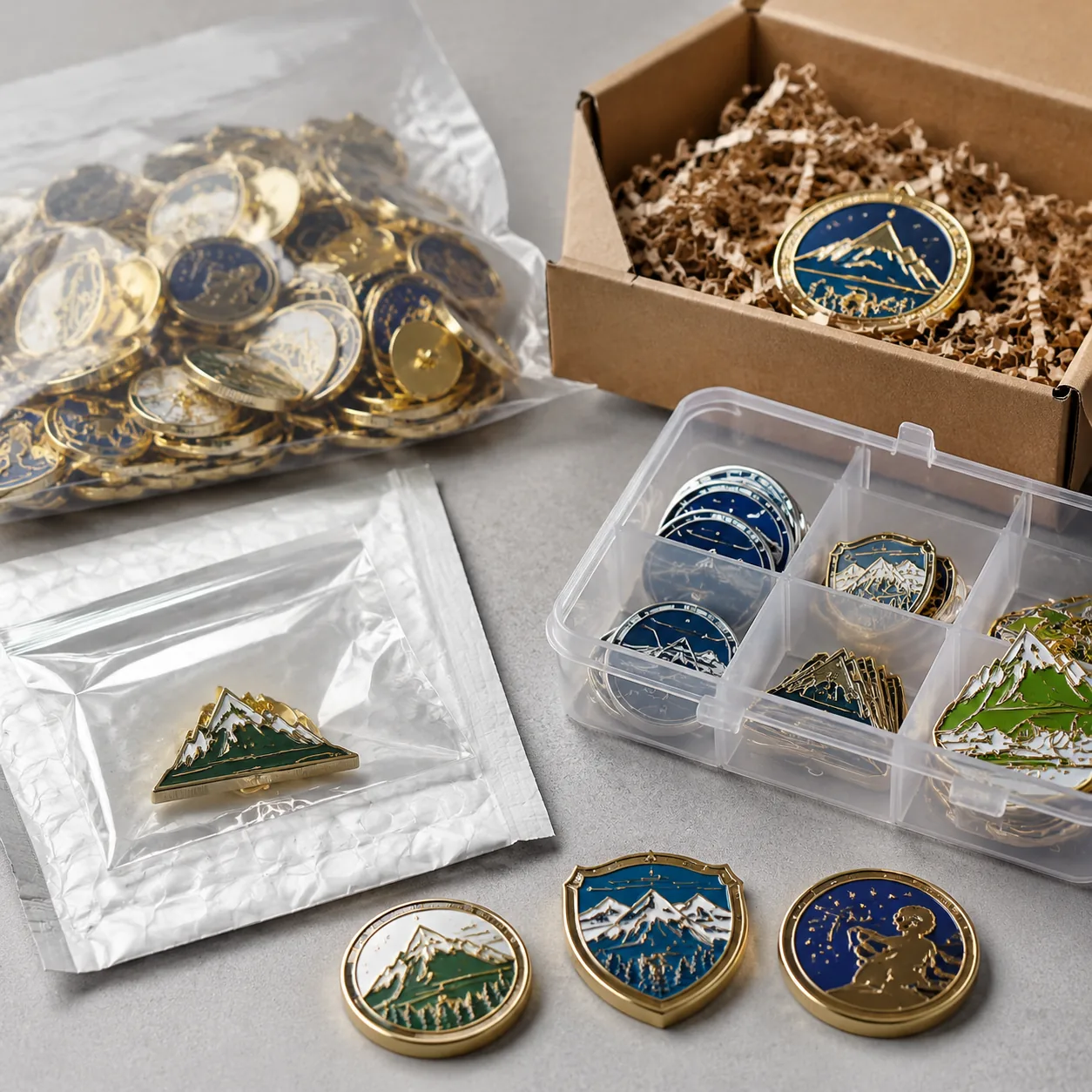
Why similar badge quotes can hide very different production risk
In custom badge sourcing, a small unit-price gap can conceal a major process mismatch. Two factories may quote the same 35 mm badge with bright nickel plating and a butterfly clutch, yet one route will control border sharpness, backside flatness, post alignment and polish consistency much better than the other. The mismatch often appears only after tooling is paid, when samples show soft text, warped backs, visible parting lines or unstable color fill.
Die-struck and die-cast badges are both standard routes for lapel pins, insignia, commemorative emblems and branded hardware, but they stop being interchangeable once the design depends on very fine linework, deep relief, internal cutouts, flat adhesive surfaces or mirror-polished presentation. The process decision should be fixed before tooling approval, with manufacturability limits written into the RFQ and sample standard.
The ranges below reflect practical 2026 capability from mainstream export factories producing die-cast zinc alloy badges and die-struck brass or iron badges. Exact limits still depend on shape, finish, attachment layout and polishing access, but these figures are realistic for RFQ writing, DFM review and pre-production sign-off.
2026 capability table: geometry, cost, tolerance and lead time
| Spec | Die-struck badge | Die-cast badge |
|---|---|---|
| Typical base metal | Brass, iron, copper; brass is preferred for premium polished badges | Zinc alloy, usually Zamak 3 or Zamak 5 equivalent |
| Best use case | Crisp outlines, enamel borders, flatter insignia, premium uniform pieces | 3D forms, deeper relief, irregular silhouettes, larger cutouts, sculpted souvenir pieces |
| Recommended finished thickness | 1.0-2.0 mm; 1.2-1.5 mm most common | 1.5-4.0 mm; 2.0-2.8 mm most common |
| Minimum raised metal line width | 0.25 mm possible, 0.30 mm safer for production | 0.35 mm possible, 0.40-0.45 mm safer |
| Minimum recessed gap width | 0.30 mm practical | 0.40-0.50 mm practical |
| Minimum raised text height | 1.0-1.2 mm readable in simple sans serif; 1.3 mm safer for serif fonts | 1.5-1.8 mm readable; avoid dense small serif text |
| Relief depth capability | 0.15-0.40 mm per level; shallow multi-level relief | 0.30-1.20 mm total relief; 3D contouring is much easier |
| Minimum internal cutout | About 1.0 mm punched hole practical; 1.2 mm safer to reduce burrs and tool wear | About 0.8-1.0 mm cast opening possible, but 1.2 mm safer for metal flow and cleanup |
| Edge definition | Sharper stamped rim, cleaner geometric perimeter | Good overall, but usually softer after casting, tumbling and polishing |
| Backside flatness | Typically better; preferred for magnets, adhesive pads and card mounting | More variable; sink, draft and ejector marks must be engineered |
| Outer-size tolerance | Typically +/-0.10 to +/-0.15 mm | Typically +/-0.15 to +/-0.20 mm |
| Thickness tolerance | Typically +/-0.08 to +/-0.10 mm | Typically +/-0.10 to +/-0.15 mm |
| Post position tolerance | Typically within +/-0.50 mm | Typically within +/-0.50 to +/-0.80 mm |
| Warp / flatness reference | Often held within 0.20-0.30 mm on a 35 mm badge | Often held within 0.30-0.50 mm on a 35 mm badge unless a flat land is designed |
| Typical parting-line visibility | None from process itself; trim edge may need polishing | Light witness line common on perimeter or deep profile transitions |
| Tooling cost, simple badge | USD 90-220 for a 2D struck die | USD 80-180 for a simple cast mold |
| Tooling cost, complex 3D or openwork | USD 180-350 depending on extra punches, piercings and die revisions | USD 120-260 depending on cavity depth, sliders and mold complexity |
| MOQ common range | 100-300 pcs; 500 pcs improves plating and color efficiency | 100-300 pcs; 500 pcs improves mold utilization |
| Sampling lead time after artwork approval | 5-8 calendar days | 6-10 calendar days |
| Mass production lead time after sample approval | 10-18 calendar days for 100-3,000 pcs | 12-20 calendar days for 100-3,000 pcs |
| FOB unit price, 100 pcs, 35 mm, standard plating | USD 0.80-1.70 | USD 0.75-1.55 |
| FOB unit price, 300 pcs, 35 mm, standard plating | USD 0.52-1.10 | USD 0.50-1.00 |
| FOB unit price, 500 pcs, 35 mm, standard plating | USD 0.42-0.98 | USD 0.40-0.90 |
| FOB unit price, 1,000 pcs, 35 mm, standard plating | USD 0.30-0.85 | USD 0.28-0.78 |
| Decorative nickel plating thickness | 0.03-0.08 micron typical; decorative, not heavy-wear jewelry plating | 0.03-0.08 micron typical; decorative, not heavy-wear jewelry plating |
| Common soft enamel fill depth below metal line | About 0.08-0.15 mm after bake | About 0.08-0.20 mm after bake |
| Recommended QC standard | AQL Major 2.5 / Minor 4.0 | AQL Major 2.5 / Minor 4.0 |
The price overlap is real, especially on standard 25-40 mm badges with one plating finish and one attachment. That overlap is why buyers often treat the two routes as substitutes. They are not once line fidelity, relief depth, backside planarity or polish appearance becomes part of the acceptance criteria.
Geometry and detail: when crisp linework beats volume, and when volume wins
Die-struck badges are made by pressing sheet metal with a hardened die, then trimming, plating, filling color if required and attaching hardware. This route favors crisp boundaries. Fine outlines, logo separators, cloisonne-style color cells and heraldic shapes usually come out cleaner in struck brass than in cast zinc. For production-safe artwork, 0.30 mm raised metal walls and 0.30 mm recessed spaces are sound baseline limits. Going below that may work on one sample but usually reduces yield and increases edge repair, color bleed or polishing loss.
Die-cast badges are formed by injecting molten zinc alloy into a steel mold under pressure. Their advantage is geometric freedom: thicker sections, domed forms, organic perimeters, deeper textures and internal windows are easier to produce without multiple stamping and piercing steps. On many cast badges, 0.60-1.20 mm total relief is realistic and visually stronger than the shallower stepped relief typical of struck parts.
A practical buying rule is straightforward. If the design reads mainly as lines, borders, text and color cells, start with die-struck. If it reads mainly as mass, contour and sculpted depth, start with die-cast. A 32 mm school crest with 1.2 mm raised lettering, four Pantone color fields and a polished rim is usually better struck. A 45 mm mascot badge with layered fur texture, a 2.5 mm thick body and an open-mouth cutout is usually better cast.
Mixed-geometry designs create the most sampling delays. A concept may combine tiny legal text with a deep sculpted figure. In that case, request two DFM markups before tooling payment: one optimized for die-striking and one for die-casting. The markup usually makes the tradeoff visible immediately, showing where 0.25 mm lines must become 0.35 mm, where text must grow from 1.0 mm to 1.6 mm, or where unsupported thin sections will bend, pit or polish poorly.
Appearance, plating and what each process looks like in the hand
Die-struck brass generally reads as more premium because the process supports sharper rims, flatter polished faces and more controlled border geometry. On hotel emblems, service awards, military-style insignia and formal corporate pins, reflected light from clean metal separators is part of the product value. A struck badge with imitation hard enamel or soft enamel usually looks more disciplined and formal than a cast piece of the same size.
Die-cast zinc performs best in finish families that work with relief rather than fight it. Antique silver, antique brass, antique copper, matte black nickel and textured recesses all suit cast geometry because they hide minor softness, blend parting-line transitions and reduce the visibility of polishing variation in deep pockets. Bright mirror gold on a high-relief cast badge is possible, but it exposes waviness, draft transitions and softened corners much more than a flatter struck surface would.
On both routes, standard decorative nickel or gold-tone plating is usually only 0.03-0.08 micron. That is adequate for most promotional, souvenir and uniform-badge use, but it is not a heavy-wear jewelry finish. If corrosion resistance matters, specify the finish stack and test target directly instead of asking for better plating. For indoor decorative use, 24-48 hours neutral salt spray is a common commercial benchmark. For hospitality, humid storage or frequent handling, buyers often require 72 hours on coated antique finishes and define acceptable discoloration against the approved sample.
Color fill also affects process choice. Die-struck parts pair especially well with soft enamel, imitation hard enamel and polished metal separators because the walls stay clean and visually controlled. Die-cast parts are stronger for textured recesses, antique washes and larger unfilled 3D surfaces. If the badge needs six small Pantone-referenced cells divided by thin polished borders, struck is normally the safer route.
Backside engineering, attachments and in-use performance
Backside geometry is one of the most underestimated sources of field failure. Die-struck badges usually have flatter backs, which helps with butterfly clutches, rubber clutches, magnetic backers, foam adhesive pads and card mounting. On small 20-28 mm pins, that flatter back also reduces rocking and wearer discomfort.
Die-cast backs are more variable because front relief affects metal flow and cooling. Ejector marks, local sink, draft transitions and uneven landing areas are normal process features unless a flat area is designed into the mold. They are not automatically defects, but they matter when a magnet plate, pressure-sensitive adhesive pad or fixture must sit flush. For cast badges with magnets, ask for a backside flat land on the drawing, for example 12 x 6 mm or 14 x 8 mm depending on magnet size, rather than assuming a usable surface will appear naturally.
Attachment choice should follow size and mass, not habit. A light 20 mm badge can use one post and a butterfly clutch. A 35 mm struck badge at 1.2-1.5 mm thickness typically remains stable with one post if weight is modest. A 45-60 mm cast badge, especially above about 18-22 g, is safer with two posts spaced at least 18-22 mm apart, or with a bar pin, to reduce rotation and fabric pull. For delicate garments, a struck badge often wears more comfortably than a cast badge above 2.5 mm thick.
For adhesive-backed emblems on boxes, displays or rigid packs, flatness should be written into the QC standard. A practical control is no visible gap above 0.30 mm when the part is placed on a flat glass plate before adhesive application. Without that requirement, a cast emblem may pass visual inspection but fail during mounting because only part of the adhesive makes contact.
Cost structure, MOQ tiers and realistic 2026 lead-time planning
The old rule that die-cast is always cheaper is no longer reliable. For simple 2D badges with one plating finish and one standard clutch, die-struck iron or brass can match or beat cast pricing. Die-cast becomes more economical when the same design would otherwise need multiple piercings, secondary forming or repeated die revisions to create 3D volume.
For a standard 35 mm badge packed in an individual polybag, practical 2026 FOB budgeting is straightforward. At 100 pcs, die-struck commonly lands at USD 0.80-1.70 and die-cast at USD 0.75-1.55. At 300 pcs, routine programs often price at USD 0.52-1.10 struck and USD 0.50-1.00 cast. At 500 pcs, struck typically falls to USD 0.42-0.98 and cast to USD 0.40-0.90. At 1,000 pcs, mainstream projects often sit at USD 0.30-0.85 struck and USD 0.28-0.78 cast. Brass instead of iron, locking clutches, magnets, laser serial numbers, gift boxes and multi-part assemblies all push the number up.
MOQ also changes by finish family. One design in four plating colors is usually treated as four production setups, often with a 100 pcs MOQ per finish. If Pantone fills differ by market or if attachments differ by channel, those are frequently separate MOQ buckets as well. Buyers planning mixed variants should ask whether the same tool can support split plating, split backing cards and mixed hardware within one master PO.
Lead times should be planned in factory reality, not optimistic quote language. Typical sampling after artwork approval is 5-8 calendar days for struck and 6-10 days for cast. Mass production after sample approval is usually 10-18 days for struck and 12-20 days for cast on 100-3,000 pcs. Add 3-7 days if the order includes multiple plating colors, epoxy domes, printed backing cards, gift boxes or magnet assemblies. Around Lunar New Year or peak Q4 gifting season, another 5-10 days of buffer is prudent.
Packaging and hardware are common underbudget items. Typical FOB adders are about USD 0.02-0.05 for a backing card, USD 0.05-0.12 for a PVC pouch, USD 0.08-0.25 for a gift box, USD 0.04-0.10 for a rubber clutch upgrade and USD 0.12-0.35 for a magnetic back depending on magnet size and whether a steel counterpart is included.
Defect patterns and the QC points worth locking before PO release
Die-struck defects usually include underformed fine detail, edge deformation after stamping, plating pits on polished high spots, enamel overfill or underfill and attachment misalignment from soldering or welding. For formal badges, it is reasonable to specify outer dimensions within +/-0.15 mm, post centering within +/-0.50 mm and no visible enamel contamination outside cell boundaries at arm's-length inspection under consistent 500-1000 lux lighting.
Die-cast defects more often include parting-line witness, micro-porosity, softened small features, local sink on broad surfaces, polishing inconsistency in deep recesses, backside ejector evidence and mild warpage. Large smooth cast faces need extra attention because photos often hide waviness. If a broad front field must read as premium, define acceptable surface condition on the approved sample and request close-up reference photos, rather than relying on vague terms such as smooth or high quality.
- Flag any raised text under 1.2 mm high for die-struck and under 1.5 mm high for die-cast.
- Flag metal lines under 0.30 mm on struck designs and under 0.40 mm on cast designs.
- For magnets or adhesive pads, require a defined flat landing area and a backside flatness limit.
- Call out plating color, attachment location, packing method and export carton standard before mass production.
- Use AQL Major 2.5 / Minor 4.0 for normal badge programs; tighten only when the application justifies the extra sorting cost.
- Keep the approved physical sample, plating chip and final artwork revision as the reorder master, not just the original rendering.
A supplier that can quote from artwork but cannot explain which defects are process-inherent versus preventable is not really engineering the part. That gap is where late sample rejection usually starts.
How to choose the right process and write a cleaner RFQ
Choose die-struck when the main priority is line clarity, uniform borders, flatter presentation and a formal premium look. Typical fits are employee service badges, school crests, military-style insignia, hotel emblems, logo pins with several enamel cells and any badge where small lettering or crisp polished rims matter. Struck is also the safer default when a flat back improves comfort, magnetic mounting or adhesive bonding.
Choose die-cast when the project depends on shape complexity, 3D volume or internal openings. Good fits include mascot badges, museum merchandise, tourism souvenirs, sculptural brooches, hollow logos, layered animal figures and emblems with organic outer profiles. Cast is strongest when the value comes from contour and depth rather than miniature text or razor-clean separators.
A useful screening test is this: if cutting the relief depth by half would ruin the concept, lean die-cast. If widening every metal line by 0.15 mm would ruin the concept, lean die-struck. That question is usually more useful than comparing metal type or tooling cost in isolation.
For RFQs, send vector artwork, target size in mm, target thickness, plating finish, Pantone references, attachment type, expected quantity, packaging method and end use. Then ask the supplier to recommend die-struck or die-cast with reasons tied to line width, relief depth, cutouts and backside requirements. Also define MOQ tier, sample lead time, production lead time, tolerance targets, plating standard, AQL level and any salt-spray requirement before tooling payment. For borderline designs, request a DFM review covering minimum line width, text height, relief depth, hardware spacing, polishing access, plating compatibility and package fit. That step usually prevents one or two unnecessary sample rounds.
Have a project? Send your artwork and target quantity and we’ll reply with a detailed quotation within 12 working hours.
Ready to get this made?
Send your sketch, target quantity and ship-date. Detailed quotation in 12 hours.



