Die-Struck Pin Failure Modes That Trigger Costly Rework
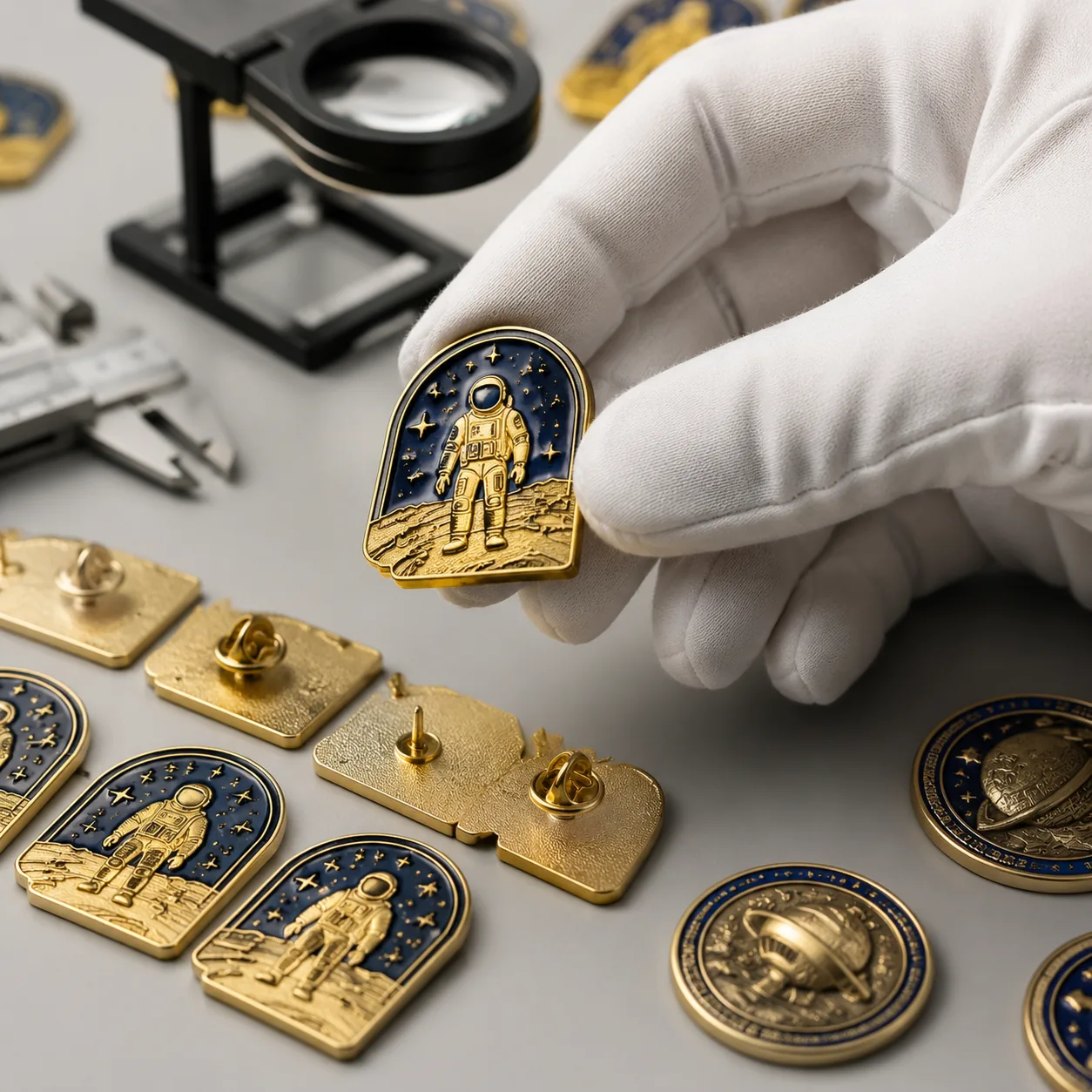
Approve the process window, not just the proof
Custom die-struck pin programs rarely fail because the vector art looked wrong. They fail because the approved proof never translated into a repeatable manufacturing window. A pre-production image confirms visual intent at one moment; it does not prove that die striking, trimming, polishing, plating, color fill, soldering, and packing can all stay within spec across 1,000, 3,000, or 10,000 pieces.
That is why most rework shows up as partial-lot fallout, not a total reject. In practice, a factory may ship a lot that is 88 to 94 percent commercially usable, but the remaining 6 to 12 percent requires sorting because several small defects stack together: low enamel in fine cells, plating rub on high points, post misalignment, burrs after trimming, or weak solder on a post. Once the order also includes backing cards, barcode labels, mixed sets, or retailer-specific packouts, that defect band becomes expensive very quickly.
The control point is a written process sheet approved before tooling release. For soft enamel die-struck pins, that sheet should define minimum drawable line width, minimum enamel cell width, nominal thickness and tolerance, base metal, plating finish and micron target, enamel acceptance criteria, post count and coordinates, attachment type, packing method, defect classes, AQL, and inspection conditions. When those limits exist up front, purchasing, production, and QC work to the same standard instead of arguing over defects after goods are packed.
Failure mode 1: the artwork is drawable, but not stable at production volume
The first breakdown usually starts in die layout. A pin can render cleanly on screen but still include recessed areas too narrow for consistent fill, raised borders too thin to survive plating and polishing, or projections too slender to withstand stamping and post-process handling. Those designs may pass a 30- to 50-piece sample run on slow setup conditions, then drift badly once the line runs several thousand pieces at normal speed.
For stamped iron or brass soft enamel pins, raised metal lines should typically be no smaller than 0.30 mm, with 0.35 mm preferred on retail-facing designs. Below 0.25 mm, the risk of edge breakup, shallow strike definition, plating loss, and color flooding rises sharply. Recessed enamel cells should generally be at least 0.40 mm wide; 0.45 to 0.50 mm is safer when using light colors or adjacent contrasting Pantones. Small text is another common failure point: front-face cap height below 1.2 mm is high risk, and stroke widths below 0.20 mm often soften after polishing and plating.
Shape geometry matters just as much as line width. Long unsupported projections such as antennae, banner tips, tails, or weapon edges tend to bend during trimming, barrel handling, or packing. If the extension is longer than roughly 4 times its local width, it should usually be thickened, bridged to nearby metal, or converted into a second layer. On pins under 25 mm wide, trying to preserve every illustration detail often creates more scrap than brand value. If legal copy, date codes, or tiny logos must remain, laser engraving or die-stamped back marks are more reliable than forcing micro-detail onto the front face.
| Design feature | Production-safe spec | High-risk threshold |
|---|---|---|
| Raised metal line | 0.30-0.35 mm minimum | Below 0.25 mm |
| Recessed enamel cell | 0.40-0.50 mm minimum width | Below 0.35 mm |
| Front text cap height | 1.2 mm or larger | Below 1.0 mm |
| Stroke width in text | 0.20 mm or larger | Below 0.18 mm |
| Pin body thickness | 1.2-1.5 mm standard | Below 1.0 mm on broad shapes |
| Unsupported extension | Length under 4x local width | Long thin tips with no bridge support |
Failure mode 2: plating looks good on the bench but degrades in packing and transit
Plating complaints are often blamed on the finish name when the real issue is the combined effect of base metal, decorative thickness, polishing method, and packing friction. Bright nickel, imitation gold, black nickel, antique copper, and matte black all react differently to polishing and storage. A bench sample can look excellent and still arrive with haze, scuffing, or tone shift after 30 to 45 days of ocean transit if pins are packed loose in bulk bags.
A usable plating specification needs four numbers or decisions: base metal, finish type, decorative thickness target, and corrosion or anti-tarnish protection. On custom pins, decorative nickel or imitation gold is commonly controlled around 0.03 to 0.08 microns, with 0.05 to 0.08 microns a practical range for premium retail work. For brass versus iron, brass generally produces cleaner coverage on mirror-like bright finishes and better edge definition on fine details, but usually adds around USD 0.05 to 0.12 per piece FOB at the 1,000-piece tier depending on size.
Packing is part of plating control, not a separate afterthought. Bulk OPP bagging works for antique or matte finishes with low rub sensitivity. For bright nickel, bright gold, black nickel, or polished dye-black surfaces, individual polybags or tissue interleaving reduce metal-to-metal abrasion materially. At 3,000 pieces, that upgrade often costs only USD 0.02 to 0.05 per piece FOB, while a rubbed lot can trigger 100 percent resorting. For programs that will sit in warehouse stock longer than 60 days, specify sealed inner liners or anti-tarnish bags, especially on bright gold-tone finishes.
As a 2026 working range, a standard 30 mm iron soft enamel pin at 300 pieces often quotes around USD 0.78 to 1.15 FOB; at 1,000 pieces, around USD 0.50 to 0.78 FOB; and at 3,000 pieces, around USD 0.38 to 0.58 FOB. The same geometry in brass with tighter finish control and individual polybagging typically moves to roughly USD 0.60 to 0.92 FOB at 1,000 pieces and USD 0.52 to 0.78 FOB at 3,000 pieces. Those premiums are usually cheaper than cosmetic rework on retail-facing programs.
Failure mode 3: hardware passes a quick pull check but fails in actual use
Attachment failures are a major hidden cost because the hardware may survive a basic factory tug test and still fail in the field. The issue is rarely just the clutch type. Post count, post spacing, solder area, solder fillet consistency, and the center of gravity of the pin all determine whether the piece rotates, leans, loosens, or separates during wear.
For pins under 25 mm and under about 8 g, one post can work if the shape is balanced and not tall. Once a pin reaches 30 to 40 mm, carries a vertical aspect ratio above roughly 1.5:1, or weighs more than 10 g, two posts are usually the safer standard. Post placement should generally be held to plus or minus 0.5 mm from approved centerlines; if the pins will be carded through pre-cut slots, plus or minus 0.4 mm is a better target, and plus or minus 0.3 mm may be justified on rigid retail cards with close visual alignment requirements.
Solder strength should be defined numerically. A practical factory standard is a random destructive pull test of at least 3.0 kgf for small single-post pins and 4.0 to 5.0 kgf for larger two-post designs, with no visible cracking, post lean, or separation at the solder joint. For magnet backs, safety-pin bars, or deluxe locking clutches, the acceptance criteria should cover in-use performance as well as presence. A pin with all hardware attached but poor retention is still a functional defect.
Hardware choice also changes cost and schedule. Butterfly clutches remain the lowest-cost standard. Rubber clutches improve comfort but can loosen under heat or repeated removal. Deluxe clutches add roughly USD 0.03 to 0.08 per piece depending on source and quantity, but reduce accidental loss. Standard production after sample approval is often 10 to 15 calendar days for plain pins, 15 to 18 days with custom carding, and 18 to 25 days when special hardware, magnets, or multi-component packing are involved.
Failure mode 4: enamel defects are waved off as handmade variation
Soft enamel is not perfectly flat, but many factories use that fact to excuse process drift. Uneven fill, pinholes, low spots, color contamination, or recurring sink marks in the same areas usually indicate unstable cavity depth, inconsistent enamel viscosity, contamination between colors, under-curing, or over-polishing after fill. These are process issues, not harmless handmade character.
The acceptance standard should be tied to product type and inspection conditions. On soft enamel pins, the enamel can sit below the raised metal line, but fill should appear visually even within each color zone. Under 600 to 1,000 lux white light at a 30 to 40 cm viewing distance, buyers can reasonably reject exposed substrate pits, obvious sink areas, air holes above about 0.20 mm on the front face, or color spread crossing metal borders. For imitation hard enamel or epoxy-coated pins, isolated low-fill dots should usually be limited to non-critical areas and remain below about 0.15 to 0.20 mm.
A golden sample alone is not enough. The supplier should retain first-off checkpoints for the struck blank, plated blank, first color-fill panel, and final assembled part. That record matters on reorders because the same vector art can behave differently if the die is recut, the plating vendor changes chemistry, or another operator runs the color station. When process-stage references are documented, root cause can be isolated before the entire lot is packed.
This is also where inspection language must be commercial, not absolute. Front-face defects that are visible under normal viewing conditions belong in the major or minor defect scheme depending on severity. Microscopic issues visible only at extreme angle or under magnification should not drive mass rejection unless the program is sold as luxury merchandise with an explicitly tighter cosmetic standard.
Failure mode 5: dimensional drift breaks carding, sets, and repeat orders
Dimensional drift becomes costly when the pin itself looks acceptable but the finished program does not function. A piece can be close to nominal overall size and still miss backing-card slots, sit crooked in a collector box, collide with adjacent items in a gift set, or fail to match a previous production lot. This happens when buyers define only overall width and height while leaving functional dimensions uncalled out.
The practical fix is to separate ornamental dimensions from functional ones. Overall width and height on standard pins can often tolerate plus or minus 0.30 mm on smaller pieces and plus or minus 0.50 mm on larger shapes. Functional dimensions should be tighter: post center distance within plus or minus 0.40 mm, card-slot engagement dimensions within plus or minus 0.30 mm, and body thickness within plus or minus 0.10 to 0.15 mm depending on design and metal. A nominal thickness of 1.5 mm plus or minus 0.15 mm is common for stamped brass or iron; for premium sets that must sit flush in foam, plus or minus 0.10 mm may be worth specifying.
This matters even more in mixed-item kits. When a pin is packed with a lanyard, patch, insert card, or EVA tray, each component brings its own tolerance stack. At MOQ 500 assembled sets and above, a final fit check on completed sets is usually cheaper than re-punching cards, re-cutting foam, or hand-sorting pins by post spacing. For subscription boxes, museum retail, and collector launches, assembled-set verification should be written into the PO as a required inspection step, not left as an informal request.
Failure mode 6: sampling and defect classes do not match the sales channel
A factory can finish inspection and still miss the buyer's actual standard if the sampling plan is too loose for the commercial channel. Internal giveaways, trade-show handouts, nonprofit membership pins, museum retail, and executive gifts do not justify the same cosmetic threshold. If the PO simply says standard inspection, both parties may believe they complied while working to different assumptions.
For most B2B custom pin orders, define critical, major, and minor defects in plain language and pair them with a named AQL. AQL 2.5 major and AQL 4.0 minor is common for promotional use. Premium resale or membership programs often tighten to AQL 1.5 major and AQL 2.5 minor. Critical defects should remain zero acceptance: detached posts, hazardous sharp burrs, wrong logo or text, wrong plating finish, missing attachment parts, magnet detachment, or anything unsafe or unusable.
Examples help prevent argument. Major defects typically include obvious front-face scratches visible at normal viewing distance, severe low fill, plating voids on visible areas, wrong color tone outside approved sample tolerance, or post position outside functional tolerance. Minor defects typically include slight antique tone variation, small backside marks, tiny color spread in hidden zones, or cosmetic imperfections not visible in normal display orientation.
- Define AQL and defect classes before tooling release
- Keep critical defects at zero acceptance for safety, logo accuracy, and detached hardware
- Separate front-face cosmetics from acceptable backside process marks
- Lock inspection conditions to 600-1000 lux and 30-40 cm viewing distance
- Use AQL 2.5 major / 4.0 minor for promotional programs and AQL 1.5 major / 2.5 minor for retail
- Require first-article confirmation for 1,000+ piece orders or any custom carding program
Build one control sheet that production, QC, and purchasing all use
The strongest buyers do not scatter quality requirements across annotated artwork, chat threads, and email approvals. They issue one control sheet that follows the order from quotation through final inspection. For die-struck pins, that document should include finished size, nominal thickness and tolerance, metal, minimum line width, minimum fill cell width, finish, plating micron target, Pantone references, enamel style, post count and coordinates, hardware type, packing method, carton requirements, defect definitions, AQL, and golden-sample reference.
A workable specification might read as follows: 32 mm brass soft enamel pin, 1.5 mm nominal thickness plus or minus 0.15 mm, raised metal lines no smaller than 0.30 mm, recessed color cells no smaller than 0.40 mm, bright nickel plating at 0.05 to 0.08 microns, two posts with center spacing tolerance of plus or minus 0.4 mm, butterfly clutches, individual polybag packing, 200-piece inner bags, export carton with sealed liner, and AQL 2.5 major / 4.0 minor for a promotional program. For a premium resale version, the same base spec might shift to brass-only production, deluxe clutches, anti-tarnish inner bags, tighter post tolerance, and AQL 1.5 major / 2.5 minor.
Most factories quote standard custom pins from MOQ 100 pieces, but the strongest FOB pricing usually appears at 300, 500, 1,000, and 3,000-piece tiers. As a practical 2026 reference for 30 to 35 mm soft enamel pins, expect roughly USD 0.75 to 1.20 FOB at 300 pieces, USD 0.58 to 0.92 FOB at 500 pieces, USD 0.48 to 0.85 FOB at 1,000 pieces, and USD 0.38 to 0.65 FOB at 3,000 pieces depending on metal, plating, hardware, and packing. Sampling usually takes 5 to 7 calendar days after artwork approval; mass production then runs 10 to 18 days, with another 3 to 7 days if complex carding, mixed-set assembly, or retailer labeling is required.
Before mass production, ask for three deliverables: a manufacturability review against the artwork, a written control sheet with measurable limits, and a retained golden sample tied to that sheet. On orders above 1,000 pieces, a first-article signoff or in-process photo confirmation typically adds only one business day and can prevent a full remake. That is the difference between approving a picture and approving a repeatable manufacturing standard.
Have a project? Send your artwork and target quantity and we’ll reply with a detailed quotation within 12 working hours.
Ready to get this made?
Send your sketch, target quantity and ship-date. Detailed quotation in 12 hours.



